

Why Is Vastu Interdisciplinary? 8 Sciences Behind the Complete Home Audit | Vastu My Home
Namaste. I am Mukesh Shah. When I describe Scientific Vastu to a physician, a building physicist, a sleep researcher, an environmental psychologist, a chronobiologist, and an architect in the same room — which has happened, in different combinations, across twenty years of practice — each of them finds something in the description that belongs to their own discipline. The chronobiologist recognises the morning solar circadian entrainment mechanism. The building physicist recognises the passive solar thermal mass prescription. The sleep researcher recognises the geopathic stress sleeping zone disruption pattern. The environmental psychologist recognises the prospect-refuge spatial arrangement framework. The architect recognises the solar orientation and ventilation design logic. And each of them, at some point in the conversation, says some version of the same thing: ‘This is what we study. Why have I never heard of Vastu before?’
The answer to that question — why Vastu is not already taught in chronobiology departments and building physics programmes and sleep medicine clinics — is a consequence of the fragmentation of modern knowledge into specialist disciplines, each with its own vocabulary, its own journals, its own professional societies, and its own insulation from adjacent fields. The contemporary university and professional world is organised around the premise that the deepest knowledge comes from the most focused specialisation — and for many purposes, that premise is correct. But it creates a systematic blind spot for questions that cannot be answered within any single discipline’s scope. And the question that Vastu has always been asking — what physical environmental conditions in the built environment most consequentially affect the health and wellbeing of the people who live in it — is precisely one of those questions.
Vastu is interdisciplinary not by design but by subject matter. The built environment’s effect on human health is not a question that belongs to chronobiology, or building physics, or sleep medicine, or environmental psychology, or acoustics, or indoor air quality science, or geomagnetic biophysics alone. It belongs to all of them simultaneously. Every one of these disciplines addresses a different physical pathway through which the home’s conditions affect the body. And Vastu — the tradition that has been asking the most comprehensive version of this question for the longest period of time, and has accumulated the most extensive observational dataset on its answer — is, by the nature of the question itself, a tradition that must draw on all of these disciplines to express what it knows in the language that contemporary science requires.
The Complete Home Health Audit is the practical expression of Vastu’s interdisciplinary character: an assessment that brings chronobiology, geomagnetic biophysics, environmental psychology, building physics, photobiology, indoor air quality science, acoustic ecology, and the traditional Vastu Purusha Mandala into a single integrated programme for the specific home and the specific family — producing findings that no single-discipline assessment could generate and corrections that no single-discipline intervention could prescribe.
What makes a tradition genuinely interdisciplinary rather than merely eclectic?
The word ‘interdisciplinary’ is used loosely in contemporary culture to describe almost any activity that draws on more than one domain of knowledge. A recipe blog that mentions the chemistry of caramelisation is not genuinely interdisciplinary. A management book that quotes evolutionary biology is not genuinely interdisciplinary. Genuine interdisciplinarity is something more demanding and more substantive: it requires that the connections between disciplines are not superficial analogies or illustrative borrowings but deep structural correspondences — cases where the same underlying reality is being addressed by multiple disciplines through different methodologies, and where the integration of those methodologies produces a more complete understanding than any individual discipline achieves alone.
Scientific Vastu meets this standard for genuine interdisciplinarity in a specific and verifiable way: its core prescriptions address physical realities that multiple independent scientific disciplines have characterised through their own methods — and the Vastu prescription, the chronobiology finding, the building physics calculation, and the environmental psychology research all converge on the same physical condition as most consequential for the human body’s health in the built environment. This convergence is not a post-hoc alignment constructed to make Vastu appear scientific. It is the natural consequence of different disciplines independently investigating the same physical reality from different methodological starting points.
Consider a single Vastu prescription — the south-west master bedroom with maximum thermal mass. Chronobiology explains why: the core body temperature decline required for sleep onset needs the sleeping zone to maintain 18–20°C overnight, which the south-west thermal mass wall provides passively. Building physics confirms the mechanism: the thermal time constant of a 300 mm compressed stone wall produces a twelve-to-sixteen-hour heat transmission delay that keeps the sleeping zone cool through the night. Environmental psychology adds the refuge quality dimension: the south-west zone’s maximum enclosure and minimum morning light activation provides the limbic safety signal that the sleeping brain requires for deep amygdala down-regulation. Passive solar design provides the solar arc geometry that explains why the south-west face specifically, at Indian latitudes, is the face with the maximum afternoon solar load that the thermal mass prescription is managing. Four entirely independent disciplines converging on the same spatial prescription for the same built environment reason. That is genuine interdisciplinarity.
The measure of a genuinely interdisciplinary tradition is whether removing any one of its contributing disciplines leaves a significant gap in the explanation. For Scientific Vastu, every contributing discipline addresses something that the others cannot cover: chronobiology without building physics cannot explain the specific wall material required; building physics without chronobiology cannot explain why the sleeping zone temperature matters; environmental psychology without geomagnetic biophysics cannot explain the full sleeping zone prescription. The integration is not decorative — it is structural, and every discipline’s removal diminishes the account.
How does the sleeping zone prescription reveal the full depth of Vastu's interdisciplinary character?
The sleeping zone is the built environment location where Vastu’s interdisciplinary character is most completely expressed — because the sleeping zone is the place where the largest number of the body’s most health-consequential biological systems are most deeply active and most environmentally sensitive simultaneously. Understanding the sleeping zone prescription through its full interdisciplinary scope is the most effective single way to appreciate why Vastu cannot be adequately described, practised, or validated by any single discipline.
Chronobiology’s contribution to the sleeping zone prescription is the account of what the sleeping body is biologically doing during sleep: conducting its primary circadian programme, consisting of the melatonin-mediated peripheral clock synchronisation, the slow-wave-NREM immune programme (NK cell activation, T-cell consolidation, inflammatory resolution), the growth hormone secretion in the first NREM episode, the REM emotional memory reprocessing, and the prefrontal cortex slow-wave restoration that determines next-day executive function and emotional regulation quality. The circadian quality of this programme depends directly on the sleeping zone’s physical conditions: melatonin amplitude (protected or suppressed by the bedroom’s RF environment), sleep architecture depth (supported or fragmented by the geomagnetic field quality), core body temperature support (provided or opposed by the thermal environment), and autonomic circadian pattern quality (aligned or misaligned by sleeping orientation).
Geomagnetic biophysics contributes the account of how the Earth’s geomagnetic field, and its local distortions in geopathic stress zones, affect the sleeping body through the magnetite-based and cryptochrome-based biological magnetoreception pathways — producing the HRV effects of correct versus incorrect sleeping orientation, and the HPA dysregulation of chronic geopathic stress exposure, through physical mechanisms that building physics can confirm and that the Building Biology SBM standard can evaluate against specific threshold values.
Building physics contributes the account of the thermal mass mechanics that determine whether the sleeping zone maintains the 18–20°C temperature range that the circadian clock’s core body temperature programme requires for efficient sleep initiation — the specific heat capacity calculations, the thermal time constant of different wall materials, the solar arc loading on different wall faces at different latitudes and seasons, and the relationship between wall thickness and passive thermal performance.
Indoor air quality science contributes the account of the VOC burden from synthetic bedroom materials and the CO2 accumulation from sealed sleeping spaces — factors that impair sleep architecture independently of the electromagnetic and geomagnetic factors, through the chemoreceptor activation that CO2 elevation produces in the sleeping brainstem and the CNS depression that VOC exposure produces in the sleeping neural tissue. Environmental psychology contributes the prospect-refuge account of the sleeping zone’s spatial arrangement and its effects on the sleeping amygdala’s background monitoring load. No single discipline of this list provides a sufficient account of the sleeping zone prescription. All of them are necessary, and their integration is what Vastu’s comprehensive sleeping zone assessment — the core of the Complete Home Health Audit — delivers.
How does modern chronobiology confirm what Vastu's morning light prescription always knew?
The relationship between Scientific Vastu and chronobiology is the most intellectually satisfying interdisciplinary dialogue in the entire Vastu science landscape — because the Nobel Prize-winning molecular mechanism research that defines modern chronobiology describes, with greater precision than the classical Vastu texts could achieve, the exact physical pathway through which the north-east prana gateway prescription operates on the sleeping and waking body. The tradition observed the effect over thousands of years. The discipline characterised the mechanism with molecular precision in the twentieth century. The integration of the two produces the most complete account of one of the most important physical health prescriptions in any residential building tradition.
The ipRGC melanopsin pathway — the specific retinal photoreceptor system dedicated exclusively to detecting ambient light for circadian entrainment purposes — responds maximally to the blue-green spectral region (approximately 480 nanometres wavelength) that is enriched in the morning sky’s scattered solar radiation at Indian latitudes. This morning spectral composition, arriving through the north-east zone’s unobstructed windows in the first two hours after sunrise, delivers the daily calibration signal to the SCN master clock through the retinohypothalamic tract. The SCN’s response — the cortisol awakening response, the serotonin synthesis cascade, the peripheral clock resynchronisation signal — is the biological implementation of what the Vastu tradition called the morning prana’s vitalising effect on the household and its members.
Vastu did not know the word melanopsin. The tradition had no concept of the retinohypothalamic tract or the SCN or the CLOCK/BMAL1 transcription factor feedback loop. But it observed, with the precision of thousands of households assessed over centuries, that families in homes with abundant north-east morning light were more vital, more healthy, and more harmoniously organised in their daily rhythms than families in homes without it. It encoded this observation in the north-east prana gateway prescription, with the specific directional precision that the solar arc geometry of the Indian subcontinent makes correct for exactly the reasons that chronobiology now explains in molecular detail.
What does the relationship between chronobiology and Vastu teach about the nature of empirical observation?
The chronobiology-Vastu relationship illustrates one of the most important principles in the philosophy of science: that careful empirical observation can arrive at correct prescriptions before the mechanism is understood, and that the eventual mechanism confirmation validates the observation rather than replacing it. The traditional Vastu practitioner who recommended north-east morning light access for family health was not guessing or performing cultural ritual. They were applying the accumulated result of careful observation of health outcomes across hundreds of years and thousands of households — an empirical database whose signal-to-noise ratio was, given the scale of the observation, more statistically robust than any single controlled study.
The Nobel Committee in 2017 described the circadian clock discovery as explaining ‘how plants, animals and humans adapt their biological rhythm so that it is synchronised with the Earth’s revolutions.’ The Manasara authors, writing perhaps fifteen hundred years earlier, were prescribing buildings designed to synchronise the human household’s daily rhythm with the Earth’s solar revolution through the north-east prana gateway. Different vocabularies, different methodologies, different eras — the same physical truth.
This is the specific meaning of Vastu’s interdisciplinarity at its deepest level: the tradition is not borrowing from chronobiology to add scientific credibility to cultural prescriptions. It is the prior observational tradition that chronobiology is independently confirming. The interdisciplinarity flows in both directions: Vastu needs chronobiology’s molecular mechanism vocabulary to explain to contemporary families why the north-east morning light matters; and chronobiology, if it engaged seriously with Vastu’s observational database, would find the most extensive longitudinal natural experiment in morning light and human health outcomes that any researcher has ever had access to.
What is the complete map of scientific disciplines that Vastu draws on — and what each contributes?
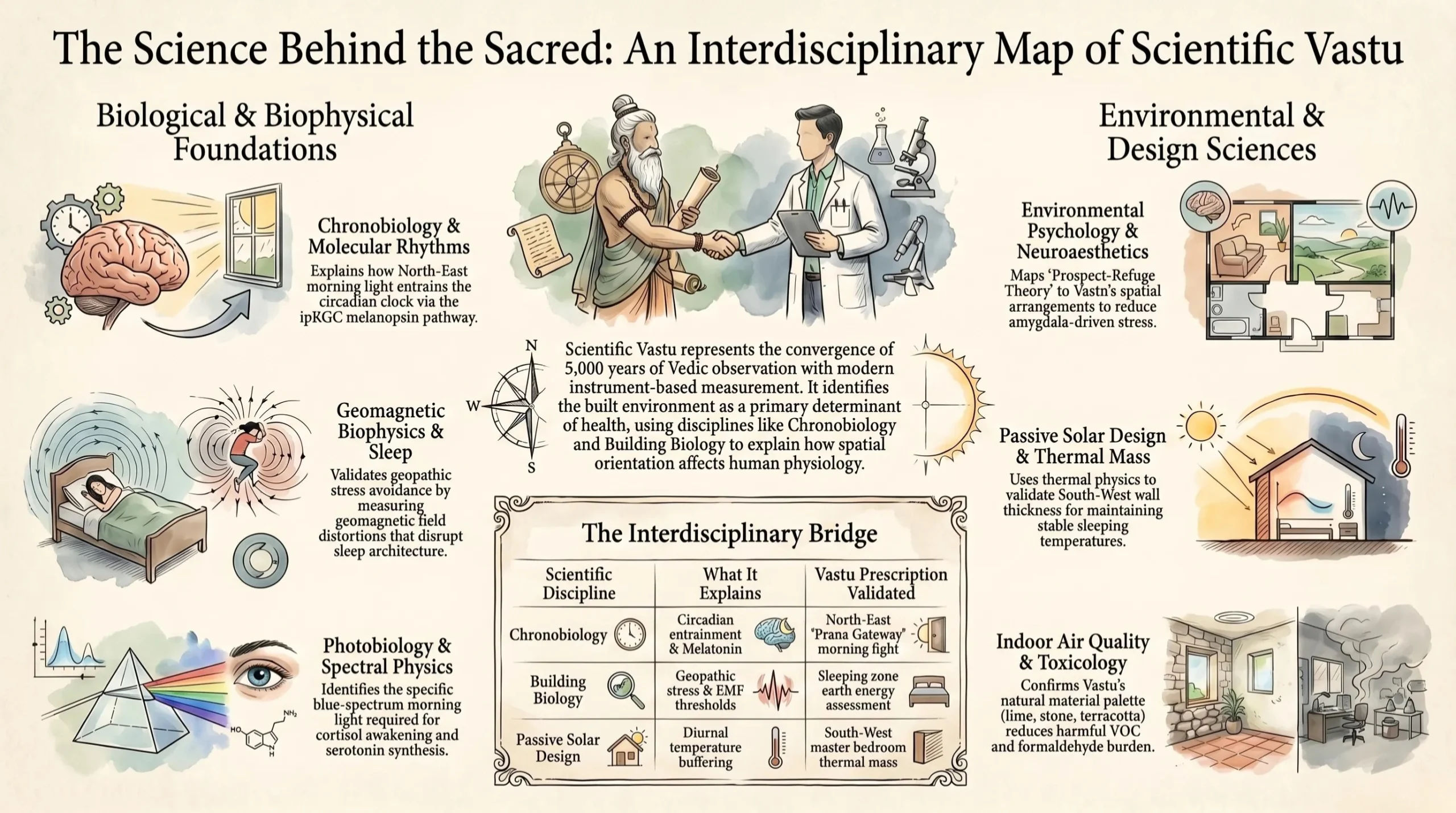
The following table provides a comprehensive reference for eight scientific disciplines that Scientific Vastu draws on — specifying how each discipline contributes to Vastu, what Vastu gives back to the discipline, the key research Vastu uses from it, and the specific Vastu prescription the discipline validates.
|
Scientific Discipline |
How It Contributes to Vastu |
What Vastu Gives the Discipline |
Key Research / Evidence Vastu Uses |
The Vastu Prescription the Discipline Validates |
|
Chronobiology and Circadian Medicine |
Explains the molecular mechanism through which the north-east morning solar light prescription delivers health: ipRGC melanopsin pathway, SCN entrainment, cortisol awakening response, peripheral clock synchronisation through melatonin |
A five-thousand-year empirical observational tradition whose practical prescriptions for morning solar access, sleeping zone thermal stability, and evening light management the discipline independently confirms — providing traditional observational evidence at a scale no laboratory study can replicate |
Nobel Prize 2017 — CLOCK/BMAL1 molecular mechanism; ipRGC photobiology; melatonin and peripheral clock synchronisation; CAR and prefrontal cognitive activation; DLMO and social jetlag |
North-east prana gateway morning light; SW thermal mass bedroom for core body temperature support; evening spatial lighting for DLMO protection; sleeping orientation for circadian autonomic pattern |
|
Geomagnetic Biophysics and Building Biology |
Explains the physical mechanism through which geopathic stress zones beneath sleeping positions affect health: geomagnetic field distortion, HPA axis chronic activation through sleep architecture impairment, Building Biology SBM threshold standards for residential geomagnetic quality |
The traditional observational framework — Bhumi Pariksha earth assessment — that motivated the development of instrument-based geopathic stress research; the clinical observation base whose patterns the instrument measurement subsequently confirmed |
Bachler 3,000-case study; Hartmann and Curry Grid research; HRV and sleeping orientation research; voltage-gated calcium ion channel research (RF bioelectromagnetics) |
Sleeping zone earth energy assessment; sleeping orientation head-South; bedroom RF and ELF elimination; geopathic stress zone avoidance |
|
Environmental Psychology and Affective Neuroscience |
Explains the neurobiological mechanism through which spatial arrangement, material quality, and zone proportions affect emotion, cognition, and wellbeing: prospect-refuge theory, amygdala environmental calibration, cortisol-clutter research, neuroaesthetics, attention restoration theory |
The most extensive and most systematically recorded observational database on the relationship between spatial arrangement and human wellbeing available in any tradition: thousands of homes assessed across twenty years, with specific spatial defects correlated against specific family health and emotional outcomes |
Appleton prospect-refuge theory; Saxbe-Repetti cortisol-clutter; Kaplan attention restoration; Ulrich stress recovery; Meyers-Levy ceiling height research; Walker sleep and emotion regulation |
SW bedroom refuge quality; Brahmasthana spatial relief; zone function congruence; natural material biophilic quality; ceiling height zone prescription |
|
Passive Solar Design and Building Physics |
Explains the thermal physics of the south-west bedroom’s thermal mass prescription: specific heat capacity, thermal time constant, diurnal temperature buffering, core body temperature circadian coupling, solar arc geometry at Indian latitudes |
The oldest and most comprehensively tested passive solar design database on the Indian subcontinent: the regional building traditions (Kerala nalukettu, Rajasthan haveli) whose climate-calibrated solar passive performance has been building-physics validated for centuries |
ASHRAE thermal comfort research; passive solar design thermal mass calculations; ISO 7730 thermal comfort standard; sleep physiology and sleeping zone temperature; solar arc geometry at specific latitudes |
SW master bedroom thermal mass specification; deep roof overhang prescription; NE morning light opening size; climate-calibrated wall thickness specification; sleeping zone 18–20°C target |
|
Photobiology and Daylighting Science |
Explains the spectral physics of natural daylight and its specific biological effects: melanopsin peak sensitivity (~480 nm), morning versus afternoon spectral composition, lux level requirements for circadian effectiveness, DLMO suppression from evening artificial light |
The traditional observational prescription for directional solar access — the north-east prana gateway, the northern diffuse light for study, the shaded south and west — which photobiology independently identifies as the optimal natural light quality prescription for human circadian health at Indian latitudes |
Figueiro and colleagues circadian lighting research; CIE circadian effectiveness standards; WELL L02/L03 circadian lighting features; daylighting simulation tools (Radiance, EnergyPlus); retail daylighting sales research (Choi and Moon; Heschong Mahone Group) |
North-east prana gateway lux and spectral specification; northern diffuse light for study and transaction zones; evening warm LED specification; NE zone opening size for circadian effectiveness |
|
Indoor Air Quality Science and Building Materials Toxicology |
Explains the chemical and physiological mechanisms through which synthetic materials harm health: formaldehyde (IARC Group 1) from MDF and synthetic board products; VOC off-gassing from synthetic paints; PM2.5 from combustion; CO2 accumulation from sealed buildings |
The traditional natural material prescription — lime, natural stone, terracotta, natural timber — which building materials toxicology independently identifies as the lowest-VOC, most hygroscopic, and most biologically neutral material palette available for residential construction |
WHO indoor air quality guidelines; IARC formaldehyde classification; EPA VOC building materials research; Harvard CO2 and cognitive performance research; WELL V01 VOC emission standards; biophilia research on natural material health effects |
Pancha Bhuta natural material prescription; Brahmasthana ventilation and CO2 management; VOC-free bedroom material specification; hygroscopic lime plaster for humidity regulation |
|
Acoustic Ecology and Room Acoustics |
Explains the physiological mechanisms through which acoustic environment affects health, sleep quality, and cognitive performance: cocktail party effect and directed attention depletion, room mode resonances and sleep fragmentation, reverberation time and speech intelligibility for cognitive quality |
The traditional zone function separation prescriptions that independently achieve optimal acoustic zone design: kitchen in SE (away from sleeping zones), sleeping zones in SW (maximum isolation from front-of-house activity), Brahmasthana acoustic character through natural material surfaces |
Leesman acoustic privacy and productivity; ISO 3382 office acoustic design; WHO night-time noise guidelines; room acoustics and sleep quality research; natural material acoustic absorption properties |
Zone function separation (kitchen-sleeping zone distance); Brahmasthana acoustic character; natural material surface acoustic quality; open-plan acoustic zone design |
|
Astronomy and Solar Geometry |
Provides the mathematical basis for Vastu’s directional prescriptions at specific Indian latitudes: solar azimuth and altitude calculations, solstice and equinox shadow angles, solar arc variation across the Indian latitudinal range, magnetic declination corrections for compass prescriptions |
The empirical observational tradition whose careful attention to solar arc geometry motivated the development of formal solar geometry: the prescriptions for which building faces receive which solar loads at which times of day at Indian latitudes are accurate astronomical descriptions that formal solar geometry subsequently confirmed |
Solar arc calculations (NOAA solar position calculator); shadow analysis tools; magnetic declination data (NOAA World Magnetic Model); solar irradiance data for Indian latitudes; passive solar design handbook solar geometry |
Directional zone prescriptions calibrated to Indian solar arc; magnetic declination correction for sleeping orientation; north-east morning light timing and quality; SW afternoon solar load thermal mass calculation; seasonal shadow analysis for new construction |
Reading this table as a whole, the most striking pattern is in the ‘What Vastu Gives the Discipline’ column: in every case, Vastu provides the discipline with something it cannot generate internally — a multi-century, multi-household observational database that no laboratory study can replicate, a directional and elemental design framework that gives the discipline’s health findings their most complete spatial implementation, or the traditional observational motivation that preceded and in some cases anticipated the discipline’s own mechanistic discoveries. The relationship is genuinely reciprocal: modern science needs Vastu’s traditional observational wisdom as much as Vastu needs modern science’s mechanism vocabulary.
The second most important pattern is in the ‘The Vastu Prescription the Discipline Validates’ column: every discipline validates a different dimension of the same integrated Vastu prescription programme. No single discipline validates the whole programme; each validates the dimension of it that corresponds to its subject matter. The Complete Home Health Audit is the practical expression of this validation map: it applies every validated prescription, supported by every confirming discipline, to the specific conditions of the specific family’s specific home — producing an assessment that is more complete than any single-discipline assessment and more specifically grounded than any traditional-only assessment could be.
How does environmental psychology make the invisible visible in Vastu's spatial prescriptions?
Environmental psychology — the scientific study of how the physical characteristics of the built and natural environment affect human experience, behaviour, emotion, and health — is the discipline that most directly bridges Vastu’s spatial prescriptions and the neurobiological account of why those prescriptions matter for human wellbeing. Without environmental psychology’s contribution, Vastu’s zone allocation, spatial proportion, and material quality prescriptions might appear as aesthetic preferences or cultural conventions. With it, they reveal themselves as specific neurobiological prescriptions for the specific environmental conditions that the human nervous system requires for health, restoration, and optimal function.
Jay Appleton’s prospect-refuge theory — the evolutionary framework that explains why human beings respond with the strongest sense of safety and ease to environments that provide both visual openness (prospect) and sheltered enclosure (refuge) simultaneously — is the environmental psychology account of what Vastu’s south-west master bedroom prescription achieves spatially. The south-west bedroom provides maximum refuge (the most enclosed, most solid, most backed position in the home) combined with controlled prospect (views toward the east through the morning living zones) — the combination that the prospect-refuge theory identifies as most conducive to the limbic system’s deepest safety signal. The family member who sleeps in a correctly placed south-west bedroom is sleeping in the spatial configuration that environmental evolution has selected for the deepest possible nightly recovery.
Darby Saxbe and Rena Repetti’s cortisol-clutter research at UCLA — which documented that women who described their homes as cluttered showed elevated cortisol throughout the day while women who described their homes as restorative showed declining cortisol — is the environmental psychology account of what Vastu’s Brahmasthana clearance prescription achieves biochemically. The open central zone of the Vastu home removes the chronic visual complexity that the UCLA research documents as the environmental driver of sustained cortisol elevation. The family’s emotional ease in a cleared Brahmasthana is not subjective aesthetics. It is a specific cortisol pattern change produced by a specific spatial intervention.
Kaplan’s attention restoration theory — which explains how natural environments restore directed attention capacity through the involuntary attention mechanism that natural patterns engage without consuming cognitive resources — is the environmental psychology account of what Vastu’s natural material prescription achieves for the recovering brain. The natural stone floor, the lime plaster wall, the natural timber joinery — each provides the organic pattern complexity that Kaplan’s involuntary attention pathway deploys for restorative cognitive recovery during the micro-recovery moments that are distributed throughout every waking hour at home.
Environmental psychology’s contribution to Vastu’s interdisciplinary character is, in one sentence: it translates Vastu’s spatial wisdom into neurobiological mechanism language. What Vastu prescribes as the spatially correct home, environmental psychology explains as the neurobiologically correct home — and the two accounts, in every case where they address the same spatial feature, are describing the same physical reality in perfectly complementary vocabularies.
Why is no single scientific discipline sufficient to assess the complete Vastu home environment?
The case for Vastu’s interdisciplinary character is most powerfully made not by describing what each discipline contributes but by demonstrating what each discipline misses when it operates alone — and why the specific health questions that families bring to Vastu assessment cannot be answered from within any single discipline’s scope. This demonstration is the most practically compelling argument for the Complete Home Health Audit’s integrated approach: not ‘look how many disciplines we draw on’ but ‘here is what you would miss if you used any one of them without the others.’
A chronobiologist consulting on a family’s sleep quality challenge would assess the light environment, the sleeping orientation, and the thermal environment — and might make excellent recommendations about evening light management and morning solar access. But without the magnetometer, the chronobiologist would not identify the geopathic stress zone beneath the sleeping position that is fragmenting the slow-wave sleep architecture that their circadian recommendations depend on for implementation. The circadian light prescription is correct. Without the geomagnetic correction, it is insufficient.
A Building Biology practitioner assessing the same family would measure the geomagnetic field, the RF and ELF electromagnetic environment, and the indoor VOC burden — and might find and correct the geopathic stress zone and the bedroom router. But without the Vastu directional framework, the Building Biology practitioner would not know to ask whether the family is sleeping in the wrong zone of the home — whether the master bedroom’s north-east placement is itself the structural root of the sleep problem, producing not only the inadequate thermal mass sleeping environment but the circadian over-activation from morning solar light at a zone that should be providing shelter rather than activation. The electromagnetic correction is correct. Without the zone allocation correction, it is insufficient.
An environmental psychologist consulting on the family’s emotional quality of life at home would assess the spatial arrangement, the material character, and the lighting quality — and might make excellent recommendations about Brahmasthana clearance and natural material improvements. But without the indoor air quality monitoring, the environmental psychologist would not identify that the sealed central zone’s CO2 accumulation is chemoreceptor-activating the family members’ brainstems throughout their waking hours in the home, independently of any spatial or material quality factor. The spatial recommendation is correct. Without the ventilation correction, it is insufficient.
The pattern is consistent: each discipline’s recommendations are correct in their domain and insufficient in isolation from the others. The family’s health challenge — whether sleep, immunity, cognition, emotion, or energy — is being shaped by multiple physical environmental factors simultaneously, each operating through a different biological pathway, each requiring a different instrument and a different disciplinary framework to identify and correct. The Complete Home Health Audit’s integrated approach is not a luxury or an academic exercise. It is the minimum sufficient response to the actual multi-factor physical reality that the family’s home is presenting.
What questions can only Vastu's interdisciplinary integration answer — that no single discipline can?
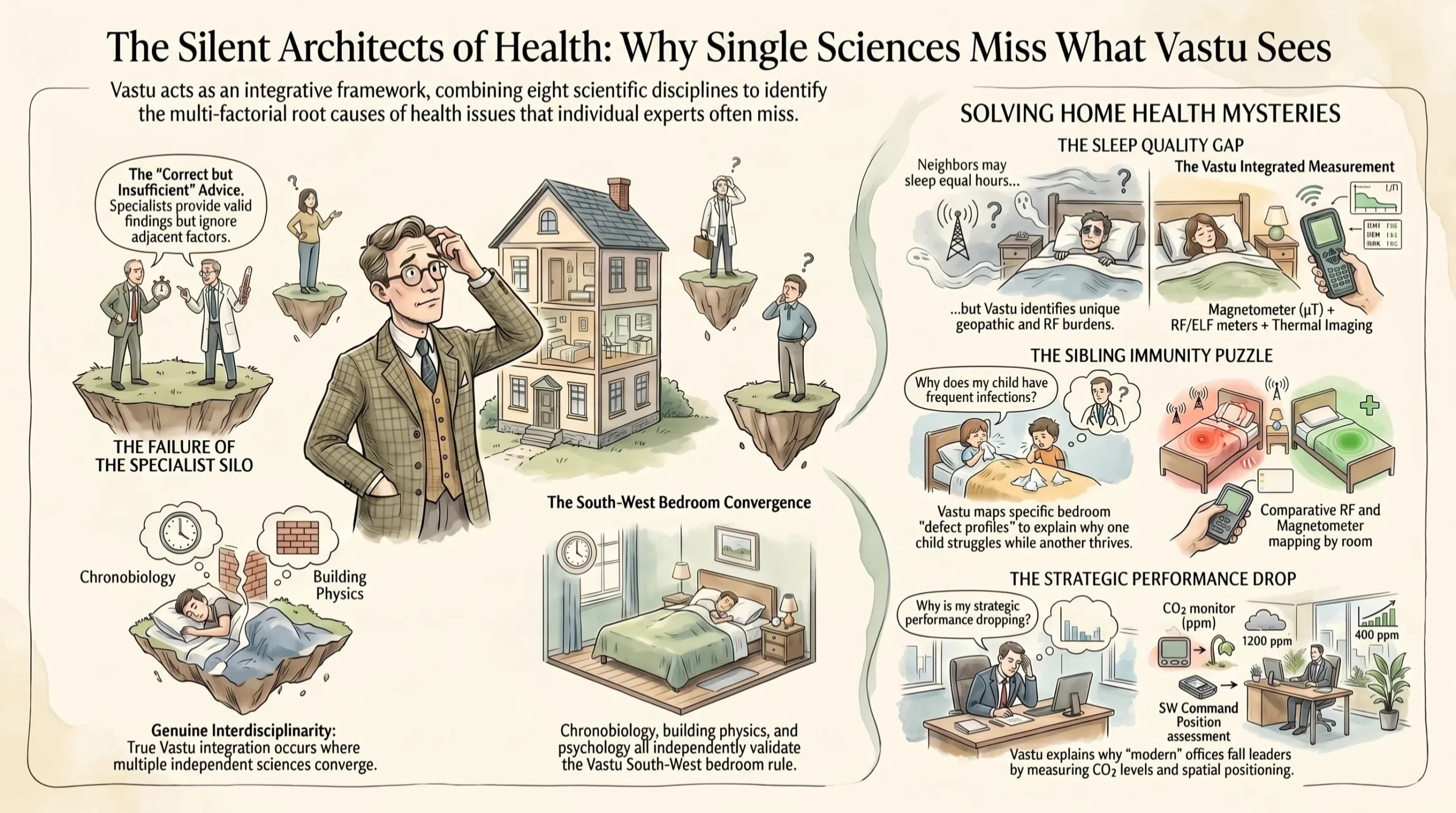
The most practically compelling demonstration of why Vastu is genuinely interdisciplinary is the class of clinical and performance questions that families bring to assessment — questions that no single discipline can answer but that Vastu’s integrated methodology addresses directly. The following table maps five of the most commonly presented questions to the disciplines that address partial dimensions of each, why no single discipline is sufficient, how Vastu’s interdisciplinary integration answers the question completely, and what the Complete Home Health Audit specifically measures.
|
Question No Single Discipline Can Answer Alone |
Which Discipline Addresses It |
Why No Single Discipline Is Sufficient |
How Vastu’s Interdisciplinary Framework Answers It |
What the Complete Home Health Audit Measures |
|
Why does my family sleep the same hours as our neighbours but feel consistently less rested? |
Chronobiology (sleep architecture quality), Building Biology (geopathic stress, EMF), Geomagnetic biophysics (sleeping orientation) |
Chronobiology explains sleep architecture but does not assess the home; Building Biology measures fields but does not analyse zone allocation; geomagnetic biophysics explains orientation but does not consider the full environment |
Vastu’s integrated sleeping zone assessment combines all three disciplines: magnetometer geopathic survey + RF/ELF measurement + sleeping orientation assessment + SW thermal mass evaluation + morning light access — a single integrated programme that no single discipline alone provides |
Magnetometer (µT), RF meter (µW/m²), ELF meter (mG), compass bearing (°), lux meter (lux), CO2 monitor (ppm), thermal imaging (°C) |
|
Why does one family member consistently have more infections than others sharing the same home? |
Immunology (individual immune variation), Chronobiology (circadian immune programme), Building Biology (sleeping zone EMF and geopathic), Environmental medicine (VOC burden) |
Immunology assesses the individual’s immune system but not the home’s differential zone environmental quality; chronobiology explains the melatonin-NK cell pathway but does not assess which family member’s bedroom has the highest RF burden; environmental medicine measures exposures but does not connect them to the spatial patterns that Vastu identifies |
Vastu maps each family member’s sleeping zone defect profile against the circadian immune programme’s specific requirements: the family member with the highest bedroom RF burden (most melatonin suppression) and the most severe geopathic stress (most circadian immune programme disruption) will show the most frequent infections regardless of individual immunological variation |
RF meter at each family member’s sleeping position (comparative); magnetometer at each sleeping position (comparative); sleeping orientation comparison across family members |
|
Why is the business owner in a better designed, better equipped new office performing worse strategically than in the old, plainly furnished one? |
Workplace psychology (cognitive performance), Building Physics (CO2, thermal), Environmental neuroscience (spatial cognition), Electromagnetic biology (occupational EMF) |
Workplace psychology identifies the productivity factors but does not assess the physical environment; building physics measures CO2 but does not consider the spatial zone placement; environmental neuroscience explains spatial cognition but does not connect it to the specific Vastu zone prescriptions for leadership positioning |
Vastu’s commercial zone assessment evaluates the business owner’s spatial position (SW command position vs north-facing active zone), the Brahmasthana CO2 quality, the new office’s electromagnetic burden from denser device infrastructure, and the biophilic quality difference between the old natural material environment and the new synthetic one |
CO2 monitor (ppm, comparative old vs new), RF assessment at owner’s workstation (µW/m²), lux meter at workstation natural light quality, material VOC assessment, zone placement vs SW command position prescription |
|
Why does one child thrive academically and emotionally while their sibling in an adjacent bedroom consistently struggles, despite comparable educational support? |
Developmental neuroscience (prefrontal development), Chronobiology (adolescent circadian), Building Biology (sleeping zone EMF, geopathic), Environmental psychology (biophilic quality) |
Developmental neuroscience explains the importance of sleep for neurodevelopment but does not assess the sleeping environment; chronobiology explains social jetlag but does not identify the home’s light environment defects; Building Biology measures fields but does not connect them to developmental outcomes longitudinally |
Vastu maps the two children’s sleeping zone environmental profiles comparatively: the struggling child almost always occupies the bedroom with higher geopathic stress, higher RF burden, worse morning light access, or more severely compromised sleeping orientation — a differential environmental profile that developmental neuroscience explains but that no single-discipline assessment identifies spatially |
Comparative magnetometer survey of both bedrooms; comparative RF measurement at each child’s sleeping position; sleeping orientation comparison; north-east morning light access comparison at bedroom windows |
|
Why does chronic fatigue persist despite excellent sleep duration and completely normal clinical investigation? |
Sleep medicine (sleep architecture), Chronobiology (circadian amplitude), Immunology (immune programme), Building Biology (sleeping zone quality), Endocrinology (HPA axis) |
Sleep medicine finds normal or near-normal sleep study results because the sleep architecture impairment from geopathic stress and bedroom EMF is subtle and non-specific; chronobiology explains the CAR blunting but does not assess the home; endocrinology finds abnormal morning cortisol but does not identify its environmental driver |
Vastu’s integrated sleeping zone assessment is the only framework that simultaneously assesses all five physical environmental factors (geopathic stress, RF, ELF, sleeping orientation, thermal stability) that contribute to the qualitatively impoverished sleep that normal-duration-but-non-restorative sleep represents |
Magnetometer geopathic survey; RF meter at sleeping position; ELF assessment; sleeping orientation confirmation; thermal imaging of sleeping zone temperature; CO2 monitoring; cortisol rhythm assessment recommendation for physician |
The diagnostic power of this table lies in the final column — ‘What the Complete Home Health Audit Measures.’ In every case, the audit’s instrument protocol addresses every disciplinary dimension of the question simultaneously: the magnetometer covers the geomagnetic biophysics dimension, the RF and ELF meters cover the bioelectromagnetics dimension, the CO2 monitor covers the indoor air quality dimension, the lux meter covers the chronobiology and photobiology dimensions, the compass covers the geomagnetic orientation dimension, and the thermal imaging covers the building physics dimension. The audit is structured by the multi-factor nature of the question, not by the single-factor scope of any individual discipline.
The most important observation across all five questions is that the families who present them have typically already been seen by at least one of the relevant specialist disciplines — and received correct but insufficient advice. They have seen the chronobiologist, the allergist, the building inspector, the workplace consultant, the developmental paediatrician, the sleep physician. Each has found something real and recommended something useful. And the family remains incompletely helped, because the missing piece is the integrative framework that reveals how the different physical environmental factors they have each addressed partial dimensions of are operating simultaneously in the same space, on the same biological systems, in a configuration that requires all of the corrections to be made together. This is Vastu’s interdisciplinary value proposition: not a single-discipline answer to a single-dimension question, but the integrated answer to the multi-dimension question that real families and real homes always present.
How does the patented photo-scanning methodology embody Vastu's interdisciplinary integration?
The patented photo-scanning methodology that initiates every Complete Home Health Audit is, in its technical design, the most concentrated expression of Vastu’s interdisciplinary character available in a single assessment tool — because it extracts, from the photographic and floor plan information that any family can provide from anywhere in the world, an integrated assessment of multiple physical environmental dimensions simultaneously, through a methodology that systematically applies the full interdisciplinary framework to the visual information available.
The photo-scanning assessment analyses the home’s images and floor plan for its solar orientation and zone allocation against the Vastu Purusha Mandala — drawing on the astronomy and solar geometry discipline for the solar arc analysis, the Vastu zone allocation tradition for the functional zone assessment, and the environmental psychology discipline for the spatial proportion and prospect-refuge quality assessment. It analyses the material character of visible surfaces for biophilic quality and natural material content — drawing on biophilic design science and indoor air quality science. It analyses the Brahmasthana zone for obstruction and ventilation pathway integrity — drawing on building physics and indoor air quality science. It analyses the bedroom positions for their zone allocation and their probable geomagnetic and electromagnetic environment profile — drawing on geomagnetic biophysics and bioelectromagnetics.
The result of this multi-disciplinary photo analysis is the identification of the top five critical defects — the physical environmental conditions most likely to be consequentially affecting the family’s health and wellbeing, prioritised by their expected health impact magnitude, and each connected to the specific instrument measurements that the site assessment will confirm. The photo-scanning assessment does not replace the site instruments. It directs them: the magnetometer goes to the sleeping zone positions most likely to contain geopathic stress based on the zone allocation analysis; the RF meter focuses on the specific device configuration visible in the bedroom photographs; the CO2 monitor is placed in the specific zones whose Brahmasthana obstruction the photo analysis has identified as most likely to be accumulating.
The patented photo-scanning methodology is, in epistemological terms, the most efficient known application of Vastu’s interdisciplinary framework to the assessment of a residential environment: it applies eight scientific disciplines in parallel to the available information, produces a prioritised defect profile that directs the instrument-based site assessment to the most consequential measurements, and delivers this integrated analysis to the family before any instrument has been deployed. It is the tradition’s five thousand years of integrated observational wisdom made computationally systematic — and it is the component of the Complete Home Health Audit that most clearly demonstrates why Vastu’s interdisciplinary character is not an academic aspiration but an operational reality.
What does Vastu's interdisciplinarity reveal about the future of environmental health science?
The field of environmental health science — the systematic study of how the physical environment affects human health across all its relevant dimensions — is, in contemporary academic and medical institutions, still largely organised around the same specialist disciplinary silos that this article has described as Vastu’s interdisciplinary contributors: chronobiology, building physics, environmental psychology, indoor air quality science, acoustic ecology, geomagnetic biophysics, and photobiology each maintain their own journals, their own conferences, their own professional communities, and their own relative insulation from each other’s findings.
The most significant health challenges that contemporary Indian urban families face — the non-communicable disease burden, the sleep disorder epidemic, the chronic fatigue prevalence, the childhood developmental challenge surge — are all, as this series of articles has argued, significantly shaped by the physical environment of the home. And the most effective interventions for these challenges involve addressing multiple physical environmental factors simultaneously — not sequentially and not in isolation, but in the integrated programme that Vastu’s interdisciplinary framework naturally provides.
The future of environmental health science is, I believe, the direction that Vastu’s interdisciplinary framework already points: an integrated built environment health science that assesses the geomagnetic field quality, the electromagnetic environment, the circadian light quality, the thermal environment, the indoor air quality, the acoustic character, and the spatial arrangement of residential and workplace environments as a simultaneous, integrated physical health programme — using the instrument-based precision that each contributing discipline provides, within the integrative spatial framework that the Vastu tradition has developed over five thousand years.
This future is already partially visible in the convergence of the WELL Building Standard’s ten concept categories, the Building Biology SBM standard, the WHO residential guidelines, and the growing body of environmental medicine clinical research — all converging on the same built environment health dimensions that Vastu addresses, through different institutional vehicles, with increasing recognition that the comprehensive assessment requires the interdisciplinary integration that no single institution currently provides as a standard service.
Vastu’s most important contribution to this future is not as a cultural heritage to be preserved but as a tested, observationally validated, practically implementable interdisciplinary framework that environmental health science is slowly converging toward from multiple specialist directions, and that is already available for the families whose homes the science is still working toward fully characterising. The Complete Home Health Audit is not waiting for the future of environmental health science to arrive. It is delivering that future to specific families, in their specific homes, today.
What does the Complete Home Health Audit deliver as a genuinely interdisciplinary assessment?
The Complete Home Health Audit is, in its most accurate description, the only genuinely interdisciplinary assessment of residential physical environment health currently available to Indian families. It applies the full eight-discipline framework described in this article — chronobiology, geomagnetic biophysics, environmental psychology, building physics, photobiology, indoor air quality science, acoustic ecology, and solar geometry — through a single integrated assessment protocol that moves from the photo-scanning synthesis of the multi-disciplinary analysis to the instrument-based site measurements that confirm its findings to the mechanism-explained corrections that its findings prescribe.
Every instrument in the assessment protocol serves a specific disciplinary function within the integrated framework. The magnetometer is the geomagnetic biophysics instrument, measuring the field quality that Building Biology’s SBM standard evaluates for sleeping zone health. The RF meter is the bioelectromagnetics instrument, measuring the melatonin suppression driver that chronobiology’s melatonin research characterises as most consequential for circadian immune and metabolic health. The ELF Gauss meter addresses the bioelectromagnetics of the building’s own wiring infrastructure. The CO2 monitor is the indoor air quality science instrument, measuring the cognitive performance driver that Harvard’s workplace research quantifies at 101% decision quality improvement potential. The lux meter and spectroradiometer are the photobiology instruments, measuring the circadian effectiveness of the morning solar light that chronobiology’s ipRGC research identifies as the most consequential single daily environmental health input. The compass is the solar geometry and geomagnetic biophysics instrument, confirming the sleeping orientation that HRV research identifies as most conducive to nocturnal parasympathetic dominance.
The Vastu Purusha Mandala zone assessment — the traditional core of the assessment — is the integrative spatial framework that gives every instrument finding its most complete interpretive context: the magnetometer reading is evaluated not only as a Building Biology field measurement but as an earth energy quality assessment of a specific Vastu zone that the tradition identifies as health-critical for specific reasons; the RF measurement is evaluated not only as an electromagnetic exposure but as a prana quality assessment of the sleeping zone whose biological mechanism the tradition identified observationally before the instrument existed to confirm it.
The Complete Home Health Audit is the most complete and most practically accessible expression of Vastu’s genuine interdisciplinarity available to any Indian family. For the family that has been trying to understand why their health challenges persist despite excellent medical care and excellent lifestyle, it provides the eight-discipline environmental health assessment that medicine does not conduct and that no single-discipline alternative provides. For the family that wants to understand the physical reality behind the prescriptions they are following, it provides the mechanism explanations from every relevant scientific discipline. For the family that wants accountability and prediction rather than tradition and trust, it provides the 100% satisfaction guarantee backed by the instrument-confirmed findings and the mechanism-grounded improvement predictions. The home that needs an interdisciplinary assessment to understand its health is, in the Indian urban context, virtually every home. The assessment that provides that understanding is the Complete Home Health Audit.
Real Case Study — A Hyderabad Family Whose Health Mystery Required Three Disciplines to Solve:
A family in Hyderabad — both parents professionals in their forties, two school-age children — came to me after what the husband described as ‘three years of specialist consultations that each found something real and nothing sufficient.’ The family’s pattern was complex: the wife had treatment-resistant anxiety that had responded partially to CBT and pharmacological support but not fully. The elder child had unexplained recurrent chest infections — five to six per year despite good nutrition and no obvious immunological deficiency. The husband had the specific cognitive fatigue pattern described in this article: normal standard workup, adequate sleep duration, but consistently non-restorative sleep and reduced morning cognitive quality.
Each of these presentations had been seen by the relevant specialist. The wife’s anxiety had been assessed by a psychiatrist and a cognitive therapist. The child’s infections had been investigated by a paediatrician and an ENT consultant. The husband’s fatigue had received a general medical workup, thyroid investigation, and sleep quality questionnaire.
The Complete Home Health Audit found what three years of specialist consultations had not: a single physical environment explanation for all three presentations. The master bedroom had a Hartmann Grid major crossing at 3.1 microtesla above background beneath both parental sleeping positions. The Wi-Fi access point was mounted on the bedroom wall producing 4,600 microWatt per square metre at the parental pillow positions. The elder child’s bedroom — adjacent to the parents’ — showed RF of 2,800 microWatt per square metre from the same access point through the shared wall. The central zone of the apartment was occupied by a large built-in wardrobe installation that completely blocked the Brahmasthana, producing CO2 accumulation to 1,650 ppm in the study where the husband worked from home each afternoon. All four bedrooms faced north-west — the husband’s sleeping orientation was head-north-west.
I explained the interdisciplinary picture to the family. ‘The geopathic stress zone — geomagnetic biophysics — is chronically activating both your HPA axes through sleep disruption, producing the sustained sympathetic overactivation that drives your wife’s anxiety baseline and your cardiovascular autonomic pattern. The RF field — bioelectromagnetics and chronobiology — is suppressing melatonin amplitude in both of you and in your elder child, impairing NK cell activation and T-cell consolidation in your child’s circadian immune programme, producing the recurrent infections. The CO2 accumulation from the blocked Brahmasthana — indoor air quality science — is impairing your afternoon decision quality and compounding your morning cognitive fatigue. The sleeping orientation — geomagnetic biophysics — is producing the lowest available sleep-period HRV in all adults in the house.’
The wife asked: ‘Why did none of our specialists see this?’ I said: ‘Because each is expert in one discipline. The geopathic stress is not in the psychiatrist’s protocol. The RF field is not in the paediatrician’s protocol. The CO2 is not in the general physician’s protocol. None of them is wrong about what they found. But each is looking at one dimension of a multi-dimensional physical environment problem that requires all dimensions to be assessed simultaneously.’
Corrections implemented over one weekend: beds repositioned to clean field zones; router moved to the utility room with wired ethernet to all bedrooms; built-in wardrobe in central zone replaced with freestanding units at the room’s perimeter; sleeping orientations corrected to head-South.
Eight-week outcome report from the family: wife’s anxiety baseline measurably reduced, CBT therapist noted improved progress; elder child completed the school term with two mild colds versus the usual six; husband’s afternoon cognitive quality improved significantly. The wife’s note: ‘Three years and three disciplines, each finding a piece. One assessment, all the pieces together. I only wish we had started here.’
What the Nobel Prize in Physiology or Medicine 2017 Revealed About Vastu’s Interdisciplinary Nature:
When the Nobel Committee awarded the 2017 prize for the discovery of circadian clock mechanisms, the prize was specifically for work at the molecular and cellular level — the CLOCK/BMAL1 transcription factor feedback loop, the Period and Cryptochrome proteins, the mechanisms through which the cellular molecular clock maintains its approximately twenty-four-hour cycle. This is one discipline: molecular chronobiology.
But the significance of that molecular discovery cannot be fully appreciated without at least five other disciplines. Building physics explains why the thermal environment of the sleeping zone matters for the molecular clock’s core body temperature output. Photobiology explains how the morning solar spectrum delivers the ipRGC signal that calibrates the molecular clock to solar time. Geomagnetic biophysics explains how the Earth’s magnetic field provides the reference for the autonomous circadian orientation that the molecular clock maintains. Indoor air quality science explains how CO2 and VOC burden in the sleeping zone impairs the molecular clock’s slow-wave sleep programme. Environmental psychology explains how the spatial quality of the sleeping zone supports or impairs the molecular clock’s autonomic circadian pattern through limbic nervous system mechanisms.
The Nobel Prize described the mechanism. Understanding the home’s relationship to that mechanism — which is what Vastu has been prescribing for, and what the Complete Home Health Audit measures — requires all six disciplines simultaneously. This is the specific sense in which Vastu is interdisciplinary at the most fundamental level: it is addressing a phenomenon — the built environment’s effect on human health — that the Nobel Prize-winning science itself cannot fully describe without drawing on every contributing discipline that Vastu’s integrated framework encompasses.
The family that understands this is the family that understands why the Complete Home Health Audit is not a collection of loosely related assessments but a single integrated investigation of a single integrated phenomenon: the physical environment of your home, assessed through every lens that science has developed for understanding how that environment affects your body.
Eight Disciplines. One Assessment. Every Dimension of Your Home's Physical Environment — Measured, Explained, and Corrected.
No single scientific discipline can answer the questions your home is posing to your family’s health. The Complete Home Health Audit draws on eight disciplines — chronobiology, geomagnetic biophysics, environmental psychology, building physics, photobiology, indoor air quality science, acoustic ecology, and solar geometry — integrated by the most comprehensive residential environment health tradition ever developed, and delivered with the instrument precision that makes every finding specific, every correction actionable, and every prediction accountable.
Your Complete Home Health Audit delivers:
- Patented photo-scanning methodology — eight-discipline simultaneous analysis of photos and floor plan; top 5 critical defects identified by Mukesh Shah personally with disciplinary source cited for each
- Magnetometer geopathic stress survey — geomagnetic biophysics instrument; Building Biology SBM standard; sleeping zone earth energy confirmed in microtesla
- RF electromagnetic assessment — bioelectromagnetics instrument; melatonin and circadian immune programme mechanism; power density in µW/m² at each sleeping position
- ELF field assessment — bioelectromagnetics of building wiring; calcium ion channel pathway mechanism; circuit corrections prescribed
- Sleeping orientation — solar geometry and geomagnetic biophysics; HRV research; compass-bearing prescription for each family member
- Lux meter and spectroradiometer — photobiology and chronobiology instrument; ipRGC melanopsin spectral assessment; morning CAR activation potential measured
- CO2 monitoring — indoor air quality science instrument; Harvard cognitive performance standard; Brahmasthana ventilation quality assessed during occupation
- Thermal imaging — building physics instrument; circadian temperature support of sleeping zone assessed; SW thermal mass performance confirmed
- Acoustic assessment — acoustic ecology dimension; zone function separation for sleep architecture protection assessed
- Vastu Purusha Mandala zone assessment — integrative spatial framework for all instrument findings; classical Manasara sources cited; environmental psychology correspondence noted
- Interdisciplinary mechanism explanation — every finding connected to its disciplinary mechanism; mechanism vocabulary appropriate for physician or specialist communication
- Multi-discipline correction programme — each correction addressed to its specific disciplinary root cause; combined correction programme prioritised by integrated health impact
- One-on-one consultation with Mukesh Shah personally
- Detailed written report — all instrument findings, disciplinary mechanisms, corrections, and predicted outcomes with citations from each contributing discipline
- 30 days of priority support through your full implementation
- 100% satisfaction guarantee
Five thousand years of integrated observational wisdom. Eight modern scientific disciplines. One assessment that addresses every physical dimension of your home’s effect on your family’s health. For your family — completely.
Book your Complete Home Health Audit today at vastumyhome.com.
Vastu is genuinely interdisciplinary because the question it asks — what physical environmental conditions in the built environment most consequentially affect human health — cannot be answered by any single scientific discipline. The sleeping zone prescription alone draws on chronobiology (melatonin and circadian immune programme), geomagnetic biophysics (geopathic stress and HPA axis), building physics (thermal mass and core body temperature), bioelectromagnetics (RF and ELF effects), indoor air quality science (CO2 and VOC), environmental psychology (prospect-refuge and amygdala calibration), and photobiology (morning solar spectrum and ipRGC entrainment). These disciplines address different physical pathways through which the same built environment conditions affect the same biological systems — and their integration is what Vastu’s comprehensive assessment provides.
The 2017 Nobel Prize in Physiology or Medicine recognised the molecular mechanisms of the circadian clock — the CLOCK/BMAL1 feedback loop, the Period and Cryptochrome proteins. This molecular mechanism is the precise physical explanation for what Vastu’s north-east prana gateway prescription has always delivered: morning solar radiation (maximally available in the north-east zone at Indian latitudes) activates the ipRGC melanopsin pathway, which signals the SCN master clock through the retinohypothalamic tract, triggering the cortisol awakening response, serotonin synthesis, and peripheral clock resynchronisation that the Vastu tradition observed as morning prana’s vitalising effect. The Nobel Prize described the mechanism. Vastu prescribed the built environment condition that delivers it. The tradition is confirmed, not replaced.
Each scientific discipline addresses one physical pathway through which the home’s conditions affect health. Chronobiology addresses light and thermal conditions but not geopathic stress. Building Biology assesses geomagnetic and electromagnetic fields but not circadian light quality or acoustic design. Environmental psychology assesses spatial arrangement but not indoor air quality or electromagnetic environment. Indoor air quality science measures CO2 and VOC but not geomagnetic field quality or photobiology. A family’s health challenges are shaped by all these factors simultaneously — acting through different biological pathways on the same biological systems. Only an integrated assessment that measures all factors simultaneously provides the complete picture. The Complete Home Health Audit is the only currently available assessment that does this for a residential environment.
The patented photo-scanning methodology analyses the family’s home photographs and floor plan through eight simultaneous disciplinary frameworks: solar geometry for orientation assessment, Vastu zone allocation for functional zone analysis, environmental psychology for spatial proportion and prospect-refuge quality, biophilic design science for natural material quality, indoor air quality science for Brahmasthana ventilation, building physics for thermal mass assessment, geomagnetic biophysics for probable earth energy zone profile, and bioelectromagnetics for preliminary electromagnetic burden estimation. The analysis identifies the top 5 critical defects — prioritised by predicted health impact across all eight dimensions — and directs the site instrument measurements to the specific locations and factors most likely to confirm significant findings. It is the most efficient known application of Vastu’s interdisciplinary framework to residential assessment.
The Complete Home Health Audit applies eight scientific disciplines through a single integrated assessment protocol: magnetometer (geomagnetic biophysics — geopathic stress in µT); RF meter (bioelectromagnetics — melatonin suppression driver in µW/m²); ELF meter (bioelectromagnetics — wiring field in mG); lux meter/spectroradiometer (photobiology/chronobiology — morning solar circadian quality); CO2 monitor (indoor air quality — cognitive performance driver in ppm); compass (solar geometry/geomagnetic biophysics — sleeping orientation in °); thermal imaging (building physics — sleeping zone temperature); and Vastu Purusha Mandala zone assessment (traditional integrative spatial framework). Every finding is explained through its disciplinary mechanism, connected to its specific health outcome, and accompanied by a specific correction with a specific improvement prediction. Delivered with one-on-one consultation with Mukesh Shah, detailed written report with disciplinary citations, 30 days priority support, and a 100% satisfaction guarantee.
I Would Love to Hear From You
I would love to hear your story or questions in the comments below. Have you experienced the impact of Vastu in your own home? Are you noticing any of the common defects I described above in your space? Share openly — every question is a step towards greater harmony.
Disclaimer: Vastu analysis and energy corrections are for harmonising your space and personal growth. They are not a substitute for professional medical, financial, legal or architectural advice.