

Namaste. I am Mukesh Shah. Among the questions that educated, curious families ask me most regularly, this one ranks near the top — and it deserves a fuller, more intellectually honest answer than the internet typically provides. How does Vastu Shastra intersect with Feng Shui? Are they the same tradition expressed in different cultural vocabularies? Are they compatible, contradictory, or simply different systems that an Indian family can freely mix and match as they wish? And if a family has received advice from both a Vastu consultant and a Feng Shui practitioner, and that advice conflicts — which should they follow?
I want to answer this question in the same spirit of intellectual transparency that I bring to every dimension of Scientific Vastu: not with cultural defensiveness about the superiority of one tradition over another, not with the vague diplomatic claim that ‘all wisdom traditions say the same thing,’ and not with the commercially motivated eclecticism of practitioners who blend both systems freely because it makes them appear more comprehensively knowledgeable. I want to give you a precise, specific, and practically useful account of where Vastu and Feng Shui genuinely converge, where they genuinely diverge, why they diverge (and what that divergence reveals about both traditions), and what an Indian family should actually do when navigating the relationship between them.
My position, developed through twenty years of practice and serious engagement with both traditions, is this: Vastu Shastra and classical Feng Shui are parallel but distinct empirical traditions that developed independently in response to different geographic and climatic environments — and that share a common physical core while diverging significantly in their cosmological frameworks, their directional systems, and their specific prescriptions. The physical core they share is genuine and valuable. The divergences are real and matter practically. And the commercially motivated eclecticism that presents itself as a synthesis of both is typically neither Vastu nor Feng Shui but a dilution of both.
Understanding the relationship clearly is not an academic exercise. It has direct practical implications for every Indian family seeking a genuine Complete Home Health Audit — because knowing which principles are grounded in the physical realities of the Indian environment, and which require adaptation or recalibration when applied outside their original geographic context, is the knowledge that separates a genuinely health-improving home assessment from a culturally cosmetic one.
What are the most important historical similarities between Vastu and Feng Shui?
Vastu Shastra and Feng Shui share a historical similarity that is, when you understand it clearly, both the most important and the most intellectually interesting fact about the relationship between them: they are the products of parallel empirical processes, conducted in different civilisations, using the observational methods available to their respective cultures, in response to the same fundamental question — how should human beings build their dwellings in order to live healthily, prosperously, and in harmony with the natural forces of their environment?
Both traditions emerged from agricultural civilisations whose survival was intimately bound to their accurate understanding of the natural world: the seasonal cycles of the sun, the patterns of rainfall and wind, the quality and character of the land. Both traditions developed their prescriptions through multigenerational observation of which building configurations, site selections, and spatial arrangements produced family health, prosperity, and wellbeing — and which produced illness, decline, and misfortune. Both traditions encoded these empirical observations in the cosmological, philosophical, and symbolic vocabulary of their respective cultures. And both traditions produced remarkably sophisticated bodies of practical building wisdom that, read through the lens of modern building science, demonstrate a level of environmental intelligence that the contemporary construction industry, in its focus on structural engineering and material cost, has largely abandoned.
The parallel is not coincidental. Both the Vedic civilisation of the Indian subcontinent and the ancient Chinese civilisation that produced Feng Shui were deeply sophisticated in their engagement with natural phenomena — astronomy, meteorology, hydrology, soil science, ecology. Both were building civilisations that constructed cities, temples, and palaces across millennia, accumulating in the process an extraordinarily detailed body of empirical knowledge about how building form, site selection, and spatial organisation affect the health and fortunes of their occupants. It would be remarkable if two traditions of this quality did not share significant principles — because the physical realities of the natural world that both traditions were responding to are the same physical realities, even if the specific expression of those realities at different latitudes and in different climates differs in consequential ways.
The most important shared historical characteristic is the most fundamental one: both traditions are empirical records of observed outcomes, encoded in the cosmological vocabulary of their time. This makes both traditions — when read carefully, when distinguished from their commercial accretions, and when engaged with through the lens of modern physical science — genuine resources of environmental wisdom whose core principles deserve serious and respectful attention.
What is the shared physical foundation that makes both traditions independently credible?
The shared physical foundation of Vastu Shastra and Feng Shui — the set of real, observable, scientifically grounded principles that both traditions have independently encoded — is more substantial than either their proponents or their critics typically acknowledge. It consists of three broad domains of genuine environmental wisdom that both traditions converge on through independent observational processes, and that modern building science is now able to validate through physical mechanism.
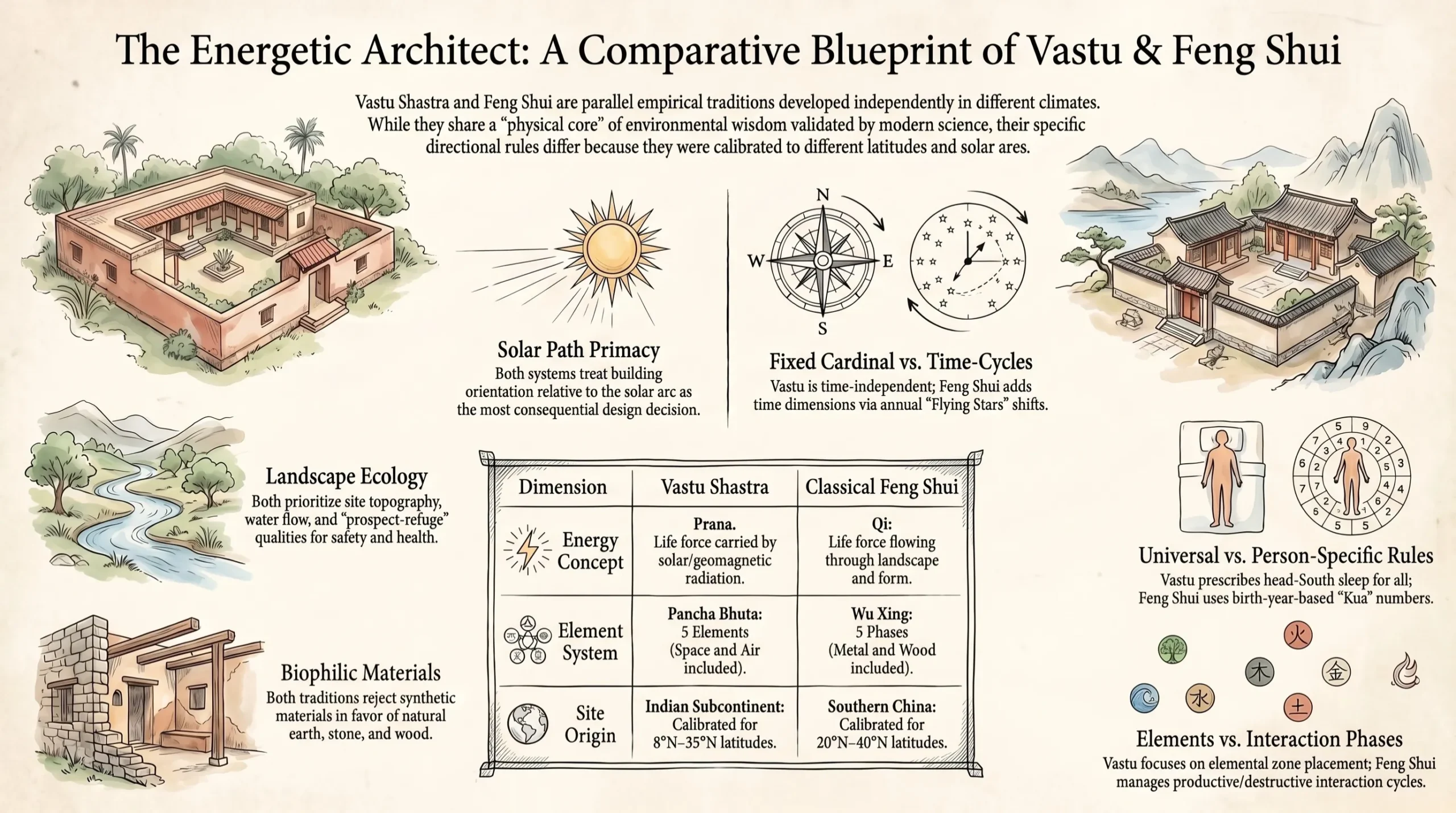
The first shared domain is solar orientation. Both traditions place primary importance on the orientation of the building relative to the solar arc — the path of the sun from its rising point in the East through its daily arc and its setting point in the West. Feng Shui’s Form School, the oldest and most geographically grounded school of the tradition, identifies the south-facing orientation (at Chinese latitudes in the Northern Hemisphere) as the most auspicious for the primary face of any building — because the south-facing facade at Chinese latitudes (20°N to 40°N) receives the maximum winter solar gain and the most favourable daylighting of any orientation. Vastu prescribes a north-south building axis, with east and north-east primary openings, as the most favourable orientation at Indian latitudes — a prescription that reflects the specific solar arc at those latitudes. Both traditions are making the same empirical observation — that solar orientation is the most consequential single design decision for the building’s environmental performance — and their specific prescriptions differ because the solar arc at Chinese and Indian latitudes differs in the ways that optimally calibrate building orientation.
The second shared domain is landscape and site quality. Feng Shui’s Form School is, at its core, a sophisticated system of landscape ecology assessment: the classic four-animal configuration — black tortoise mountain behind, red phoenix open prospect in front, green dragon hill to the left, white tiger hill to the right — describes the ideal topographic setting for a human settlement in terms that modern landscape ecology and environmental psychology would immediately recognise as the conditions of maximum shelter, maximum solar access, maximum water availability, and maximum spatial refuge quality. Vastu’s site assessment prescriptions — for plot slope toward the north-east, for backing toward the south-west, for water availability from the north — are the Indian expression of the same landscape ecology wisdom, calibrated to the specific hydrological, solar, and topographic character of the Indian environment.
The third shared domain is the centrality of energy flow through the building. Vastu’s Brahmasthana — the open, unobstructed central zone of the home that functions as the building’s passive ventilation and cosmic energy axis — and Feng Shui’s prescription for unobstructed pathways of Qi flow through the building’s primary zones are both expressions of the same physical insight: that a building’s interior spatial organisation must allow for continuous movement and renewal of air, light, and environmental energy through its primary living zones, and that blocking, compartmentalising, or obstructing this flow produces a measurable degradation in the indoor environmental quality that affects the health and wellbeing of every occupant.
This shared physical foundation is the basis on which an Indian family consulting both traditions will find the most reliable and most consistent guidance — because both traditions’ physical-core prescriptions reflect genuine environmental wisdom rather than cultural preference, and the areas of convergence between them are the areas most solidly supported by independent modern scientific validation.
Where do Vastu and Feng Shui most significantly diverge — and why does the divergence matter?
The divergences between Vastu Shastra and Feng Shui are as important as their convergences — and they matter practically, not merely academically, because they are the points at which following advice from one tradition while operating in the other tradition’s geographic and climatic context produces prescriptions that are at best suboptimal and at worst actively counter to the family’s health and environmental wellbeing. Understanding where the divergences lie and why they exist is the most important discernment tool available to an Indian family navigating both traditions.
The most significant divergence is in the specific directional prescriptions for primary openings, sleeping zone placement, and elemental zone assignment. Vastu prescribes east and north-east primary openings, south-west master bedroom, and south-east kitchen based on the solar arc and geomagnetic field character at Indian latitudes. Classical Feng Shui’s Compass School (specifically the Flying Stars and Kua number systems) prescribes sleeping orientations and primary direction alignments based on calculations that incorporate birth year, magnetic compass reading, and time-cycle energy shifts — producing prescriptions that may differ significantly from Vastu’s for the same person in the same home. A Feng Shui Kua number analysis might recommend that a particular individual’s best sleeping direction is east; Vastu would prescribe south or east for anyone — but the specific calculation methodology differs entirely.
The deeper source of this divergence is geographic and climatic. Feng Shui’s Compass School prescriptions were developed in China — at latitudes ranging from approximately 20°N to 40°N, with a climate dominated by cold northerly winds in winter (making south-facing orientation most valuable for solar gain) and a landscape character dominated by mountain ranges running east-west. The specific directional qualities encoded in the Flying Stars system and the Kua number calculations reflect centuries of empirical observation in this specific geographic context. Applying them directly in India — at latitudes from 8°N to 35°N, with a monsoonal climate, a different prevailing wind pattern, and a different solar arc geometry — is applying a geographically calibrated system outside its calibration zone.
What is the practical risk of mixing Flying Stars prescriptions with Vastu zone corrections?
The practical risk of directly combining Flying Stars Feng Shui prescriptions with Vastu zone corrections — without expert recalibration of both systems to the specific geographic, temporal, and physical context of the home — is that the directional reference frameworks of the two systems are not directly compatible, and the prescriptions they generate can point in opposite directions for the same design decision. A Flying Stars analysis might recommend activating the south-east sector of the home for wealth energy in a particular annual period; Vastu simultaneously prescribes the south-east as the Agni (fire) zone appropriate for the kitchen — a zone whose specific elemental character makes it inappropriate for living area activation in the Flying Stars sense. Activating both prescriptions simultaneously in the same zone produces not a synthesis but a contradictory spatial programme that the family’s home cannot coherently accommodate.
A more practically common conflict arises in sleeping orientation. The Feng Shui Kua number system assigns each person, based on birth year and gender, one of eight directional groups, each with its own set of auspicious and inauspicious sleeping directions. For many Indians consulting both systems, the Kua number’s prescribed ‘best sleeping direction’ may be west, north-west, or north-east — directions that Vastu unambiguously identifies as unfavourable for sleeping (head-North in particular is the direction most explicitly contraindicated by Vastu’s geomagnetic biophysics). Following the Kua prescription in an Indian home would place the sleeping body in a configuration that Vastu — and the Building Biology and geomagnetic research that validates Vastu’s prescription — identifies as geomagnetically stressful.
My recommendation for any Indian family who has received conflicting directional advice from Vastu and Feng Shui practitioners: prioritise the prescription with the clearer physical mechanism. Head-South sleeping has a documented geomagnetic mechanism validated by HRV research and biophysics. The Kua number system’s directional prescriptions are based on a numerological-cosmological framework whose physical mechanism has not been independently established. For an Indian family living in India, in the physical environment for which Vastu’s prescriptions were calibrated over five thousand years, the physically grounded prescription should take precedence.
What is the complete map of how Vastu and Feng Shui compare across every major dimension?
The following table provides a precise, dimension-by-dimension comparison of Vastu Shastra and classical Feng Shui — covering their geographic origins, cosmological frameworks, energy concepts, directional systems, site assessment methodologies, sleeping zone prescriptions, material and colour guidance, and scientific validation status. The final two columns — ‘Where They Converge’ and ‘Where They Diverge Most’ — are the most practically useful for any Indian family trying to navigate the relationship between the two traditions.
|
Dimension |
Vastu Shastra |
Classical Feng Shui (Form and Compass Schools) |
Where They Converge |
Where They Diverge Most |
|
Geographic origin and climate |
Indian subcontinent; 8°N–35°N latitude; tropical and semi-arid climate; strong monsoonal pattern |
Southern China; 20°N–40°N latitude; subtropical and temperate; East Asian landscape character |
Both calibrated to local solar arc, prevailing winds, landscape form |
Directional prescriptions optimised for different latitudes and climates — not interchangeable without adaptation |
|
Cosmological framework |
Pancha Bhuta (five elements: Earth, Water, Fire, Air, Space); Vedic directional cosmology; Vastu Purusha Mandala; Brahman as cosmic order |
Wu Xing (five phases: Wood, Fire, Earth, Metal, Water); Yin-Yang polarity; Ba Gua eight-trigram directional map; Qi as universal life force |
Five-element / five-phase framework; directional cosmological map; universal life energy concept; elemental zone assignment |
Five elements differ in composition and interaction cycles; directional cosmological maps differ significantly; elemental interaction models are distinct |
|
Primary energy concept |
Prana — the vital life force carried by solar radiation, fresh air, morning light, and geomagnetic coherence; assessed by physical presence |
Qi — the life force flowing through landscape, building form, and interior arrangement; assessed by landscape reading and compass orientation |
Both posit a universal vital energy whose quality in the built environment determines occupant health and wellbeing |
Prana is more directly correlated with physically measurable environmental factors; Qi encompasses a broader range of landscape and formal qualities |
|
Directional system |
Eight compass directions plus central Brahmasthana; directions fixed to geomagnetic / solar North; prescriptions calibrated to Indian solar arc |
Eight trigrams (Ba Gua) with two major systems: Form School reads landscape topography; Compass School (San He, San Yuan, Flying Stars) reads directional orientation and time cycles |
Both use an eight-direction framework; both prescribe specific functions for specific directions; both treat centre as special zone |
Flying Stars Feng Shui adds time dimension (annual and period energy shifts); Vastu directional prescriptions are time-independent; directional character of specific sectors differs between systems |
|
Site assessment methodology |
Bhumi Pariksha: soil quality, slope direction, underground water, plot shape, surrounding landscape form; geopathic stress survey with modern instruments |
Form School (Luan Tou): dragon veins, tiger-dragon topographic balance, water course orientation, mountain backing; later integration with compass |
Both assess site topography, water flow direction, surrounding landscape quality before building; both treat site selection as foundational |
Feng Shui Form School gives greater weight to macro-landscape topography (dragon veins, mountain forms); Vastu gives more explicit attention to underground earth energies |
|
Sleeping zone prescription |
Master bedroom in South-West zone; head-South or head-East orientation; zone assessed for geopathic stress and electromagnetic burden |
Master bedroom placement varies by system; Compass School uses Kua number to determine auspicious direction; Form School uses backing-mountain principle |
Both treat bedroom placement and sleeping direction as primary health determinants; both specify auspicious sleeping orientations |
Vastu’s SW prescription is geographically and geomagnetically grounded; Feng Shui’s Kua-number system is person-specific and varies by birth year — the two systems may recommend different directions for the same person |
|
Water feature placement |
North-East (Jal element zone); flowing water for prana and negative ionisation; NE low point aligned with site hydrology |
South-East or North in Black Hat; varies by Compass system; water associated with wealth and Qi activation; facing direction critical |
Both prescribe water features as energy activators; both associate water with prosperity and vitality; both treat water direction as significant |
Specific placement prescriptions differ between systems; Vastu’s NE water placement is geographically grounded in solar and hydrological terms; Feng Shui water placement more system-dependent |
|
Material and colour prescriptions |
Pancha Bhuta elemental colours by zone; natural materials (earth, wood, stone, lime); elemental character of materials by zone |
Five Phase (Wu Xing) colour and material associations by sector; productive and destructive cycle determines colour compatibility |
Both prescribe natural materials; both associate colours with directional zones through elemental frameworks; both treat material quality as energetically significant |
Specific colour-direction associations differ; Feng Shui’s productive-destructive cycle adds interaction complexity absent from Vastu’s zone-by-zone elemental prescription |
|
Scientific validation status |
Core prescriptions validated by chronobiology (solar alignment), Building Biology (geopathic stress, EMF), geomagnetic biophysics (orientation), passive solar design (SW thermal mass), indoor air quality (Brahmasthana ventilation) |
Form School landscape prescriptions partially validated by environmental psychology and landscape ecology; Compass School time-based prescriptions have limited independent scientific validation to date |
Both traditions’ landscape-scale and solar-alignment principles find corroboration in environmental and ecological science |
Vastu’s physical prescriptions (orientation, zone, EMF, geopathic stress) have more direct physical mechanism correlates in current Building Biology research than most Feng Shui Compass School prescriptions |
Reading this table carefully, the pattern that emerges is consistent and instructive. The rows where the ‘Where They Converge’ column is most substantial — solar orientation, site landscape assessment, energy flow, elemental zone concept, natural materials — correspond precisely to the rows where both traditions have the strongest independent physical grounding. The rows where the ‘Where They Diverge Most’ column is most significant — specific directional prescriptions, sleeping orientation systems, time-based energy calculations — correspond precisely to the rows where one or both traditions’ specific prescriptions are most geographically contextual, most culturally specific, or most reliant on cosmological frameworks without established physical mechanism.
This pattern is, I believe, the most important interpretive key to understanding the relationship between the two traditions: where both converge, the convergence reflects physical reality; where they diverge, the divergence reflects geographic context and cultural cosmological vocabulary. And the practical implication is clear: follow the points of convergence with confidence — they are validated by both traditions and by modern science. Navigate the points of divergence with awareness of geographic context and mechanism quality — and, for an Indian family in India, apply the tradition that was calibrated to the Indian environment.
How does the Pancha Bhuta framework compare with Wu Xing — and where do they genuinely agree?
The elemental frameworks of the two traditions — Vastu’s Pancha Bhuta (five great elements: Prithvi/Earth, Jal/Water, Agni/Fire, Vayu/Air, Akasha/Space) and Feng Shui’s Wu Xing (five phases: Wood, Fire, Earth, Metal, Water) — are among the most frequently conflated and most genuinely distinct dimensions of the two systems. They are not the same framework in different vocabularies. They are genuinely different conceptual models of the elemental constitution of the natural world — models that share the number five, the basic concept of elemental interaction, and the application of elemental analysis to directional zones of the built environment, but that differ significantly in their specific elements, their interaction models, and their design implications.
The most immediately obvious difference is in the elements themselves: Vastu’s five elements include Air (Vayu) and Space (Akasha) as distinct elements alongside Earth, Water, and Fire; Wu Xing’s five phases include Wood and Metal as distinct phases alongside Fire, Earth, and Water. Wood and Metal are absent from the Pancha Bhuta; Air and Space are absent from Wu Xing. This is not a translational difference — it is a genuine conceptual difference in how each tradition understands the fundamental constituents of the natural world, reflecting different philosophical frameworks that emerged from different cultural and intellectual contexts.
The interaction models also differ significantly. Wu Xing’s most distinctive and most practically important feature is its two interaction cycles: the Sheng (productive/generating) cycle in which each element generates the next in the sequence Wood-Fire-Earth-Metal-Water-Wood, and the Ke (controlling/overcoming) cycle in which each element controls an alternating element. These cycles are central to Feng Shui’s approach to elemental balance — the practitioner analyses whether the elemental profile of a space’s zones is in a productive or controlling relationship and adjusts material, colour, and object choices to create the most harmonious cycle. The Pancha Bhuta framework does not employ this productive-destructive cycle model; its primary tool is the assignment of each element to its natural directional zone and the assessment of whether each zone’s room function, material character, and spatial quality are appropriate to the zone’s elemental nature.
Where does the elemental comparison between Vastu and Feng Shui produce the most practical convergence?
Despite the genuine differences in their elemental models, Vastu’s Pancha Bhuta and Feng Shui’s Wu Xing produce several areas of strong practical convergence that are worth noting — precisely because these areas of convergence reflect genuine shared physical wisdom rather than coincidental cosmological similarity.
Both traditions share the prescription for natural materials as the highest-quality elemental expression in the built environment. Vastu’s Pancha Bhuta prescribes natural earth (lime, clay, terracotta), natural water (stone, natural wood), natural fire (light, terracotta tones), natural air (ventilation, natural textiles), and natural space (the open Brahmasthana) as the elemental palette of the harmonious home. Wu Xing prescribes natural wood, natural stone, earth materials, and metal in their natural forms as the highest-quality elemental expressions. Both traditions share the fundamental insight that synthetic materials — plastics, resins, composites — are elementally incoherent: they do not express any natural elemental quality with integrity, they off-gas VOCs that degrade the indoor air environment, and they fail to provide the biophilic connection to natural material qualities that human biology and the human nervous system require for optimal health and wellbeing.
The shared natural materials prescription is, as I have discussed in other contexts, among the most strongly validated dimensions of both traditions by modern building science. Indoor air quality research documents the VOC burden of synthetic materials; biophilia science documents the physiological benefits of natural material exposure; Building Biology documents the hygroscopic, thermally moderating, and allergen-resistant properties of natural building materials. When Vastu and Feng Shui agree — as they do here — that natural materials are the elemental foundation of a healthy home, they are both pointing to the same physical truth that modern material science confirms.
What does Feng Shui's Form School share with Vastu's site assessment wisdom?
Of all the dimensions of Feng Shui, the Form School — the oldest, most geographically grounded, and most physically intuitive branch of the tradition — is the one I regard with the most consistent respect and the one whose insights I find most readily compatible with Vastu’s own site assessment wisdom. The Form School’s engagement with landscape — its reading of topographic form, water flow, solar access, wind exposure, and spatial prospect — is, viewed through the lens of landscape ecology and environmental psychology, one of the most sophisticated ancient systems of ecological site assessment in the architectural heritage of any civilisation.
The classic Form School four-animal configuration — the ideal site with a mountain or elevated ground to the north providing shelter from cold winds, an open, south-facing prospect before the building providing solar access and visual openness, a gentle hill to the east (the green dragon) providing morning shelter without blocking solar access, and a slightly lower hill to the west (the white tiger) providing afternoon shade without blocking the western social prospect — is an exquisitely precise description of the topographic setting that maximises every environmental quality that human habitations require: thermal protection, solar gain, wind shelter, water availability from the mountain drainage, and the spatial refuge-and-prospect balance that environmental psychology identifies as the most health-supporting landscape configuration for human dwellings.
Vastu’s site assessment wisdom engages with the same landscape qualities through a different but complementary vocabulary: the prescription for south-west high ground and north-east low, open prospect; the preference for a site with a natural hill or elevated building mass to the south-west providing shelter and thermal mass; the north-east slope enabling passive water harvest from the monsoon rainfall; the avoidance of sites hemmed in on the east or north-east by obstructing landscape features that would block the morning solar prana and the fresh north-east breeze. These are, at the level of physical landscape ecology, describing the same ideal site configuration that the Form School’s four-animal metaphor expresses — simply calibrated to the specific solar arc, prevailing wind pattern, and hydrological character of the Indian subcontinent rather than the Chinese landscape.
For Indian families building on new plots or assessing existing sites, the insight from this comparison is practical: both the Vastu Bhumi Pariksha and the Feng Shui Form School four-animal configuration are assessing the same physical site qualities — shelter, solar access, water, prospect, and spatial refuge. Consulting both traditions’ landscape assessment frameworks for the same site will, in most cases, produce complementary rather than contradictory guidance — because both are responding to the same physical environmental realities that the landscape presents.
How do Indian families living abroad navigate the Vastu-Feng Shui question in a new geographic context?
One of the most genuinely interesting practical dimensions of the Vastu-Feng Shui comparison arises for the very substantial Indian diaspora living in countries where Feng Shui has a longer cultural presence than Vastu — Singapore, Malaysia, the United Kingdom, the United States, Australia — and where Indian families may encounter Feng Shui practitioners and advice more readily than Vastu practitioners who understand the specific geographic calibration their principles require when applied outside the Indian subcontinent.
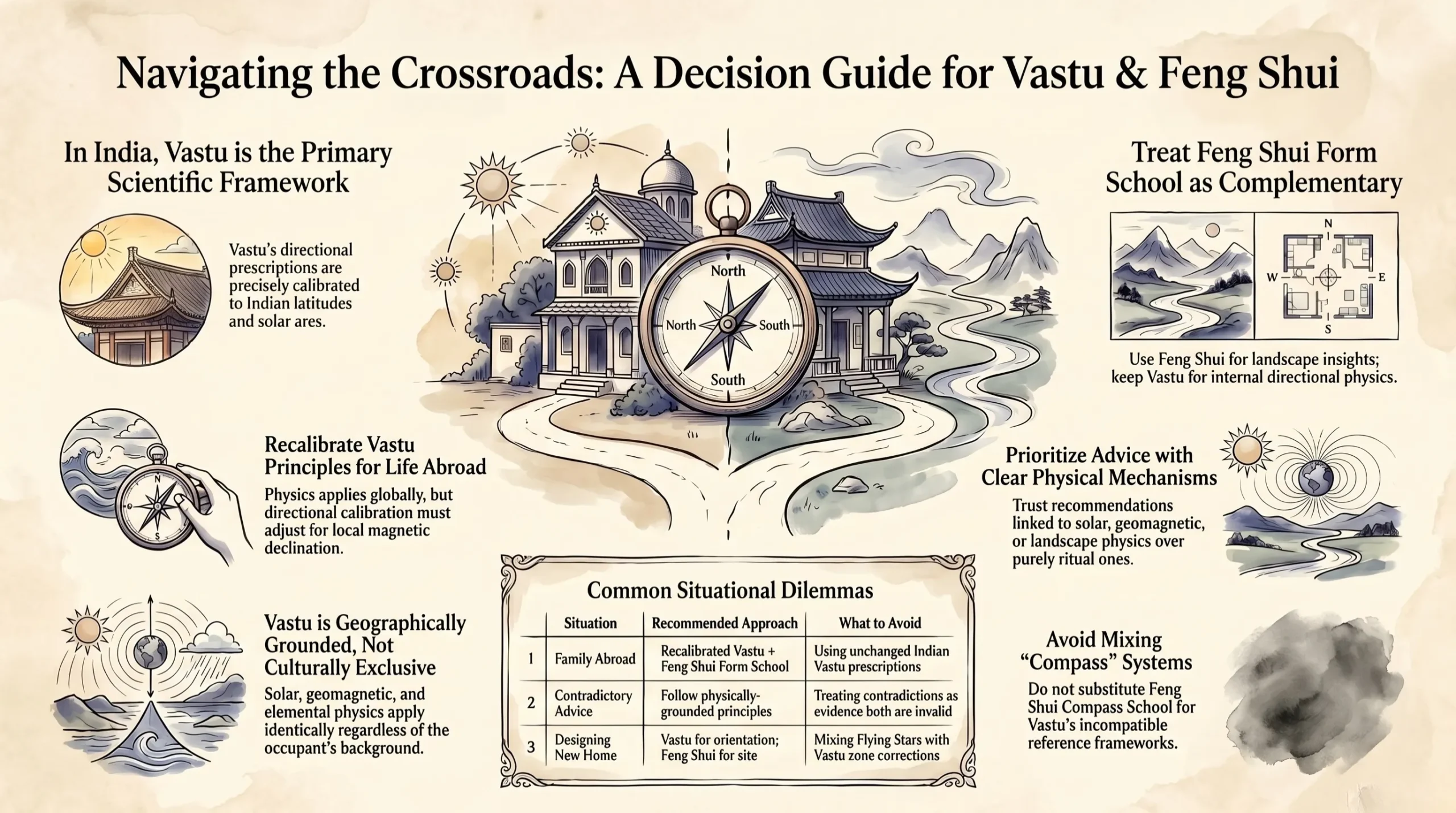
The key principle for Indian families abroad is this: Vastu’s physical principles apply globally, but Vastu’s directional prescriptions require recalibration for the specific solar arc and geomagnetic declination of the new geographic location. The Earth’s geomagnetic field flows south-to-north everywhere, not only in India — so the head-South sleeping prescription is equally valid in Singapore, in London, and in Toronto as it is in Mumbai. Geopathic stress zones exist everywhere — the Hartmann and Curry geomagnetic grids cover the entire Earth’s surface, and underground water veins and geological faults are universal phenomena. The electromagnetic burden of bedroom Wi-Fi and wiring ELF fields is identical in a London flat and a Bengaluru apartment. These physical principles require no geographic recalibration.
What does require recalibration is the solar arc and associated directional prescriptions. Vastu’s east and north-east primary opening prescription is calibrated to the solar arc at Indian latitudes — where the north-east face of a correctly oriented building receives the most biologically valuable morning solar radiation of any face. At 51°N (London) or 40°N (New York), the solar arc is significantly higher and more southward than at Indian latitudes, and the specific prescription for primary openings may need adjustment to reflect the new solar geometry. Similarly, Vastu’s south-west bedroom prescription draws in part on the thermal dynamics of the south-west zone at Indian latitudes — where the south-west wall receives the most intense afternoon solar heat load. At higher latitudes where winter solar gain is more critical than summer cooling, the thermal logic of the south-west bedroom prescription changes somewhat.
For Indian families abroad, my recommendation is to engage a Vastu practitioner who explicitly understands geographic recalibration — and to draw on Feng Shui Form School landscape insights for the local topographic and landscape context, where they are available and relevant, as a complementary resource that the recalibrated Vastu framework can usefully inform. The physically grounded principles of both traditions are geographically portable; the specific directional prescriptions of both require geographic contextualisation to produce optimal results in the specific environment of the family’s actual home.
What should an Indian family actually do when they have received advice from both traditions?
The most practically urgent question for the many Indian families who have received Vastu advice, Feng Shui advice, or both — and who find themselves navigating inconsistencies, contradictions, or genuine confusion about which system’s prescriptions to follow — is this: what specific decision framework should guide their choices? The following table provides a specific decision guide for the most common situations families encounter.
|
Situation |
Recommended Approach |
Why |
What to Avoid |
|
Indian family in India — new home assessment |
Scientific Vastu: full assessment to Indian solar arc, geomagnetic field, geopathic stress, EMF |
Vastu’s directional prescriptions are calibrated to Indian latitudes; geomagnetic and solar alignment most accurate for Indian context |
Applying Feng Shui flying stars or Kua numbers without Vastu recalibration — directional assumptions differ |
|
Indian family abroad (Singapore, UK, US, etc.) |
Scientific Vastu recalibrated for local solar arc and geomagnetic field; Feng Shui Form School insights for local landscape |
Vastu’s physical principles apply globally; directional calibration must account for different latitude and magnetic declination |
Using Indian Vastu prescriptions unchanged — solar arc and geomagnetic declination differ by location |
|
Indian family interested in Feng Shui after Vastu |
Treat Feng Shui Form School as complementary landscape wisdom; do not substitute Feng Shui Compass School for Vastu directional prescriptions |
Form School landscape wisdom is largely complementary; Compass School directional systems use different reference frameworks than Vastu |
Mixing Feng Shui flying star prescriptions with Vastu zone corrections without expert recalibration — conflicting directional systems |
|
Non-Indian family in India wanting Vastu |
Vastu fully applicable regardless of cultural background — principles are physical and geographically grounded, not culturally exclusive |
Solar arc, geomagnetic field, geopathic stress, and elemental zone physics apply identically regardless of the occupant’s cultural background |
Assuming Vastu is only for Hindu or Indian families — the physical principles are universal |
|
Family considering combining both systems |
Use Vastu as primary physical framework; draw on Feng Shui Form School for complementary landscape and topographic insights |
The two traditions’ physical landscape and solar alignment principles are largely compatible; their directional systems and elemental models are not directly combinable without expert adaptation |
Attempting direct combination of flying stars, Kua numbers, and Vastu zone prescriptions — the reference systems are incompatible |
|
Family who received contradictory advice from both |
Return to physically grounded principles of both traditions — the recommendations that have clear physical mechanism (solar, geomagnetic, landscape) are reliable; those without mechanism are negotiable |
Both traditions have a physically grounded core and a culturally variable periphery; the core prescriptions of both are largely compatible |
Treating the contradiction as evidence that both traditions are invalid — the conflict is usually in the culturally variable layer, not the physically grounded core |
|
Architect designing for multicultural client |
Physical Vastu principles (orientation, zone, natural ventilation, geopathic avoidance) as primary framework; Feng Shui Form School topographic analysis as complementary site input |
The physical building science of both traditions is architecturally implementable regardless of cultural context; the cosmological layers can be held lightly |
Designing by either system’s ritual layer without understanding the physical principles — misses the genuine health and performance benefits of both |
The thread running through every row of this decision table is the same principle I apply to every dimension of Vastu practice: prioritise the prescription with the clearest physical mechanism, most direct scientific validation, and most appropriate geographic calibration for the specific context of the family’s home. Both Vastu and Feng Shui have a physically grounded core and a culturally variable periphery. The core prescriptions of both deserve respect. The peripheral prescriptions of both deserve scrutiny.
For an Indian family in India — which is the context in which our Complete Home Health Audit is most commonly conducted — the answer is clear: Vastu Shastra, applied through the Scientific Vastu methodology with Building Biology instruments and modern physical science validation, is the appropriate primary framework. Its principles are calibrated to the Indian environment, validated by the Indian textual tradition’s five thousand years of accumulated observational evidence, and confirmed by the independent findings of chronobiology, geomagnetic biophysics, Building Biology, and passive solar design. Feng Shui’s Form School landscape insights are a valuable complementary resource where relevant; its Compass School directional prescriptions require recalibration and careful expert reconciliation before being applied alongside Vastu zone corrections.
What can Vastu genuinely learn from Feng Shui — and vice versa?
A genuinely intellectually honest account of the relationship between Vastu and Feng Shui would be incomplete without acknowledging what each tradition might valuably learn from the other — because both traditions are incomplete in different ways, and the specific areas of each tradition’s relative weakness correspond, often precisely, to the other tradition’s relative strength.
What Vastu might valuably learn from Feng Shui is the practice of landscape-scale topographic assessment that the Form School has developed to an extraordinary level of sophistication. The classical Feng Shui practitioner’s ability to read the energy character of a site from its macro-landscape context — the mountain backing, the water courses, the topographic prospect and refuge — is, in the Form School’s finest expressions, a level of ecological landscape literacy that even the best classical Vastu texts do not quite match in their site assessment protocols. Vastu’s Bhumi Pariksha is excellent at assessing the immediate plot level — soil quality, slope, underground water indicators, plot shape — but less developed than the Form School at the landscape scale of the surrounding kilometer and beyond. Incorporating this landscape-scale ecological literacy into Vastu practice would strengthen its site assessment methodology in precisely the dimension where it is most valuable for families building in complex landscape settings.
What Feng Shui might valuably learn from Vastu — and from Scientific Vastu in particular — is the instrument-based, Building Biology-integrated approach to the assessment of earth energies and electromagnetic environmental quality that our practice has developed through the integration of the classical Vastu tradition with modern geomagnetic biophysics and building biology measurement methodology. Classical Feng Shui, even in its most sophisticated Form School expressions, does not have an equivalent of the magnetometer-based geopathic stress survey, the RF and ELF field measurement of the sleeping zone, or the Building Biology SBM standard for bedroom electromagnetic environment quality. These instrument-based assessment tools add a precision and a physical specificity to the assessment of earth and electromagnetic energies that the traditional Feng Shui practitioner’s tools — the Luopan compass, the landscape reading, the birth year calculation — cannot provide.
The tradition that is most able to benefit from this cross-pollination is, in my view, the tradition whose practitioners are most intellectually honest about where their tradition’s tools are strongest and where they are limited. The finest practitioners of both Vastu and Feng Shui are those who can say clearly: this is what my tradition does exceptionally well, this is where it has limitations, and this is how I draw on complementary knowledge without compromising the integrity of the framework I am working within. That is the standard I hold myself to — and the standard I would encourage every family to hold both their Vastu and their Feng Shui practitioners to.
Real Case Study — A Chennai Civil Engineer Who Began Sceptical of Both Traditions and Ended with a Clear Understanding of Each:
A civil engineer in Chennai came to me after a frustrating experience with two practitioners: a Vastu consultant who had prescribed specific metal objects and ritual procedures without any physical assessment of his home, and a Feng Shui consultant who had recommended activating his ‘wealth corner’ with a water feature in the south-east — a placement directly contradicting Vastu’s prescription for the south-east as the Agni zone where water placement creates elemental conflict.
His opening question to me was precise: ‘Both practitioners contradicted each other and neither could explain the physical mechanism for anything they recommended. How do I know which, if either, to trust?’
I began not with his home but with the comparison I have outlined in this article. I explained the geographic calibration difference: that the south-facing orientation the Feng Shui Form School prescribes as most auspicious reflects the Chinese solar arc at 30°N-40°N latitude, not the Indian solar arc at his Chennai latitude of 13°N. I explained the Kua number system and why its directional prescriptions, developed in a different geomagnetic declination context, require recalibration before application in India. I showed him the Water Qi placement and explained the Vastu elemental conflict — and then showed him the physical reason: a large water feature in the south-east Agni zone increases humidity in the zone of maximum mid-morning solar thermal loading, creating a damp-heat combination that is both elementally inappropriate and practically uncomfortable.
His assessment then proceeded on Scientific Vastu principles: geopathic stress survey (one stress zone confirmed beneath the master bedroom); RF measurement (router at 3,100 microWatt per square metre at sleeping position); sleeping orientation head-North-West; master bedroom in north-east zone.
Three corrections implemented in one weekend: bed repositioned away from stress zone; router moved to study; bed reoriented to head-South. One month later: ‘I sleep through the night for the first time in three years. My wife says the house feels different — calmer. I have not yet made any other changes. I am now a convert — not to Vastu as a belief system, but to Vastu as a physical science. The mechanism explanation was what I needed. Once I understood why, I trusted the what.’
What does a Complete Home Health Audit offer that no eclectic Vastu-Feng Shui blend can match?
The practical implication of everything this article has established about the relationship between Vastu and Feng Shui is this: the eclecticism that the popular wellness marketplace presents as ‘East-meets-East wisdom’ — freely blending Feng Shui Bagua maps with Vastu zone corrections, overlaying Flying Stars calculations with Vastu Purusha Mandala zone prescriptions, mixing Kua number sleeping direction recommendations with Vastu’s head-South prescription — does not produce a more comprehensive home energy assessment. It produces a more complicated and less coherent one.
The reason is not cultural loyalty to one tradition over another. The reason is physical: the directional reference systems of Vastu and Feng Shui’s Compass School are not designed to be overlaid, because they were calibrated in different geographic contexts using different astronomical and cosmological frameworks. Overlaying them without expert recalibration is like overlaying two maps that were drawn at different scales using different projection systems and treating the resulting composite as a more accurate map than either original. The composite is less accurate than either source — not because the sources are wrong, but because they cannot be directly combined.
What a Complete Home Health Audit provides — and what no eclectic blend of Vastu and Feng Shui without physical assessment can provide — is the instrument-based, mechanism-grounded assessment of the specific physical conditions of the specific home: the actual geopathic stress field beneath the actual sleeping position, measured with a magnetometer. The actual RF field at the actual sleeping body position, measured with an RF meter. The actual sleeping orientation of each family member and its actual relationship to the Earth’s geomagnetic field. The actual zone placement of the master bedroom and its actual geomagnetic, thermal, and spatial refuge quality. These are not assessments that any decorative or cosmological overlay — whether Feng Shui or commercial Vastu — can substitute for.
The tradition that makes the most verifiable predictions about the most physically consequential aspects of the home environment is the tradition most worth following — and both Vastu and Feng Shui, at their physically grounded best, make such predictions. Our Complete Home Health Audit delivers the instrument-verified, mechanism-explained, priority-ranked correction of the specific physical defects in your specific home that produces the health and wellbeing improvements every family deserves — not because one cultural tradition is superior to another, but because the physical environment of your home is the most consequential health environment your family occupies, and it deserves the most rigorous and most honestly grounded assessment available.
Why Two Traditions that Share a Physical Core Can Give Contradictory Advice — and How to Navigate It:
I sometimes explain the Vastu-Feng Shui relationship to sceptical engineers and architects by analogy with two independent weather stations built in different cities to measure the same atmospheric phenomena. Both stations measure temperature, humidity, wind speed, and barometric pressure — the same physical quantities, using the same physical instruments, in response to the same physical atmosphere. But the specific readings they produce differ, because the atmosphere in Chennai and the atmosphere in Beijing are genuinely different, even though they are both expressions of the same global atmospheric system.
Neither station is wrong. Both are correctly measuring the local expression of the universal physical reality. But if you take the Chennai station’s readings and apply them in Beijing as though they described the Beijing atmosphere, you will make consistently incorrect weather predictions — not because the Chennai measurement methodology is wrong, but because you have applied a geographically specific measurement outside its calibration zone.
This is precisely the relationship between Vastu and Feng Shui. Both traditions are correctly measuring the local expression of universal physical forces — the solar arc, the geomagnetic field, the landscape ecology, the elemental energy character — in their respective geographic contexts. The convergences between them reflect the universal physical forces they are both measuring. The divergences reflect the genuine differences in those forces’ local expression at Indian versus Chinese latitudes.
The practical implication is not that one tradition is right and the other wrong. It is that each tradition’s prescriptions are most reliable in the geographic context for which they were calibrated — and that the families who receive the clearest benefit are those who apply the geographically appropriate tradition with the physical understanding and instrument-based precision that modern building science makes possible. For an Indian family in India, that means Scientific Vastu, applied rigorously, with full awareness of what Feng Shui’s best insights can complementarily offer at the landscape scale where both traditions’ physical wisdom overlaps most completely.
Your Home Deserves the Right Framework — Applied with Physical Precision.
Vastu and Feng Shui share a physical core of genuine environmental wisdom. But for an Indian family in India, the tradition calibrated to the Indian solar arc, the Indian geomagnetic field, the Indian monsoonal climate, and the Indian building ecology — developed across five thousand years of disciplined empirical observation and now validated by Building Biology, chronobiology, geomagnetic biophysics, and passive solar design — is Vastu Shastra. And the most complete expression of that tradition, with the precision that modern instrument-based assessment provides, is our Complete Home Health Audit.
No Bagua overlay. No Flying Stars calculation. No Kua number sleeping direction that contradicts your geomagnetic field reality. Just a precise, instrument-verified, mechanism-explained assessment of your home’s specific physical conditions — and a priority-ranked correction plan that addresses each defect with a specific, implementable remedy whose physical mechanism you will understand completely before you implement it.
Your Complete Home Health Audit delivers:
- Patented photo-scanning energy analysis — top 5 critical Vastu and energy defects identified by Mukesh Shah personally
- Geopathic stress assessment — magnetometer survey; sleeping zone mapping; relocation prescription with confirmed clear zone
- Electromagnetic environment — RF at sleeping position; ELF from bedroom wiring; router relocation and circuit protocol
- Sleeping orientation — head-South or head-East prescription; geomagnetic mechanism explained for every family member
- Nine-zone Vastu Purusha Mandala — master bedroom; kitchen; study; living areas; all correctly allocated by zone function
- Brahmasthana integrity — open-centre ventilation and cosmic axis assessment; clearance prescribed where blocked
- Elemental balance — Pancha Bhuta zone analysis; natural material prescriptions; elemental activation corrections
- North-East activation — prana gateway assessment; water feature placement; morning light access confirmation
- Indoor air quality — VOC source identification; natural material guidance; CO2 ventilation assessment
- Mechanism explanation for every finding — you will know why each correction matters and what to expect from it
- One-on-one consultation with Mukesh Shah personally
- Detailed written report — findings, corrections, mechanisms, and expected improvement timelines
- 30 days of priority support — guidance through every step of your implementation
- 100% satisfaction guarantee.
The best of both East Asian traditions points to the same physical truth: your home’s relationship to the natural forces of its environment determines your family’s health. Let us assess that relationship with the precision it deserves.
Book your Complete Home Health Audit today at vastumyhome.com
No — Vastu Shastra and Feng Shui are parallel but distinct traditions that developed independently in the Indian and Chinese civilisations respectively. They share a common physical core: both emphasise solar orientation, site landscape quality, energy flow through the building, natural materials, and the elemental character of directional zones. However, their cosmological frameworks differ (Pancha Bhuta vs Wu Xing), their directional systems differ significantly (especially in the Feng Shui Compass School), and their specific prescriptions are calibrated to different geographic contexts — India vs China — and cannot be applied interchangeably without recalibration.
Both traditions’ physically grounded principles — solar orientation, site landscape, natural materials, energy flow through open spaces — are largely compatible and can be followed simultaneously. However, the Feng Shui Compass School’s directional prescriptions (Flying Stars, Kua numbers, Ba Gua sector activations) are based on a different directional reference framework from Vastu’s nine-zone Vastu Purusha Mandala, and directly combining them without expert recalibration can produce contradictory spatial programmes for the same zone or conflicting sleeping orientation prescriptions for the same person. For Indian families in India, prioritise Vastu’s geographically calibrated prescriptions and draw on Feng Shui Form School landscape insights as a complementary resource.
In the Vastu framework, the South-East is the Agni (fire) zone — the zone whose elemental character is fire, heat, and activation, associated with the kitchen and morning solar thermal energy. Placing a water feature in this zone creates an elemental conflict between the zone’s Agni character and the Jal character of the water feature — a conflict that the classical Vastu texts associate with household discord and elemental imbalance. Some Feng Shui systems prescribe water in South-East for wealth activation; this prescription is derived from a different elemental reference system (Wu Xing) and a different geographic context. For an Indian home, the Vastu prescription is the geographically appropriate one: water belongs in the North-East Jal zone, not the South-East Agni zone.
Vastu and Ayurveda unambiguously prescribe head-South or head-East sleeping, based on the geomagnetic mechanism of aligning the body’s biomagnetic axis with the Earth’s south-to-north geomagnetic field. Feng Shui’s Compass School (specifically the Kua number system) assigns each person an individual best sleeping direction based on birth year — which may be south, east, or any other direction depending on the calculation. The two systems may therefore agree on south for some individuals but disagree for others. Where they disagree, the geomagnetically grounded Vastu prescription (head-South or head-East) has the stronger physical mechanism validation — HRV research and geomagnetic biophysics — and should take precedence for Indian families.
A Complete Home Health Audit using our Scientific Vastu methodology provides instrument-based physical assessment that classical Feng Shui tools cannot: magnetometer geopathic stress mapping of all sleeping zones; RF field measurement at sleeping body position from all wireless devices; ELF field measurement from bedroom wiring; Building Biology standard comparison for bedroom electromagnetic environment; plus the full nine-zone Vastu Purusha Mandala directional analysis calibrated to the specific Indian latitude and solar arc of the family’s home. Every finding is explained through its physical mechanism (geomagnetic, chronobiological, electromagnetic, thermal) and supported with a specific, measurable, implementable correction. Delivered with one-on-one consultation with Mukesh Shah, detailed written report, 30 days priority support, and 100% satisfaction guarantee.
I Would Love to Hear From You
I would love to hear your story or questions in the comments below. Have you experienced the impact of Vastu in your own home? Are you noticing any of the common defects I described above in your space? Share openly — every question is a step towards greater harmony.
Disclaimer: Vastu analysis and energy corrections are for harmonising your space and personal growth. They are not a substitute for professional medical, financial, legal or architectural advice.