

How Does Vastu Evolve with Technology? Smart Homes, EMF & Modern Assessment | Vastu My Home
Namaste. I am Mukesh Shah. There is a question I am asked by engineers, by technology professionals, and by the highly educated urban families who form a growing proportion of those seeking serious Vastu guidance — and it is a question that deserves an answer more precise, more specific, and more intellectually honest than the Indian wellness market typically offers. Does the Vastu tradition evolve with technology? And if it does, how? Does technology threaten Vastu compliance, extend it, improve it, or fundamentally change what it means?
My answer, developed across twenty years of practice at the intersection of classical Vastu scholarship and modern building science, is: all four. Technology simultaneously threatens Vastu compliance by introducing new categories of environmental stress that the classical texts could not have addressed; extends Vastu assessment by providing instruments that can confirm and quantify what the classical tradition could only observe and infer; improves Vastu practice by replacing intuitive assessment with measurable, reproducible, independently verifiable physical data; and changes what Vastu means by demonstrating that the tradition’s core principles are not cultural artifacts but physical laws whose mechanism has been independently confirmed by technologies the tradition’s authors could not have imagined.
Understanding all four dimensions of this relationship is practically important for every family navigating the contemporary Indian home — because the technology in their home is, simultaneously, the most significant new source of Vastu defects their ancestors never faced, and the most powerful set of tools available for identifying and correcting those defects with a precision the classical tradition could never have achieved. The router that suppresses their child’s melatonin is technology. The RF meter that measures the suppression at their child’s sleeping position and quantifies the correction is also technology. The tradition’s evolution through technology is not a departure from its physical core. It is the physical core’s most faithful modern expression.
For the families who engage our Complete Home Health Audit, the technology dimension of this evolution is directly visible in the instruments we use, the photo-scanning methodology that initiates every assessment, and the smart home sensing tools we recommend for verifying corrections. Technology has made Vastu more precise, more accountable, and more practically powerful than at any previous point in the tradition’s five-thousand-year history. And the new technologies in the family’s home have made the need for that precision more urgent than ever.
What is the fundamental relationship between Vastu's physical principles and technological change?
The most important insight that frames the entire Vastu-technology relationship is this: the physical principles at the core of Vastu Shastra are not cultural conventions that change with culture — they are physical laws that the tradition discovered through observation and that technology is now measuring with instruments. Physical laws do not evolve with technology. The geomagnetic field has flowed south-to-north through the Earth since long before the first Vastu text was written, and it will continue to do so regardless of what technologies are installed in the homes above it. The solar arc has delivered its morning photon spectrum to the north-east face of a correctly oriented Indian home in the same wavelength pattern for five thousand years. The human body’s melatonin secretion by the pineal gland has been suppressed by radiofrequency electromagnetic fields since the first RF transmitter was switched on near a sleeping body — even before anyone knew what melatonin was.
What evolves is not the physical principle but the environment in which it operates and the tools available for engaging with it. Every technological advance in the past three hundred years has done one of two things to the Vastu tradition’s operating context: it has either introduced new sources of environmental disturbance that the tradition’s classical methodology had no tools to address — the artificial electromagnetic environment is the clearest example — or it has provided new instruments that make it possible to assess, with quantified physical precision, the environmental conditions that the tradition’s classical methodology could only assess qualitatively through observation, dowsing, intuition, and accumulated practitioner experience.
The magnetometer is a technology that does not change the physical reality of geopathic stress. It reveals it with an exactness — in microtesla, at centimetre resolution, with reproducible readings that any other practitioner with the same instrument can independently verify — that transforms the Vastu assessment of earth energies from a qualitative judgment into a quantified measurement. The RF meter does not change the physical reality of the bedroom router’s radiofrequency field. It reveals it in microWatt per square metre, at the exact sleeping position, with a specific Building Biology threshold against which the measurement can be evaluated and a specific correction whose effectiveness can be confirmed by post-correction re-measurement. These instruments have not changed what Vastu is. They have made it more honest, more accountable, and more practically powerful.
This is the framework within which I want every family to understand Vastu’s relationship with technology: the tradition’s physical core is unchanged and unchangeable, because it is grounded in physical laws; its methodology evolves continuously, because technology continuously provides better tools for measuring those laws; and its practical scope expands continuously, because each new technology introduced into the home either adds new defects requiring new assessment methodology or provides new tools for identifying and correcting existing ones.
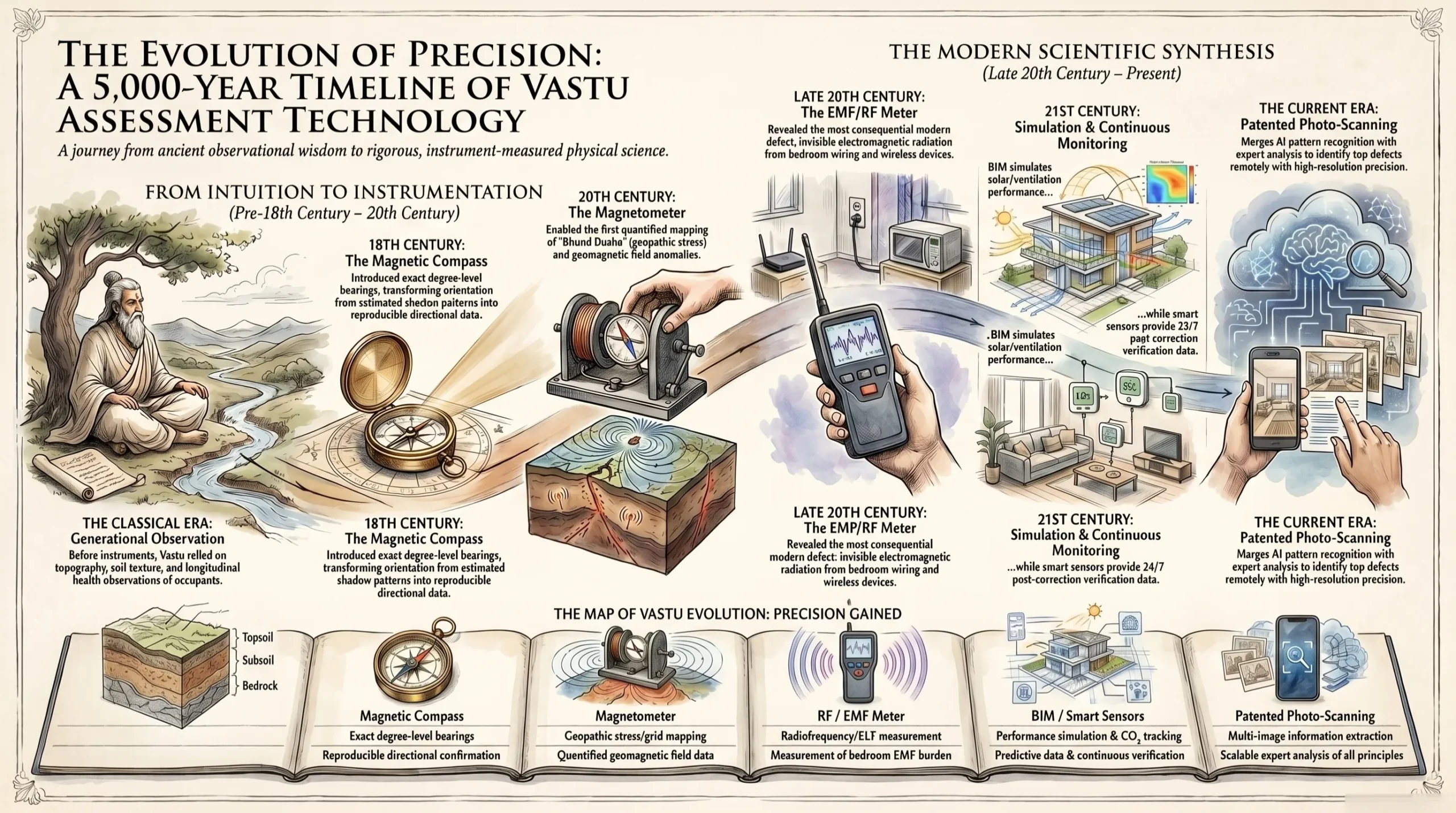
How has each generation of measurement technology transformed Vastu assessment precision?
The history of Vastu assessment is, from one perspective, the history of the instruments available to assess the physical environmental conditions that Vastu prescriptions address. Each major instrument technology has added a specific, irreplaceable dimension of physical precision to the assessment — not replacing the classical observational core but extending it into domains of physical reality that the classical methodology could not access with its available tools.
The magnetic compass — introduced to Indian practice through Islamic and later British contact and incorporated into Vastu assessment methodology by the eighteenth and nineteenth centuries — added exact directional measurement to a tradition that had previously assessed orientation through solar observation and astronomical calculation. The compass made sleeping orientation prescription reproducible and independently verifiable at a specific degree level, rather than dependent on the practitioner’s skill at estimating directional relationships from shadow patterns and sun position. This seems like a modest advance. In practice it was transformative: it is the difference between prescribing ‘generally south-facing’ and prescribing ‘head at 178 degrees magnetic bearing’ — the difference between a recommendation that is approximately correct and one that is precisely correct and demonstrably so.
The magnetometer added the entire dimension of earth energy assessment to the instrumental toolkit. The classical Vastu tradition’s geopathic assessment — Bhumi Pariksha — was conducted through soil analysis, topographic reading, dowsing, and the observation of indicator species (certain plants preferentially colonise geopathic stress zones; certain animals avoid them). These observational methods have genuine signal value — they are drawing on real physical information — but they have no mechanism for distinguishing different intensities of stress zone, for confirming or denying the presence of a stress zone at the specific sleeping position rather than somewhere on the plot, or for providing post-correction verification that a relocated sleeping position is genuinely in a clean field zone. The magnetometer provides all three: specific intensity data, sleeping-position specificity, and post-relocation confirmation.
What has the RF meter revealed about the modern home that the classical Vastu tradition had no way to see?
The RF meter’s contribution to Vastu assessment is the most consequential single instrument advance in the tradition’s modern evolution — because it has revealed a category of Vastu defect that is simultaneously the most prevalent, the most biologically serious, and the most completely invisible to every assessment methodology that does not use an instrument. The bedroom electromagnetic burden of the contemporary Indian urban home — the radiofrequency field from the Wi-Fi router, the ELF field from the bedroom’s wiring, the external RF from the building-mounted mobile base station — is, in the large majority of urban Indian homes I assess, the primary sleeping zone defect. It is present in virtually every home where a modern wireless device operates within the bedroom or adjacent rooms. It produces the most directly documented of all Vastu correction outcomes: the restoration of melatonin amplitude, the improvement of sleep architecture, and the progressive recovery of immune function that follows bedroom RF elimination.
And it was completely invisible to every Vastu assessment conducted before RF measurement instruments became available to practitioners — meaning that every Vastu assessment conducted in the Indian market before the late twentieth century, however expertly conducted using classical methodology, was systematically missing the most prevalent and most health-consequential defect in the modern Indian sleeping zone. This is not a criticism of the classical tradition. It is the most compelling argument for understanding technological evolution as an expansion of the tradition’s assessment scope rather than a departure from it. The classical tradition assessed every physical factor it had instruments to assess. The RF meter has added the most important missing dimension.
The smart home environmental sensor — continuous CO2, humidity, temperature, and particulate matter monitoring — adds a temporal dimension that neither classical assessment nor even sophisticated instrument-based assessment alone can provide: continuous post-correction verification. It is the difference between measuring the indoor CO2 at a single point in time during an assessment visit and observing the actual CO2 pattern across a complete week of normal occupation, including overnight sleeping zone accumulation. This continuous data transforms Vastu assessment from a snapshot into a dynamic, ongoing relationship between the family and their home’s physical environment — the most faithful modern expression of the classical tradition’s concept of the home as a living, breathing physical system whose health requires continuous attention.
What new Vastu defects has technology introduced that the classical texts never anticipated?
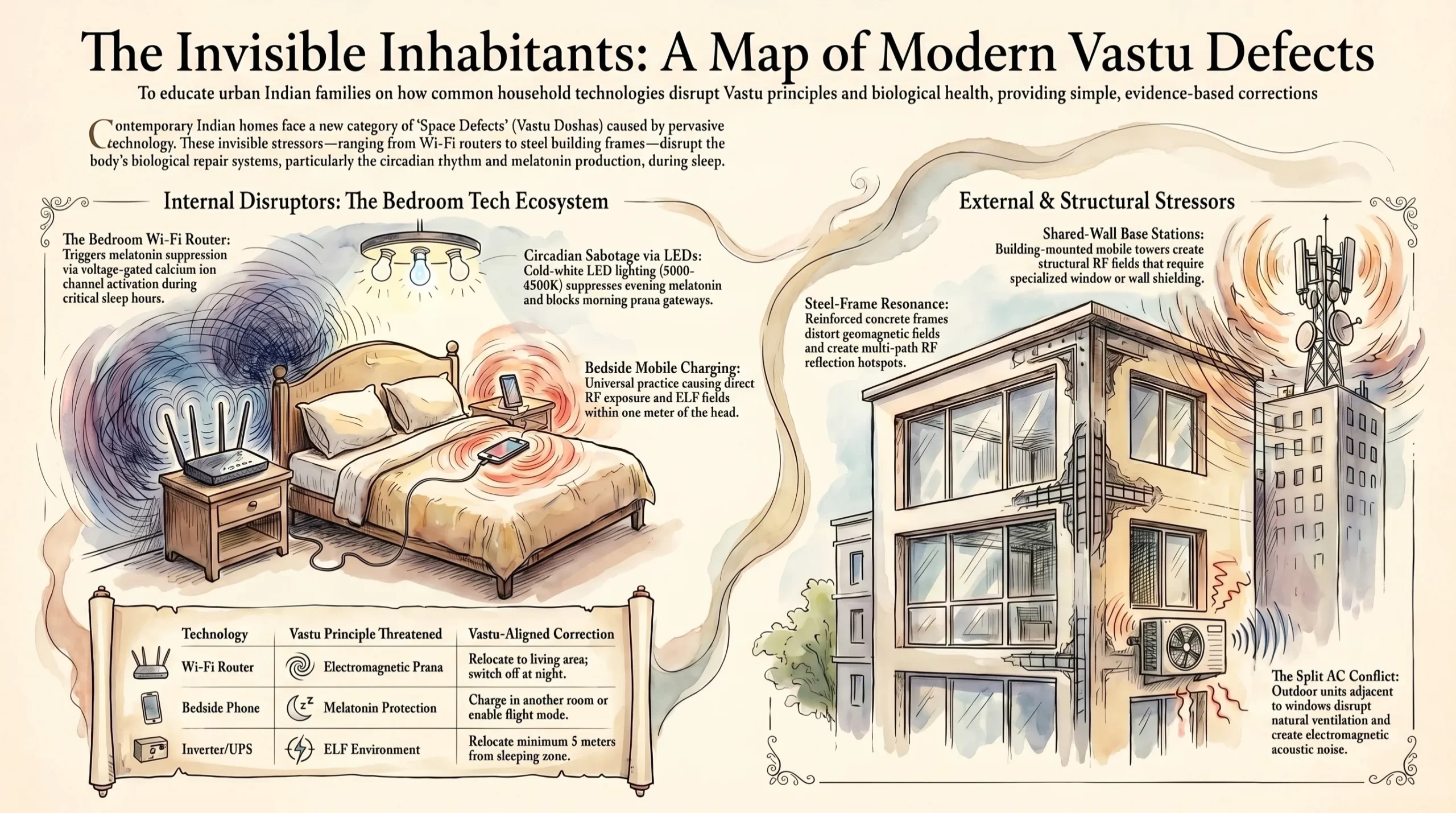
The most practically consequential dimension of the Vastu-technology relationship for contemporary Indian families is not the technology that improves Vastu assessment — it is the technology that creates new categories of Vastu defect. The modern Indian home contains a suite of technologies whose collective electromagnetic, thermal, acoustic, and air quality impact on the sleeping zone represents the most significant new environmental health challenge that the Vastu tradition has ever needed to address — and one for which the classical texts provide no direct guidance because the technologies were entirely unknown to their authors.
Understanding these technology-created Vastu defects in specific, mechanism-grounded terms — not as abstract concerns about ‘modern energy pollution’ but as specific, measurable, biologically documented environmental stressors with specific, effectively free corrections — is the foundation of what makes the Complete Home Health Audit relevant to every contemporary Indian family, regardless of whether they have any prior familiarity with Vastu.
The Wi-Fi router is the single most consequential new Vastu defect in the contemporary Indian bedroom. Its mechanism is precisely characterised: it transmits radiofrequency electromagnetic radiation at 2.4 GHz and 5 GHz, producing field intensities at typical bedroom router placement distances that peer-reviewed research documents as sufficient to suppress pineal gland melatonin secretion through voltage-gated calcium ion channel activation. This suppression is not a vague energy sensitivity concern. It is a specific molecular pathway, documented in multiple independent peer-reviewed studies, producing a specific reduction in melatonin amplitude that has specific and well-characterised consequences: impaired slow-wave sleep architecture, reduced NK cell activation, reduced nightly antioxidant protection of the genome, and progressive immune dysregulation over years of continuous exposure. The correction costs nothing: the router is moved outside the bedroom.
The mobile phone charging at the bedside is the second most universal new Vastu defect. In the typical Indian bedroom, one to three smartphones charge overnight within arm’s reach of the sleeping position, each producing both direct RF emission during data synchronisation cycles and ELF field emission from the charging cable and power adapter. The combined electromagnetic burden from bedside charging devices can add several hundred to several thousand microWatt per square metre to the sleeping zone’s RF profile — in addition to the router field that may be the larger contributor. The correction, again, costs nothing: the devices are charged in another room, or at minimum placed more than two metres from the sleeping position with mobile data disabled overnight.
What makes these technology-created defects so consequential is precisely their ubiquity. Every Indian urban family with a Wi-Fi router and smartphones has these defects in their sleeping zone. The question is not whether the defect is present but how serious it is — and the RF meter answers that question specifically, in microWatt per square metre, at the exact sleeping position, in under five minutes. This is what Vastu assessment looks like when it has evolved to meet the technology-created challenges of the contemporary home.
What is the complete map of how technology has evolved Vastu assessment across every era?
The following table maps the evolution of Vastu assessment across eight technological eras — from the classical observational period through the compass, magnetometer, RF meter, digital photography, BIM simulation, smart home sensing, and our current patented photo-scanning methodology — specifying what each technology added to the assessment, which classical principle it serves, the precision gained over the previous era, and what still requires the next advance.
|
Era / Technology |
What It Added to Vastu Assessment |
Classical Vastu Principle It Serves |
Precision Gained Over Previous Era |
Still Requires |
|
Classical era (pre-instrument) Observation, intuition, accumulated knowledge |
Directional compass reading; site topography reading; soil assessment by colour, texture, and moisture; occupant health observation over years |
All foundational principles: orientation, geopathic avoidance, zone allocation, material selection |
Baseline: generational accumulation of correlated observation; no instrument confirmation |
Everything below — all advances are cumulative additions, not replacements of the classical observational core |
|
Magnetic compass (18th–19th century) Precision directional measurement |
Exact compass bearing of building and sleeping position; reproducible magnetic north confirmation; precise zone allocation relative to true and magnetic north |
Sleeping orientation; directional zone allocation; building solar orientation |
Exact degree-level confirmation of orientation vs classical estimation; reproducible and verifiable by any practitioner |
Site earth energy assessment; electromagnetic environment assessment; material assessment |
|
Magnetometer (20th century) Geomagnetic field measurement in microtesla |
Instrument-confirmed geopathic stress zone mapping; Hartmann and Curry grid intersection detection; underground water course indication; anomalous geomagnetic field characterisation at sleeping positions |
Geopathic stress avoidance; sleeping zone earth energy quality; Bhumi Pariksha earth assessment |
Quantified, reproducible, independently verifiable geomagnetic field data at specific sleeping positions rather than dowsing or intuitive assessment |
Electromagnetic RF/ELF environment; indoor air quality; material VOC assessment |
|
RF meter / EMF meter (late 20th century) Radiofrequency and ELF measurement |
Quantified RF field measurement at sleeping positions (microWatt per square metre); ELF field measurement from bedroom wiring (milligauss); specific device identification by field contribution; Building Biology SBM standard comparison |
Electromagnetic environment of sleeping zone; artificial EMF as modern geopathic stress analogue; prana quality of indoor environment |
Direct measurement of the single most consequential modern Vastu defect — bedroom electromagnetic burden — entirely absent from classical methodology |
Indoor air quality assessment; smart home environmental sensing; photo-based remote analysis tools |
|
Digital photography and satellite imaging (early 21st century) High-resolution visual information encoding |
Precise building orientation determination from shadow analysis; site topography from satellite elevation data; NE obstruction assessment from facade photography; visible EMF risk factor identification from exterior images |
Solar orientation assessment; site landscape assessment; prana gateway obstruction analysis |
Remote preliminary assessment capability; ability to assess homes before site visit; systematic photo-based screening of top defects |
On-site instrument measurement (magnetometer, RF, ELF); material sampling; acoustic assessment |
|
Building information modelling / BIM (21st century) Digital building performance simulation |
Solar path simulation for any building on any site at any latitude; shadow impact simulation across entire diurnal and seasonal cycle; passive solar performance prediction; CFD ventilation flow simulation of Brahmasthana |
Solar orientation optimisation; passive solar zone thermal performance; Brahmasthana ventilation function confirmation |
Predictive performance data before construction; ability to test Vastu zone thermal and ventilation performance in simulation before committing to design |
On-site earth energy assessment; occupant-specific health correlation; material VOC and biophilic quality assessment |
|
Smart home environmental sensors (21st century, current) Continuous indoor environment monitoring |
Continuous CO2 monitoring in sleeping zones; real-time humidity tracking for Jal zone and Brahmasthana ventilation performance; temperature logging for SW bedroom thermal stability; particulate matter (PM2.5) monitoring for indoor air quality |
Brahmasthana ventilation function; Jal zone humidity regulation; SW bedroom thermal stability; indoor air prana quality |
Post-correction verification — continuous data confirming whether corrections have achieved predicted environmental outcomes; occupant empowerment through ongoing environment visibility |
Interpretation expertise; Vastu-calibrated threshold guidance; integration with EMF monitoring |
|
Patented photo-scanning with AI-assisted analysis (current, proprietary) Systematic multi-image information extraction |
Systematic extraction of orientation, zone allocation, architectural geometry, visible EMF risk factors, material character, and NE gateway obstruction from standardised photo sets; AI-assisted pattern recognition for common defect signatures |
All foundational principles assessed in parallel from a single structured photo set; rapid preliminary defect ranking |
Scalable preliminary assessment enabling expert focus on highest-impact findings; consistent defect checklist application across every assessment |
On-site instrument confirmation of geopathic stress and EMF fields; final correction prescription; one-on-one consultation |
The pattern across this evolution table reveals something important and counterintuitive: each technological advance has made Vastu assessment more rigorous, more accountable, and more specifically grounded in physical measurement — while simultaneously narrowing the gap between what the tradition’s classical prescriptions predicted and what the physical science of each era could confirm. The magnetometer did not change geopathic stress avoidance. It confirmed it with quantified data. The RF meter did not change the sleeping zone electromagnetic principle. It revealed its most significant modern expression and made correction verification possible. The photo-scanning methodology did not change the foundational assessment framework. It made it accessible, systematic, and scalable.
Each technology serves the tradition’s original purpose with greater precision than the previous era could achieve. The tradition has not been replaced by technology. It has been empowered by it — and its empowerment is, in every case, a more complete fulfilment of the empirical spirit that the Manasara’s authors always intended: assess the physical environment as precisely as available tools permit, prescribe corrections with specific predicted outcomes, and hold those predictions accountable against observable results.
How does the smart home revolution create both new Vastu threats and new assessment opportunities simultaneously?
The smart home revolution — the proliferation of internet-connected devices, sensors, automation systems, and wireless control networks throughout the contemporary Indian home — is the most current and most rapidly evolving dimension of the Vastu-technology relationship. It creates both new Vastu threats, through the electromagnetic burden of the devices it introduces, and new assessment opportunities, through the environmental monitoring data those same device networks can generate. Understanding both dimensions clearly is essential for families navigating smart home adoption in a Vastu-aware way.
The threat dimension is straightforward and measurably significant. A fully smart home — with smart bulbs on Zigbee mesh networks, smart plugs on Z-Wave, a mesh Wi-Fi system with multiple access points throughout the home, smart speakers in every room, a smart doorbell, smart air conditioning controllers, and the smartphone apps controlling all of them — can produce a residential electromagnetic environment substantially more complex and more burdensome than the simple single-router apartment of even five years ago. The mesh Wi-Fi system’s multiple access points, each transmitting at full power to maintain the mesh’s backhaul connections, can produce RF field levels throughout the home — including in sleeping zones far from the primary router — that substantially exceed what a single router would produce. The smart speaker operating on its always-on wake word detection mode is an RF source that transmits to its parent network at regular intervals throughout the night, including during the family’s sleeping hours.
The opportunity dimension is equally significant. The same sensor infrastructure that enables smart home automation — temperature, humidity, CO2, light level, and air quality sensors distributed throughout the home — provides the continuous environmental monitoring data that transforms Vastu post-correction verification from a single assessment snapshot into an ongoing, data-rich environmental health relationship. A family that installs a CO2 sensor in the master bedroom can observe directly whether the Brahmasthana clearance or the ventilation pathway correction they implemented has produced the predicted reduction in overnight CO2 accumulation. A family with a temperature logger in the bedroom can confirm whether the thermal mass correction to the south-west sleeping zone is maintaining the predicted 18–20°C stable sleeping temperature. A family with a humidity sensor can verify whether the natural material corrections have improved hygroscopic humidity regulation in the family’s preferred range.
What is the correct approach to smart home technology that serves Vastu compliance rather than undermining it?
The correct approach to smart home technology adoption in a Vastu-aware household is not the rejection of smart home technology — that position misunderstands both Vastu and technology. It is the deliberate, informed selection of smart home technologies that provide genuine environmental management benefit while minimising the electromagnetic burden introduced into sleeping zones. This means applying one clear principle consistently: wired is always preferred over wireless for anything whose function does not require wireless communication; and wireless is always preferred off during sleeping hours for anything whose function does not require overnight wireless operation.
Specifically, this means: smart home sensors (temperature, humidity, CO2, air quality) preferred on wired or Zigbee low-power mesh rather than Wi-Fi; smart bulbs and plugs in sleeping zones controlled through timer programmes that switch off wireless communication overnight rather than remaining in always-on network status; mesh Wi-Fi access points removed from sleeping zone proximity and clustered to non-sleeping areas where their coverage function does not require placement adjacent to sleeping positions; smart speakers excluded from sleeping zones entirely; and the primary home router placed in the furthest possible room from all sleeping zones, ideally switched off at night through an automatic timer.
A smart home configured on these principles delivers all the environmental monitoring and comfort management benefits of home automation while maintaining a sleeping zone electromagnetic environment well within Building Biology precautionary thresholds. The technology serves Vastu compliance rather than threatening it — and the family benefits from both the ancient tradition’s environmental health wisdom and the modern technology’s environmental monitoring precision simultaneously.
What is the complete map of technology-created Vastu defects in the contemporary Indian home?
The following table maps eight technology categories that create Vastu defects in contemporary Indian homes — specifying the Vastu principle each threatens, the biological mechanism of harm, the scale of impact in Indian urban homes, and the specific Vastu-aligned correction for each. This is the practical reference guide for understanding what the Complete Home Health Audit’s electromagnetic assessment addresses in the contemporary home.
|
Technology |
Vastu Principle Threatened |
Biological Mechanism of Harm |
Scale of Impact in Indian Urban Homes |
Vastu-Aligned Correction |
|
Wi-Fi router (2.4 / 5 GHz) Typically placed in bedroom or adjacent room |
Electromagnetic prana quality of sleeping zone |
Voltage-gated calcium ion channel activation → melatonin suppression → NK cell impairment; circadian disruption; genomic antioxidant depletion |
High — typically 800–8,000 µW/m² at bedroom sleeping position in standard Indian apartment router placement |
Router relocated to study or living area; switched off at night; replaced with wired ethernet connection for highest performance |
|
Mobile phone charging at bedside (typical: 1–3 devices per bedroom) |
Sleeping zone EMF environment; melatonin protection |
Direct RF exposure at < 1 metre from sleeping head; ELF field from charging cable; blue-light screen exposure if used before sleep |
High — virtually universal practice in Indian households across all income levels |
Devices charged in another room; flight mode enabled if kept in bedroom; no screen use within 60–90 minutes of sleep |
|
Smart TV in bedroom (increasingly common in Indian bedrooms) |
Sleeping zone light environment; sleeping zone RF environment; sleep hygiene |
Blue-light screen suppresses melatonin pre-sleep; standby mode RF emission; EMF from power supply at sleeping zone |
Medium and rising — bedroom TV penetration increasing rapidly in Indian urban households |
TV relocated to living room; absolute minimum — no use within 90 minutes of sleep; complete shutdown at night rather than standby |
|
Inverter / UPS unit in sleeping zone (common in areas with power outages) |
ELF electromagnetic environment of sleeping zone |
Inverter battery and transformer produce significant ELF field at 50 Hz; sleeping within 1–2 metres of active inverter produces ELF exposure well above Building Biology precautionary levels |
Medium — particularly significant in Indian tier-2 and tier-3 cities and rural areas with power supply instability; inverter commonly in bedroom for convenient access |
Inverter unit relocated to utility room, corridor, or store; minimum 3 metres from sleeping position; wiring routed to avoid bedroom sleeping zone |
|
High-density apartment building with steel-reinforced concrete frame (virtually all Indian apartments) |
Geomagnetic environment of sleeping zone; EMF resonance character of bedroom |
Dense steel reinforcement distorts local geomagnetic field in some apartments; creates multi-path RF reflection environment that concentrates router RF at unexpected sleeping positions |
Medium — effect is structural and cannot be corrected; compounding factor for geopathic stress and EMF corrections |
Geopathic stress assessment with magnetometer essential in all steel-frame apartments; RF assessment requires multi-point measurement to identify reflected field hotspots |
|
Shared wall mobile base station (increasingly common in Indian high-rises) |
RF electromagnetic environment across all sleeping zones in affected building face |
External RF from building-mounted or adjacent rooftop base station penetrates building fabric; produces ambient RF field at sleeping positions that is structural and cannot be corrected by device relocation alone |
Medium to high and rising — mobile base station mounting on residential building rooftops is widespread in Indian cities; penetration is highest on upper floors and east/north-east faces |
Independent RF measurement of sleeping positions on affected building faces; if above Building Biology no-concern threshold, RF shielding of bedroom window or RF-attenuating wall treatment considered; ideally addressed at plot and apartment selection stage |
|
Air conditioner (split unit) With outdoor unit adjacent to bedroom window |
Electromagnetic environment; acoustic sleeping environment; natural ventilation of sleeping zone |
Outdoor unit creates EMF field through adjacent window; air conditioning replaces natural ventilation with recirculated indoor air; increases CO2 and indoor air particulate concentration; creates acoustic noise that fragments sleep |
High — split AC near-universal in Indian urban bedrooms; outdoor unit placement against bedroom wall very common |
Outdoor unit sited away from bedroom wall where possible; AC used to cool room before sleep, then switched off during sleep; natural ventilation through north-east opening preferred during appropriate months |
|
LED lighting throughout home (cold white colour temperature, 5000–6500 K) |
Morning prana quality and evening melatonin environment |
Cold white LED (5000–6500 K) produces high blue-spectrum emission that suppresses melatonin when used in the evening; inadequate warm natural light in morning to support circadian entrainment if north-east openings are blocked |
High — cold white LED dominant in Indian residential specification; warm LED (2700–3000 K) available but not default choice |
Warm white LED (2700–3000 K) in all sleeping and living zones; cool white restricted to task areas (study, kitchen work surface); smart dimming to reduce light intensity and shift spectrum toward warm after sunset |
Reading this table, the pattern that emerges is both sobering and empowering. Sobering because the technology-created Vastu defects it describes are present to some degree in virtually every contemporary Indian urban bedroom — the Wi-Fi router, the bedside smartphone, and the LED lighting colour temperature issues affect almost every family regardless of income, awareness, or Vastu knowledge. Empowering because every correction listed in the final column is non-structural, cost-free or very low-cost, and implementable within a single evening without any professional involvement. The correction for the most consequential technology Vastu defect in the Indian urban home — moving the bedroom router to the study — costs nothing and takes five minutes.
The assessment that reveals which of these defects is most significant for the specific family’s specific sleeping zone — and quantifies each one with an instrument-confirmed measurement rather than a generic concern — is precisely what the Complete Home Health Audit delivers. The audit does not tell families to be afraid of technology. It tells them, specifically and measurably, which technologies in which positions are creating which health-relevant defects at which sleeping positions — and exactly what to do about each one.
How has digital photography and remote assessment technology transformed access to expert Vastu guidance?
One of the most significant practical consequences of technology’s evolution of Vastu practice is the transformation of geographic access to expert assessment. The classical Vastu assessment required the physical presence of a practitioner in the home — because the assessment tools of the classical era were embodied in the practitioner’s sensory experience of the space, their observation of solar access and shadow patterns, their reading of the landscape, and their accumulated pattern recognition across thousands of previous assessments. This requirement for physical presence meant that expert Vastu guidance was available only to families who could afford a practitioner’s travel costs, who lived in cities where experienced practitioners were available, and who could organise a site visit within the narrow windows of the practitioner’s schedule. Families in smaller cities, families in rural areas, and Indian families living abroad were largely excluded from access to serious expert assessment.
Digital photography and the systematic photo-based assessment methodology that our patented technology enables have fundamentally changed this access equation. A standardised set of photographs — exterior facades from each cardinal direction, floor plan, key interior zones, sleeping positions, and visible technology placement — encodes the physical information required for a skilled practitioner to identify the home’s five most significant Vastu defects with high confidence, regardless of the home’s geographic location. The building’s solar orientation is encoded in shadow angles and facade illumination. The zone allocation is encoded in the floor plan geometry. The sleeping orientations are encoded in the bedroom photographs. The visible electromagnetic risk factors — router placement, bedside device arrangement, AC unit position — are directly visible in the interior photographs.
This is not remote sensing in any metaphysical sense. It is systematic physical information extraction from a structured photo set — a methodology grounded in the same classical information physics that makes any technical document analysis possible. An architect reading a structural drawing is extracting physical information encoded in the document. A Vastu practitioner reading a structured photo set is doing exactly the same thing, with the additional pattern recognition that twenty years of calibrated assessment experience provides. The photograph does not replace the on-site magnetometer and RF meter assessment — those instrument readings require physical presence. But the photo-based preliminary assessment identifies the structural and spatial defects that are the foundation of the correction programme, enabling the instrument assessment to focus on confirming and quantifying the top-priority defects rather than discovering them from scratch.
The practical consequence for Indian families is that expert Vastu assessment from a practitioner with twenty years of experience and thousands of assessments is now accessible from anywhere in India, and to every Indian family living abroad, through a technology that requires only a smartphone with a camera. The democratisation of access to expert environmental health guidance — making the same quality of assessment available to a family in a tier-3 city in Odisha that was previously available only to a family in south Mumbai — is technology’s most socially valuable contribution to the Vastu tradition’s modern evolution.
What does artificial intelligence offer Vastu assessment — and what must it never be allowed to replace?
Artificial intelligence is the next major technological frontier for Vastu assessment methodology, and it deserves both an honest account of its genuine potential and an equally honest account of what it must never be allowed to replace. Both dimensions of this account are practically important for families navigating the rapidly expanding marketplace of AI-powered wellness apps that are beginning to offer Vastu-related features.
The genuine potential of AI in Vastu assessment is in pattern recognition at scale. An AI system trained on a large, well-curated dataset of Vastu assessments — including photographs of assessed homes, their identified defects, the corrections prescribed, and the health outcomes reported — could potentially develop the ability to identify common Vastu defect signatures from standardised photo sets with useful preliminary reliability. The most common and most visually detectable defects — router on bedroom wall, blocked north-east zone, Brahmasthana obstruction, building orientation significantly rotated from cardinal, sleeping position visible in photograph with head-north orientation — are the kind of pattern recognition task that well-trained computer vision systems handle effectively. An AI-assisted preliminary screening that reliably flags these common defects would be a genuinely useful addition to the assessment workflow, accelerating the identification of the most common defects and freeing practitioner attention for the more nuanced assessment dimensions that require expert judgment.
What AI cannot and must not replace is the physical measurement and the personalised, mechanism-explained correction prescription. An AI system can identify that a router appears to be positioned on a bedroom wall. It cannot measure the RF field that router is producing at the sleeping position in microWatt per square metre, because that information is not in the photograph — it requires a physical RF meter. An AI system can identify that a sleeping position appears to be head-north from the photograph’s visual information. It cannot confirm whether the geomagnetic field at that sleeping position is disturbed by a Hartmann Grid intersection — because that information is not visible at all; it requires a magnetometer. And an AI system cannot explain the specific biological mechanism of a defect to a family in a way that motivates implementation — because mechanism explanation requires understanding, and understanding requires a practitioner who has engaged with the research literature and can translate it into language that makes the correction meaningful to a specific family.
The correct relationship between AI and expert Vastu assessment is the same relationship that exists between diagnostic imaging and a physician: the technology extends the expert’s reach and precision, flags patterns that warrant attention, and makes assessment more scalable — but the expert’s judgment, the physical instrument confirmation, and the personalised mechanism explanation remain irreplaceable. A family that receives an AI-generated Vastu report without an expert consultation, without on-site instrument measurement, and without a personalised correction programme has received a screening tool, not an assessment. The screening is useful — it is better than nothing. But it is not the Complete Home Health Audit.
What does the future of Vastu and technology look like — and what will remain constant?
Looking forward, the trajectory of Vastu’s technological evolution is clear in its direction even if its specific milestones are uncertain: the assessment toolkit will continue to expand, the precision of the physical measurements will continue to improve, the accessibility of expert guidance through technology-mediated channels will continue to increase, and the biological evidence base confirming the physical principles underlying Vastu’s core prescriptions will continue to strengthen. Each of these trajectories is already well established and is accelerating.
The next generation of environmental sensing technology — miniaturised, wearable, and integrable with smart home platforms — will make continuous sleeping zone environmental monitoring accessible to every family at consumer price points. A family will be able to track their sleeping zone’s RF field intensity, CO2 concentration, temperature stability, and humidity regulation continuously and automatically, receiving alerts when any parameter exceeds the Building Biology precautionary threshold. This continuous monitoring will transform post-correction verification from a once-assessment snapshot into a continuous quality assurance system — making it possible to confirm not only that the router relocation reduced RF below threshold on the day of assessment, but that it has remained below threshold every night since, and alerting the family when a new device or change in the electromagnetic environment has pushed a parameter back above threshold.
The next generation of AI-assisted assessment will bring increasingly sophisticated photo-based defect identification, incorporating not just visual pattern recognition but computational solar simulation from photograph metadata — using the exact time, date, and GPS coordinates embedded in a smartphone photograph to compute the precise solar arc at the assessment moment and derive the building’s exact solar orientation automatically, rather than requiring manual compass measurement. This will make the preliminary orientation assessment faster, more consistently accurate, and less dependent on the practitioner’s manual calculation.
What will remain constant through all of these advances is the physical core that makes them advances rather than replacements: the geomagnetic field will continue to require magnetometer measurement for geopathic stress assessment. The RF field will continue to require RF meter measurement for bedroom electromagnetic burden assessment. The sleeping body’s need for a clean geomagnetic zone, a low-RF environment, a stable thermal sleeping zone, morning circadian light, and biophilically rich natural material surfaces will continue to be exactly what the Manasara’s authors observed it to be — because it is grounded in human biological requirements that evolve over geological timescales, not technological ones.
The tradition that has evolved from observational wisdom to compass to magnetometer to RF meter to photo-scanning to smart home sensing will continue to evolve with every technology that improves its ability to serve this constant purpose: assessing the physical environmental conditions that most consequentially affect the health of the human body in its built environment, and prescribing the corrections that most effectively restore those conditions to their optimal character. That is what Vastu has always been. Technology has made it more powerful, more precise, and more accessible. It has not changed what it is for.
What does the Complete Home Health Audit deliver that captures the best of Vastu's technological evolution?
The Complete Home Health Audit is the practical expression of everything this article has described about Vastu’s technological evolution — the synthesis of the classical tradition’s accumulated observational wisdom, the physical instrument precision of modern Building Biology measurement, and the systematic photo-based assessment methodology that our patented technology provides. It is, in every instrument it uses and every methodology it applies, a product of the technology-tradition integration that this article has been arguing for.
The assessment begins with the patented photo-scanning analysis — the technology-enabled preliminary assessment that identifies the top five structural and spatial defects from standardised photos and floor plan, providing the orientation, zone allocation, Brahmasthana, sleeping position, and visible EMF risk factor analysis that focuses the subsequent instrument assessment on the most important findings. This is technology serving the classical assessment framework with modern information extraction capability.
The on-site instrument assessment deploys the magnetometer for geopathic stress zone mapping at the sleeping positions — providing the specific, reproducible, independently verifiable geomagnetic field data that transforms the classical geopathic stress assessment from qualitative judgment to quantified measurement. The RF meter measures the radiofrequency field at each sleeping position — revealing the technology-created Vastu defect that no classical methodology could have detected and prescribing the specific, cost-free correction with the specific predicted melatonin and immune outcomes. The ELF meter measures the alternating current field from bedroom wiring. The compass confirms sleeping orientation to the specific degree.
The correction programme integrates the technology-extended assessment findings with the classical zone allocation, directional, and elemental corrections — producing a priority-ranked, mechanism-explained, biologically predicted correction plan that is the most complete Vastu assessment available at any point in the tradition’s five-thousand-year history. And the smart home sensing recommendations we provide as part of the service extend the assessment’s value beyond the assessment day, giving families the continuous environmental monitoring tools to verify their corrections’ performance and maintain their home’s physical health quality ongoing. This is Vastu evolved with technology: more precise, more accountable, more accessible, and more powerfully aligned with its original purpose than ever before — and more urgently needed in the contemporary Indian home than at any previous point in the tradition’s history.
Real Case Study — A Mumbai Technology Executive Who Made His Home Smarter and More Vastu-Compliant Simultaneously:
A senior technology executive in Mumbai came to us specifically because of the paradox he had identified in his own home. ‘I have a fully automated smart home,’ he explained. ‘Every light is smart, every socket is smart, there are four mesh Wi-Fi access points, two smart speakers, and twelve environmental sensors. My home knows the temperature in every room. It also has the worst sleep environment I have ever experienced. Tell me why.’
The RF assessment told him immediately. Four mesh Wi-Fi access points, two of which were mounted in the bedroom ceiling and hallway ceiling immediately adjacent to the master bedroom, were collectively producing 11,400 microWatt per square metre at the sleeping position — one of the highest residential readings I have encountered in twenty years of assessment. The smart speaker on the bedside table added another 340 microWatt per square metre during its overnight wake-word detection cycles. The ELF field from the smart socket network’s wiring in the bedroom walls added a significant additional component. His sleeping environment was, electromagnetically, a thoroughly hostile space.
The magnetometer also identified a Hartmann Grid secondary intersection beneath the sleeping position. His head-north sleeping orientation completed a perfect storm of the three primary sleeping zone defects: geopathic stress, extreme RF burden, and geomagnetically opposed sleeping direction.
The corrections were entirely non-structural and non-destructive of his smart home: the two mesh access points were relocated from bedroom and hallway ceiling to the study and living room, where coverage of the bedroom was maintained at acceptable signal levels but without the extreme proximity. The smart speaker was removed from the bedroom and relocated to the kitchen. All remaining devices were placed on overnight scheduling via his smart home controller — mesh network on at 6 AM, off at 10:30 PM; smart sockets in bedroom switched off at 11 PM. The bed was repositioned 1.4 metres west to clear the geopathic stress zone. Orientation corrected to head-south.
His own smart home environmental sensors provided the post-correction verification: the RF level he monitored on his own equipment dropped from 11,400 to approximately 180 microWatt per square metre at the sleeping position after the corrections — well within Building Biology no-concern range.
Six-week follow-up: ‘I slept through the night without waking on the second night after corrections. By week three I had stopped taking the melatonin supplements I had been using for two years. My wife described it as living in a different home. My smart home is now smarter — it turns off its own electromagnetic burden every night at the time my body needs it most. The Vastu assessment and the smart home technology are now working together rather than against each other. I wish I had understood this before I installed the second and third access points.’
What Five Thousand Years of Wisdom and Five Hundred Years of Scientific Instruments Have in Common:
I am sometimes asked — usually by engineers and technology professionals — whether I think Vastu will eventually be ‘replaced’ by building science and environmental medicine as those fields become more comprehensive in their understanding of the built environment’s health effects. My answer is no — and I want to explain why, because the reason reveals something important about the relationship between tradition and technology that goes beyond Vastu specifically.
Building science and environmental medicine are discovering, through their own investigative methods, the same physical relationships between building design and human health that Vastu observed through five thousand years of empirical practice. They are not replacing Vastu’s findings. They are explaining them. The RF meter did not discover the health importance of the bedroom electromagnetic environment by starting from first principles — it provided the measurement tool that confirmed what Vastu had always known was important about the sleeping zone’s energy quality. The magnetometer did not discover geopathic stress — it confirmed what every traditional building practice worldwide, from Feng Shui to European geomancy to Aboriginal siting wisdom, had observed for millennia.
What makes the tradition irreplaceable is not its specific prescriptions — those continue to evolve as the physical environment they address changes. It is the tradition’s integrative framework: the understanding that every aspect of the home’s physical environment — orientation, zone allocation, earth energy, electromagnetic environment, material character, proportional quality, elemental balance — is part of a single coherent system serving the health of the people who live in it. Modern building science addresses each of these dimensions in isolation: passive solar design, electromagnetic biology, indoor air quality, biophilia science, acoustic design. Vastu addresses them as a system.
Technology will continue to improve the precision with which Vastu’s system is assessed and corrected. It will not change the system, because the system is grounded in physical and biological laws that technology measures but does not create. The family who understands this — who uses both the tradition’s integrative framework and the technology’s measurement precision — has the most complete and most practically powerful environmental health toolkit available to any family in the world today.
Five Thousand Years of Wisdom. Modern Instruments. The Most Complete Vastu Assessment in the Tradition's History.
The Complete Home Health Audit is the practical synthesis of Vastu’s full technological evolution — the classical tradition’s accumulated observational wisdom, the physical precision of magnetometer and RF meter measurement, and the systematic photo-scanning methodology that makes expert assessment accessible from anywhere. It identifies the technology-created Vastu defects your classical assessment would have missed. It confirms the earth energy defects your intuition cannot quantify. And it prescribes, with specific physical mechanism and specific predicted health outcomes, the corrections that restore your home’s physical environment to the conditions your family’s biology requires.
Your Complete Home Health Audit delivers:
- Patented photo-scanning analysis — systematic extraction of orientation, zone allocation, Brahmasthana, sleeping positions, and visible technology Vastu defects from your photo set; top 5 critical defects identified by Mukesh Shah personally
- Geopathic stress magnetometer survey — instrument-confirmed stress zone mapping in microtesla; every sleeping position confirmed in clean field zone
- Technology-created EMF assessment — RF measurement at every sleeping position (microWatt per square metre); ELF field from bedroom wiring (milligauss); router, mesh access point, and bedside device contributions individually identified
- Smart home EMF audit — mesh access point placement review; smart speaker assessment; overnight scheduling corrections; wired vs wireless recommendations
- Sleeping orientation — exact compass bearing; head-South or head-East prescription; HRV and geomagnetic mechanism explained
- Solar orientation and circadian light assessment — building solar orientation confirmed; NE morning prana gateway quality assessed; circadian light prescription for LED colour temperature and timing
- LED lighting correction — colour temperature review; warm white evening prescription; blue-light exposure timeline guidance for melatonin protection
- Nine-zone Vastu Purusha Mandala — full zone allocation with technology-era defects integrated into classical framework; correction priority ranked by health impact
- Smart home sensing recommendations — CO2, temperature, humidity, and air quality sensor placement for post-correction continuous verification
- Mechanism explanation for every finding — classical principle, physical mechanism, research reference, and predicted health outcome for every defect and correction
- One-on-one consultation with Mukesh Shah personally
- Detailed written report — all findings, measurements, mechanisms, corrections, and predicted outcomes with research citations
- 30 days of priority support through your full implementation
- 100% satisfaction guarantee Ancient wisdom and modern instruments, serving the same purpose they have always served: your family’s health in the home they live in.
Book your Complete Home Health Audit today at vastumyhome.com
Technology threatens Vastu compliance primarily through the artificial electromagnetic environment it introduces into sleeping zones. Wi-Fi routers at typical bedroom placement distances produce radiofrequency fields that suppress melatonin secretion through voltage-gated calcium ion channel disruption — a peer-reviewed biological mechanism with documented immune and sleep consequences. Smartphones charging at the bedside add additional RF and ELF burden. Smart home mesh networks with multiple access points can produce extreme RF levels at sleeping positions. Cold white LED lighting suppresses melatonin pre-sleep through blue-spectrum emission. Building-mounted mobile base stations contribute ambient RF that penetrates building facades. All of these represent technology-created Vastu defects that the classical texts could not have addressed — and that the Complete Home Health Audit’s electromagnetic assessment specifically identifies and corrects.
Each major instrument technology has added a specific, irreplaceable assessment dimension. The compass added exact degree-level sleeping orientation measurement, replacing approximate solar observation. The magnetometer added quantified, reproducible geopathic stress zone mapping in microtesla, replacing dowsing and qualitative observation. The RF and ELF meter added measurement of the most consequential modern Vastu defect — bedroom electromagnetic burden — which is entirely invisible to all classical assessment methods. Digital photography and patented photo-scanning methodology added remote preliminary assessment capability, making expert guidance accessible regardless of geographic location. Smart home environmental sensors add continuous post-correction verification. Each advance serves the classical framework with greater measurement precision.
A smart home creates Vastu problems specifically through its wireless electromagnetic infrastructure: mesh Wi-Fi access points near sleeping zones, always-on smart speakers, overnight-active device networks, and smart lighting systems that produce blue-spectrum emission in the evening. However, a smart home configured with Vastu awareness can also enhance Vastu compliance: wired sensors for environmental monitoring, overnight scheduling that switches off wireless infrastructure during sleeping hours, smart lighting with warm-white evening profiles that protect melatonin, and continuous CO2 and temperature monitoring that verifies the effectiveness of Brahmasthana ventilation and SW bedroom thermal stability corrections. The same technology that creates the problem, configured correctly, provides the solution and its verification.
The patented photo-scanning methodology extracts physical information from standardised photo sets — exterior facades, floor plan, sleeping positions, and interior zones — that allows the assessment of building orientation from shadow analysis, zone allocation from floor plan geometry, sleeping orientation from bedroom photographs, Brahmasthana obstruction from interior images, and visible technology risk factors from device placement. This makes expert preliminary assessment possible from any location worldwide, without requiring a physical site visit. The methodology makes twenty years of practitioner experience and thousands of calibrated assessments accessible to families in smaller Indian cities and to Indian families abroad who previously lacked geographic access to expert Vastu guidance. It precedes but does not replace on-site instrument measurement for geopathic stress and EMF confirmation.
Three actions, in order of health impact, that can be taken immediately at zero cost: first, move the Wi-Fi router out of the bedroom and into the study or living area — if complete removal is not possible tonight, at minimum switch the router off at the wall each night before sleep; second, charge all smartphones in a different room overnight, or place them more than two metres from the sleeping position with mobile data disabled; third, replace any cold white (5000–6500 K) LED bulbs in bedside and living zone lights with warm white (2700–3000 K) equivalents, and eliminate all screen use in the 90 minutes before sleep. These three corrections address the three most prevalent technology-created Vastu defects in the Indian urban bedroom and will produce observable sleep quality improvements within one to three weeks for most families.
I Would Love to Hear From You
I would love to hear your story or questions in the comments below. Have you experienced the impact of Vastu in your own home? Are you noticing any of the common defects I described above in your space? Share openly — every question is a step towards greater harmony.
Disclaimer: Vastu analysis and energy corrections are for harmonising your space and personal growth. They are not a substitute for professional medical, financial, legal or architectural advice.