

Why Study Vastu for Mental Clarity? Brain Fog, Focus & Environment | Vastu My Home
Namaste. I am Mukesh Shah. Of all the health outcomes that families report following Vastu corrections — improved sleep, restored immune function, reduced infection frequency, normalised blood pressure — the one that surprises them most, and that they are least prepared to expect, is the improvement in mental clarity. The lifting of the morning brain fog they had accepted as their normal. The return of the focused attention that had been fading for years. The ease of decision-making that had become effortful. The creativity and quick thinking that they had attributed to ageing or stress and had quietly resigned themselves to losing.
I am not surprised by these reports. After twenty years of assessments and thousands of families, I understand exactly why the mental clarity outcomes occur, in which family members they appear, in what timeline after specific corrections, and through which biological mechanisms. The relationship between the home’s physical environment and the mind’s clarity is not mystical, not metaphorical, and not a secondary or uncertain benefit of Vastu correction. It is among the most directly and most specifically documented relationships in the entire Vastu evidence base — grounded in sleep neuroscience, cognitive neuroscience, chronobiology, indoor air quality science, and biophilia research in ways that are precise, independently validated, and practically actionable.
The reason the mental clarity outcomes surprise families is that most people do not think of their cognitive performance as environmentally determined. They think of it as a function of their intelligence, their effort, their stress levels, their age, and their psychological state. They do not think: my difficulty concentrating is partly caused by the 2,800 microWatt per square metre of RF radiation from my bedroom router suppressing the melatonin that protects my hippocampal neurons each night. They do not think: my morning brain fog is partly caused by the Hartmann Grid intersection beneath my sleeping position fragmenting my slow-wave sleep and preventing the prefrontal cortex restoration that clear morning thinking requires. They do not think: my afternoon decision fatigue is partly caused by the CO2 accumulation in my home study that the blocked Brahmasthana is allowing to build toward the 1,800 parts per million at which cognitive impairment becomes directly measurable.
This article makes the case that studying Vastu for mental clarity is not studying Vastu for a secondary benefit. It is studying Vastu for one of its most consequential and most scientifically grounded primary outcomes. The environmental corrections that the Health-Focused Energy Correction service prioritises — sleeping zone earth energy, electromagnetic environment, morning light, indoor air quality — are environmental corrections whose cognitive consequences are as significant as, and in some cases more immediately observable than, their immune and endocrine consequences. For the large and growing number of Indian families in which at least one member is experiencing unexplained cognitive decline, persistent mental fog, or progressive difficulty with the thinking that their professional and personal lives require, environmental root cause assessment is the most overlooked and the most potentially transformative investigation available.
Why is the brain the most environmentally sensitive organ in the human body?
The brain is the most metabolically active organ in the human body — consuming approximately twenty percent of the body’s total energy budget despite comprising only two percent of its mass. This extraordinary metabolic activity makes the brain simultaneously the organ most dependent on the quality of the physical environment that supports its energy supply and waste clearance, and the organ most vulnerable to the physical environmental factors that disrupt those processes. Understanding this fundamental biological fact is the foundation for understanding why Vastu’s environmental corrections produce the cognitive improvements they do.
The brain’s metabolic requirements create three specific dependencies on the physical environment that Vastu addresses directly. The first is the dependency on deep sleep quality for the overnight restoration of prefrontal cortex function. The prefrontal cortex — the brain region responsible for working memory, sustained attention, decision-making quality, impulse control, and emotional regulation — is the most sleep-sensitive brain region. Research published in leading neuroscience journals documents that even a single night of impaired slow-wave sleep produces measurable decrements in prefrontal function that persist throughout the following day: slower decision-making, reduced working memory capacity, impaired sustained attention, and reduced emotional regulation. Multiply this impairment across months and years of chronically disrupted sleep produced by environmental Vastu defects, and the cumulative cognitive cost is substantial.
The second dependency is on the overnight glymphatic waste clearance system — a recently characterised biological process in which cerebrospinal fluid flows through the brain’s interstitial space during slow-wave sleep, clearing the metabolic waste products of neuronal activity including beta-amyloid and tau protein, the pathological accumulations associated with neurodegenerative disease. The glymphatic system is almost entirely inactive during wakefulness; its clearance activity is coupled specifically to the slow-wave sleep stage. An environmental condition that fragments slow-wave sleep or prevents its full depth — geopathic stress, bedroom RF fields, thermal instability in the sleeping zone — is an environmental condition that chronically reduces the brain’s overnight waste clearance capacity. The cognitive consequences of chronic glymphatic insufficiency are not immediate — they accumulate over years and decades. But they are real, they are measurable in cerebrospinal fluid biomarkers, and they are addressable by the environmental corrections that restore slow-wave sleep quality.
The third dependency is on the morning cortisol awakening response for the daily cognitive activation that makes clear, focused thinking possible from the morning’s first mental task. The CAR — the rapid fifty to one hundred percent cortisol surge in the first thirty to forty-five minutes after waking — is the brain’s primary daily mobilisation signal. It initiates the dopaminergic and noradrenergic arousal that underlies focused attention, activates the prefrontal cortex’s executive regulation of thought and emotion, and calibrates the day’s motivational energy. A blunted CAR from poor sleep quality or from inadequate morning solar access to the north-east zone produces the characteristic cognitive morning state that many Indian families have normalised as simply how they are: heavy, slow, and unable to think clearly until two or three hours after waking — a state that is not inevitable but environmental.
What does sleep neuroscience reveal about the Vastu sleeping zone's cognitive importance?
Sleep neuroscience is the research field that most directly and most specifically illuminates the relationship between Vastu’s sleeping zone corrections and mental clarity outcomes. The field’s findings over the past three decades have transformed our understanding of what sleep does for the brain — moving from a model in which sleep is primarily rest to a model in which sleep is active, biologically essential processing: memory consolidation, synaptic homeostasis, glymphatic clearance, neuroplasticity regulation, and prefrontal cortex restoration. Every one of these sleep functions is disrupted by the environmental conditions that Vastu sleeping zone corrections address.
Memory consolidation is among the most clinically significant of these sleep functions for the cognitive experience of daily life. The process by which the day’s learning and experiences are stabilised into long-term memory — transferred from the hippocampus, where they are initially encoded, to the neocortex, where they are stored in the form of durable memory traces — occurs primarily during slow-wave NREM sleep and REM sleep, in a specific sequence across the night’s sleep architecture. This consolidation process is not a passive transfer of information but an active, energy-intensive process in which the hippocampus replays and tags experiences for neocortical integration. Its effectiveness depends directly on the depth, duration, and continuity of the slow-wave and REM sleep periods in which it occurs.
A sleeping body above a geopathic stress zone experiences chronic disruption of precisely the sleep architecture in which memory consolidation occurs most effectively. Building Biology field research documents that geopathic stress produces characteristic sleep architecture changes: increased light NREM sleep, reduced slow-wave NREM depth, increased number of brief arousal events, and reduced REM sleep continuity. The cognitive signature of this disrupted architecture is the memory consolidation impairment that many families describe as ‘remembering less well than I used to’ — a difficulty with encoding new information that is consistently worse after nights in the affected bedroom and systematically better after nights in a clean-field environment.
Synaptic homeostasis — the process by which the brain resets the strength of its synaptic connections during sleep, preventing the runaway synaptic potentiation that would occur if waking learning continually strengthened synapses without overnight recalibration — is a function that depends specifically on slow-wave sleep depth. This reset is the biological mechanism underlying the subjective experience of ‘sleeping on it’ — the well-documented phenomenon by which solutions to problems that were unavailable at bedtime appear with clarity on waking after quality sleep. When slow-wave sleep is chronically fragmented by geopathic stress or bedroom EMF, the synaptic homeostasis reset is incomplete. The brain accumulates synaptic noise — the build-up of indiscriminate synaptic strengthening that makes it harder to distinguish the important signals from the background. The cognitive experience is exactly what families describe: difficulty filtering relevant from irrelevant information, reduced ability to focus on what matters, a sense that everything demands attention equally.
The neuroscience of sleep is, in one sense, the neuroscience of Vastu’s sleeping zone corrections — because every environmental factor that Vastu’s sleeping zone prescriptions address (geopathic stress, EMF, thermal instability, sleeping orientation) affects a specific and well-characterised dimension of the sleep processes that the neuroscience has characterised. Correcting the sleeping zone is not merely a sleep health intervention. It is a cognitive restoration intervention whose effects are grounded in the most precisely characterised neuroscience research currently available
How does the prefrontal cortex depend on the sleeping zone — and what happens when it is chronically deprived?
The prefrontal cortex is, in the technical language of cognitive neuroscience, the seat of executive function — the collection of higher-order cognitive capacities that distinguish the human mind at its best: working memory, sustained attention, flexible thinking, inhibitory control, planning, and the emotional regulation that allows considered responses to replace reactive ones. These are the capacities that families describe losing when they describe the cognitive symptoms that bring them to Vastu assessment: not raw intelligence, which rarely changes, but the executive clarity that allows intelligence to be effectively directed.
What makes the prefrontal cortex uniquely relevant to the Vastu sleeping zone discussion is its extraordinary sensitivity to sleep deprivation relative to other brain regions. Studies in which subjects are kept awake for extended periods, or in which their sleep is selectively disrupted in its slow-wave component, document that the prefrontal cortex shows the largest and most consistent functional decline of any brain region under sleep deprivation conditions. Its blood flow and metabolic activity fall faster and further than any other region. Its connections to the subcortical limbic system — which it normally modulates, keeping emotional responses proportionate and cognitively mediated — weaken first. The result is the characteristic cognitive profile of sleep deprivation that most Indian families experiencing sleeping zone Vastu defects will recognise in themselves or their family members: difficulty concentrating, impaired working memory, poor decision quality, exaggerated emotional reactivity, reduced patience, and — in severe or prolonged cases — the profound mental fatigue that makes thinking feel like physical effort.
What is critical to understand about this prefrontal vulnerability is that it manifests not only under complete sleep deprivation but under the chronic partial sleep disruption that environmental Vastu defects typically produce. A family member sleeping above a geopathic stress zone is not sleeping no hours — they may be sleeping seven or eight hours. But those hours of sleep are architecturally impoverished: less slow-wave depth, more fragmentation, less restorative efficiency per hour. The prefrontal cortex, as the first cognitive casualty of sleep architecture impairment, bears the full cognitive cost of this qualitative sleep degradation even when the quantitative sleep duration appears adequate.
What is the cognitive timeline of prefrontal restoration after sleeping zone correction?
One of the most practically useful pieces of information I can give to any family member who is implementing sleeping zone corrections for cognitive reasons is the specific timeline of prefrontal cortex restoration. This timeline is not a vague promise of gradual improvement — it is a specific biological sequence grounded in what sleep neuroscience has characterised about the brain’s restoration kinetics.
In the first one to three weeks after correction, the most immediate changes are in sleep continuity and subjective sleep quality. Most family members report sleeping more deeply and waking less frequently within three to seven days of geopathic stress relocation and RF elimination. This is the sleep architecture beginning to normalise — the slow-wave depth beginning to restore, the arousal frequency beginning to fall. In the three to six week period, the first cognitive changes become observable: clearer morning thinking, faster information processing on waking, and reduced brain fog on the days following good sleep. Working memory begins to improve, manifesting as better retention of recent information and faster retrieval. In the two to four month period, the more complex executive function improvements become apparent: better sustained attention, improved decision quality, greater emotional regulation capacity, and the return of the creative and integrative thinking that slow-wave sleep supports through its synaptic homeostasis function.
For family members experiencing memory consolidation impairment — the most worrying cognitive symptom for many families — the hippocampal restoration timeline is somewhat longer: two to six months of consistently improved sleep architecture are typically required before the full benefit of restored memory consolidation becomes reliably observable. This timeline is consistent with the known kinetics of hippocampal neuroplasticity under improved sleep conditions and should be communicated to families as a realistic expectation, not a disappointment. The cognitive restoration is real, it is progressive, and it is grounded in well-characterised neurobiology. But it requires patience, consistent implementation of corrections, and the confidence that the biological processes of restoration are proceeding at their natural pace.
What is the complete map of environmental factors, Vastu principles, and their mental clarity outcomes?
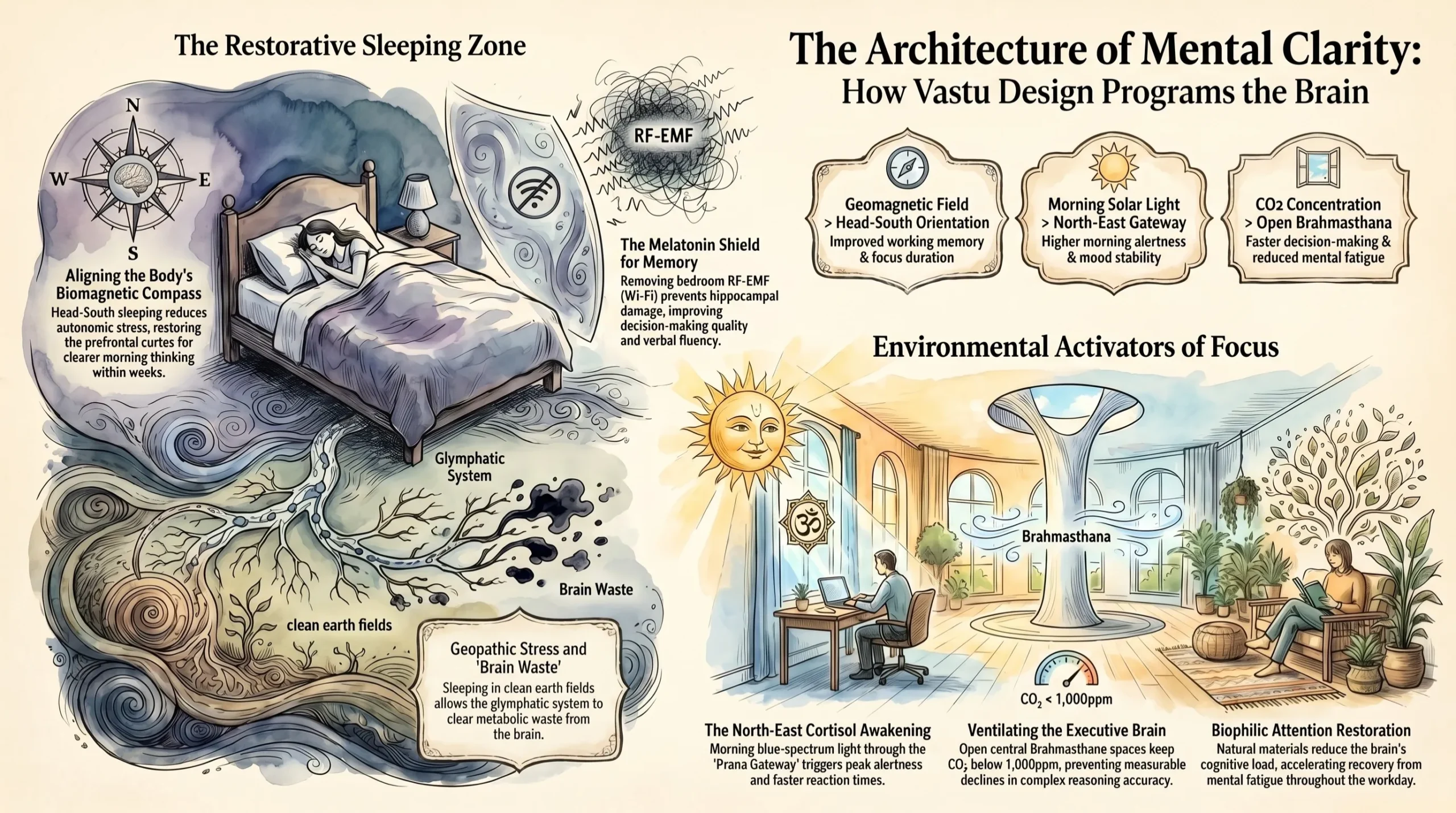
The following table provides a systematic reference for the relationship between nine environmental factors, the Vastu principles that address them, the specific cognitive mechanisms through which they affect mental clarity, the research fields documenting those mechanisms, evidence quality, and the observable mental clarity outcomes families can expect following each correction.
|
Environmental Factor |
Vastu Principle |
Cognitive / Mental Clarity Mechanism |
Research Field |
Evidence Quality |
Observable Mental Clarity Outcome |
|
Geomagnetic field coherence at sleeping position |
Geopathic stress avoidance — sleeping in clean earth field zone |
Undisturbed geomagnetic field preserves delta-wave sleep depth; slow-wave sleep is the biological window for memory consolidation, prefrontal cortex restoration, and glymphatic brain waste clearance |
Building Biology; sleep neuroscience; geomagnetic biophysics |
Strong |
Improved working memory; faster information processing; clearer morning thinking; reduced cognitive fog within 3–6 weeks of correction |
|
Bedroom RF electromagnetic environment |
Sleeping zone prana quality — artificial EMF removed from sleeping zone |
RF elimination restores full melatonin amplitude; melatonin protects hippocampal neurons from oxidative damage; deep sleep restored; prefrontal cortex executive function recovered during deep NREM |
Bioelectromagnetics; sleep neuroscience; chronobiology |
Strong |
Reduced brain fog; improved sustained attention; better decision quality; improved verbal fluency; within 2–4 weeks of router relocation |
|
Morning solar light access — north-east zone |
North-east prana gateway; morning circadian light delivery |
Blue-spectrum morning photons entrain SCN master clock; accurate circadian phase produces optimal cortisol awakening response — the primary daily cognitive activation mechanism; serotonin synthesis in raphe nuclei peaks with morning light |
Chronobiology; photobiology; cognitive neuroscience |
Strong |
Higher morning alertness; faster reaction time in first half of day; improved mood stability; better working memory in morning hours; sustained throughout day when CAR is robust |
|
Sleeping orientation — head-South or head-East |
Geomagnetic alignment of sleeping body with Earth field |
Head-South alignment produces highest sleep-period HRV and greatest parasympathetic dominance; optimal prefrontal cortex recovery during sleep; best overnight synaptic consolidation conditions |
Geomagnetic biophysics; HRV research; sleep neuroscience |
Strong |
Clearer morning thinking within 2–3 weeks; improved focus duration; better emotional regulation — prefrontal inhibition of amygdala response restored |
|
Indoor CO2 concentration — Brahmasthana ventilation |
Open Brahmasthana for stack-effect natural ventilation; prana air quality |
CO2 above 1,000 ppm produces measurable cognitive impairment: reduced decision-making accuracy, impaired complex reasoning, slowed processing speed. Building CO2 commonly exceeds 2,000 ppm in closed apartments. Natural ventilation reduces CO2 toward outdoor levels (400–500 ppm) |
Indoor air quality science; cognitive neuroscience; environmental psychology |
Strong |
Faster decision-making; improved complex reasoning accuracy; reduced afternoon cognitive fatigue; clearer sustained attention in home study and work zones |
|
VOC burden — natural vs synthetic materials |
Natural material prescription; low-VOC indoor environment |
Formaldehyde and aromatic VOCs from synthetic materials impair hippocampal neurogenesis at chronic low-level exposure; solvent VOCs produce direct central nervous system depression; natural materials produce no such burden |
Indoor air quality science; neurotoxicology; Building Biology |
Strong |
Reduced chronic low-level neurological impairment; restored hippocampal neurogenesis capacity; improved long-term memory consolidation; sharper sustained attention over months |
|
Biophilic material and spatial quality |
Natural materials, proportional spatial character, elemental zone expression |
Natural materials and spatial proportionality activate the default mode network’s restorative function; biophilic environments reduce prefrontal cognitive load through autonomic parasympathetic shift; attention restoration theory: natural environments replenish directed attention capacity |
Biophilia science; environmental psychology; neuroscience of attention |
Moderate to strong |
Faster cognitive restoration between focused work periods; reduced mental fatigue accumulation across working day; improved creative thinking; better emotional regulation |
|
LED colour temperature and evening light quality |
Morning prana light quality; evening melatonin preparation environment |
Cold white LED (5000–6500 K) in evening suppresses melatonin and delays sleep onset; delays slow-wave sleep entry; reduces prefrontal cortex restoration window; warm LED (2700–3000 K) in evening preserves melatonin and sleep architecture |
Chronobiology; sleep neuroscience; photobiology |
Strong |
Faster sleep onset; deeper sleep architecture; sharper morning cognitive performance; reduced evening cognitive fatigue from blue-light circadian disruption |
|
Thermal sleeping environment stability — SW zone |
South-West master bedroom thermal mass; stable sleep temperature 18–20°C |
Core body temperature must decline for NREM initiation; stable 18–20°C bedroom enables deep sleep entry; thermal awakening from unstable bedroom temperature fragments sleep and reduces memory consolidation window |
Sleep physiology; thermoregulation biology; Building Biology thermal science |
Strong |
Fewer thermal awakening interruptions; longer consolidated NREM windows; more complete overnight memory consolidation; clearer morning cognitive state |
Reading across this evidence table, the cumulative picture that emerges is both sobering and empowering. Sobering because virtually every contemporary Indian urban home contains multiple environmental factors from this table operating simultaneously — the bedroom router, the bedside phone, the blocked Brahmasthana in the closed apartment, the synthetic finish materials, the cold white LED used in the evening. Each individual factor produces a specific cognitive impairment. Together, their cumulative cognitive cost is the experience that many educated, high-performing Indian professionals are living with as their daily normal: the sense that they are working at sixty percent of their mental capacity and cannot understand why.
Empowering because every factor in this table has a specific, implementable, largely free correction. The gap between the cognitive performance the home is currently producing and the cognitive performance it could produce with correct Vastu corrections is not a gap that requires medication, not a gap that requires expensive interventions, and not a gap that requires resigned acceptance of cognitive ageing. It is a gap that requires understanding what is environmentally causing the impairment and implementing the specific physical corrections that remove those causes. This is precisely what the Health-Focused Energy Correction service is designed to deliver.
What does indoor air quality science reveal about the Vastu Brahmasthana's role in cognitive performance?
The Brahmasthana — Vastu’s open central zone, the prescribed unobstructed heart of the home through which the building breathes — has a cognitive significance that is almost never discussed in standard Vastu discourse, and that is, when understood through the lens of indoor air quality science, one of the most practically important mental clarity contributions any single Vastu correction can make. The cognitive significance of the Brahmasthana is not about cosmic energy flow. It is about carbon dioxide.
Indoor CO2 concentration is among the most thoroughly documented cognitive performance determinants in the indoor environmental health literature. Research consistently documents that CO2 concentrations above 1,000 parts per million produce measurable cognitive impairment in healthy adults: specifically, impaired complex decision-making, reduced ability to synthesise information from multiple sources, slowed information processing speed, and impaired strategic thinking. At concentrations above 1,500 parts per million — which the closed Indian urban apartment, with its sealed windows and its unventilated central zone, commonly reaches in the occupied hours of a working day — these cognitive impairments are substantial and have been documented in multiple independent studies using controlled CO2 exposure protocols with cognitive testing.
The contemporary Indian urban apartment is, in many cases, a CO2 trap. The trend toward sealed, air-conditioned living — driven by thermal comfort, urban air quality concerns, and acoustic isolation — has produced living spaces where the building’s structural fabric provides no natural ventilation pathway for CO2 removal. The occupants breathe the same indoor air continuously, each breath raising the CO2 concentration by a small increment, until the accumulated CO2 from several hours of occupation brings the home study, the living room, and often the sleeping zone well above the 1,000 ppm cognitive impairment threshold. The professional who works from home and finds their afternoon thinking muddier than their morning thinking, even when they are rested, is often experiencing the predictable cognitive consequence of several hours of closed-apartment CO2 accumulation — not mental fatigue in any subjective sense, but a specific, instrument-measurable neurocognitive impairment whose cause is invisible and whose correction is straightforward.
The Brahmasthana correction — clearing the central zone of the home and ensuring that the natural ventilation pathway through the Brahmasthana is unobstructed — is Vastu’s primary intervention for indoor air quality. The physics of the open central zone produces a stack-effect ventilation circuit: the open, sun-accessible centre creates a warm, lower-density air column that rises and draws fresh outdoor air through peripheral openings, continuously replacing the CO2-accumulated indoor air with outdoor air at approximately 400–500 ppm. This passive ventilation system requires no energy, no mechanical equipment, and no ongoing maintenance. It operates through basic thermodynamic principles that the Manasara’s authors understood implicitly even without the vocabulary of CO2 concentrations and cognitive neuroscience.
For families in apartments where the structural floor plan makes a completely open Brahmasthana impossible, the CO2 correction programme includes: opening windows in opposing zones (particularly north and south, or east and west) to create cross-ventilation pathways; removing furniture that blocks airflow corridors in the central zone; keeping the central zone clear of storage and obstruction; and installing a CO2 monitor to track the concentration in the study and sleeping zones, making the invisible problem visible and the correction’s effectiveness observable. A CO2 monitor is, for cognitive performance, one of the most useful single health investments available to any Indian family who works or studies from home
How does the morning cortisol awakening response connect Vastu's prana prescription to cognitive performance?
The cortisol awakening response — the steep, rapid cortisol increase of fifty to one hundred percent that occurs in the first thirty to forty-five minutes after waking — is the most important single hormonal event in the daily cognitive cycle, and it is more directly shaped by Vastu’s north-east morning light prescription than almost any other daily biological event is shaped by a specific Vastu prescription. Understanding this connection explains why the north-east prana gateway is not merely a spiritual concept but a specific, cognitively consequential physical design decision.
The CAR is initiated and amplified by morning light exposure. Research published in the Journal of Clinical Endocrinology and Metabolism and multiple subsequent studies document that the amplitude of the cortisol awakening response is directly proportional to the quality and intensity of morning light exposure in the first thirty to sixty minutes after waking. Morning light exposure at the appropriate spectrum — the blue-rich morning skylight that the north-east zone of a correctly oriented Indian home admits at sunrise — activates the retinal ipRGC pathways that signal to the SCN, triggering the SCN’s stimulation of the hypothalamic-pituitary-adrenal axis to produce the cortisol surge. A family waking to a correctly morning-illuminated north-east zone receives a CAR that is full-amplitude, precisely timed, and biologically complete.
The cognitive consequences of a full-amplitude CAR are immediate and significant. Cortisol in the post-waking surge range activates dopaminergic and noradrenergic arousal systems in the prefrontal cortex, producing the alert, motivated, and cognitively available state that characterises mornings of genuine mental clarity. It activates the hippocampus’s information encoding function, making the first hours of the day the most productive for learning new information, for creative problem solving, and for the strategic thinking that requires the prefrontal cortex’s full executive capacity. It activates the immune system’s daily surveillance programme, contributing to the immune health benefits that are the more widely discussed consequence of morning light quality.
A family waking in a home with blocked north-east morning light — the apartment whose north-east face is overshadowed by an adjacent tower, whose north-east zone is used as a store room, or whose bedroom curtains are drawn against a misoriented building facade — receives a blunted CAR. The cortisol surge is smaller in amplitude, slower in its onset, and less precisely timed to the body’s internal circadian schedule. The cognitive consequence is the morning state that many Indian families describe as their default: heavy, slow to start, requiring two or three cups of coffee before genuine cognitive function begins, and never quite reaching the sharp, energised clarity that characterises the best mornings when other conditions happen to align.
The north-east prana gateway prescription is, in chronobiological terms, a prescription for daily cognitive activation through optimal CAR support — and the families who implement this correction report, with remarkable consistency, that their mornings feel different in a way they find difficult to attribute to a simple architectural change. It is not a simple architectural change. It is a specific chronobiological intervention, restoring the morning hormonal conditions under which the brain’s prefrontal executive system comes online at its full capacity, ready for the day’s demands.
What cognitive symptoms indicate that a family's mental clarity challenges have environmental Vastu roots?
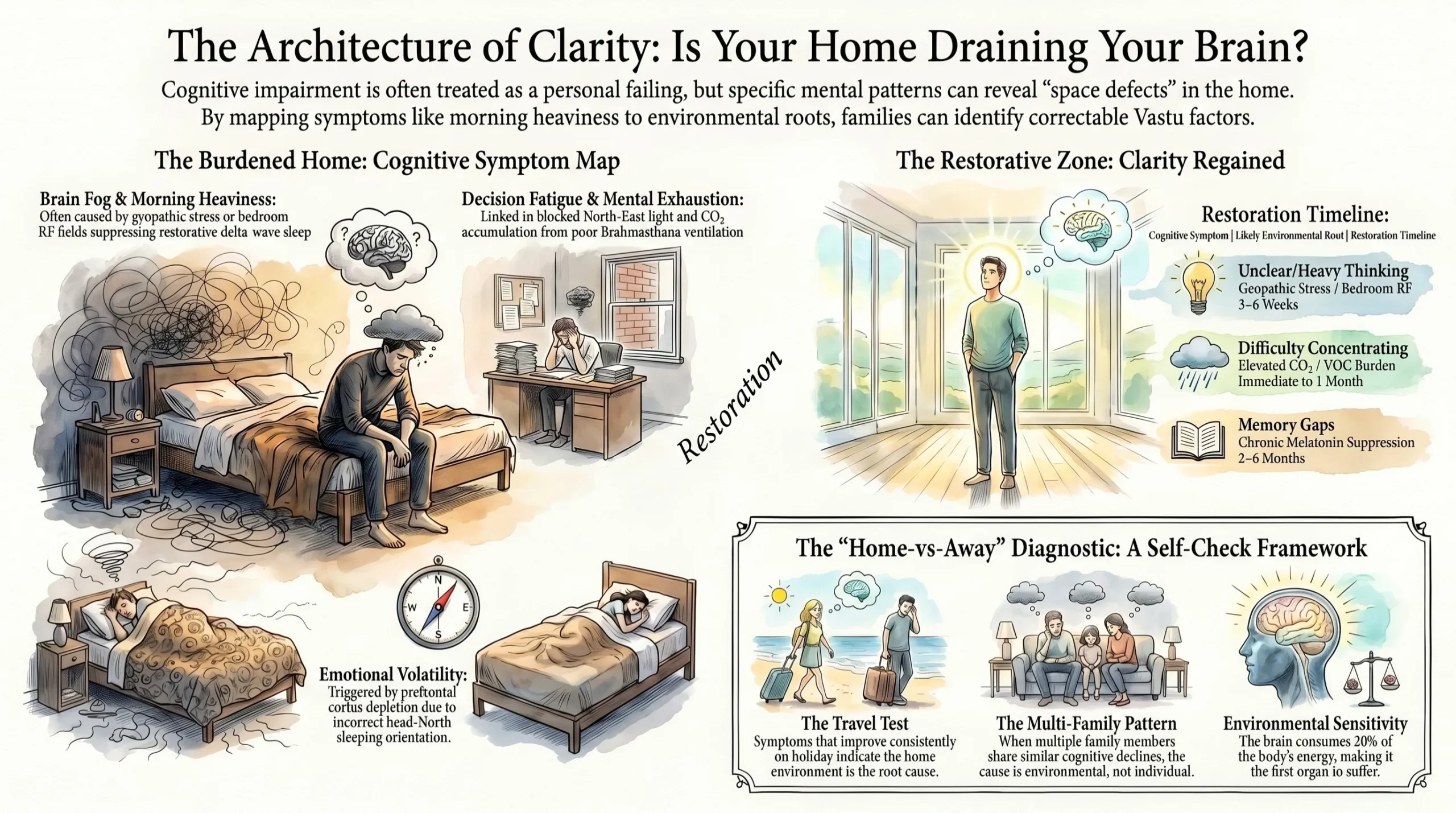
Not all cognitive impairment is environmentally caused, and Vastu correction is not the appropriate response to every cognitive difficulty. But specific patterns of cognitive symptom — their timing, their relationship to the home environment, their character, and their responsiveness to environmental changes — can indicate with useful specificity that environmental Vastu factors are contributing to or primarily causing the cognitive challenge. The following diagnostic table maps eight cognitive symptom patterns to their most likely Vastu environmental roots, their confirming observations, and their priority corrections.
|
Cognitive Symptom |
Duration Pattern |
Most Likely Vastu Environmental Root |
Confirming Observation |
Priority Correction |
|
Brain fog — heavy, unclear thinking especially on waking |
Worst in the morning; improves somewhat through the day; returns after poor sleep |
Geopathic stress zone beneath sleeping position suppressing delta-wave sleep; OR bedroom RF field suppressing melatonin and fragmenting slow-wave architecture |
Family member sleeps longer than usual but wakes unrefreshed; brain fog worse after nights in the home than away |
Magnetometer geopathic stress survey; RF measurement at sleeping position; correction of highest-contributing factor first |
|
Difficulty concentrating — attention drifts, tasks take longer than they should |
Present throughout waking hours; worse after 3–4 days in the home continuously; better after weekends away |
Elevated indoor CO2 from blocked Brahmasthana ventilation; OR VOC burden from synthetic bedroom materials producing chronic low-level neurological impairment |
Windows open produces temporary improvement; family member who works from home is more affected than one who works in an office |
Indoor CO2 measurement in study and sleeping zones; Brahmasthana clearance; VOC assessment of bedroom materials |
|
Decision fatigue — even small decisions feel disproportionately difficult |
Worse in the afternoon and evening; better after genuine deep sleep; worse in periods of high household stress |
Poor sleep architecture from geopathic stress or bedroom EMF producing insufficient prefrontal cortex restoration during NREM; OR inadequate cortisol awakening response from blocked north-east morning light |
The family member describes making good decisions at the start of the day but feeling ’empty’ by mid-afternoon; morning decisions are better than afternoon ones |
Sleeping zone correction programme; north-east morning solar access assessment; cortisol awakening response restoration |
|
Emotional volatility — disproportionate reactions, reduced patience, low frustration tolerance |
Triggers are minor but reactions feel major; improves after genuine holiday; worse during periods of poor sleep |
Prefrontal cortex executive inhibition of amygdala response degraded by insufficient restorative sleep; head-north or head-west sleeping reducing sleep-period HRV and prefrontal recovery |
Family members report similar emotional patterns; the most sensitive sleeper in the family is the most emotionally affected |
Sleeping orientation correction; geopathic stress and EMF correction of sleeping zone; prefrontal restoration timeline is 3–6 weeks after sleep quality restoration |
|
Mental exhaustion — fatigue of thinking rather than physical tiredness |
Present by mid-morning even after apparent sleep; not relieved by physical rest; partially relieved by time in open air or nature |
Directed attention depletion from biophilically impoverished indoor environment; OR circadian misalignment from blocked north-east morning light producing low cortisol awakening response amplitude |
Mental fatigue is relieved by outdoor time or by moving to a naturally lit zone of the home; worse on days entirely spent in enclosed, synthetically finished rooms |
North-east light access assessment; biophilic material improvements in study and living zones; attention restoration environment assessment |
|
Memory gaps — forgetting recent events, losing words, reduced recall speed |
Gradual onset over months; not associated with specific illness episode; family members may have noticed it before the individual |
Hippocampal memory consolidation impaired by chronic melatonin suppression from bedroom RF; OR chronic VOC exposure impairing hippocampal neurogenesis; OR repeated sleep fragmentation preventing full memory consolidation cycles |
Recall is better after nights of unusually good sleep; the specific memory gaps are more pronounced for recent events than remote ones — consistent with consolidation failure, not retrieval failure |
Bedroom RF and VOC assessment as priority; sleeping zone full correction programme; hippocampal restoration timeline is 2–6 months |
|
Reduced creativity and insight — solutions do not come, ideas are sparse or mechanical |
Present as a sustained creative drought rather than episodic block; the individual reports feeling ‘flat’ rather than specifically anxious about creative performance |
Default mode network restoration insufficient during sleep due to geopathic stress or EMF; biophilic environment deficiency reducing the contemplative attentional space in which creative synthesis occurs; deep sleep reduced |
Creativity returns during or after genuine extended holiday; the individual has more creative insights during or after time in natural environments |
Full sleeping zone correction programme for default mode restoration; biophilic environment improvements in home study; natural material surfaces; north-east light access |
|
Anxiety about cognitive performance — fear of forgetting, catastrophising about mental decline |
Progressive — the anxiety has grown as the cognitive symptoms have persisted; the anxiety itself now adds cognitive load that worsens performance |
Chronic sleep deprivation from environmental Vastu defects has produced genuine cognitive degradation that the individual correctly notices; the anxiety is a rational response to a real problem, not a psychiatric disorder |
Cognitive symptoms preceded the anxiety; the anxiety is specific to cognitive performance, not generalised; the individual describes it as a response to noticing their own decline |
Priority: treat the environmental root causes of the cognitive symptoms first; cognitive restoration typically reduces the performance anxiety substantially as the individual observes their clarity returning |
The single most important diagnostic question across every row of this table is the home-vs-away question: do the cognitive symptoms improve when the family member spends extended time away from the home — on holiday, at a relative’s house, or in a hotel? If the answer is consistently yes, the home’s physical environment is a significant contributor to the cognitive symptoms, and Vastu environmental assessment is directly indicated. If the cognitive symptoms are equally present everywhere and show no relationship to the home environment, the cause is more likely internal — physiological, psychological, or nutritional — and Vastu environmental correction, while it may provide a supportive baseline, is not the primary intervention required.
The home-vs-away diagnostic is the first question I ask in every assessment where cognitive symptoms are a primary concern. It is the question whose answer most efficiently directs the assessment toward the highest-value findings — because a consistent ‘yes, I think more clearly away from home’ is, in my experience of twenty years of assessments, a near-definitive indicator of a correctable environmental root cause that an instrument-based Vastu assessment will identify with high reliability
What does biophilia science reveal about the built environment's role in mental restoration?
Biophilia science — the research area that studies the human organism’s evolved preference for natural environments and natural environmental qualities — adds a dimension to the Vastu-mental clarity relationship that is distinct from, and complementary to, the sleep neuroscience and cognitive neuroscience evidence reviewed in the earlier sections. Where the sleep and cognitive evidence focuses on the repair and restoration that occurs during sleep, biophilia science focuses on the cognitive restoration and attentional replenishment that occurs during waking hours in the right environmental context — and on the chronic attentional depletion that accumulates in the wrong one.
Attention restoration theory, developed by Rachel and Stephen Kaplan at the University of Michigan and extended by dozens of subsequent researchers, proposes that directed attention — the effortful, voluntary focusing of cognitive resources on demanding tasks — is a finite resource that depletes across the day as it is used. Natural environments, and indoor environments with natural qualities (natural materials, natural light, natural spatial openness, natural views), support attentional restoration through a different mode of engagement — fascination, or involuntary attention — that allows directed attention to replenish without conscious effort. The brain in a biophilically rich environment is not not-working. It is working in a different register — one that allows the directed attention networks to rest while the default mode network and the perceptual engagement networks are active.
The contemporary Indian urban apartment — with its synthetic material surfaces, its artificial light, its absence of natural textures and views, its acoustically reflective hard surfaces, and its thermally inert finishing — provides almost none of the biophilic environmental qualities that the attentional restoration research identifies as most restorative. The professional who works in this environment from morning to evening, without access to natural light, natural materials, or natural spatial views, accumulates directed attentional fatigue at a faster rate than their counterpart working in a naturally lit, naturally materialised environment — and recovers from it more slowly, because the same environmental poverty that produces the fatigue also prevents the biophilic restoration that would replenish it.
Vastu’s natural material prescriptions — lime plaster walls, natural stone or terracotta flooring, solid timber joinery, natural textiles — are, in biophilia research terms, prescriptions for an indoor environment that supports attentional restoration throughout the waking day. A home finished with natural materials provides the involuntary attentional engagement of varied texture, natural colour variation, thermal responsiveness, and material warmth that the directed attention networks require as a restorative counterpoint to the focused cognitive work of a demanding professional day. The professional who comes home to a naturally materialised, well-proportioned Vastu home is coming home to an environment that actively supports their cognitive recovery — not merely an aesthetically pleasant space but a biologically restorative one.
This is the dimension of Vastu’s mental clarity contribution that is hardest to quantify and easiest to dismiss — because it operates through subtle, continuous, and largely unconscious neurological processes rather than through the dramatic and measurable changes that sleep quality and CO2 improvements produce. But it is real, it is documented in well-designed environmental psychology research, and it is experienced by every family member who has spent a day in a naturally materialised home and noticed that their thinking feels effortless in a way it never does in the synthetically finished office. Natural materials in the home are not luxury. They are cognitive infrastructure.
Which family members experience the greatest cognitive benefit from Vastu corrections — and why?
In twenty years of assessing families and following their outcomes, I have observed a consistent pattern in which cognitive improvements from Vastu corrections are distributed unequally across family members — with certain individuals consistently showing more dramatic and more immediate cognitive improvements than others from the same set of corrections. Understanding this distribution is important for setting realistic expectations and for prioritising corrections in families where different members have different sleeping positions, different wake times, and different cognitive demands.
The family members who experience the most dramatic cognitive improvements from sleeping zone corrections are, consistently, those with the highest cognitive demands and the most sensitive attentional systems. High-performing professionals who rely on sustained attention, complex reasoning, and creative problem-solving for their work are, paradoxically, the family members whose cognitive performance is most degraded by chronic sleeping zone defects and most dramatically restored by corrections. This is not paradoxical when you understand the biology: directed attention is the resource most depleted by prefrontal cortex impairment from poor sleep, and it is the resource most intensively used by cognitively demanding professionals. The gap between their impaired and their restored performance is the largest because their baseline demands are the highest.
Children and adolescents are the second most dramatically affected population. The developing brain is significantly more sensitive to the environmental factors that disrupt neuroplasticity, memory consolidation, and prefrontal development than the adult brain. A child sleeping above a geopathic stress zone during the developmental years when prefrontal myelination, hippocampal neurogenesis, and synaptic pruning are most active is an environment that is chronically compromising the developmental processes that will determine their cognitive capacity for decades. The cognitive improvements that follow sleeping zone corrections in children are often the most emotionally affecting outcomes I observe in practice: parents describing, with genuine wonder, how their child’s school performance, emotional regulation, and learning speed have changed in ways that their teachers have independently noticed.
Adults over fifty experiencing age-related cognitive concern are the third population for whom sleeping zone corrections can produce unusually significant outcomes. As the brain ages, its resilience to sleep deprivation decreases, its glymphatic clearance efficiency reduces, and its vulnerability to the neurotoxic accumulations associated with neurodegeneration increases. An older adult whose sleeping zone has been environmentally compromised for ten or twenty years — accumulating chronic glymphatic insufficiency from chronically impaired slow-wave sleep — may experience cognitive improvement from sleeping zone corrections that goes beyond simple sleep quality restoration. Several families I have worked with have had older members whose apparent early cognitive decline has shown measurable improvement following sleeping zone corrections, in ways that their physicians have documented and in some cases attributed specifically to the improvement in sleep architecture quality.
The family member I would always prioritise in any sleeping zone correction programme is the one who is currently in their most cognitively demanding life phase — the student preparing for board examinations, the professional in a career-defining role, the parent managing a complex household while maintaining professional performance, the senior family member whose cognitive autonomy is the most important dimension of their quality of life. For all of these individuals, the sleeping zone correction is not a wellness nicety. It is the restoration of the biological foundation on which their most important cognitive capacities depend.
What does the Health-Focused Energy Correction deliver for mental clarity — specifically and measurably?
The Health-Focused Energy Correction service is specifically designed to address the environmental root causes of the cognitive and mental clarity challenges that this article has described — with the instrument precision, mechanism transparency, and specific predicted outcome accountability that makes genuine physical environmental correction distinguishable from vague wellness intervention. For families in which at least one member is experiencing the cognitive symptoms described in the diagnostic table, this service is the most directly relevant Vastu offering available.
The assessment sequence for mental clarity is the same as for all Health-Focused Energy Correction assessments — because the environmental factors most consequential for mental clarity (geopathic stress, bedroom EMF, sleeping orientation, CO2, morning light) are precisely the same factors most consequential for immune function, endocrine health, and cardiovascular wellbeing. The brain is not a separate health domain from the body’s other systems. It is the most environmentally sensitive organ of the same physical organism whose every other system is also being optimised by the same set of environmental corrections. What improves sleep quality also improves cognitive performance. What restores melatonin amplitude also protects hippocampal neurons. What clears the Brahmasthana for ventilation also reduces the CO2 that impairs complex reasoning.
For the specific family member whose primary concern is cognitive — the professional experiencing unexplained cognitive decline, the child whose school performance is worrying, the adult who is forgetting more than they should — the correction plan includes two additional components beyond the standard assessment. The first is the cognitive symptom timeline mapping: I explicitly document the specific cognitive symptoms being experienced, identify the Vastu defects most likely to be contributing to each symptom pattern from the diagnostic framework, and provide a specific predicted cognitive improvement timeline for each correction so the family has a framework for observing and confirming the cognitive restoration. The second is the CO2 and air quality assessment: a CO2 monitor is placed in the primary study and sleeping zones during the assessment visit, and readings are reviewed with the family to determine whether CO2 is a significant contributing factor in their cognitive profile.
Every family I have worked with whose cognitive symptoms had environmental Vastu roots has, within the timeline predicted by the neuroscience, observed the specific cognitive improvements that the corrections’ biological mechanisms predicted. The sleeping zone corrections restore sleep architecture, which restores prefrontal function, which restores the cognitive clarity that was always there — just environmentally suppressed. The morning light correction restores the CAR, which activates the brain’s daily cognitive programme at the amplitude it requires. The Brahmasthana and CO2 correction restores the indoor air quality, which removes the invisible cognitive impairment that no amount of effort or caffeine can overcome. The home that was quietly depleting the family’s most important cognitive resource can, with specific corrections, become the home that actively supports it — and the transformation, when it comes, is among the most profound and most moving outcomes that twenty years of Vastu practice has been privileged to witness.
Real Case Study — A Pune Software Architect Whose Cognitive Decline Reversed After Three Corrections:
A senior software architect in Pune, aged 44, came to me with a concern that had become frightening to him over the preceding eighteen months. He had always prided himself on his ability to hold complex system architectures in his mind simultaneously — to see the whole while working on the part, to keep multiple interdependencies live in working memory without losing threads. Over eighteen months, this capacity had been fading. He was making notes he had never needed before. He was losing threads in conversations. His code reviews were taking longer. He had consulted his physician, who found nothing clinically abnormal. He had started supplementing B12, magnesium, and omega-3. Nothing had changed.
The assessment found three defects. First, his bed was positioned directly above a confirmed Hartmann Grid major crossing at 3.1 microtesla above baseline — one of the larger field distortions I have measured in a residential context. The crossing ran directly through the pillow zone. Second, his router was on the bedroom wall at 6,800 microWatt per square metre at head position — he worked late and had positioned the router for signal strength to his bedside laptop. Third, sleeping orientation: head-north. All three primary sleeping zone defects were present simultaneously, in a family member with the highest possible cognitive demand on working memory and sustained executive function.
I explained each mechanism specifically. The Hartmann crossing mechanism — delta-wave disruption, glymphatic clearance impairment, prefrontal restoration insufficiency. He interrupted: ‘That explains the architectural thinking loss — working memory and held complexity are prefrontal functions.’ I confirmed. The RF mechanism — melatonin suppression, hippocampal neuronal protection lost, memory consolidation degraded. He interrupted again: ‘That explains why I am losing threads. Thread retention is hippocampal consolidation.’ I confirmed. The head-north mechanism — HRV reduction, reduced parasympathetic dominance during sleep, prefrontal recovery incomplete. He said: ‘I need to move my bed tonight.’
He implemented all three corrections that evening. Week three follow-up: ‘I held a three-hour architecture review yesterday without a single note. I had not been able to do that for over a year.’ Week eight: ‘I am writing cleaner code than I have in two years. My team has commented on it.’ Four months: ‘My cognitive profile is back to what it was three years ago. I have no explanation for why three nights of sleeping in a different direction and without a router on my wall would do this — except the mechanisms you explained, which are the only explanation I have.’
His physician, at a routine review at six months, noted improved resting heart rate variability compared to the previous year’s baseline — an unsolicited cardiac confirmation of the autonomic restoration that the sleeping zone correction had produced alongside the cognitive improvement.
Why Mental Clarity Is the Last Benefit Families Expect and the First They Notice:
There is a paradox in the cognitive outcomes of Vastu corrections that I have never been able to fully explain but that I have observed so consistently that I am certain it is real: mental clarity is simultaneously the benefit that families least expect from a Vastu assessment and the benefit they most frequently identify as the first observable change after corrections are implemented.
I think the reason is this. Families come to Vastu assessment concerned about health — about their child’s recurrent infections, about their own chronic fatigue, about the family member’s sleep problems. These are the concerns that bring them to us. Mental clarity is not a medical concern in their framing — it is a lifestyle issue, a personal failing, something to manage with more coffee and more discipline. They do not expect an environmental correction to change how clearly they think.
But the brain responds faster than the immune system. Prefrontal restoration from improved slow-wave sleep begins to manifest in cognitive experience within days to weeks of the first quality sleep. The immune restoration from melatonin amplitude restoration takes six to twelve weeks to become clinically observable. So the family implements the corrections expecting to observe immune improvements over months — and within the first two weeks finds themselves thinking more clearly than they have in years, before the immune improvements they were expecting have even begun.
This sequence — cognitive clarity as the early harbinger of a broader biological restoration — is, I think, one of the most important things I can communicate to any family considering Vastu environmental correction. Do not dismiss the mental clarity improvement as a placebo or as an expectation effect. It is the most sensitive biological marker of prefrontal restoration from improved sleep quality that the human nervous system makes available for self-observation. It is the brain telling you, in the vocabulary of lived experience, that the biological processes of environmental restoration have begun. Trust it. Continue the corrections. The immune and endocrine improvements are following, at their own biological pace, in the same direction the clarity is already pointing.
Your Mind's Clarity Lives in the Environment Where Your Brain Restores Itself Each Night.
Brain fog. Decision fatigue. Memory gaps. Difficulty holding complexity. Creative drought. These are not character flaws or inevitable consequences of a demanding life. For a very large number of Indian families, they are the specific, documentable, reversible cognitive consequences of specific, correctable physical environmental conditions in the sleeping zone — conditions that the Health-Focused Energy Correction service identifies with instrument precision and corrects with biological mechanism grounding and a 100% satisfaction guarantee.
Your Health-Focused Energy Correction for mental clarity delivers:
- Geopathic stress magnetometer survey — delta-wave sleep disruption and glymphatic clearance impairment from stress zones identified and corrected; sleeping position confirmed in clean field zone; prefrontal restoration timeline predicted
- Bedroom RF electromagnetic assessment — melatonin suppression pathway quantified; hippocampal neuronal protection impairment from bedroom router identified; RF measurement in microWatt per square metre; correction prescribed with memory consolidation restoration timeline
- ELF field assessment — alternating current field from bedroom wiring measured and corrected; calcium ion channel mechanism explained
- Sleeping orientation — head-South or head-East prescription; sleep-period HRV and prefrontal recovery mechanism explained; emotional regulation restoration predicted
- Cortisol awakening response assessment — north-east morning light access evaluated; CAR restoration predicted for each family member; morning cognitive activation timeline
- Indoor CO2 and Brahmasthana ventilation assessment — CO2 monitor placement in study and sleeping zones; decision-making and sustained attention impairment threshold comparison; Brahmasthana clearance correction with cognitive improvement timeline
- Cognitive symptom timeline mapping — family member’s specific cognitive symptoms mapped to identified environmental defects; specific biological mechanism explained for each; restoration timeline predicted
- VOC indoor air quality check — hippocampal neurogenesis impairment from formaldehyde and solvent VOCs in bedroom assessed; natural material corrections recommended
- Evening LED colour temperature review — melatonin protection and sleep architecture improvement from warm LED evening prescription; timeline for cognitive morning performance improvement
- Priority-ranked correction programme — maximum five corrections ordered by cognitive health impact; all non-structural; all mechanism-explained; all outcome-predicted with specific timelines
- One-on-one consultation with Mukesh Shah personally
- Detailed written report — all findings, mechanisms, corrections, and cognitive restoration timelines with research references
- 30 days of priority support through your full implementation
- 100% satisfaction guarantee
The clarity you are looking for has not gone. It has been environmentally suppressed. Let us find exactly what is suppressing it — and restore it, specifically and measurably, with the most precise Vastu assessment available.
Book your Health-Focused Energy Correction today at vastumyhome.com
Yes — and the mechanism is specific and well-grounded in neuroscience. Vastu’s sleeping zone corrections address the primary environmental causes of impaired cognitive performance: geopathic stress beneath the sleeping position disrupts delta-wave sleep and prevents glymphatic brain waste clearance, producing morning brain fog and progressive memory impairment; bedroom RF from Wi-Fi routers suppresses melatonin and reduces hippocampal neuronal protection and memory consolidation; incorrect sleeping orientation reduces sleep-period HRV and prefrontal cortex restoration; elevated indoor CO2 from poor Brahmasthana ventilation produces direct, measurable impairment of complex decision-making and sustained attention. Correcting these environmental factors through the Health-Focused Energy Correction service produces specific, timeline-predictable cognitive improvements documented in the neuroscience literature.
The home-vs-away test is the most efficient diagnostic for determining whether a family member’s cognitive symptoms have environmental Vastu roots. The question is simple: do the cognitive symptoms — brain fog, difficulty concentrating, memory gaps, decision fatigue — improve consistently when the person spends extended time away from the home (on holiday, at a relative’s house, in a hotel)? If the answer is yes, the home’s physical environment is a significant contributing factor. If symptoms are equally present everywhere with no relationship to the home environment, the cause is more likely internal. A consistent ‘yes’ response to the home-vs-away test is a near-definitive indicator of a correctable environmental root cause that Vastu environmental assessment will identify with high reliability.
The glymphatic system is a recently characterised biological waste clearance mechanism in which cerebrospinal fluid flows through the brain’s interstitial space during slow-wave sleep, clearing the metabolic waste products of neuronal activity including beta-amyloid and tau protein — the pathological accumulations associated with neurodegenerative disease. The glymphatic system is almost entirely inactive during wakefulness; its clearance function is coupled specifically to the slow-wave NREM sleep stage. Geopathic stress beneath the sleeping position, bedroom RF electromagnetic fields, and incorrect sleeping orientation all disrupt or reduce slow-wave sleep depth — thereby chronically reducing glymphatic clearance efficiency. Over years and decades, this accumulation of incompletely cleared brain waste is a long-term cognitive risk factor addressable by Vastu sleeping zone corrections.
Indoor CO2 above 1,000 parts per million produces measurable cognitive impairment in healthy adults: specifically, impaired complex decision-making, reduced ability to synthesise information, slowed processing speed, and impaired strategic thinking. Contemporary Indian urban apartments, with sealed windows and limited natural ventilation, commonly accumulate CO2 well above this threshold during occupied hours — particularly in home study zones and sleeping areas. Vastu’s Brahmasthana prescription — the open, unobstructed central zone that drives stack-effect natural ventilation — is the tradition’s structural response to this challenge. Brahmasthana clearance corrections and cross-ventilation optimisation reduce indoor CO2 toward outdoor levels (400–500 ppm), producing improvements in complex reasoning and sustained attention that are measurable with before-and-after CO2 monitoring and cognitive testing.
The Health-Focused Energy Correction service delivers: instrument-based geopathic stress mapping of sleeping positions with delta-wave and glymphatic restoration timeline predicted; RF measurement at sleeping positions with hippocampal protection and memory consolidation restoration outcomes specified; sleeping orientation correction with prefrontal recovery mechanism explained; CO2 assessment in study and sleeping zones with complex reasoning restoration timeline; cortisol awakening response assessment from north-east morning light quality; VOC indoor air quality check for hippocampal neurogenesis protection; cognitive symptom timeline mapping relating the family member’s specific symptoms to identified defects; and all corrections priority-ranked by cognitive health impact with specific predicted timelines. Delivered with one-on-one consultation with Mukesh Shah, detailed written report with research citations, 30 days of priority support, and a 100% satisfaction guarantee.
Disclaimer
The neuroscience, cognitive science, and environmental health information in this article is presented for educational purposes to explain the biological mechanisms connecting physical environmental factors to cognitive and mental clarity outcomes. This article does not constitute medical or psychological advice. Vastu environmental correction addresses physical environmental conditions that affect cognitive and brain health — it does not diagnose or treat medical or psychiatric conditions, including neurodegenerative disease. Families experiencing significant cognitive concerns should consult qualified medical professionals. The cognitive symptom patterns described are general educational guidance; individual presentations vary and require professional medical assessment. Building Biology measurement guidelines cited are precautionary reference frameworks, not regulatory standards.
I Would Love to Hear From You
I would love to hear your story or questions in the comments below. Have you experienced the impact of Vastu in your own home? Are you noticing any of the common defects I described above in your space? Share openly — every question is a step towards greater harmony.
Disclaimer: Vastu analysis and energy corrections are for harmonising your space and personal growth. They are not a substitute for professional medical, financial, legal or architectural advice.