

How Do Spatial Arrangements Influence Emotions? Vastu & Neuroscience | Vastu My Home
Namaste. I am Mukesh Shah. In twenty years of Vastu assessment, some of the most moving conversations I have had with families are not about sleep quality, immune function, or blood pressure — though I care about all of these deeply and address every one of them. They are about the emotional quality of life in the home. About the family that describes their home as feeling heavy, oppressive, or draining — a place they endure rather than restore in. About the couple whose conflicts seem to arise nowhere but intensify there, cycling through the same arguments in the same rooms with the same unreasonable escalation. About the child who is easy, settled, and emotionally resilient at their grandparents’ house in the village but difficult, anxious, and emotionally reactive the moment they return to the family apartment. About the professional who describes themselves as patient with colleagues, clients, and strangers — but reliably short-tempered with their own family by the end of each day at home.
These families have come to understand — sometimes explicitly, always experientially — something that environmental psychology and neuroscience are now documenting with increasing rigour: that the spatial arrangement, material character, light quality, and energy environment of the home directly, continuously, and consequentially shapes the emotional experience of every person who lives in it. Not because the home has a mood or an intention. Because the human nervous system has evolved to read the physical environment as a continuous stream of emotional and threat-relevant information — and to respond to that information with the hormonal, autonomic, and neurobiological changes that produce the emotions we experience.
The Vastu tradition understood this relationship with a precision that is, in retrospect, extraordinary. Its prescriptions for zone function, spatial proportion, prospect and refuge balance, morning light quality, material character, and elemental zone allocation address, with remarkable specificity, the exact dimensions of the spatial environment that environmental psychology and affective neuroscience have independently identified as the most consequential emotional determinants. The Vastu home is not merely a physically healthy home. It is a neurologically, emotionally, and relationally healthy home — a built environment designed not only to support the body’s physical maintenance but to support the nervous system’s emotional regulation, the family’s relational quality, and the individual’s sense of being in a place that holds rather than depletes them.
The families who most need this understanding — whose emotional difficulties at home have been attributed entirely to stress, relationship patterns, or individual psychological vulnerabilities — deserve to know that the space they live in is not a neutral backdrop to their emotional lives. It is an active participant. And the Health-Focused Energy Correction service addresses the spatial and environmental factors most directly driving the emotional patterns that families bring to us — not by providing therapy or counselling, but by correcting the physical environmental conditions that are quietly undermining the emotional regulation capacity that every family member is working so hard to maintain.
Why does the brain process spatial arrangements as emotional information?
The question of why spatial arrangements influence emotions is ultimately a question about how the human brain processes the physical environment — and the answer, developed across the fields of evolutionary psychology, environmental neuroscience, and affective science, reveals that the brain’s emotional response to space is not a secondary cultural response layered over a primary functional assessment. It is a primary, automatic, and deeply evolved biological response that precedes and shapes every cognitive assessment of space, and that operates continuously, in every room of every home, whether the occupant is aware of it or not.
The evolutionary basis of the brain’s spatial emotional processing is the prospect-refuge framework, first articulated by geographer Jay Appleton and subsequently elaborated by environmental psychologists, evolutionary biologists, and neuroscientists. Human beings spent the overwhelming majority of their evolutionary history as hunter-gatherers in savannah and woodland landscapes where survival depended on two spatial qualities simultaneously: prospect — the ability to see out over the landscape for predators, prey, and social information; and refuge — a sheltered, defensible position offering protection from behind. Environments that provided both simultaneously — a slight elevation with a clear view of the landscape and a tree-line or rocky outcrop at the back — were the safest and most resource-rich environments available. The nervous system learned to read the presence of these two spatial qualities as the primary signal of environmental safety and ease, and to respond to their presence with the autonomic shift toward parasympathetic dominance and limbic amygdala quieting that we experience as the feeling of being in a good place.
This evolutionary spatial processing is not turned off in modern built environments. The same neural pathways that assessed the savannah in our ancestors now assess the living room, the bedroom, and the kitchen — continuously, automatically, and below the threshold of conscious awareness. A room that provides both prospect (a view outward, adequate light, visual openness) and refuge (a solid wall behind the primary seating or sleeping position, ceiling height that is contained rather than vast in intimate zones) is read by the nervous system as safe. A room that provides prospect without refuge — a sleeping position facing a large uncurtained window with no solid backing — maintains background vigilance. A room that provides refuge without prospect — a sleeping position in a dark, closed, low-ceiling space with no views outward — produces claustrophobic anxiety. A room that provides neither — an open-plan space with no solid wall anchor points, harsh overhead lighting, and synthetic surfaces — produces the chronic low-level environmental stress that biophilia research documents in cortisol elevations.
Vastu’s zone allocation system — its placement of sleeping zones in the enclosed, protected south-west; its living zones with views toward the east and north; its kitchen in the south-east with controlled light and activity; its central Brahmasthana as the home’s breathing space — is a systematic implementation of the prospect-refuge balance that the nervous system requires in each room’s functional context. The Vastu home is not merely aesthetically pleasing or energetically harmonious. It is neurobiologically calibrated — designed to provide the specific spatial emotional signals that the human nervous system has evolved to interpret as home.
What does environmental neuroscience reveal about how the home shapes the amygdala?
The amygdala — the brain’s primary threat-detection and emotional significance-assessment structure — is the neural structure most directly shaped by the home’s physical environment. Understanding the amygdala’s role in spatial emotional processing explains both why Vastu’s spatial corrections produce the emotional improvements families report and why those improvements can feel so dramatic: a small change in the physical environment, correctly targeted, can produce a large change in the amygdala’s background activation level — with consequences for every emotional and relational experience that occurs in the space.
The amygdala continuously and automatically processes the sensory environment for signals of threat, danger, or social-emotional significance. It operates below the threshold of conscious awareness — its threat assessments typically reach consciousness only as a vague feeling of unease, a diffuse anxiety, or an undifferentiated sense that something is wrong — rather than as articulated thoughts. This below-threshold operation is precisely what makes environmental amygdala activations so difficult for families to identify and so easy to misattribute. The family member who feels inexplicably tense at home, whose patience is thin in ways it is not elsewhere, whose anxiety rises in ways they cannot connect to specific thoughts or worries — is experiencing, most likely, a background amygdala activation driven by the home’s physical environment, not by their inner psychological state.
The environmental signals that most reliably activate the amygdala’s chronic low-level threat response in built environments are well-characterised by environmental neuroscience. Visual clutter and unresolved visual complexity — the stacked papers on the table, the overflowing storage, the blocked corridors — maintain the amygdala’s vigilance because the brain reads unresolved visual disorder as environmental uncertainty requiring monitoring. Direct glare and harsh overhead lighting stimulate the amygdala’s arousal system through the superior colliculus pathway. Synthetic materials and the absence of natural environmental qualities fail to provide the specific sensory signals — natural texture variation, natural colour complexity, natural temperature gradients — that the biophilic visual pathways use to down-regulate the amygdala toward parasympathetic safety. Irregular, unpredictable sounds from adjacent zones or mechanical systems maintain low-level amygdala arousal that the consciously attending mind cannot always identify as the source of its unease.
Vastu’s prescriptions that most directly address amygdala calibration are those that create the spatial conditions for amygdala down-regulation: the south-west sleeping zone’s enclosed refuge quality for the sleeping amygdala’s deepest nightly rest; the Brahmasthana’s open, uncluttered central space for visual relief from environmental complexity; the natural material palette’s biophilic sensory richness for the evolved amygdala-calming visual pathway; the zone function appropriateness that ensures each space’s sensory character matches its function, eliminating the spatial dissonance that maintains amygdala uncertainty. Each of these prescriptions is, in environmental neuroscience terms, a specific intervention in the amygdala’s environmental calibration — and their combined implementation produces the emotional experience that families most consistently describe following Vastu correction: the home feeling like it is finally on their side.
The most practically important implication of the amygdala-environment relationship for any family is this: the chronic low-level tension, anxiety, irritability, and emotional fatigue that many families attribute to the stresses of their work and life is often, in significant part, an amygdala activation produced and maintained by the home’s physical environment — an environmental load that adds to, amplifies, and sustains the emotional burdens that the family is carrying regardless of its internal sources. Correcting the environmental drivers of the amygdala activation does not resolve the work stress, the relationship challenges, or the life difficulties. But it removes the environmental amplifier that has been making everything harder than it needs to be.
How does the sleeping zone's spatial quality shape the next day's emotional experience?
Of all the spatial arrangements in the home, the sleeping zone’s configuration has the most consequential influence on the emotional quality of the following day — because the sleeping zone is where the brain conducts the most emotionally significant processing of the entire twenty-four-hour cycle, and because the quality of that processing depends directly on the physical conditions of the space in which it occurs. Understanding this relationship between sleeping zone quality and next-day emotional experience is the foundation for understanding why the Health-Focused Energy Correction’s sleeping zone assessment is so often the most emotionally transformative intervention available to the families we serve.
Matthew Walker’s research at the University of California Berkeley — documented in his landmark work on sleep and emotion — has established that REM sleep is the primary biological mechanism through which the brain processes emotional memories and restores emotional regulation capacity. During REM sleep, the hippocampus replays the day’s emotionally significant experiences in a neurochemical environment that is specifically characterised by the absence of noradrenaline — the brain’s primary arousal and stress-response molecule. This noradrenaline-free neurochemical state allows the brain to reprocess emotionally charged memories, reducing their affective intensity while preserving their informational content. The experience that has been distressing, frightening, or overwhelming is reprocessed during REM into something that is remembered clearly but no longer carries the same acute emotional charge.
Walker describes this as ‘overnight therapy’ — and the description is precise. The REM stage of sleep is the most sophisticated emotional regulation mechanism the human nervous system possesses, operating automatically each night in every person whose REM sleep is architecturally intact and uninterrupted. The emotionally exhausted person who goes to bed dreading tomorrow and wakes having ‘slept on it’ with a clearer, calmer perspective has experienced REM emotional reprocessing. The person who wakes from a night of disrupted, fragmented, architecturally impoverished sleep with the same emotional weight they carried to bed has been deprived of this REM emotional processing — by whatever environmental factor fragmented and shortened their REM sleep.
The sleeping zone’s spatial quality affects REM sleep through several specific pathways. The thermal environment of the sleeping zone — the south-west bedroom’s thermal mass maintaining stable cool temperature — supports the core body temperature decline that is prerequisite for REM sleep entry. The electromagnetic environment — the bedroom RF field’s melatonin suppression — directly disrupts REM architecture by shortening REM episodes and increasing REM fragmentation. The geopathic stress field beneath the sleeping position — whose arousal-generating effects are most prominent in the lighter sleep of the second half of the night when REM is most abundant — fragments precisely the REM episodes that the night’s emotional reprocessing depends on.
The family member who wakes regularly with the same emotional burdens they carried to bed, who cannot seem to ‘sleep off’ difficult experiences the way other people appear to, who finds themselves ruminating on unresolved emotional content from days and weeks ago rather than processing and releasing it — is often a family member whose REM sleep is being architecturally disrupted by a correctable sleeping zone defect. The most powerful single intervention available for improving a family member’s emotional resilience, emotional regulation, and emotional recovery speed is correcting the sleeping zone environment that has been depriving them of their brain’s own overnight emotional therapy.
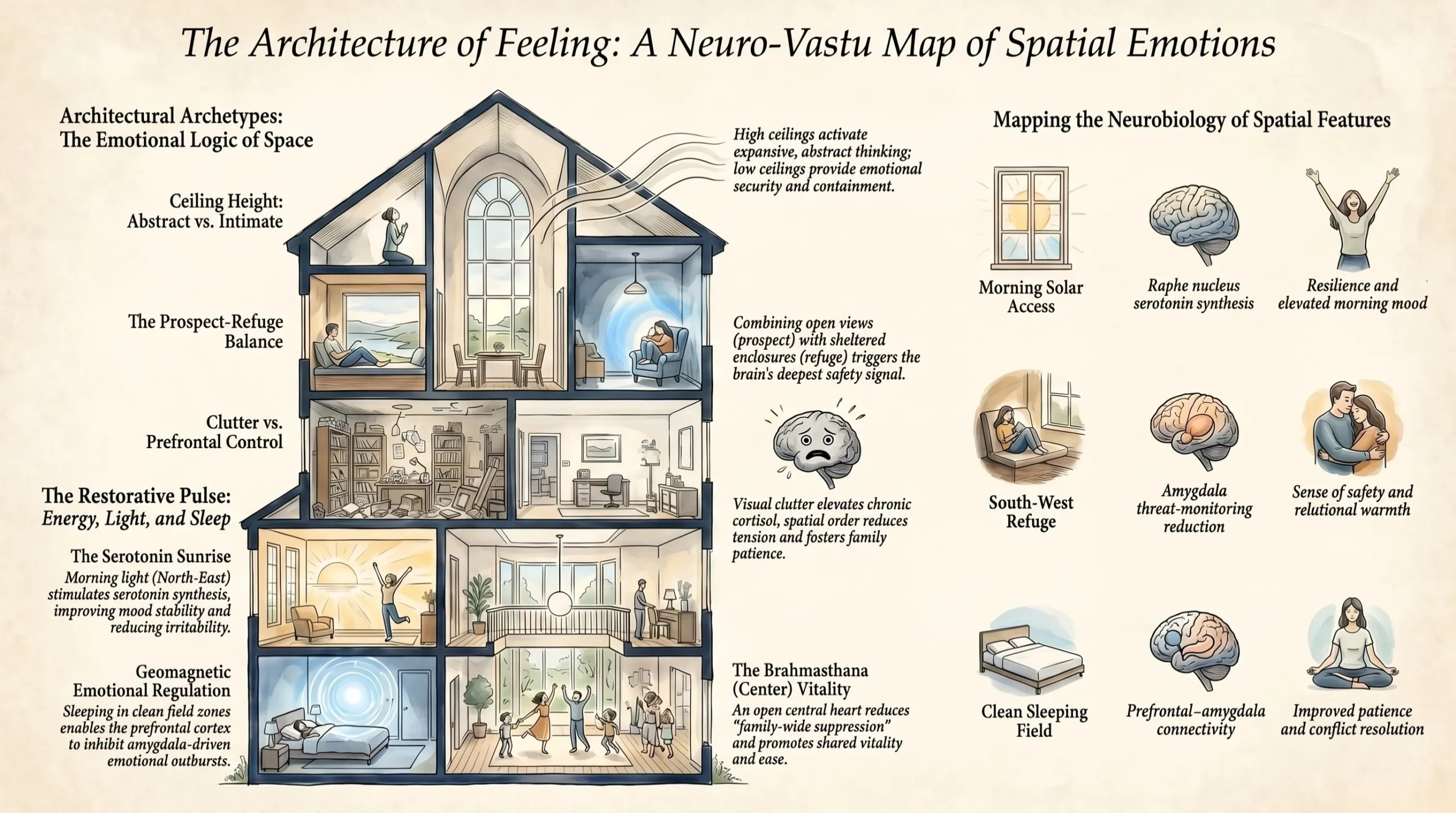
What is the complete map of spatial features and their emotional outcomes?
The following table maps nine spatial and environmental features to their Vastu principles, emotional mechanisms, neurobiological pathways, evidence quality, and observable emotional outcomes. This is the most comprehensive single reference connecting specific spatial arrangements to specific emotional consequences — grounded in environmental psychology, affective neuroscience, and twenty years of family assessment outcomes.
|
Spatial / Environmental Feature |
Vastu Principle |
Primary Emotional Mechanism |
Neurobiological Pathway |
Evidence Quality |
Observable Emotional Outcome |
|
Ceiling height — high vs low in different zones |
Zone-appropriate proportional character; Brahmasthana sky connection |
High ceilings in living and study zones activate abstract thinking and expansive emotional processing; low ceilings in intimate zones (bedrooms) support comfort and containment; the brain reads spatial volume as emotional register |
Prefrontal cortex activation increases with ceiling height (embodied cognition research); ceiling height modulates self-regulatory breadth vs detail focus; amygdala arousal is lower in spacious environments when adequate refuge quality is also present |
Strong — multiple independent studies; Meyers-Levy and Zhu 2007; embodied cognition research |
High living zone ceiling: broader thinking, reduced tension, expanded perspective. Low intimate bedroom ceiling: emotional security and comfort without claustrophobia when natural light is adequate |
|
Prospect and refuge balance — views outward vs sheltered enclosure |
SW zone refuge quality; NE zone prospect and openness; directional zone character in living vs sleeping areas |
Evolutionary survival need for simultaneous prospect (information about threats and opportunities) and refuge (safety and shelter); environments that provide both simultaneously activate the deepest sense of safety and ease in the nervous system |
Appleton prospect-refuge theory; limbic system safety assessment; amygdala threat monitoring reduced when both prospect and refuge cues are simultaneously available; parasympathetic activation |
Strong — Appleton 1975; evolutionary landscape aesthetics extensive literature; Bratman and colleagues environmental neuroscience |
Reduced background anxiety; sense of ease and safety without claustrophobia; emotional calm that supports relational warmth and patience |
|
Natural light quality and direction in living zones |
North-east morning light; northern sky diffuse light in study zones; controlled solar access in living zones |
Natural light quality modulates mood through serotonin and dopamine synthesis; morning light specifically elevates serotonin via raphe nucleus activation; diffuse northern light produces emotional calm; direct bright light produces alertness |
Raphe nucleus serotonin synthesis stimulated by morning light; dopaminergic mesolimbic reward pathway activation by natural light quality; mood disorder correlation with light deprivation well-documented |
Strong — seasonal affective disorder research; photobiomodulation and mood; light therapy clinical evidence |
Elevated morning mood and emotional resilience; reduced afternoon irritability; improved emotional recovery speed after stressors; lower generalised anxiety baseline |
|
Clutter and spatial order — Brahmasthana clearance and zone function integrity |
Brahmasthana openness; zone function appropriateness; material quality in each zone |
Visual clutter produces chronic low-level cortisol elevation; the brain’s threat-monitoring system treats unresolved visual complexity as low-grade environmental stress; spatial order activates the prefrontal cortex’s sense of control and reduces amygdala vigilance |
Prefrontal cortex executive load from visual complexity; cortisol elevation from chronic environmental uncertainty cues; limbic system visual environment assessment for safety and order |
Strong — Saxbe and Repetti 2010 (cortisol and clutter); visual complexity and stress extensive literature |
Reduced background tension; improved sense of control; faster emotional recovery; reduced family conflict in cleared spaces (reported by multiple families in longitudinal assessments) |
|
Sleeping zone geomagnetic field quality |
Geopathic stress avoidance; sleeping in clean earth field zone |
Undisturbed slow-wave sleep enables full prefrontal cortex restoration overnight; prefrontal inhibition of amygdala response (top-down emotional regulation) depends on prefrontal restoration quality; chronically sleep-deprived prefrontal cortex loses amygdala inhibitory capacity |
Prefrontal–amygdala connectivity is sleep-dependent; slow-wave sleep restores prefrontal inhibitory tone; amygdala reactivity increases with sleep debt; emotional dysregulation is a primary symptom of sleep deprivation across all age groups |
Strong — Walker sleep and emotion regulation research; prefrontal–amygdala and sleep multiple independent studies |
Improved emotional regulation; reduced disproportionate reactions; greater patience; better conflict resolution; reduced anxiety in children whose sleeping zone is corrected |
|
Bedroom electromagnetic environment (RF and ELF) |
Sleeping zone prana quality; artificial EMF removal |
Melatonin suppression from bedroom RF degrades slow-wave sleep; prefrontal cortex restoration incomplete; emotional regulation capacity reduced; additionally, chronic mild sleep deprivation produces the specific emotional profile of elevated negative affect and reduced positive affect |
Same prefrontal–amygdala mechanism as geopathic stress; amplified by: melatonin’s own direct anxiolytic effect (melatonin receptors in amygdala modulate fear response directly); suppressed melatonin removes this direct anxiolytic protection |
Strong — melatonin and anxiety/mood research; Walker emotional dysregulation and sleep; amygdala melatonin receptor function |
Reduced baseline anxiety; reduced evening irritability; improved emotional resilience; better morning mood; in children, reduced emotional reactivity and improved behavioural regulation |
|
Biophilic material surfaces — natural stone, timber, terracotta, lime |
Natural material prescription; Pancha Bhuta elemental character |
Natural material textures, warmth, and colour variation activate the autonomic nervous system’s parasympathetic shift through the evolved biophilic visual pathway; natural materials signal environmental safety to the limbic system in a way synthetic materials do not |
Koniocellular visual pathway and subcortical projections to amygdala and hypothalamus; Ulrich’s stress recovery theory; natural environments reduce salivary cortisol and salivary amylase (sympathetic nervous system activation markers) |
Strong — Ulrich stress recovery theory; biophilia and cortisol extensive; natural material contact and autonomic tone research |
Reduced resting cortisol; lower sympathetic baseline; improved sense of home as safe and restorative; emotional ease that families describe as ‘the home holds us’ |
|
Zone function appropriateness — sleeping in SW, working in north, cooking in SE |
Vastu Purusha Mandala zone allocation; elemental zone character |
Zone function misalignment creates a persistent low-grade spatial dissonance — the nervous system receives conflicting messages about what activity the space supports; sleeping in a high-solar-energy zone or working in a thermally unstable zone produces subtle but persistent emotional friction |
Predictive processing (Karl Friston); the brain continuously generates predictions about the spatial environment; mismatched zone function creates prediction error that maintains low-level arousal and uncertainty; resolved by zone function correction |
Moderate — spatial congruence and emotional comfort research; predictive processing and environment not yet directly Vastu-studied but mechanistically coherent |
Reduced background sense of unease in the home; improved sense that the space ‘works’; greater ease in activity transitions; emotional harmony between what the space offers and what the occupant needs |
|
Thermal environment of sleeping zone — SW bedroom stable at 18–20°C |
SW thermal mass; circadian temperature support |
Core body temperature decline enables deep sleep and emotional processing; deep sleep REM phase processes emotional memories, reduces emotional intensity of difficult experiences, and restores the emotional regulation capacity that waking emotional demands deplete |
Walker REM sleep and emotional memory processing; emotional memory consolidation in REM; emotional regulation the morning after REM vs non-REM sleep; sleep-dependent emotional memory reprocessing |
Strong — Walker sleep and emotion extensively peer-reviewed; REM and emotional memory processing well-characterised |
More settled emotional state in the morning after quality REM sleep; better emotional perspective on difficult experiences; reduced emotional reactivity; improved capacity for empathy and relational warmth |
Reading this table as a whole, what emerges is a portrait of the Vastu home as an emotionally intelligent environment — one whose spatial arrangements have been calibrated, across five thousand years of accumulated wisdom, to provide the specific neurobiological conditions for emotional wellbeing, relational warmth, and the psychological sense of being in a place that is genuinely supportive of the people who live in it. Every row of the table represents a specific environmental investment in emotional health that the conventionally designed home does not make — and that the families who live without it experience as the chronic emotional depletion, background tension, and cyclical conflict that brought them to Vastu assessment.
The most striking pattern across the table is the column on neurobiological pathway: in every case, the mechanism runs through the autonomic nervous system’s balance between sympathetic activation and parasympathetic recovery. The Vastu home is a home that continuously tips the nervous system toward parasympathetic dominance — toward the physiological state of safety, ease, and restorative engagement that is the biological foundation of emotional wellbeing, relational generosity, and the capacity for patient, loving presence with the people who matter most
Why does clutter undermine emotional wellbeing — and what does the Brahmasthana principle say about it?
The relationship between environmental clutter and emotional wellbeing is among the most practically actionable and most thoroughly documented dimensions of environmental psychology’s contribution to the Vastu-emotion connection. Research by Darby Saxbe and Rena Repetti at UCLA — one of the landmark environmental stress studies in the field — documented that women who described their homes as cluttered or unfinished showed elevated cortisol profiles throughout the day, while women who described their homes as restorative showed declining cortisol profiles over the same period. The homes were producing the cortisol pattern, not merely reflecting the occupants’ stress levels.
The neurobiological mechanism for this cortisol-clutter relationship is the brain’s continuous visual monitoring system. The prefrontal cortex and anterior cingulate cortex maintain a continuous low-level monitoring of the visual environment for unresolved tasks, incomplete information, and environmental ambiguity that requires attention. Visual clutter — the stacked papers, the overcrowded shelves, the objects without designated places, the corridors blocked by storage — represents a continuous stream of visual signals that say to the monitoring brain: there is unfinished business here, there are unresolved tasks, there is ambiguity that requires your attention. This monitoring consumes prefrontal cognitive and emotional resources continuously and involuntarily. It is not experienced as consciously attending to the clutter — it is experienced as the vague tension, the inability to fully relax, the sense that something needs doing that characterises the cluttered home’s occupants’ emotional baseline.
The Brahmasthana prescription — Vastu’s insistence on an open, unobstructed, materially simple central zone at the home’s geometric heart — is the tradition’s most direct spatial response to this emotional-cognitive load problem. The open Brahmasthana provides the visual relief that the monitoring brain requires: a space whose simplicity, openness, and material clarity signals ‘here, there is nothing unresolved, nothing requiring attention, nothing threatening or ambiguous.’ This visual relief activates the anterior cingulate cortex’s resolution response — the neural signal that says ‘this environment is managed, safe, and complete’ — and produces the parasympathetic shift that is experienced as the home feeling easy and light rather than heavy and pressing.
What is the emotional difference between a cleared Brahmasthana and a cleared storage room?
Families who have implemented the Brahmasthana clearance correction sometimes ask me: ‘I have decluttered my study and my bedroom — why hasn’t it produced the emotional improvement you predicted?’ The answer lies in the specific spatial quality of the Brahmasthana correction that distinguishes it from general decluttering, and that makes it the most emotionally potent single spatial correction available in the home.
The Brahmasthana is not simply a clear room. It is the home’s geometric centre — the spatial point from which every other room relates, around which the building’s spatial experience is organised, and to which the occupant’s spatial perception continuously, subconsciously, refers as the home’s primary orientation point. Clearing this specific spatial position — not a peripheral room, not a study or a bedroom, but the actual geometric centre of the living space — produces a different psychological and neurological effect than clearing any other space. It produces the experience of the home’s centre holding: the sense that the space’s core is calm, open, and ordered, from which every peripheral zone can be experienced as appropriately contained and purposeful.
In traditional Indian architecture, the Brahmasthana is the courtyard — the open sky-connected heart of the home around which all rooms are organised, into which all rooms open, and whose qualities (light, air, openness, natural sound) permeate every adjacent room. In modern apartment living, the Brahmasthana is most commonly the corridor or central hall — often the most cluttered space in the home, used as overflow storage, laundry staging, furniture accumulation, and the repository of objects that have no other place. Clearing this specific space — even when it produces no additional functional benefit, even when the cleared area is not used for any activity — produces an emotional quality change in the whole home that families consistently describe as the most surprising and most immediate outcome of all their Vastu corrections.
The Brahmasthana clearance is free. It requires no purchase, no professional involvement, and no structural change. It requires only the decision to reclaim the centre of the home for its intended purpose: to be the home’s breathing space — the visual and spatial anchor that tells the nervous system that this home is in order, that its centre holds, and that the people who live in it are, in this space, genuinely at rest.
How does prospect-refuge theory explain the Vastu bedroom's emotional design?
The prospect-refuge balance — the simultaneous presence of visual openness and sheltered enclosure that the human nervous system has evolved to read as the highest-quality environmental safety signal — is expressed with particular precision in Vastu’s master bedroom prescription. Understanding why the south-west bedroom’s specific spatial qualities produce the emotional conditions that the sleeping body and the resting mind require illuminates one of the tradition’s most practically valuable and most neurobiologically sophisticated design prescriptions.
The master bedroom’s prospect-refuge requirements are different from those of the living room or the study — because the emotional needs of the sleeping and resting body are different from those of the socially engaged, cognitively working, or recreationally active body. The sleeping body requires maximum refuge: the solid, protective, thermally stable south-west wall at the back of the sleeping position; the contained, lower-ceiling character of the sleeping zone; the minimum openings on the south and west faces that reduce the visual and acoustic prospect to the ambient evening and night environment. The sleeping body does not need to monitor the landscape for threats. It needs the neurobiological signal that the shelter is complete, the enclosure is protecting, and the monitoring brain can stand down.
The prospect-refuge prescription for the sleeping zone is therefore: maximum refuge characteristics on the south and west faces (solid walls, thermal mass, minimum openings); moderate prospect on the east face (windows for morning solar access and visual connection to the morning sky); and the sleeping body positioned with its back toward the south-west solid wall, facing toward the room’s east or north-east. This configuration provides the neurological signal of safety that the amygdala requires to allow its overnight monitoring activity to disengage — to permit the quality of sleep that deep rest requires, rather than maintaining the background vigilance that an inadequately refuged sleeping position produces.
The family member who cannot fall asleep despite exhaustion — whose mind continues to run, to rehearse, to monitor — often has a sleeping position that is providing insufficient refuge. The bed positioned against the east wall facing the door is an emotionally unsupported sleeping configuration: the back is against the east wall (minimum thermal mass, most open morning face), the visual prospect is the room’s entry (triggering the evolved monitoring response to the most socially exposed spatial position). Moving this bed to the south-west corner, with the solid south-west wall at the back and the head oriented south, produces an immediate and sometimes dramatic improvement in sleep onset ease — because it delivers, for the first time, the neurobiological refuge signal that the sleeping amygdala has been waiting for.
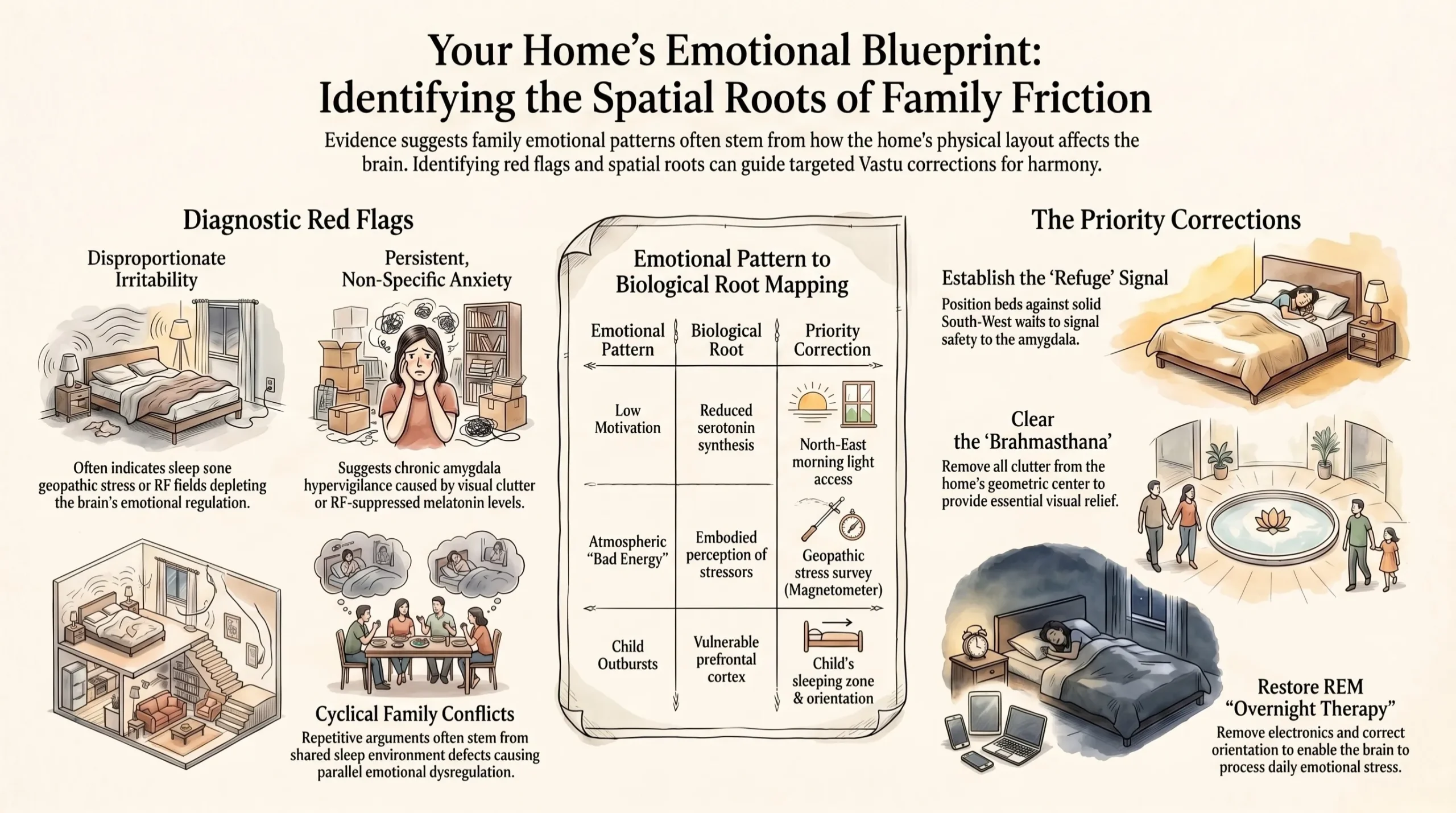
What emotional patterns indicate that a family's difficulties have correctable spatial roots?
The emotional patterns that most reliably indicate spatial and environmental Vastu roots are those whose character, timing, and context suggests environmental origin rather than purely internal psychological origin. The following diagnostic table maps seven emotional patterns to their most likely spatial and environmental roots, their key diagnostic questions, and the priority corrections that the Health-Focused Energy Correction service assesses.
|
Emotional Pattern in the Home |
What It Suggests Biologically |
Most Likely Spatial / Environmental Root |
Key Confirming Question |
Priority Correction |
|
Disproportionate irritability — small things trigger large reactions, especially toward family members |
Prefrontal inhibition of amygdala response is depleted; the top-down emotional regulation that converts impulse into considered response is insufficient; most commonly from sleep deprivation |
Geopathic stress zone or RF field in sleeping zone degrading slow-wave sleep and prefrontal restoration; OR head-north orientation producing poor HRV and insufficient prefrontal recovery |
Does the irritability worsen after poor sleep nights? Is it significantly better after genuine holidays with good sleep? Which family member sleeps above the suspected stress zone and is most irritable? |
Magnetometer geopathic survey; RF measurement at sleeping position; sleeping orientation correction — prefrontal restoration timeline 3–6 weeks |
|
Persistent anxiety without clear trigger — background unease, not specific fear |
Chronic amygdala hypervigilance; autonomic sympathetic overactivation; melatonin’s direct anxiolytic effect at amygdala receptors is absent from RF-suppressed individuals; OR geopathic stress chronically activating HPA axis |
Bedroom RF field suppressing melatonin — whose amygdala receptor effect directly modulates anxiety baseline; AND/OR geopathic stress chronically activating the HPA axis through its sleep disruption mechanism; AND/OR clutter and visual complexity maintaining chronic cortisol elevation |
Is the anxiety worse at home than elsewhere? Does it feel physical (physiological arousal without cognitive trigger) rather than cognitive (worry thoughts)? Does it reduce on holidays without specific reason? |
RF assessment and geopathic survey as priority; Brahmasthana clearance; clutter reduction in primary living zones; melatonin restoration timeline 2–4 weeks |
|
Family conflicts that feel cyclical and disproportionate — the same arguments return regardless of resolution |
Not primarily a communication problem; likely a shared sleep environment problem producing parallel prefrontal regulation impairment in multiple family members simultaneously |
A shared sleeping environment defect — geopathic stress zone affecting the family’s main sleeping area, or a router serving the whole bedroom floor — is simultaneously degrading prefrontal regulation in multiple family members, producing the parallel emotional dysregulation that manifests as cyclical conflict |
Do the arguments happen more frequently after nights of poor household sleep? Are all affected parties sleeping in the same geomagnetically or electromagnetically compromised environment? Do the conflicts significantly reduce during holidays where sleeping conditions differ? |
Full household sleeping zone assessment; correction of the shared zone defect producing parallel family emotional dysregulation |
|
Low motivation and emotional flatness — absence of enthusiasm rather than presence of sadness |
Dopaminergic reward pathway underactivation; serotonin synthesis reduced; most commonly from inadequate morning solar light entrainment producing insufficient serotonin synthesis and blunted CAR |
Blocked north-east morning light in primary waking and living zones; OR apartment facing south-west with no morning solar access; OR north-east zone used as store reducing morning light entry to living areas |
Is the flatness specifically a morning-to-midday phenomenon? Does it improve noticeably on bright sunny days? Does it improve on holidays in naturally lit settings? |
North-east morning solar access assessment; NE zone function review; morning light prescription; serotonin synthesis restoration timeline 2–4 weeks of improved morning light |
|
Emotional sensitivity to the home’s ‘atmosphere’ — a feeling that the home has bad energy, that something is wrong |
This is not superstition; it is the nervous system’s embodied perception of subtle environmental stressors that are operating below conscious threshold; the somatic anxiety of unresolved environmental signals |
Usually geopathic stress — which produces the specific physical-emotional experience most often described as ‘the house feels heavy’ or ‘something is wrong here’; OR zone function misalignment producing persistent spatial dissonance |
Is the feeling specific to certain rooms or areas of the home? Is it strongest in the sleeping area? Does it persist despite efforts to redecorate or rearrange? Is it noticed more strongly by certain family members (children and animals are often most sensitive)? |
Magnetometer geopathic stress survey as highest priority — this is the defect most associated with the described atmospheric experience; zone function review as secondary |
|
Emotional withdrawal at home — preference for being elsewhere, reluctance to spend time in the home |
The home is not providing the emotional restoration that the nervous system requires; the built environment is producing net emotional depletion rather than restoration; the occupant is correctly, instinctively, seeking restoration elsewhere |
Biophilic environment deficiency — synthetic materials, artificial light, absence of natural views, sealed indoor environment; AND/OR sleeping zone defects producing chronic fatigue that makes the home feel like the place of depletion rather than restoration |
Is the preference for being elsewhere specifically about outdoor environments or naturally lit spaces? Does the individual feel differently about their bedroom than the rest of the home, or is the withdrawal from the whole home? |
Natural material improvements in primary living zones; north-east light access; Brahmasthana clearance; sleeping zone correction — combined programme addressing both the depletion mechanism and the restoration deficit |
|
Children’s emotional difficulty — increased anxiety, emotional outbursts, poor frustration tolerance |
The developing prefrontal cortex is more sleep-sensitive and more biophilically responsive than the adult brain; children are the most vulnerable household members to environmental emotional regulation impairment |
Sleeping zone defects in the child’s bedroom — geopathic stress, RF from parental router through shared wall, incorrect sleeping orientation; AND/OR biophilically impoverished bedroom environment producing insufficient neurological restoration during sleep and waking |
Is the child significantly more settled on holidays or weekends without structure? Does the child sleep in the same room as or adjacent to the household’s primary Wi-Fi router? Is the child’s bedroom finished with synthetic materials and artificial light without natural elements? |
Child’s sleeping zone as highest priority — same assessment as adult but with greater urgency; children’s developing brains are more vulnerable to the emotional regulation impairment produced by sleeping zone defects |
The diagnostic pattern across this table shares a common thread: environmental emotional effects are characterised by their relationship to the home environment specifically (better when away, worse when at home), by their physical character (the anxiety feels somatic rather than cognitive, the irritability feels physiological rather than situational), and by their consistency across family members (the same emotional patterns in multiple people sharing the same space are almost always environmental rather than coincidentally individual).
The single most clarifying diagnostic question for any family experiencing these emotional patterns is the one I always ask first: ‘Tell me how you feel at the end of a day spent entirely at home, compared to how you feel at the end of a comparable day when you have been out.’ If the answer is ‘worse at home,’ the home’s physical environment is a significant emotional health factor. If the answer is ‘the same wherever I am,’ the emotional challenges are more likely internal in origin. The home-at-end-of-day question is the fastest and most reliable filter for identifying the families whose emotional wellbeing will be most dramatically improved by environmental Vastu correction.
How does natural light in the home directly shape emotional regulation?
Natural light is the environmental factor with the most extensively documented and most directly measurable effect on human emotional regulation — and the Vastu prescription for maximising morning solar access through the north-east zone, for protecting diffuse northern sky light in study and reading zones, and for managing direct solar gain carefully across all zones is, in its emotional dimension, a prescription for optimal daily mood, serotonin regulation, and emotional resilience throughout the day.
The mood-regulating effects of natural light operate through two primary biological pathways. The first is the serotonin synthesis pathway: morning light activates serotonin synthesis in the brain’s raphe nucleus through a retinal photoreceptor pathway that is sensitive to the morning solar spectrum’s brightness and spectrum composition. Serotonin — the neurotransmitter most associated with mood stability, emotional resilience, and the sense of ease and wellbeing — is synthesised in greatest daily quantity during the morning light exposure period and declines through the afternoon. A family member who receives abundant morning solar light through a well-oriented north-east zone begins the day with a serotonin synthesis advantage that translates into greater emotional resilience, more stable mood throughout the day, more patient and generous relational engagement, and reduced vulnerability to the afternoon mood decline that many people experience as their patience and warmth diminish.
The second pathway is the cortisol awakening response, discussed at length in the circadian rhythm article in this series. The CAR’s emotional significance is that it activates the prefrontal cortex’s executive emotional regulation network — the neural systems responsible for converting emotional impulse into considered response, for maintaining patience under provocation, and for the compassionate attunement with others that relational warmth requires. A full-amplitude CAR, triggered by adequate morning light exposure, means that the family member’s emotional regulation system comes online at full capacity from the morning’s first social interaction. A blunted CAR, from blocked north-east light or from the sleep deprivation that other Vastu defects produce, means the emotional regulation system starts the day at reduced capacity — a deficit that compounds as the day progresses and emotional demands accumulate.
The afternoon emotional pattern that many Indian families describe — the parent who is patient and loving in the morning but becomes short-tempered and emotionally depleted by the time the children return from school; the professional who is engaged and generous with colleagues through the working day but arrives home to find their emotional reserves empty — is, very frequently, the natural trajectory of a morning that began with insufficient serotonin synthesis and a blunted CAR. The morning light environment is not merely a chronobiological factor. It is the emotional baseline from which the entire day’s relational life unfolds.
One of the most practically significant and most rapidly observable improvements from Vastu correction is the improvement in morning emotional quality that follows north-east light maximisation — and the upstream family effects that improvement produces. A mother who begins her morning with full serotonin synthesis and a robust CAR responds differently to her children’s morning demands than the same mother beginning with inadequate light entrainment and a blunted cortisol response. The quality of the morning light in the north-east zone of the home is the single most emotionally consequential spatial decision available to a family building or renovating — and one of the most immediately observable corrections in any existing home.
What does REM sleep's emotional processing reveal about the relational quality of the Vastu home?
The relationship between REM sleep quality and the quality of family relationships — the relational warmth, patience, empathy, and conflict resolution capacity that determine whether the home is experienced as a place of connection or a place of friction — is one of the most practically significant and least discussed dimensions of the Vastu-emotion connection. Understanding it transforms the sleeping zone assessment from a health optimisation exercise into a relational wellbeing intervention of the first order.
The relational consequences of REM sleep impairment are as well-documented as the cognitive consequences. Matthew Walker’s research group at Berkeley has demonstrated that sleep-deprived subjects show reduced empathic accuracy — the ability to correctly read others’ emotional states from facial expression and tone of voice; elevated social threat perception — interpreting neutral or ambiguous social signals as hostile or rejecting; reduced prosocial motivation — the inclination to invest effort in others’ wellbeing; and increased self-focused rather than other-focused emotional processing. These are the specific emotional and social changes that sleep-deprived people find most damaging to their relationships — not the reduced cognitive performance or the physical fatigue, but the loss of the emotional attunement with their family members that makes daily life together feel harmonious rather than conflicted.
In the home context, the relational consequences of chronic sleeping zone Vastu defects produce a specific and recognisable family emotional pattern. One or more family members — typically those sleeping above the geopathic stress zone or closest to the bedroom RF source — become progressively less emotionally patient, less relationally warm, and more prone to disproportionate conflict responses over months and years of chronic REM disruption. The other family members — perhaps sleeping in cleaner environmental conditions in different rooms or less sensitive to the shared defect — experience this change as the emotionally affected member becoming ‘more difficult,’ ‘less present,’ or ‘harder to live with.’ The emotionally affected member, lacking the external reference of the clear sleep they have lost, often attributes their relational difficulties to stress, work demands, or the other family members’ behaviour — rather than to the environmental impairment of the emotional processing system that their relationships depend on.
When the sleeping zone corrections are implemented — the bed moved away from the stress zone, the router relocated, the orientation corrected — the relational improvement is typically the outcome that produces the most profound family gratitude. It is not the immune improvement or the cognitive clarity that generates the most emotional responses from the families I work with. It is the mother who says ‘I have my husband back.’ The child who says ‘Mamma is happy again.’ The couple who says ‘we haven’t argued in three weeks — we don’t know what happened but we are afraid to change anything in case it comes back.’ The home’s sleeping zone is the foundation of the family’s relational life — because it is where the brain’s overnight emotional repair and relational attunement restoration either occurs or is prevented from occurring by the physical conditions of the space.
What does the Health-Focused Energy Correction deliver for emotional and relational wellbeing?
The Health-Focused Energy Correction service is not a psychological service, a counselling service, or a relationship therapy service. It is an environmental health assessment — grounded in the physical sciences of building biology, neuroscience, and environmental psychology — that addresses the physical environmental conditions most consequential for the emotional and relational wellbeing of the families it serves. But within that scope, the emotional and relational improvements it produces are among the most significant and most personally meaningful outcomes the service delivers.
Every correction in the Health-Focused Energy Correction programme addresses, through its primary physical mechanism, at least one of the neurobiological pathways through which the home’s physical environment shapes the family’s emotional experience. The geopathic stress correction restores the slow-wave sleep quality on which prefrontal emotional regulation depends. The RF elimination restores melatonin amplitude — protecting both the prefrontal restoration that allows emotional regulation and the amygdala anxiety modulation that melatonin’s receptor function directly provides. The sleeping orientation correction restores sleep-period HRV and the autonomic emotional balance of the night. The north-east light correction restores serotonin synthesis and the CAR that activates the emotional regulation system at the start of each day. The Brahmasthana clearance removes the chronic amygdala activation of visual environmental disorder.
For families in whom emotional patterns are the primary presenting concern — the persistent family conflict, the chronic anxiety, the emotional flatness, the child’s emotional difficulty — the Health-Focused Energy Correction service includes an explicit emotional wellbeing mapping component. I document the specific emotional patterns, map them to the spatial and environmental defects most likely to be contributing to each pattern, and provide a specific predicted emotional improvement timeline for each correction. This framework gives the family both the understanding of why their emotional experience at home is what it is, and the confidence that the corrections they are implementing will address it — not vaguely, not eventually, but specifically and in the predicted timeline.
I want to close this article with the observation that has stayed with me most consistently across twenty years and thousands of families: the improvement that matters most to the families I work with is not the immune metric, not the blood pressure, not the sleep duration number. It is the quality of emotional life in the home — the warmth, the patience, the ease of being together, the sense that the home is a place that holds rather than depletes the people who live in it. This is what Vastu is ultimately for: not a healthy house in the abstract, but a home where human beings can live, love, and restore themselves in the way they deserve to. And the physical environmental corrections that make this possible are among the most important contributions that a correctly practised Vastu tradition can make to any family’s life.
Real Case Study — A Hyderabad Family Whose Cyclical Conflict Resolved in Three Weeks:
A family in Hyderabad — husband and wife, both in their late thirties, two children aged nine and twelve — came to me not with a health concern but with a domestic one. ‘We have been through couples counselling, communication workshops, and multiple attempts to change our patterns,’ the wife explained. ‘The arguments keep coming back. They are always about the same things but they are not really about those things. We are good people having the same bad conversations in the same rooms. Our therapist suggested we look at the space.’
The assessment found what I expected it to find in a family presenting with this specific pattern: a geopathic stress zone running through the bedroom directly beneath both the master bed and the larger child’s bed; the household router mounted on the shared wall between the master bedroom and the hallway at 4,100 microWatt per square metre at the master sleeping position; both parents sleeping head-north; the central zone of the apartment — a generous corridor that could be the home’s Brahmasthana — packed with furniture overflow, school bags, exercise equipment, and years of accumulated domestic accumulation.
I explained each mechanism. For the geopathic stress: the prefrontal-amygdala connection, the sleep deprivation emotional regulation impairment, the parallel emotional dysregulation in two people sharing the same environmentally compromised sleeping space. The husband, who was an engineer, interrupted: ‘Both of us are running on depleted prefrontal regulation every morning. We are both more reactive than we want to be. And we are attributing it to each other.’ I said: ‘That is exactly what I observe in families with this pattern.’
I explained the melatonin-amygdala pathway for the RF field. I showed them that melatonin has its own direct anxiolytic effect through amygdala receptors — that their bedroom router was not only impairing their sleep but was removing a direct biological protection against anxiety and irritability that their amygdalae were supposed to have each night.
Three corrections: beds repositioned to the south-east of the bedroom, clearing the stress zone (confirmed clean at the new position by magnetometer); router moved to the study on the other side of the apartment; corridor Brahmasthana completely cleared over one weekend.
Three-week follow-up: ‘We have not had a single significant argument. I do not know how to describe it except that we feel like ourselves with each other again. The children have noticed. My nine-year-old asked if we had done something different because the house feels better. We are almost afraid to talk about it in case it goes away.’ The husband’s note: ‘The engineering explanation was what made us implement immediately. Parallel prefrontal depletion in a shared sleep environment. It is so obvious in retrospect. Why is this not standard domestic advice?’
What Vastu Understood About the Emotional Home That Architecture Schools Are Only Now Beginning to Teach:
For most of the twentieth century, architectural education treated the emotional dimension of built environments as an aesthetic concern — a matter of subjective preference, cultural association, and individual taste that was beyond the scope of technical architectural science. The hard sciences of the building — structure, thermal performance, acoustics, services — were considered the architectural curriculum’s proper domain. Emotions were someone else’s department.
This division is now, belatedly, being corrected. Environmental neuroscience, evolutionary psychology, and affective science have produced enough evidence over the past three decades to make the emotional performance of built environments as scientifically discussable as their thermal performance. The prospect-refuge balance, the amygdala calibration effects of visual complexity, the serotonin and cortisol consequences of natural light quality, the REM emotional processing dependence on sleeping zone thermal and electromagnetic quality — these are now topics that appear in architecture schools, in hospital design guidelines, in workplace wellness research, and in residential product marketing.
What is remarkable, and what I would like architecture schools to recognise, is that the tradition that most comprehensively addressed the emotional performance of residential environments was not written in the twentieth century. It was not written in the nineteenth century. The Manasara — the most systematically comprehensive Vastu text on residential design — was written in a civilisation that had been observing the relationship between building design and human emotional and social wellbeing for so long, so carefully, and so empirically that it had produced a set of residential design prescriptions that addresses, with remarkable specificity, every major finding of the environmental psychology and affective neuroscience that modern architecture is now beginning to take seriously.
The conversation between Vastu scholarship and architectural education is one of the most important and most overdue intellectual exchanges available in contemporary building culture. This article is my contribution to beginning it.
Your Home Is Either Building Your Emotional Resilience or Draining It. We Measure the Difference.
Persistent irritability. Background anxiety. Cyclical family conflict. The child who is easy everywhere but home. The emotional depletion that arrives at your own front door. These are not character flaws or family problems beyond your reach. For many Indian families, they are the specific, correctable emotional consequences of specific, identifiable physical environmental conditions — conditions that the Health-Focused Energy Correction service assesses with instrument precision and addresses with neurobiological mechanism grounding and a 100% satisfaction guarantee.
Your Health-Focused Energy Correction for emotional and relational wellbeing delivers:
- Geopathic stress magnetometer survey — sleeping zone earth energy assessed; parallel family emotional dysregulation pattern identified; prefrontal-amygdala restoration timeline predicted for each affected family member
- Bedroom RF assessment — melatonin amygdala anxiolytic pathway evaluated; REM emotional processing quality assessed; anxiety and irritability correction with specific timeline
- ELF field measurement — bedroom wiring assessed; autonomic evening emotional baseline impact evaluated
- Sleeping orientation — head-South or head-East prescription; HRV and emotional regulation mechanism explained; relational warmth restoration timeline predicted
- North-east morning light assessment — serotonin synthesis pathway evaluated; CAR amplitude and morning emotional regulation prediction; daily emotional baseline restoration timeline
- Brahmasthana clearance assessment — central zone clutter impact evaluated; amygdala visual monitoring load assessed; emotional ease restoration through spatial order
- Zone function congruence review — sleeping, working, cooking, and living zones assessed for spatial dissonance; zone function corrections prescribed for emotional coherence
- Prospect-refuge balance assessment — sleeping position and living zone spatial configuration for neurobiological safety signals; refuge quality of master bedroom assessed and corrected
- Emotional wellbeing mapping — family’s specific emotional patterns mapped to identified environmental defects; neurobiological mechanism explained for each; emotional restoration timeline predicted
- REM sleep quality assessment — sleeping zone conditions for emotional memory processing evaluated; specific corrections prescribed with relational wellbeing restoration timeline
- One-on-one consultation with Mukesh Shah personally
- Detailed written report — all spatial mechanisms, corrections, and emotional restoration timelines with research references
- 30 days of priority support through your full implementation
- 100% satisfaction guarantee
The home that is on your side emotionally is not an aspiration. It is a specific set of physical environmental conditions — and we know exactly how to measure and correct them.
Book your Health-Focused Energy Correction today at vastumyhome.com
Spatial arrangements influence emotions through several specific neurobiological pathways. The amygdala continuously and automatically assesses the spatial environment for threat signals — visual clutter, inadequate refuge, harsh light, synthetic surfaces — producing chronic cortisol elevation and background anxiety when the environment fails its safety assessment. The prospect-refuge balance (simultaneous visual openness and sheltered enclosure) activates the limbic system’s deepest safety signal, producing parasympathetic emotional ease. Natural light quality drives serotonin synthesis and the cortisol awakening response that activates emotional regulation capacity. REM sleep quality — directly shaped by the sleeping zone’s physical conditions — determines the brain’s overnight emotional memory reprocessing and next-day emotional regulation capacity. These are all physical mechanisms, not cultural or mystical ones.
Visual clutter maintains the brain’s prefrontal cortex and anterior cingulate cortex in a continuous state of low-level environmental monitoring — because unresolved visual disorder signals to the neural monitoring system that there are unfinished tasks, unresolved ambiguity, and environmental uncertainty requiring attention. This monitoring consumes cognitive and emotional resources continuously and involuntarily, producing the chronic cortisol elevation that Saxbe and Repetti’s UCLA research documented in cluttered homes. Clearing the home’s central zone — the Brahmasthana — produces emotional relief disproportionate to the area cleared because the central zone is the spatial reference point from which the rest of the home is experienced. A clear centre signals environmental order to the amygdala and reduces its vigilance baseline.
The sleeping zone affects family relationships through REM sleep quality. During REM sleep, the brain reprocesses emotionally significant experiences in a noradrenaline-free neurochemical environment, reducing their affective intensity and restoring emotional regulation capacity. Sleep-deprived individuals show reduced empathic accuracy, elevated social threat perception, reduced prosocial motivation, and increased emotional reactivity — the specific changes that damage family relationships. Environmental Vastu defects in the sleeping zone (geopathic stress, RF electromagnetic fields, incorrect orientation) disrupt REM architecture, degrading the overnight emotional repair that relational warmth and patience depend on. Correcting the sleeping zone restores REM quality and with it the relational emotional capacities that the family needs.
The experience of ‘bad energy’ or a ‘heavy atmosphere’ is not superstition — it is the nervous system’s embodied perception of subtle environmental stressors operating below the threshold of conscious identification. The most common physical root is geopathic stress — a distortion of the Earth’s geomagnetic field produced by underground water courses or geological fault lines, which the body’s biological magnetic sensing processes detect as environmental disturbance and the nervous system translates into the somatic experience of unease. Zone function misalignment, inadequate spatial refuge quality, and high electromagnetic background can also produce the experienced spatial dissonance described as ‘bad energy.’ An instrument-based Vastu assessment identifies the specific physical root. In the large majority of cases where families describe this atmospheric quality, a magnetometer survey confirms a geopathic zone.
The Health-Focused Energy Correction service delivers instrument-based assessment of the physical environmental factors most consequential for emotional wellbeing: geopathic stress (prefrontal-amygdala emotional regulation impairment from sleep disruption); bedroom RF and ELF fields (melatonin anxiolytic pathway protection and REM emotional processing quality); sleeping orientation (HRV and emotional regulation capacity); north-east morning light (serotonin synthesis and CAR emotional activation quality); Brahmasthana spatial order (amygdala chronic activation from clutter); zone function congruence (predictive processing dissonance); and prospect-refuge balance (limbic safety signal quality). Each finding is explained through neurobiological mechanism; each correction comes with a specific emotional restoration timeline. Delivered with one-on-one consultation with Mukesh Shah, detailed written report, 30 days priority support, and a 100% satisfaction guarantee.
Disclaimer
The environmental psychology, affective neuroscience, and sleep science information in this article is presented for educational purposes. This article does not constitute psychological or psychiatric advice. Vastu environmental correction addresses physical environmental conditions that affect emotional wellbeing; it does not diagnose or treat psychological disorders, relationship difficulties, or psychiatric conditions. Families experiencing significant emotional or relational challenges are encouraged to seek qualified professional support. The emotional patterns described are general educational guidance; individual presentations vary and require professional assessment. Building Biology measurement guidelines cited are precautionary reference frameworks, not regulatory standards.
I Would Love to Hear From You
I would love to hear your story or questions in the comments below. Have you experienced the impact of Vastu in your own home? Are you noticing any of the common defects I described above in your space? Share openly — every question is a step towards greater harmony.
Disclaimer: Vastu analysis and energy corrections are for harmonising your space and personal growth. They are not a substitute for professional medical, financial, legal or architectural advice.