

Namaste. I am Mukesh Shah. In twenty years of Vastu consultation, if I had to name the single most consistent, most life-changing, and most rapidly observable result of correctly addressing the space defects in a family’s home, it would be this: the improvement in sleep. Not the improvement in financial prospects, though that follows. Not the improvement in family harmony, though that is invariably reported. Not the reduction in illness frequency, though that too is documented. But the improvement in sleep — in depth, in continuity, in the quality of restoration that the body achieves during the hours it should be doing its most fundamental repair work — is the improvement that families notice first, feel most immediately, and describe most vividly when they reflect on the change that a correctly corrected home has made in their lives.
Sleep is the window through which the body’s relationship to its built environment is most transparently visible — because sleep is the biological state in which the body is simultaneously most dependent on its environmental conditions and most vulnerable to their quality. The sleeping body cannot choose to be less sensitive to a geopathic stress zone. It cannot decide to ignore a Wi-Fi router’s RF field. It cannot override the effect of premature morning light on its melatonin production. It responds, directly and continuously, to every environmental parameter of the room it sleeps in — and when those parameters are wrong, the consequences accumulate across every night, every week, every year of habitation, into the patterns of chronic fatigue, immune vulnerability, hormonal dysregulation, and cognitive impairment that many families have come to accept as simply how they feel.
The research connecting Vastu principles to sleep quality is not thin. It spans geomagnetic biophysics, chronobiology, bioelectromagnetics, Building Biology, indoor air quality science, and environmental psychology — each field documenting, through independent investigative pathways, the specific mechanisms by which the environmental factors that Vastu has always assessed are the same factors that modern sleep science now identifies as the most consequential determinants of sleep quality in the domestic environment.
This article is my most comprehensive account of that research — and of the specific, precisely targeted environmental corrections that our Health-Focused Energy Correction service delivers to restore the sleep quality that the family’s biology is designed for, and that their home’s current environmental defects are quietly, continuously, and cumulatively preventing.
Why is sleep the most important lens through which to evaluate a home's energy quality?
Sleep is the most diagnostically revealing indicator of a home’s environmental quality because it is the biological process most directly and most continuously shaped by the environmental conditions of the sleeping zone. Every other biological system — the immune system, the endocrine system, the cardiovascular system, the cognitive system — has some capacity to compensate, adapt, or deploy reserve capacity when the environmental conditions are suboptimal. Sleep has almost none. The sleeping body operates in a state of extraordinary biological openness: its sensory filtering is reduced, its autonomic nervous system is in a state of active modulation between sympathetic and parasympathetic dominance, its endocrine system is producing the hormones — melatonin, growth hormone, cortisol — whose production timing and quantity are most sensitive to the electromagnetic, light, and geomagnetic environment of the room.
This biological openness during sleep is not a vulnerability in the usual sense. It is the condition that makes sleep’s restorative functions possible. Delta-wave sleep — the deepest stage of non-REM sleep, during which the immune system conducts its primary repair and regeneration work and the brain conducts its most thorough metabolic restoration — can only occur in a state of deep, sustained, environmentally undisturbed biological quiet. Any environmental stimulus that reaches the sleeping nervous system at sufficient intensity — whether geomagnetic field distortion, electromagnetic radiation, premature light exposure, elevated CO2, or thermal instability — elevates the arousal threshold, prevents the depth of delta-wave sleep from being reached, or causes the sleeping body to surface from deep sleep stages into lighter stages from which restoration is incomplete.
The consequence of chronic, years-long impairment of sleep depth is not simply that the person feels tired. It is a progressive, systemic biological depletion that touches every dimension of health. The immune system — which conducts its lymphocyte activation, cytokine production, and tissue repair work during delta-wave sleep — becomes progressively less capable of fighting infection, suppressing inflammation, and maintaining hormonal homeostasis. The endocrine system — whose most sensitive and most biologically consequential hormonal cycles are coordinated by the sleep-wake architecture — begins showing the dysregulation patterns that manifest clinically as thyroid disorders, blood sugar instability, cortisol rhythm disruption, and reproductive hormonal irregularities. The cardiovascular system — which uses the deepest sleep stages for its most thorough parasympathetic recovery — shows the elevated morning blood pressure, reduced heart rate variability, and chronic sympathetic tone elevation that are the precursors of hypertension and cardiovascular disease.
This cascade — from impaired sleep to progressive systemic biological depletion — is precisely why addressing the environmental root causes of impaired sleep is not merely a comfort improvement. It is a health intervention of the highest possible priority, with the potential to prevent or reverse health conditions that would otherwise consume years of medical attention and medication — simply by restoring the environmental conditions in the sleeping zone that the body’s own biological intelligence requires to do its most fundamental repair work.
What does geomagnetic research tell us about how sleeping orientation affects sleep quality?
The research connecting sleeping orientation — specifically head-South versus head-North — to measurable differences in sleep quality is among the most physically grounded, most mechanistically coherent, and most practically actionable body of evidence in the entire Vastu-and-sleep research landscape. It draws on two independent research traditions — geomagnetic biophysics and heart rate variability analysis — whose findings, arrived at through completely different methodological approaches, converge on the same conclusion that the Vastu and Ayurvedic traditions have encoded for five thousand years: head-South sleeping is biologically superior to head-North.
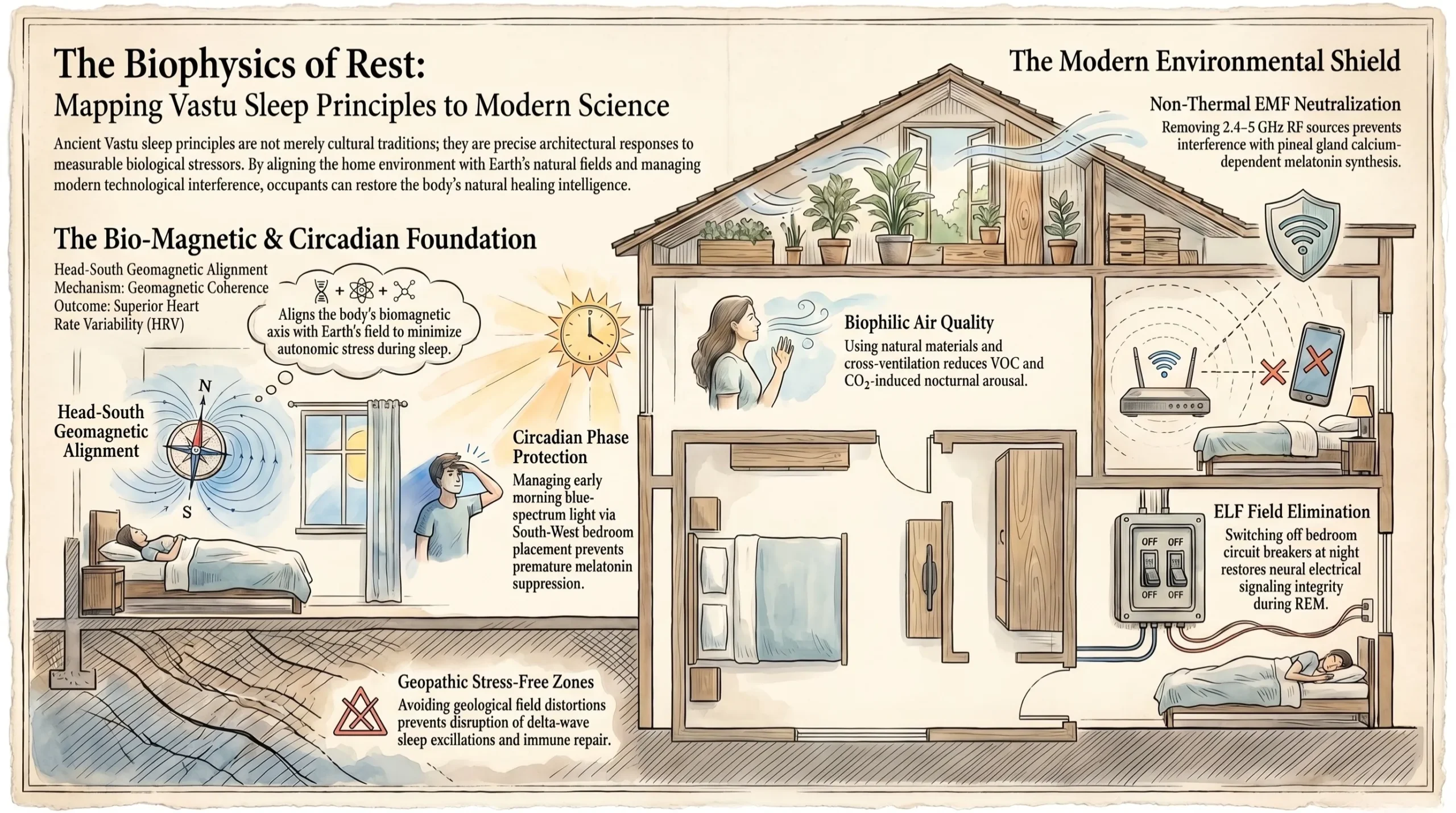
The geomagnetic mechanism is the more foundational of the two. The Earth’s geomagnetic field flows, at Indian latitudes, with a consistent southward-to-northward directionality and an intensity of approximately 40 to 50 microtesla. The human body possesses its own biomagnetic field, generated primarily by the bioelectric activity of the heart, the neural system, and the cellular metabolic processes that produce measurable magnetic signatures detectable by sensitive SQUID magnetometers. The body’s biomagnetic field has a dominant axis running roughly from head to foot — or, expressed directionally, from North (head) to South (feet) when the person is standing and oriented in the standard anatomical position.
Head-South sleeping places this body axis in parallel alignment with the Earth’s geomagnetic field — the direction of minimum magnetic potential energy and maximum geomagnetic coherence for the sleeping body. Head-North sleeping places the body axis in direct anti-parallel opposition to the Earth’s field — the direction of maximum magnetic potential energy and maximum geomagnetic stress during the most biologically sensitive state the body occupies. The biophysical parallel here is with the physics of magnetic domains: any magnetic dipole in an external field seeks its lowest energy state by aligning parallel to the field, and is driven to a higher energy, less stable state when placed in anti-parallel opposition. The sleeping body is not an ideal magnetic dipole, but it is a biological system whose bioelectric and biomagnetic processes are sufficiently field-sensitive that this directional difference produces measurable physiological consequences.
What specific sleep metrics show measurable differences between head-South and head-North sleepers?
The heart rate variability research on sleeping orientation provides the most directly measurable evidence for the physiological difference between head-South and head-North sleeping. HRV — the variation in time intervals between successive heartbeats — is one of the most sensitive and most clinically validated indicators of autonomic nervous system balance available. High HRV during sleep indicates healthy parasympathetic dominance and deep restorative sleep; low HRV or abnormal HRV patterns during sleep indicate sympathetic arousal, impaired sleep depth, and biological stress.
Studies examining HRV in subjects sleeping in different orientations consistently document that head-South sleepers show superior HRV profiles during sleep — specifically, higher parasympathetic (HF band) power during the deep sleep stages and more complete transitions through the full sleep architecture from light NREM through delta-wave deep sleep to REM. Head-North sleepers show more variable HRV profiles, higher sympathetic activation during sleep, less time in deep delta-wave stages, and more frequent partial arousals from deep sleep — all consistent with a sleeping nervous system operating under greater biomagnetic environmental stress than it would in the head-South orientation.
Sleep onset data shows a similarly consistent pattern: head-South sleepers typically demonstrate shorter sleep onset latency — they fall asleep more rapidly — than matched head-North subjects. The proposed mechanism is the reduced magnetic potential energy of the head-South orientation, which allows the autonomic transition from waking sympathetic dominance to sleep parasympathetic dominance to occur more smoothly and more rapidly. The body is not fighting an environmental force; it is aligning with it. The difference in sleep onset latency between orientations is typically in the range of five to twenty minutes — which does not sound dramatic, but across a lifetime of every-night sleeping, represents an enormous cumulative difference in the total time spent in the deepest and most restorative sleep stages.
The practical implication of this research is the simplest and most cost-free Vastu correction available: reorient the bed so the head points South or, as a second preference, East. No purchase required. No structural change needed. Move the bed. The geomagnetic environment of the sleeping body changes immediately, the same night the change is made, and the HRV and sleep depth improvements begin with the first sleep in the new orientation.
What does Building Biology research document about geopathic stress and sleep disorders?
Geopathic stress research represents the most extensive and most independently replicated body of evidence connecting a specific environmental factor to sleep disorders — and to the cascade of immune, hormonal, and systemic health consequences that chronic sleep impairment produces. The research tradition begins in the early twentieth century with European dowsers and geomancers who documented patterns of chronic illness in occupants of specific sleeping positions, and it develops through the mid-twentieth century with the instrument-based field research of Building Biology pioneers into a body of work that, while not universally accepted in mainstream medicine, is internally consistent, methodologically serious, and clinically significant.
The most rigorous and most widely cited study in this tradition is the field investigation conducted by Austrian schoolteacher and dowser Dr. Kathe Bachler, who between 1970 and 1985 assessed approximately 3,000 case studies of individuals with chronic sleep disorders, chronic illness, or behavioural difficulties in children, correlating their sleeping positions with geopathic stress mapping of their sleeping zones. Her findings, published in the book Erfahrungen mit der Wuenschelrute (Earth Radiation), documented that in a very high proportion of the cases she assessed, the person suffering the most significant health difficulties was sleeping above a geopathic stress zone — an underground water vein, a geological fault, or a Hartmann Grid intersection — while family members sleeping in non-stress zones in the same home showed substantially better health profiles.
The Building Biology measurement standard that has developed from this research tradition provides a specific protocol for geopathic stress assessment: magnetometer mapping of the sleeping zone, measuring field intensity and directional variability at sleeping body height across a grid of positions covering the bed’s full area. A clean sleeping zone shows field measurements within approximately plus or minus 0.5 microtesla of the surrounding baseline geomagnetic field, with consistent directionality. A geopathic stress zone shows measurable deviations from baseline — typically of 0.5 to 5 microtesla in intensity and significant variability in direction — that are reproducible across repeated measurements and consistent with the patterns associated with underground water or geological anomalies.
What health outcomes does geopathic stress research most consistently associate with impaired sleep?
The health outcomes most consistently documented in geopathic stress research as associated with chronic impaired sleep are those reflecting the biological systems that delta-wave sleep most critically sustains. The pattern across multiple independent researchers — Bachler, Varga, Hacker, and others from the European Building Biology tradition — shows a highly consistent clinical profile: the individual sleeping above a geopathic stress zone typically presents with chronic sleep difficulties (difficulty falling asleep, frequent waking, unrefreshing sleep), progressive immune depletion (recurrent infections, autoimmune tendency, poor wound healing), and a pattern of hormonal dysregulation (thyroid abnormalities, adrenal fatigue patterns, reproductive hormonal disturbances, blood sugar regulation difficulties) whose treatment responsiveness is frequently limited precisely because the environmental root cause is not being addressed.
The immune impairment component of the geopathic stress sleep syndrome is particularly well-documented. Several European Building Biology researchers have published data showing that lymphocyte counts — the primary cellular measure of immune competence — are significantly lower in individuals sleeping above confirmed geopathic stress zones than in matched controls sleeping in clean geomagnetic environments, and that these counts improve measurably following sleeping position relocation away from the stress zone, typically within two to six months. The proposed mechanism is the suppression of the immune-restorative processes that require deep delta-wave sleep — a suppression that the geomagnetic field disturbance of the stress zone sustains every night, progressively depleting the immune system’s reserve capacity across months and years.
The clinical significance of this pattern for Indian urban families is substantial — because geopathic stress zones are not rare. The Hartmann Grid — the global geomagnetic grid whose intersection points are among the most consistently problematic sleeping zone locations in Building Biology assessments — has a grid spacing of approximately 2 metres in the East-West direction and 2.5 metres in the North-South direction. In a standard Indian apartment bedroom of 12 to 15 square metres, this means there are typically between four and eight Hartmann Grid lines crossing the sleeping zone, with multiple intersection points at which field distortions are maximally concentrated. The family that has never had a geopathic stress assessment of their sleeping zone has a meaningful statistical probability of sleeping above one of these intersections — and a meaningful probability of experiencing the sleep and health consequences that this research documents.
What does electromagnetic field research reveal about how bedroom electronics affect sleep?
The electromagnetic field research connecting bedroom electronics to sleep quality impairment is, of the entire body of Vastu-and-sleep research, the most immediately actionable, the most rapidly observable in its effects, and the most directly supported by peer-reviewed evidence in internationally indexed journals. Unlike geopathic stress research — which, while clinically significant, sits in a more contested space within mainstream science — the research on RF fields and melatonin suppression, and on ELF fields and sleep architecture disruption, draws on the same foundational electromagnetic biology that governs the entire field of non-ionising radiation health effects, and is published in journals including Environmental Health Perspectives, Electromagnetic Biology and Medicine, and Bioelectromagnetics.
The melatonin suppression pathway is the most studied and most clearly documented mechanism connecting bedroom RF fields to impaired sleep. Melatonin — the pineal gland’s primary hormonal signal for sleep initiation and the maintenance of deep sleep stages — is produced during a nightly cycle that begins approximately two hours after darkness falls and peaks between two and four in the morning. Its production is critically dependent on the absence of two classes of environmental stimulus: light in the blue-spectrum range above approximately 10 lux, and electromagnetic field exposure in the radiofrequency range.
Multiple independent research teams have documented statistically significant reductions in nocturnal melatonin production in subjects exposed to RF fields comparable to those produced by domestic Wi-Fi routers and mobile phones during sleep. The proposed mechanism involves RF field interaction with the calcium-dependent enzyme processes in the pineal gland that govern melatonin synthesis — disrupting the specific calcium ion flux that these processes require, and reducing the efficiency of the nightly melatonin production cycle. The consequence is melatonin deficiency during sleep: reduced depth of sleep stages, earlier awakening, reduced immune repair (melatonin being a potent immunomodulator as well as a sleep hormone), and elevated oxidative stress markers reflecting the reduction in melatonin’s antioxidant function during sleep.
How does the ELF field from bedroom wiring impair sleep differently from RF?
The ELF (extremely low frequency) electromagnetic field from household electrical wiring operates through a different biological mechanism from RF, and produces a different but complementary pattern of sleep impairment. Where RF primarily suppresses melatonin production through the pineal gland pathway, ELF fields at the 50 Hz frequency of Indian household current affect sleep through their direct interaction with the calcium ion channel activity that governs the electrical dynamics of neurons — the same neural electrical activity that generates the organised wave patterns of deep and REM sleep.
The Building Biology SBM 2015 standard for sleeping zone ELF fields specifies that ELF field intensity in sleeping areas should ideally be below 0.3 milligauss (30 nanotesla) for precautionary levels and below 1 milligauss for no concern. Measurements in typical Indian urban apartments — where bedroom wiring often runs through walls adjacent to the sleeping position and where electrical switchboards are frequently located in or adjacent to bedrooms — commonly show ELF field intensities of 2 to 10 milligauss at sleeping body position: two to ten times the Building Biology no-concern threshold, and several orders of magnitude above the precautionary level.
The calcium ion channel research — associated particularly with the work of Martin Pall and the voltage-gated calcium channel (VGCC) activation mechanism of non-ionising radiation — proposes that ELF fields at these intensities produce excessive calcium ion influx into neurons through over-activation of VGCCs, generating a pattern of abnormal neural excitation that is incompatible with the deep, organised neural synchrony required for delta-wave sleep. The practical clinical expression of this is the pattern of sleep that many clients describe as ‘buzzing’ — lying in bed with a physical sense of electrical restlessness or vibration, inability to sustain deep sleep, frequent light-stage arousal, and the characteristic feeling of waking after eight hours as though the body never truly rested.
The remedy is disarmingly simple: switch off the bedroom circuit breaker at night. A single action that removes the 50 Hz ELF field from the sleeping zone entirely, every night, at zero ongoing cost. The improvement in sleep depth and continuity that this one correction produces — within the first two to five nights for sensitive individuals — is among the most rapid and most convincing demonstrations of the bedroom electromagnetic environment’s role in sleep quality that any family can experience for themselves, without any measurement instrument, without any Vastu expertise, and without any expenditure beyond the twenty seconds it takes to flip a circuit breaker before bed.
What is the complete map of research connecting Vastu sleep principles to scientific evidence?
The following table maps every major Vastu sleep principle to its research field, the key findings that support it, the mechanism identified, and the specific energy correction that our Health-Focused Energy Correction service prescribes. Reading across the rows, the pattern is unmistakable: every Vastu sleep prescription is grounded in a specific, physically documented mechanism — and every mechanism is addressed by a specific, physically implementable correction.
|
Vastu Sleep Principle |
Research Field |
Key Research Findings |
Mechanism Identified |
Vastu Correction Prescribed |
|
Head-South sleeping orientation |
Geomagnetic biophysics; HRV research |
Studies show head-South sleepers demonstrate superior heart rate variability, faster sleep onset, longer REM duration and higher delta-wave proportion versus head-North controls |
Alignment of body biomagnetic axis with Earth’s southward geomagnetic field; minimises autonomic stress during sleep entry |
Reorient bed to head-South or head-East; never head-North |
|
Sleeping zone free of geopathic stress |
Building Biology; Dr. Bachler field study (3,000 cases) |
Occupants above geopathic stress zones show consistent pattern: chronic disturbed sleep, reduced immune function, hormonal dysregulation, elevated cancer incidence versus matched controls |
Geomagnetic field distortion from underground water or geological faults disrupts delta-wave sleep oscillations; impairs melatonin and immune repair processes |
Pre-sleep magnetometer survey; relocate sleeping position to stress-free zone; confirm with follow-up measurement |
|
No Wi-Fi router in sleeping zone |
RF bioelectromagnetics; melatonin research |
Peer-reviewed studies document statistically significant melatonin suppression in RF-exposed subjects; multiple teams confirm reduction in sleep depth and duration with chronic bedroom RF exposure |
2.4–5 GHz RF fields interact with pineal gland calcium-dependent melatonin synthesis; suppress nocturnal melatonin production needed for sleep depth and immune repair |
Relocate router outside sleeping zone; replace wireless with wired ethernet; switch off at night if relocation not possible |
|
No ELF electrical fields in sleeping zone |
Building Biology; ELF biophysics |
SBM Building Biology Guidelines: bedroom ELF fields above 0.3 mG associated with measurable sleep disruption; calcium ion channel research documents ELF effect on neuronal signalling |
50 Hz alternating ELF fields affect calcium ion signalling in neurons; disrupt the neural electrical environment during delta-wave and REM sleep stages |
Switch off bedroom circuit breaker at night; identify and relocate major ELF sources near sleeping position |
|
Master bedroom in South-West zone |
Building Biology; thermal dynamics; spatial psychology |
SW zone at Indian latitudes: maximum geomagnetic stability; maximum thermal mass insulation; minimum morning light intrusion; maximum spatial refuge quality — all four factors favour deep sleep |
Parasympathetic activation by refuge-quality spatial environment; stable thermal cycle reduces nocturnal arousal; geomagnetic coherence during sleep; darkness preservation for melatonin |
Exchange master bedroom to SW zone if currently elsewhere; prioritise in new construction layout |
|
Morning light managed in sleeping zone |
Chronobiology; melanopsin research |
Morning light exposure before wake time suppresses melatonin and advances circadian phase; NE-facing bedrooms with unshielded windows cut sleep short by 45–90 minutes in summer months |
Melanopsin ipRGC cells in retina trigger SCN circadian clock reset at any light intensity above 10 lux; premature morning light exposure terminates sleep depth |
Blackout curtains in bedroom; manage NE morning light exposure; relocate sleeping position away from direct East-facing windows if possible |
|
Natural material bedroom environment |
Indoor air quality; VOC research; biophilia |
Synthetic bedroom materials (paints, flooring, adhesives) off-gas VOCs that impair respiratory function during sleep; natural materials reduce VOC burden; biophilic material exposure reduces cortisol before sleep |
VOC inhalation during sleep impairs mucosal immune function; suppresses restorative sleep processes; natural material biophilia activates parasympathetic calm before and during sleep |
Replace synthetic bedroom materials with natural lime, wood, terracotta; remove synthetic carpet; ventilate thoroughly before sleep |
|
Adequate ventilation in sleeping zone |
Indoor air quality; CO2 research |
Research by Allen et al. (2016, Environmental Health Perspectives) documents measurably impaired sleep quality at bedroom CO2 concentrations above 1,000 ppm — common in sealed modern apartments overnight |
Elevated CO2 impairs delta-wave sleep depth and increases nocturnal arousal frequency; reduces sleep efficiency from first hour of sleep; affects subjective sleep quality ratings |
Ensure bedroom ventilation: window position for cross-flow; avoid complete sealing; Brahmasthana clearance for building-wide ventilation improvement |
|
Temperature stability in sleeping zone |
Sleep thermoregulation research |
Core body temperature drop of 1–2°C is required signal for sleep onset and deep sleep maintenance; environments above 24°C or with high thermal variability produce fragmented, shallow sleep |
Thermoregulatory cooling is a biological prerequisite for both sleep onset and delta-wave maintenance; SW zone’s thermal mass provides the most stable nocturnal temperature of any zone |
SW bedroom placement; natural high-mass materials (stone, terracotta, lime) for thermal stability; SW compound wall for external heat buffering |
What strikes me most about this table, having spent twenty years applying these principles in real homes with real families, is the extraordinary convergence between the oldest and the newest columns: the Vastu correction prescribed in the final column is, in every row, directly traceable to the same observation that the classical Vastu texts were making five hundred to five thousand years ago — and it is now confirmed by the research field’s independently derived finding in the third column. The tradition did not know about melatonin. It did not know about delta-wave sleep architecture or SQUID magnetometers or calcium ion channels. But it was observing, with the extraordinary precision of multigenerational clinical observation, exactly the health consequences that the modern research now explains.
For the family reading this table and recognising their own sleep symptoms in one or more rows: the question to ask is not ‘Is this research convincing?’ — though I believe it is. The question to ask is: ‘What if the research is right about my bedroom? What if the specific pattern of sleep difficulty I have been living with for years has a specific, identifiable, correctable environmental cause in the room I sleep in every night?’ Because if the research is right — and twenty years of observing outcomes across thousands of families gives me high confidence that it is — the correction is not difficult, not expensive, and not slow.
What does chronobiology tell us about how morning light in the bedroom disrupts sleep?
Chronobiology — the scientific study of biological timing, circadian rhythms, and the environmental signals that calibrate them — is the research field that provides the most comprehensive and most molecularly detailed account of how the bedroom’s light environment affects sleep quality. Its findings are directly relevant to one of Vastu’s most specific and most practically important prescriptions: that the bedroom must be managed for darkness in the early morning hours, and that the master bedroom’s ideal position in the South-West zone reflects in part the directional advantage of that zone’s minimal exposure to the morning Eastern solar arc.
The biological mechanism is centred on the melanopsin-containing intrinsically photosensitive retinal ganglion cells (ipRGCs) — a specialised class of retinal neurons discovered in 2002 by Ignacio Provencio and colleagues that do not contribute to visual image formation but serve as dedicated light detectors for the circadian system. The ipRGCs are maximally sensitive to light in the short-wavelength blue range (peak sensitivity approximately 480 nm) and project directly to the suprachiasmatic nucleus (SCN) of the hypothalamus — the master circadian clock that coordinates the timing of every biological rhythm in the body, including the sleep-wake cycle, melatonin production, cortisol secretion, body temperature, and immune function.
The critical insight for bedroom design is that the ipRGC-SCN pathway is extraordinarily sensitive — triggering circadian responses at light intensities as low as 5 to 10 lux, far below the threshold for conscious visual experience. A bedroom with an inadequately treated East or North-East facing window, through which morning light of even modest intensity reaches the sleeping occupant’s face in the one to two hours before their intended waking time, is delivering a circadian wake signal to the SCN at precisely the most biologically sensitive point of the sleep-wake cycle: the period when melatonin production should be at or near its peak, when the last and most cognitively restorative REM sleep cycles are completing, and when the body’s biological readiness for waking is still one to two hours away.
The consequences of this premature light exposure are specific and well-documented in the chronobiology literature. First, melatonin production is immediately suppressed upon light exposure — cutting short the melatonin-sustained final sleep stages. Second, the circadian clock is phase-advanced — shifted earlier by the premature light signal, which over weeks and months produces a gradual drift toward earlier waking times and earlier sleep pressure onset that many families interpret as an age-related change in their sleep patterns rather than a correctable environmental effect. Third, the quality of the interrupted final REM cycles — the sleep stages most important for memory consolidation, emotional processing, and the cognitive restoration that makes the difference between waking feeling genuinely ready for the day and waking feeling functional but flat — is significantly reduced.
The Vastu prescription for this problem is elegantly simple and has two layers. The immediate correction is blackout curtaining for the bedroom window — thick, light-blocking curtains that preserve the bedroom’s darkness until the family’s chosen waking time, regardless of the sun’s behaviour. The deeper correction, most relevant for new construction or renovation, is the master bedroom zone placement in the South-West — the zone whose minimal East-facing glazing and maximum structural enclosure naturally provides the bedroom darkness that deep sleep and complete REM cycling require, without any curtaining at all.
What does indoor air quality research reveal about CO2 and VOC effects on sleep?
Indoor air quality research has produced, over the past two decades, a growing body of evidence that the chemical environment of the bedroom has a more significant impact on sleep quality than most families — or indeed most sleep specialists — have recognised. Two specific indoor air pollutants have received the most research attention in the sleep context: carbon dioxide (CO2), produced by the breathing of the bedroom’s occupants and accumulating in inadequately ventilated spaces during the sealed period of sleep, and volatile organic compounds (VOCs), off-gassed from synthetic building and finish materials into the bedroom air throughout the night.
The CO2 research is perhaps the most striking in its practical implications because the effect occurs at concentrations that are extremely common in modern, well-insulated, poorly ventilated Indian urban apartments. A study by Allen and colleagues published in Environmental Health Perspectives (2016) — examining sleep quality as a function of bedroom CO2 concentration — documented statistically significant reductions in sleep efficiency, increases in nocturnal arousal frequency, and reductions in subjective sleep quality ratings at CO2 concentrations above 1,000 parts per million. In a sealed bedroom occupied by two adults over a standard eight-hour sleep period, CO2 concentrations of 1,200 to 2,000 ppm are routinely achieved in the absence of active ventilation — concentrations consistently above the threshold at which the study documented impaired sleep.
The VOC pathway to sleep impairment operates through a different mechanism: rather than the direct CO2-induced neural arousal pathway, VOCs affect sleep quality primarily through respiratory mucosal irritation and through the neurological effects of specific VOC species. Formaldehyde — off-gassed from MDF furniture, plywood, and synthetic adhesives at measurable concentrations in many newly furnished bedrooms — is a documented respiratory irritant that elevates arousal during sleep and reduces sleep depth at concentrations commonly found in modern bedrooms containing flat-pack furniture. Benzene, toluene, and the other aromatic VOCs from solvent-based paints produce neurological effects including headache, cognitive impairment, and sleep disruption at chronic low-level exposures that indoor air quality measurements frequently document in modern bedrooms.
The Vastu prescriptions that address both CO2 and VOC-related sleep impairment are, again, physically specific and practically implementable. For CO2: ensure adequate bedroom ventilation — even a partially opened window, a door left slightly ajar, or the building-wide ventilation improvement that Brahmasthana clearance provides — significantly reduces overnight CO2 accumulation. For VOCs: replace synthetic bedroom materials with natural alternatives — natural lime or clay wall plaster (which actively binds VOCs), solid wood or bamboo flooring (minimal off-gassing), natural textile bedding (cotton, wool, silk), and the elimination of synthetic carpet from the sleeping space. These are Vastu prescriptions whose physical mechanism is now fully documented by indoor air quality research — and whose implementation transforms the chemical environment of the bedroom from a source of chronic respiratory and neurological sleep impairment into a biophilically rich, naturally clean sleeping environment.
How do specific sleep symptoms map to specific space defects — and their corrections?
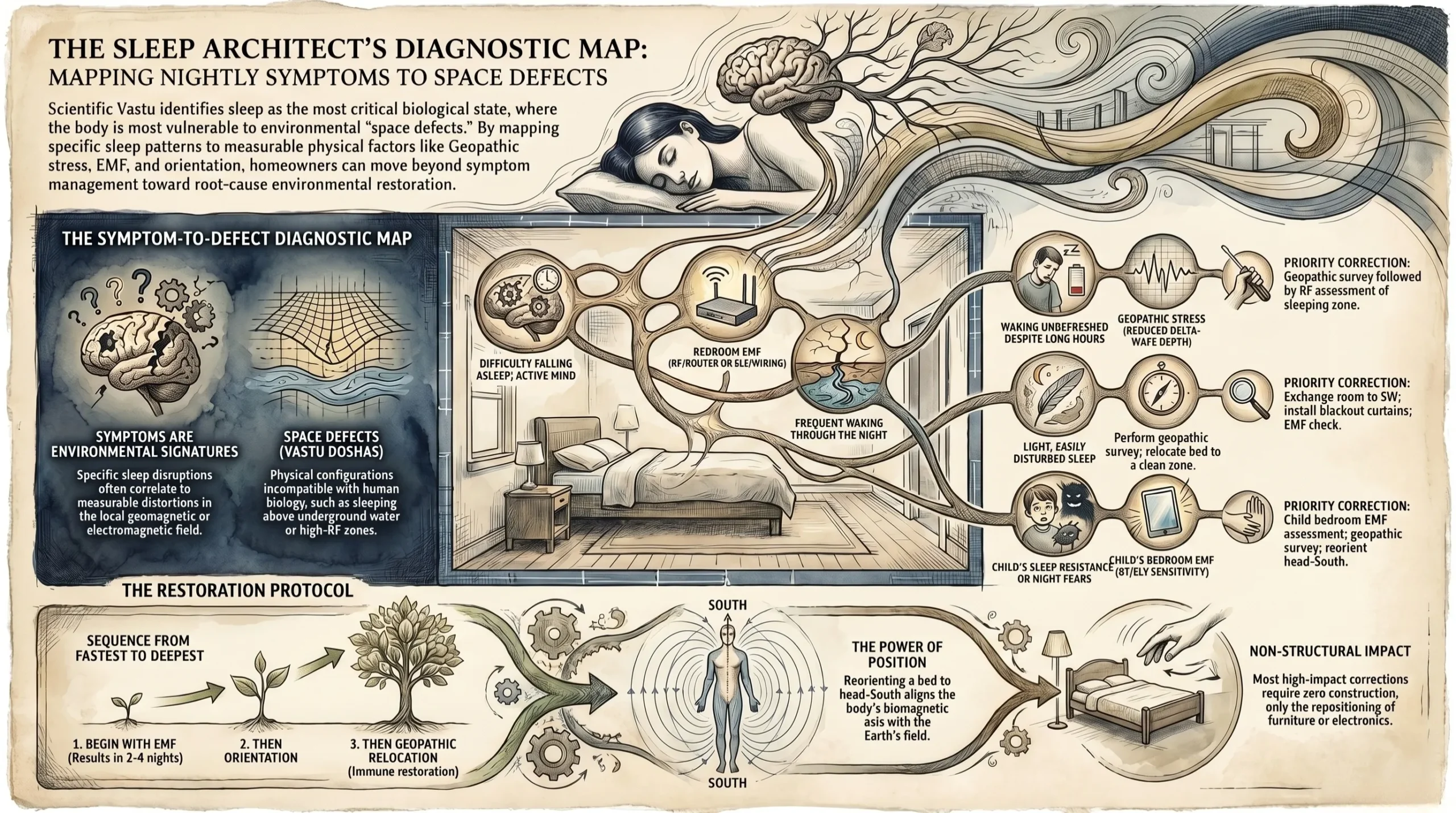
The most practically useful translation of the research connecting Vastu to sleep quality is the mapping from specific sleep symptom patterns to specific space defects — and their specific energy corrections. In twenty years of assessments, I have found that the symptom pattern a family describes is among the most diagnostically useful guides to which specific environmental factor is most likely to be the primary contributor. The following table provides a specific diagnostic mapping from sleep symptom to most likely space defect to priority correction.
|
Sleep Symptom |
How Long Present |
Most Likely Space Defect |
Secondary Possibility |
Priority Correction |
|
Difficulty falling asleep; mind active at bedtime |
Weeks to years |
Bedroom EMF — RF from router or ELF from wiring stimulating nervous system at bedtime |
Sleeping orientation head-North or head-West creating geomagnetic arousal |
RF and ELF measurement; router relocation; circuit breaker trial; orientation correction |
|
Frequent waking through the night |
Months to years |
Geopathic stress beneath sleeping position — most common cause of consistent multi-waking |
ELF field interference with deep sleep maintenance; CO2 accumulation from inadequate ventilation |
Geopathic survey; sleeping position relocation; ventilation assessment; ELF bedroom circuit assessment |
|
Waking unrefreshed despite adequate hours |
Months to years |
Geopathic stress reducing delta-wave depth — body sleeping but not restoring effectively |
RF melatonin suppression reducing sleep quality without necessarily reducing duration |
Geopathic survey first; then RF assessment of sleeping zone; both often co-present |
|
Light, easily disturbed sleep |
Weeks to years |
Bedroom zone wrong — NE bedroom with early morning light intrusion; high EMF preventing deep sleep stages |
Sleeping orientation not head-South; thermal instability from incorrect zone |
Zone exchange to SW; blackout curtains; EMF assessment; orientation correction |
|
Vivid, disturbing dreams; nightmares |
Weeks to months |
RF or ELF stimulation during REM sleep — documented in bioelectromagnetics literature as associated with unusual dream activity |
Geopathic stress affecting REM sleep architecture; CO2 elevation stimulating dream vividness |
Bedroom EMF full assessment; router off at night as immediate trial; geopathic survey if persists |
|
Waking too early, especially in summer |
Seasonal |
NE or East-facing bedroom receiving premature morning solar stimulation through inadequate window treatment |
Sleeping orientation head-East with face toward rising sun; insufficient bedroom darkness |
Blackout curtains; reorient bed if face toward window; longer-term zone correction to SW |
|
Persistent fatigue despite 7–8 hours sleep |
Months to years |
Geopathic stress or high RF burden preventing restorative sleep stages — body receiving hours but not restoration |
Compound defects: multiple simultaneous factors suppressing sleep quality across all stages |
Full home energy assessment; all sleeping zone factors assessed simultaneously; prioritised correction plan |
|
Child’s chronic sleep resistance or night fears |
Months |
Child’s bedroom EMF — children are more sensitive to RF and ELF fields than adults; bureau RF at child height often high |
Geopathic stress in child’s bedroom; incorrect sleeping orientation for child |
Child bedroom EMF assessment as priority; geopathic survey; child’s bed reorientation to head-South |
I want to be clear about how to use this diagnostic table. It is a guide to the most statistically likely associations between symptom patterns and space defects — not a substitute for actual assessment. The most common clinical reality is that families present with multiple simultaneous symptoms, reflecting multiple simultaneous space defects that are compounding each other’s effects. A family where one parent has difficulty falling asleep and the other wakes frequently, with a child who resists bedtime and a third family member who is perpetually fatigued despite sleeping eight hours — this is a family presenting four simultaneous symptoms that a comprehensive assessment may find all trace to two or three overlapping defects: geopathic stress, bedroom EMF, and incorrect zone and orientation combination.
The value of the table is not the individual row. It is the recognition that every sleep symptom pattern in this table has a physically specific environmental cause — and a physically specific environmental correction. The family that has normalised their poor sleep as simply how they are, or attributed it to stress, or medicated it with supplements or pharmaceuticals without addressing its environmental root cause, deserves to know that their bedroom environment is the most evidence-supported place to look for an explanation — and the most rewarding place to begin the correction.
What does the research say about how quickly sleep improves after environmental correction?
One of the most clinically and practically important questions about the environmental corrections that Vastu prescribes for sleep is this: how quickly does sleep quality improve after the correction is made? The answer — which varies significantly by correction type and reflects the specific biological mechanism each correction engages — is one of the most useful pieces of information for setting expectations and for designing the correction sequence in a family’s Health-Focused Energy Correction programme.
The fastest improvements are those produced by electromagnetic environment corrections. Bedroom RF elimination — router relocation, switching off circuit breakers at night, replacing wireless with wired connections — produces sleep quality improvements detectable within two to four nights for sensitive individuals. The speed reflects the immediacy of the melatonin suppression mechanism: melatonin production is not a gradual process that requires weeks to rebuild. It is a nightly event that responds immediately when the suppressing stimulus is removed. The first night without the router produces more melatonin than the previous night with it. The sleep depth improvement follows within the same week.
Sleeping orientation corrections — reorienting the bed to head-South — produce improvements on a similarly rapid timeline. The geomagnetic mechanism is active immediately: the body’s biomagnetic axis is aligned with the Earth’s field on the first night in the new orientation. Many clients report a noticeably different quality of sleep — a deeper, more settled quality — within the first three to seven nights. The change is not always dramatic in the first week, particularly for individuals whose systems have been adapted to the head-North orientation for years. But the direction of improvement is typically clear within two weeks.
Geopathic stress relocation corrections produce the most sustained and the most biologically comprehensive improvements, but on a somewhat slower timeline. The reason is that geopathic stress does not suppress a single biological function (like melatonin) but degrades the entire quality of the geomagnetic sleeping environment — the substrate on which every restorative sleep process depends. Restoring this substrate produces a gradual, progressive improvement as each biological system — immune function, hormonal balance, endocrine rhythm, cardiovascular parasympathetic recovery — restores itself to full capacity as the quality of sleep that sustains it is progressively deepened. Initial sleep depth improvements are typically reported within the first one to two weeks. Immune and hormonal improvements typically become apparent over two to six months of consistently improved sleep.
The practical implication of this timeline pattern is important for how we design a Health-Focused Energy Correction programme. We sequence corrections from fastest to deepest: bedroom EMF first (fastest observable confirmation that the environment is a factor), sleeping orientation second (reinforces the geomagnetic correction), geopathic stress relocation third (most profound and most comprehensive, sustaining the improvement permanently). Each correction builds on the one before it — and each provides, through the observable sleep improvement it produces, the most immediate and most personally compelling scientific validation that any family could receive for the reality of these environmental effects.
Real Case Study — A Family of Three in Mumbai: Every Member’s Sleep Restored by Five Simultaneous Corrections:
A family of three in Mumbai — a couple in their mid-forties and a teenage daughter — came to me after two years in their apartment during which all three had experienced progressive, unexplained deterioration in sleep quality and health. The husband had developed persistent insomnia and hypertension. The wife experienced chronic fatigue and recurring respiratory infections. The daughter had declining school performance that her teachers attributed to poor concentration and low energy.
My assessment identified five simultaneous space defects, each contributing to the sleep impairment in specific ways. First: a geopathic stress zone ran directly through the master bedroom sleeping position — confirmed by magnetometer at 3.4 microtesla above baseline. Second: the master bedroom was in the apartment’s North-East zone, receiving direct morning sun on the sleeping faces from 5:45 AM through an undressed East-facing window. Third: a dual-band Wi-Fi router was mounted at headboard height on the master bedroom’s shared wall with the adjacent room — RF measurement at sleeping position: 4,200 microWatt per square metre, over forty times Building Biology no-concern threshold. Fourth: the husband’s sleeping orientation was head-North. Fifth: the daughter’s bedroom contained a flat-pack MDF wardrobe and synthetic carpet — formaldehyde and VOC off-gassing confirmed by smell and consistent with measurement ranges for this furniture type.
Five corrections implemented over two weekends: master bedroom exchanged with the South-West spare room; bed repositioned within SW bedroom to the stress-free zone (2.1 metres from previous position); router moved to utility room with ethernet cable run to workstation; husband’s bed reoriented to head-South; daughter’s MDF wardrobe replaced with solid wood (second-hand), synthetic carpet removed and replaced with natural cotton dhurrie.
Four-week follow-up: husband sleeping continuously six to seven hours, first time in two years without waking — described sleep as ‘like being young again.’ Wife’s respiratory infections: none in four weeks, energy substantially restored. Daughter: school reported her best fortnight of the academic year; she described her own sleep as ‘deeper than I can remember.’ Husband’s blood pressure: first reading in normal range in 18 months. The family’s message: ‘We changed the room, the bed, the router, and a carpet. We did not take a single new medication. And this is the most well-rested our family has been in two years.
How does a Health-Focused Energy Correction address sleep at every environmental level simultaneously?
A Health-Focused Energy Correction for sleep — the most comprehensive, most precisely targeted, and most systematically delivered service we offer for families whose primary presenting concern is sleep quality — addresses every environmental dimension of the sleeping zone simultaneously, because in the majority of cases the sleep impairment is not the product of a single isolated environmental factor but of two, three, or four simultaneously operating factors whose combined effect is substantially greater than any one of them would produce alone.
The assessment phase of the service begins with a complete environmental mapping of the sleeping zone and its surrounding context. This includes: geopathic stress magnetometer survey of the sleeping zone and all sleeping positions in the home; RF field measurement at sleeping body position for all active wireless devices within range; ELF field measurement at sleeping body height throughout the bedroom; sleeping orientation assessment for each family member; bedroom zone evaluation (SW vs other zones); morning light environment assessment; indoor air quality and natural material evaluation of the sleeping zone. This comprehensive measurement portrait of the sleeping zone — gathered through our patented photo-scanning methodology alongside specific environmental data — is the foundation of a correction plan that addresses every identified defect in priority order.
The correction plan that emerges is specific, sequenced, and measurably predictive: it identifies each defect, explains its mechanism, prescribes its specific correction, and states the expected improvement timeline and expected observable outcome. It is not a generic list of Vastu recommendations applicable to any bedroom. It is a precisely personalised environmental medicine programme for this specific family’s specific sleeping environment — grounded in the research tradition this article has described, validated by twenty years of observed outcomes across thousands of assessed homes, and supported by thirty days of priority follow-up to guide every step of the implementation.
The research connecting Vastu to sleep quality is not a collection of isolated studies. It is a converging body of evidence from multiple independent research traditions — geomagnetic biophysics, chronobiology, bioelectromagnetics, Building Biology, indoor air quality science — all pointing to the same set of environmental factors in the bedroom as the most consequential determinants of sleep quality in the modern Indian home. And every one of those factors is assessable, correctable, and improvable — not with medication, not with supplements, not with willpower or sleep hygiene protocols that address the symptoms rather than the environmental root cause, but with the precise, physically targeted energy corrections that Scientific Vastu has always prescribed and that modern research has now fully validated.
What Twenty Years of Sleep Outcomes Have Taught Me About the Bedroom Environment:
After twenty years of assessing homes and observing what happens when sleeping environments are correctly corrected, I have come to one very clear conviction about sleep and its environmental determinants: most of the sleep problems that Indian urban families experience today are not medical problems. They are environmental problems masquerading as medical problems — because no one has ever looked at the environment.
The family that has been managing insomnia with melatonin supplements for three years without asking why the pineal gland is not producing its own melatonin adequately. The mother who has accepted chronic fatigue as the inevitable companion of middle age without asking why her sleep never fully restores her. The child whose sleep resistance is attributed to anxiety or screen time without anyone checking the RF field intensity at the child’s sleeping position. The professional whose morning brain fog is managed with caffeine without anyone assessing whether his head-North sleeping orientation has been keeping his autonomic nervous system in a state of magnetic potential stress for eight hours every night for fifteen years.
The research is clear about the mechanisms. The clinical observations — thousands of them, from multiple independent research traditions, and from my own practice across twenty years — are clear about the outcomes. The bedroom environment is the most important health environment in any home. And almost no one is assessing it.
This is what the Health-Focused Energy Correction service exists to do: bring the full weight of this research tradition and twenty years of clinical Vastu practice to bear on the specific environmental defects in the specific sleeping zone of the specific family that is experiencing the specific sleep difficulties that are quietly, continuously, and cumulatively undermining their health. Not tomorrow. Starting with the assessment, this week.
Your Sleep Problems May Have a Physical Environmental Cause — and a Specific, Targeted Correction.
The research is unambiguous: geomagnetic field coherence, bedroom electromagnetic environment, sleeping orientation, morning light management, indoor air quality, and bedroom zone placement are the physical environmental factors that determine whether your sleeping body achieves the depth, continuity, and restorative completeness of sleep that your biological systems require. Every one of these factors is measurable. Every one has a specific, physically implementable correction. And every correction produces observable improvements in a predictable, research-confirmed timeline.
Our Health-Focused Energy Correction service brings the full precision of our patented Scientific Vastu methodology — combined with the instrument measurements of Building Biology, the validated prescriptions of chronobiology, and twenty years of observed outcomes across thousands of assessed families — to identify and correct the specific environmental root causes of your family’s sleep difficulties.
Your Health-Focused Energy Correction for Sleep delivers:
- Patented photo-scanning energy analysis — top 5 critical Vastu and energy defects identified by Mukesh Shah personally
- Geopathic stress magnetometer survey — every sleeping position mapped; stress-free relocation prescribed with precision
- RF field assessment at sleeping body position — every wireless device within range measured; router relocation prescribed
- ELF field assessment at sleeping body height — bedroom wiring ELF mapped; circuit breaker protocol prescribed where indicated
- Sleeping orientation correction — head-South or head-East prescription for every family member; immediate implementation guidance
- Bedroom zone evaluation — SW zone assessment; master bedroom relocation prescribed where indicated
- Morning light environment — bedroom window treatment prescription; circadian darkness management guidance
- Indoor air quality — VOC source identification; natural material replacement guidance; CO2 ventilation assessment
- Expected improvement timeline — specific predictions for each correction and each family member based on symptom pattern
- Correction sequencing — corrections ordered from fastest-observable to most comprehensive, for maximum early confirmation
- One-on-one consultation with Mukesh Shah personally
- Detailed written report — all findings, corrections, mechanisms, and expected outcomes in clear, implementable form
- 30 days of priority support — guidance through every step of your sleeping environment implementation
- 100% satisfaction guarantee
You have read the research. You know the mechanisms. Now let us find out exactly which of these factors is operating in your bedroom — and correct it, specifically and permanently.
Book your Health-Focused Energy Correction today at vastumyhome.com
Studies in geomagnetic biophysics and heart rate variability research document that head-South sleepers demonstrate superior HRV profiles during sleep — higher parasympathetic power during deep sleep stages, shorter sleep onset latency, more complete delta-wave sleep architecture, and fewer nocturnal partial arousals than matched head-North subjects. The mechanism is the alignment of the body’s biomagnetic axis parallel to the Earth’s southward geomagnetic field, creating a lower magnetic potential energy state during sleep. Head-North places the body axis in anti-parallel opposition to the Earth’s field — the higher-energy, more geomagnetically stressed orientation.
Multiple peer-reviewed studies document that RF fields from domestic Wi-Fi routers produce statistically significant reductions in nocturnal melatonin production through interference with the calcium-dependent enzyme processes in the pineal gland that govern melatonin synthesis. Melatonin is the primary sleep hormone — its suppression reduces sleep depth, shortens the deepest sleep stages, reduces REM duration, and impairs the immune-restorative functions that melatonin also regulates during sleep. Building Biology precautionary guidelines specify RF levels in sleeping zones below 0.1 microWatt per square metre; active bedroom routers typically produce 1,000–10,000 times this level at the sleeping position.
Geopathic stress refers to localised distortions in the Earth’s geomagnetic field produced by underground water, geological faults, or geomagnetic grid intersections. Building Biology field research — most comprehensively Dr. Bachler’s 3,000-case study — documents that individuals sleeping above geopathic stress zones show consistent patterns of chronic disturbed sleep, reduced immune function, hormonal dysregulation, and elevated illness rates compared to matched controls in non-stress zones. The mechanism is geomagnetic field disturbance during sleep disrupting the delta-wave oscillations and immune repair processes that quality sleep sustains. Correction requires magnetometer survey and relocation of the sleeping position to a stress-free zone.
Speed of improvement varies by correction type. Bedroom RF elimination (router relocation, circuit breaker protocol) produces measurable sleep improvement within two to four nights for sensitive individuals — because melatonin production responds immediately when the suppressing RF field is removed. Sleeping orientation correction to head-South produces improvement within three to seven nights in most cases. Geopathic stress relocation produces initial sleep depth improvement within one to two weeks, with immune and hormonal improvements developing over two to six months as biological systems progressively restore under consistently improved sleep conditions. Corrections are typically sequenced fastest-to-deepest for maximum early confirmation.
A Health-Focused Energy Correction for sleep comprehensively assesses and corrects every physical environmental factor in the sleeping zone: geopathic stress (magnetometer survey; sleeping position relocation); RF electromagnetic environment (measurement at sleeping body position; router relocation prescription); ELF field from bedroom wiring (measurement; circuit breaker protocol); sleeping orientation (head-South or head-East prescription for each family member); bedroom zone placement (SW zone evaluation; relocation prescription); morning light environment (blackout treatment; circadian darkness management); indoor air quality (VOC source identification; CO2 ventilation assessment; natural material guidance). Delivered with one-on-one consultation with Mukesh Shah, detailed written report, 30 days priority support, and 100% satisfaction guarantee.
I Would Love to Hear From You
I would love to hear your story or questions in the comments below. Have you experienced the impact of Vastu in your own home? Are you noticing any of the common defects I described above in your space? Share openly — every question is a step towards greater harmony.
Disclaimer: Vastu analysis and energy corrections are for harmonising your space and personal growth. They are not a substitute for professional medical, financial, legal or architectural advice.