

Namaste. I am Mukesh Shah. Every living tradition worth taking seriously contains within itself genuine philosophical disagreements — positions on fundamental questions about what the tradition is, what it is for, and how it should be practised — that its practitioners have debated across generations and that have not been resolved, and may never be fully resolved, because they touch on questions where reasonable, thoughtful, and deeply committed people can reach different conclusions from the same evidence. The Vastu Shastra tradition is no exception.
In twenty years of practice, in every serious professional conversation I have had with other Vastu practitioners, scholars, architects, and the educated families who seek the deepest possible understanding of the tradition they are placing their trust in, I have encountered the same philosophical debates recurring with remarkable consistency. They are not debates about peripheral details — about which specific plant is best in the north-east, or whether the Brahmasthana centre should be measured to the structural or functional centre of the building. They are debates about the most fundamental questions the tradition faces: what kind of knowledge Vastu is; whether its principles are universal or geographically specific; whether its effects work through physical mechanism or cosmic spiritual force; who has legitimate authority to practise it; and how it should be positioned in relation to the larger ecosystem of Indian knowledge traditions and to modern scientific enquiry.
I want to address these debates in this article not by pretending they do not exist, not by dismissing the positions I disagree with as simply wrong, and not by offering false reconciliation where genuine disagreement is more honest. I want to address them as the serious intellectual questions they are — laying out the strongest version of each position, explaining what each position gets right and what I believe it gets wrong, and being transparent about where my own practice has come down on each debate and why. Because these philosophical positions are not merely academic. They have direct practical consequences for the families who receive Vastu guidance — consequences that show up in the quality of the assessment they receive, the nature of the corrections they are prescribed, the relationship they are invited into with their practitioner, and ultimately in whether their family’s health challenges are genuinely addressed or merely culturally elaborated.
Understanding where the philosophical debates lie, and how different positions on them translate into different practical experiences for the client, is the most useful preparation any family can undertake before engaging a Vastu practitioner. It is also the context within which I want you to understand every dimension of our Complete Home Health Audit — as the product of specific, considered positions on each of these debates, positions I hold not from authority or lineage but from twenty years of asking the same questions the debates raise and finding, in the evidence and the outcomes, the answers that have shaped my practice.
What is the most fundamental philosophical debate within Vastu — science or spirituality?
The most foundational philosophical debate within the Vastu tradition is the one that underlies every other debate: is Vastu Shastra fundamentally a physical science of the built environment whose prescriptions operate through physical mechanisms, or is it fundamentally a spiritual cosmology whose prescriptions reflect a cosmic order that transcends physical mechanism? This is not a debate between Vastu practitioners and their sceptical critics. It is a debate within the tradition itself, between practitioners who hold different positions on the question of what the tradition fundamentally is.
The physical science position holds that Vastu’s prescriptions encode genuine empirical observations about the relationship between building design and human health, developed through generations of careful observation across thousands of dwellings, and that the cosmological vocabulary in which those observations are expressed — prana, Vastu Purusha, Pancha Bhuta, directional cosmic forces — is the intellectual packaging of its era, not the substance of the tradition’s knowledge. On this view, the sleeping orientation prescription is not fundamentally a prescription about aligning with cosmic forces — it is a prescription about aligning the body’s biomagnetic axis with the Earth’s geomagnetic field, with documented effects on sleep quality and immune function. The north-east prana gateway prescription is not fundamentally about cosmic energy entry — it is a prescription about morning solar radiation access, with documented effects on circadian entrainment and cortisol awakening response. The cosmological language describes the physical reality with the vocabulary available to its era. Modern physical science describes the same physical reality with more precise vocabulary. The reality is the same.
The spiritual cosmology position holds that reducing Vastu to its physical mechanisms misses and ultimately distorts the tradition’s essential character. On this view, the cosmic being of the Vastu Purusha is a genuine metaphysical reality, not merely a functional design metaphor. The directional deities — Indra in the east, Yama in the south, Varuna in the west, Kubera in the north — are not merely symbolic representations of physical directional qualities but genuine cosmic presences whose character shapes the built environment in ways that physical mechanism cannot fully account for. The tradition’s prescription for ritual participation by the householder in the energising of the home is not a cultural addition to a physical core but an essential dimension of the tradition’s complete practice. Physical mechanism explains some of what Vastu does; the spiritual cosmological framework is required to explain the rest.
My own position, developed through twenty years of practice and rigorous engagement with both the primary texts and the modern science, is on the physical science side — but with a specific nuance. I believe the physical mechanisms are sufficient to explain all of Vastu’s documented health effects, and I am sceptical of claims that require additional metaphysical machinery beyond what physical science provides. But I also believe the cosmological vocabulary of the classical texts is not merely ornamental. It is a sophisticated, culturally rich encoding of genuine physical wisdom — a way of making physical truths memorable, transmissible, and emotionally resonant for a civilisation that thought about the natural world in cosmological rather than mechanistic terms. Honouring the cosmological language while understanding its physical content is not a compromise position. It is the most intellectually complete position available.
What divides practitioners on whether Vastu prescriptions are universal or regionally specific?
The universality debate is, after the science-spirituality debate, the most practically consequential philosophical disagreement within contemporary Vastu practice. It asks: are the tradition’s prescriptions universally valid for any home anywhere on earth, or were they calibrated specifically to the Indian subcontinent’s geographic character and require recalibration when applied elsewhere?
The universality position argues that Vastu’s core prescriptions are universal because they are grounded in universal physical laws. The Earth’s geomagnetic field flows south-to-north everywhere on the planet, not only in India — so the head-South sleeping prescription, grounded in geomagnetic biophysics, is equally valid in Singapore, London, or São Paulo as in Mumbai. The human body’s circadian clock is entrained by morning blue-spectrum solar radiation everywhere — so the north-east prana gateway prescription for morning solar access is equally valid at any latitude. Geopathic stress zones occur wherever the geological conditions that produce them exist — everywhere on Earth. The universalist position is appealing in its simplicity and has the advantage of making Vastu straightforwardly applicable to Indian families abroad without requiring complex recalibration.
The geographic specificity position argues that this universalism oversimplifies. The Vastu Shastra’s directional prescriptions are not merely grounded in universal physical laws — they are grounded in the specific expression of those laws at the Indian subcontinent’s latitudes (8°N to 35°N), with its specific solar arc geometry, its specific monsoonal climate pattern, its specific prevailing wind directions, and its specific geomagnetic field characteristics. The prescription for south-west thermal mass is a prescription calibrated to the Indian summer’s specific solar heat load geometry. The prescription for north-east prana gateway orientation is calibrated to the morning solar arc’s photon delivery geometry at Indian latitudes. At 51°N latitude in London, the morning solar arc is significantly higher and more southward — the precise calibration of the morning prana prescription changes. At 1°N latitude in Singapore, the solar arc is nearly vertical at noon — the thermal logic of the south-west mass zone changes significantly.
How should an Indian family abroad navigate the universality debate practically?
For Indian families living outside India — and there are tens of millions of them, across Southeast Asia, the Gulf, the United Kingdom, North America, and Australia — the universality debate is not an academic question. It is the most practically urgent philosophical question in their Vastu engagement, because the answer determines whether they apply the classical prescriptions as stated, whether they apply a locally recalibrated version, or whether they have a practitioner assess both dimensions explicitly.
My considered position is that the debate has a specific resolution that serves these families best. The geomagnetically grounded prescriptions — head-South or head-East sleeping orientation — are genuinely universal, because the geomagnetic field’s south-to-north flow is a planetary constant. The geopathic stress prescription is genuinely universal, because geological geopathic stress features exist at every latitude. The electromagnetic environment prescription is genuinely universal, because bedroom RF suppresses melatonin through calcium ion channels regardless of the home’s geographic location. These prescriptions apply in London, Singapore, and Toronto exactly as they apply in Mumbai.
The directional zone prescriptions — specifically the solar arc-dependent aspects of zone allocation, thermal mass placement, and primary facade orientation — are geographically calibrated prescriptions that require explicit recalibration for the specific latitude and solar arc of the family’s actual location. A practitioner who applies Indian Vastu zone prescriptions to a home in Edinburgh without accounting for Edinburgh’s 56°N latitude solar arc is delivering geographically miscalibrated guidance that will produce suboptimal results for solar access and passive thermal performance, however correctly the geomagnetically grounded prescriptions are applied.
The correct answer to the universality debate is therefore not a single yes or no but a differentiated yes: the geomagnetically and biologically grounded prescriptions are universal; the solar arc-calibrated directional prescriptions require geographic contextualisation. A practitioner who cannot make this distinction — who applies all classical prescriptions uniformly regardless of latitude or who recalibrates all prescriptions when some should remain fixed — is demonstrating a philosophical position on the universality debate that has practical consequences for the family’s assessment quality.
What is the debate about the Vastu Purusha Mandala — literal entity or functional design tool?
The Vastu Purusha Mandala is the tradition’s most visually distinctive and most philosophically loaded design concept: the cosmic being whose body, lying face-down across the square of the building site, defines the directional zone allocation of every properly designed dwelling. The debate about what the Vastu Purusha Mandala fundamentally is — a literal cosmic entity whose orientation and zone allocation must be respected to avoid disturbing a metaphysical being, or a brilliantly designed functional framework that encodes the building site’s relationship to physical directional forces — is among the most actively debated questions in contemporary Vastu scholarship and practice.
The literal entity position has deep roots in the tradition’s devotional and ritual dimensions. The Manasara’s description of the Vastu Purusha — the specific mythological account of how the cosmic being came to be pinned to the earth by the Brahma and the directional deities, and of the consequences of disturbing specific body parts through incorrect building placement — is presented in a narrative register that is not obviously metaphorical. On the literal reading, the south-west zone is the Vastu Purusha’s lower body and legs — the seat of physical strength, stability, and earthly force — and placing the master bedroom there is a prescription for aligning the household head with the cosmic being’s most stable and protective dimension. Placing a toilet in the south-west is not merely a functional error; it is a violation of the cosmic being’s body that invites the consequences that violation incurs.
The functional design tool position holds that this literal reading, while culturally honoured, is not the most intellectually productive engagement with what the Vastu Purusha Mandala actually does as a design tool. The 64-square and 81-square Mandala variants encode a sophisticated directional zoning system that allocates the building’s programme to zones whose physical character — solar exposure, geomagnetic field character, thermal mass requirements, ventilation function — is suited to each programme’s physical needs. The south-west zone’s allocation to the master bedroom is grounded in the zone’s geomagnetic stability and thermal mass capacity, not in the Vastu Purusha’s lower body. The north-east zone’s allocation to the prana gateway and water element is grounded in the zone’s morning solar access and its position at the intersection of the two primary natural energy axes of the building site, not in the Vastu Purusha’s head.
My own position is clear: the Vastu Purusha Mandala is one of the most ingenious design frameworks in the history of architecture — a precise physical zoning system whose genius lies in how elegantly it encodes genuinely complex physical site analysis into a memorable, teachable, and practically applicable template. The cosmic mythology surrounding it is a culturally rich transmission vehicle for a physical truth. The transmission vehicle deserves respect. The physical content it carries deserves understanding. Conflating the two — treating the mythological packaging as though it were the physical content — produces the kind of rigidity that refuses to adapt the Mandala’s zone prescriptions to modern apartment constraints, or that prescribes bathroom placement corrections based on which body part of the cosmic being is being insulted rather than on the actual physical consequences of the zone’s function. The physical tool is powerful. The mythology enriches it. The conflation weakens it.
What is the complete map of the major philosophical debates and how Scientific Vastu resolves each one?
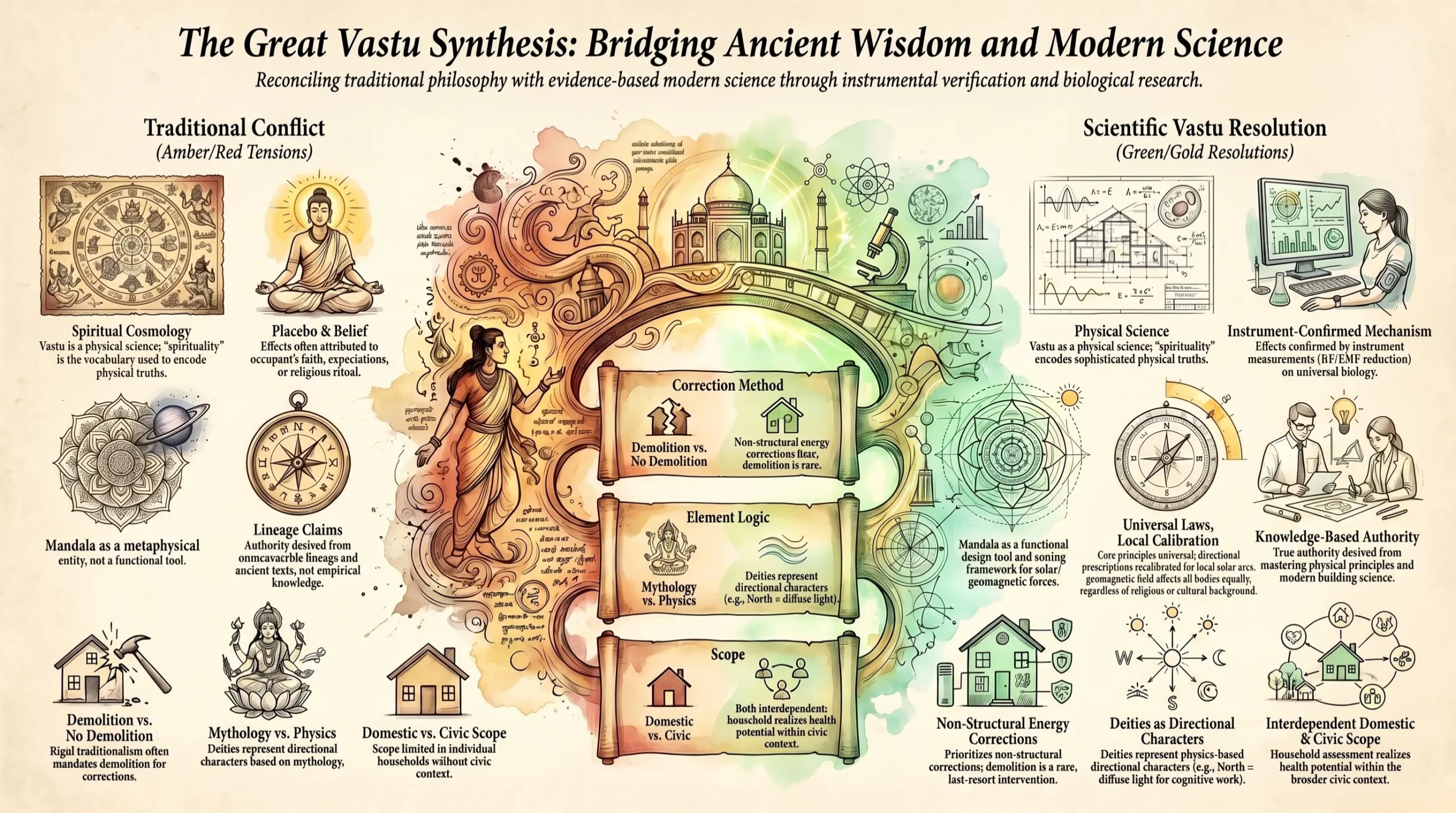
The following table maps seven of the most consequential philosophical debates within contemporary Vastu practice — laying out both positions with equal fairness, identifying what the debate reveals about the tradition, and stating Scientific Vastu’s concluded position on each. This map is not meant to settle every debate — some of these questions are genuinely open and may never be fully closed. It is meant to make each debate explicit and to show how the position taken on each one shapes every dimension of assessment practice.
|
Philosophical Debate |
Position A |
Position B |
What the Debate Reveals |
Scientific Vastu’s Conclusion |
|
Is Vastu a physical science or a spiritual cosmology? |
Vastu is fundamentally a physical science of the built environment — its prescriptions are grounded in solar geometry, geomagnetic biophysics, thermal dynamics, and indoor air quality; spirituality is the cultural vocabulary in which physical observations were encoded |
Vastu is fundamentally a spiritual cosmology — the physical effects are secondary expressions of a cosmic order that transcends physical mechanism; mechanism explanation reduces and distorts the tradition’s true depth |
This debate determines whether the tradition seeks external scientific validation or treats external validation as a category error; it has profound implications for how defects are assessed and how corrections are prescribed |
The physical mechanisms are real, independently validated, and sufficient to explain all documented Vastu effects; the spiritual vocabulary is a culturally rich encoding of physical truth; both can be honoured without conflating them |
|
Are Vastu prescriptions universal or geographically specific? |
Core Vastu prescriptions — sleeping orientation, geopathic stress avoidance, south-west bedroom — are universal because they are grounded in universal physical laws: the geomagnetic field, the solar arc’s biological effects, the thermal physics of the south-west zone |
Vastu prescriptions are calibrated specifically to the Indian subcontinent’s latitude range, climate, and geomagnetic character; applying them without geographic recalibration to other latitudes distorts rather than extends the tradition |
This debate has direct practical consequences for Indian families abroad and for the relationship between Vastu and other regional traditions such as Feng Shui; it also determines how rigidly any prescription should be applied |
The physical core is universal but geographically calibrated — head-South sleeping is geomagnetically grounded everywhere; specific directional prescriptions for zones reflect the Indian solar arc and must be recalibrated at other latitudes |
|
Does Vastu require religious belief to be effective? |
Vastu’s physical effects operate through physical mechanisms regardless of the occupant’s religious beliefs, cultural background, or spiritual orientation; the geomagnetic field does not distinguish a Hindu family from a secular engineer |
Vastu is inseparable from its Vedic cosmological framework; the blessings and protection it confers require the householder’s ritual participation and alignment with the tradition’s spiritual dimension to be fully activated |
This debate has profound implications for who Vastu can serve and how it is practised; a tradition that requires religious belief is culturally exclusive; a tradition whose effects are physical is universally accessible |
Vastu’s physical effects are documented by Building Biology and chronobiology research that makes no reference to religious belief; the physical corrections work through physical mechanisms; ritual participation is a separate cultural choice whose value does not require the physical mechanisms to validate it |
|
Is the Vastu Purusha Mandala a literal cosmic entity or a functional design framework? |
The Vastu Purusha — the cosmic being whose body underlies every built structure — is a literal metaphysical reality whose orientation and zone allocation must be respected to avoid disturbing the cosmic order of the dwelling |
The Vastu Purusha Mandala is a functional design framework — a sophisticated zoning system that organises the built environment’s relationship to solar radiation, geomagnetic field, wind, and elemental forces; the cosmic language is the packaging, not the content |
This is among the most actively debated internal debates in Vastu scholarship; it determines how literally practitioners interpret classical prescriptions and how they handle cases where the mandala’s prescriptions conflict with modern structural constraints |
The Vastu Purusha Mandala is a brilliantly designed functional framework that encodes real physical zone relationships; treating it as literal cosmology produces rigidity that serves neither the tradition nor the families; treating it as a physical design tool enables its full practical power |
|
Should Vastu practitioners ever prescribe structural demolition? |
No structural demolition should ever be prescribed without first exhausting all non-structural corrections; the large majority of Vastu defects are correctable without any structural intervention; demolition prescriptions are almost always either unnecessary or commercially motivated |
Some structural defects — a permanently misoriented building on a plot that allows reorientation, a Brahmasthana column that cannot be functionally addressed non-structurally — occasionally justify structural correction when the health stakes are sufficiently high and the correction is genuinely proportionate |
This debate has direct ethical implications; structural demolition prescriptions cause financial harm to families and are the hallmark of the least ethical practitioners; the debate requires clear criteria for the rare cases where structural correction might be legitimate |
Non-structural corrections first, always; structural corrections considered only after all non-structural options are exhausted and only when the specific defect’s health impact is significant enough to justify the cost and disruption; never prescribed as a first-line intervention |
|
Is Vastu’s effectiveness placebo or physical mechanism? |
The health improvements following Vastu correction are the result of placebo effect — the family expects to feel better, they attend more carefully to their home, they sleep more mindfully; expectation and attention produce the improvement, not physical mechanism |
The health improvements following Vastu correction are produced by specific, instrument-confirmed changes in the physical environment — reduced RF field, relocated sleeping position from stress zone, restored thermal stability — whose effects are documented by independent research on populations with no knowledge of Vastu |
This is the debate most often raised by sceptics in medical and engineering professions; it has direct implications for the tradition’s credibility and for how corrections should be prescribed and evaluated |
Placebo is excluded by the documented effects in non-human organisms and in individuals with no Vastu awareness; instrument-confirmed pre- and post-correction measurements demonstrate physical environmental changes; biological mechanisms are independently characterised in peer-reviewed literature |
|
Who has the authority to practise Vastu — lineage holders or knowledge-demonstrated practitioners? |
Legitimate Vastu authority derives from initiation within a specific guru-lineage whose knowledge transmission has been maintained continuously from the classical period; practitioners outside these lineages lack the authentic authority to conduct assessments |
Legitimate Vastu authority derives from demonstrated mastery of the tradition’s physical principles, classical texts, modern building science, and instrument-based assessment methodology; lineage is culturally significant but not epistemically necessary |
This debate has direct consumer protection implications — lineage claims are unverifiable and have been used to establish commercial authority for practitioners whose actual knowledge is limited; knowledge quality is the only verifiable quality criterion |
Practitioner quality should be assessed by knowledge quality, methodology rigour, and documented outcomes — not by lineage claims; the tradition’s finest classical texts define Vastu knowledge by intellectual mastery, not by ritual initiation into a specific lineage |
|
Is Vastu primarily a domestic or a public/civic tradition? |
Vastu’s primary application is the domestic dwelling — the Griha Vastu; its civic and urban applications (Nagara Vinyasa) are secondary developments that depend on getting the household level right first |
Vastu’s most consequential application is the urban and civic scale — the Nagara Vinyasa — because settlement-scale decisions determine the health baseline for entire populations; household Vastu works within the context those decisions create |
This debate determines where scarce practitioner resources and policy attention should be directed; it also determines how individual household assessment is understood in its larger context |
Both scales are essential and interdependent; settlement-scale decisions set the context; household-level assessment realises the best available outcome within that context; neither alone is sufficient for the family’s full health potential |
Reading across this table, what is visible is not a tradition mired in irresolvable disagreement but a tradition with a living intellectual core whose debates are signs of intellectual health rather than confusion. Every philosophical tradition worthy of its name contains genuine internal debates on fundamental questions. The debates within Vastu are serious debates about genuine questions — and the positions taken on them have real, observable consequences for the families who receive guidance from practitioners at different points on the philosophical spectrum.
The column that matters most practically — Scientific Vastu’s Conclusion — is not merely one position among equals. It is the position that, over twenty years of practice and thousands of families assessed, has produced the most specific, most predictable, most verifiable, and most health-improving outcomes. The philosophical positions are held not as articles of faith but as hypotheses that have been tested against outcomes — and the outcomes have consistently favoured the position that physical mechanisms are real, sufficient, and universal; that prescriptions are geographically calibrated; that physical evidence is the arbiter of the placebo debate; and that knowledge quality, not lineage, is the correct measure of practitioner authority
How does the placebo debate affect how Vastu corrections should be designed and evaluated?
The placebo debate — the question of whether Vastu corrections produce their health effects through physical mechanism or through the psychological effects of expectation, attention, and cultural meaning — is the debate most frequently raised by sceptics from medical and engineering backgrounds. It deserves a more careful and more honest treatment than it typically receives from either side, because the question is genuinely important and the evidence that bears on it is more complex than the simplest version of either position acknowledges.
The strongest version of the placebo argument goes like this: the families who receive Vastu assessments are families who are distressed about their health challenges, who have chosen to engage with a tradition they believe can help them, who receive a detailed assessment that makes their home feel understood and cared for, and who implement a programme of changes that engages them actively in creating a more supportive environment. Any one of these factors — expectation, meaning, active engagement, environmental attention — is documented by psychological research to produce genuine health improvements independent of the specific physical changes made. On the placebo view, Vastu corrections work not because they change the geomagnetic field or the RF level at the sleeping position but because they mobilise the psychological resources of a family that has chosen to take its health environment seriously.
The physical mechanism response to this argument is specific and empirically grounded. First, geopathic stress effects have been documented in non-human organisms — in cancer cell growth rates, in bee colony behaviour, in plant growth patterns — that are not subject to expectation or cultural meaning. The geomagnetic field does not care whether the organism above it believes in Vastu. Second, instrument-confirmed pre- and post-correction measurements demonstrate real, quantified changes in physical environmental parameters — RF fields drop from 4,800 to 60 microWatt per square metre when the router is moved; the geomagnetic field reads 0.8 microtesla above baseline at the stress zone position and 0.05 above baseline at the corrected sleeping position. These are not psychological improvements. They are physical environmental changes whose biological effects are independently characterised in peer-reviewed literature. Third, the specific timeline and character of the improvements reported following specific Vastu corrections align with the specific biological timelines documented for those physical parameters — sleep improvement within three weeks following RF elimination aligns with melatonin restoration timelines, not with expectation timelines that would produce more immediate effects.
The honest conclusion on the placebo debate is this: placebo effects are real, and they undoubtedly contribute to some of the benefits families report following Vastu assessment — the attention, the meaning, and the active engagement with the home environment are psychologically beneficial in ways that are not specific to Vastu. But the physical mechanism evidence is sufficient and specific enough to establish that placebo is not the complete explanation, and the instrument-confirmation methodology of our assessment practice is specifically designed to make the physical mechanism case unambiguous: RF measured before correction, RF measured after correction, melatonin restoration observed within the specific timeline that RF elimination predicts. The physical mechanism and the psychological meaning both serve the family’s health. Neither is required to deny the other.
What divides practitioners on the authority question — and why does it matter for families?
The authority debate — who has legitimate standing to practise Vastu consultation, and on what basis — is a debate with immediate and consequential practical implications for every family seeking Vastu guidance. The philosophical position a practitioner holds on this question is not merely an internal professional matter. It directly shapes how the practitioner presents their credentials, what they claim as the source of their authority, and whether that authority can be verified by the family before they commit to an engagement.
The lineage authority position holds that Vastu knowledge is validly transmitted only through the guru-shishya parampara — the teacher-student tradition of direct knowledge transmission within recognised lineages. On this view, a practitioner who has studied classical texts independently, developed expertise through thousands of assessments, and integrated modern building science and instrument methodology into their practice is not a legitimate Vastu practitioner if they lack initiation and transmission within a recognised lineage. The tradition’s authority is not available to self-taught practitioners, however knowledgeable, because the tradition’s essential knowledge is not contained in the texts but in the living transmission that the texts document and encode.
The knowledge-demonstrated authority position holds that this lineage gatekeeping is both epistemically unjustified and practically harmful. It is epistemically unjustified because the claim that essential Vastu knowledge is contained exclusively in guru-shishya transmission and not in the classical texts is falsified by the extraordinary richness and detail of the classical texts themselves. The Manasara contains more precise, more systematically organised, and more physically detailed Vastu knowledge than any practitioner’s transmission could plausibly add. A practitioner who has mastered the classical texts, engaged seriously with the modern building science literature, developed instrument-based assessment methodology, and accumulated twenty years of calibrated outcome data has knowledge credentials that no unverifiable lineage claim can meaningfully exceed. The authority-by-lineage position is practically harmful because lineage claims are unverifiable — a family has no way to assess whether a practitioner’s claimed lineage is authentic, deep, or relevant to the physical assessment they need — while knowledge quality is verifiable through the specific, observable dimensions of how the practitioner practises.
The family protection implication of this debate is direct: ask not for the practitioner’s lineage credentials but for their methodology credentials. Ask what instruments they use to measure geopathic stress and electromagnetic fields. Ask what classical texts they draw on for their zone prescriptions and whether they can cite specific chapters. Ask what predicted outcomes they commit to and how they hold themselves accountable. Ask whether they sell products. These are the questions that reveal knowledge quality and ethical standing — the only practitioner credentials that serve the family’s interest rather than the practitioner’s authority claim.
How do different philosophical positions translate into different practical outcomes for families?
The philosophical debates described in this article are not merely interesting intellectual questions for scholars and practitioners. They translate directly and specifically into the kind of assessment the family receives, the corrections they are prescribed, the relationship they are invited into with their practitioner, and the long-term health consequences of that relationship. The following table makes these practical translations explicit across five different philosophical positions.

|
Philosophical Position Held |
How It Shapes Assessment Practice |
How It Shapes Correction Prescription |
How It Shapes Client Relationship |
Long-term Consequence for the Family |
|
Vastu as cosmic spiritual cosmology requiring ritual compliance |
Assessment includes astrological calculation and ritual timing; physical measurement may be absent or secondary to cosmological analysis |
Corrections frequently include ritual procedures, commercial objects, and auspicious timing requirements; structural changes may be prescribed cosmologically |
Client positioned as supplicant requiring the practitioner’s ritual authority to mediate between cosmic forces and household; dependency is structurally embedded |
Costs accumulate without predictable physical outcomes; family may be helped spiritually but physical environmental defects remain uncorrected; chronic health issues persist |
|
Vastu as geographic science requiring lineage authority |
Assessment validity depends on practitioner’s lineage claims; classical texts interpreted through lineage tradition rather than independent textual scholarship; geographic recalibration absent if tradition does not include it |
Corrections reflect lineage tradition’s specific emphases; prescriptions may be geographically miscalibrated for families abroad or at different Indian latitudes |
Lineage authority creates hierarchy that discourages client questions; practitioner’s authority is claimed rather than demonstrated through outcomes |
Geographically miscalibrated corrections produce suboptimal outcomes; family’s questions are discouraged rather than answered; no mechanism explanation enables independent verification |
|
Vastu as physical science with physical mechanism explanation |
Assessment instrument-based; each finding quantified; classical text source cited; physical mechanism explained for every prescription |
Corrections prioritised by physical health impact; non-structural first; specific predicted outcome stated; timeline given; satisfaction guaranteed |
Client informed and empowered; mechanism explanation enables independent verification and informed consent; dependency avoided by design |
Physical defects specifically identified and corrected; biological outcomes predicted and observed; family develops durable understanding of their home’s physical character; no ongoing practitioner dependency needed |
|
Vastu as syncretic eclecticism (blend of multiple systems) |
Assessment combines Vastu zone analysis with Feng Shui Ba Gua, numerology, and astrology; multiple competing directional systems applied simultaneously |
Correction lists are long, internally inconsistent, and geographically uncalibrated; conflicting prescriptions from different systems create a confusing mix |
Client cannot evaluate which recommendations come from which tradition or why they might conflict; no accountability framework possible when mechanisms are not specified |
Conflicting prescriptions paralyse implementation; the family implements the least demanding recommendations and ignores the rest; the most important physical corrections are diluted by cosmological noise |
|
Vastu as cultural heritage to be preserved without questioning |
Assessment applies classical prescriptions literally without testing their applicability to modern built forms; apartment contexts, technology environments, and non-Indian families handled awkwardly or excluded |
Corrections may include prescriptions whose physical context (open rural compound, traditional Indian materials, pre-industrial building form) does not translate to modern urban apartment context |
Client may be told their apartment ‘cannot be corrected’ because the classical prescriptions were written for a different building type; modern defects (EMF, synthetic materials) unaddressed |
Modern environmental health challenges go unaddressed; family in apartment receives culturally authentic but practically inadequate guidance; technology-created defects remain uncorrected |
Reading this table from the perspective of a family evaluating Vastu practitioners, the most practically useful column is the final one — Long-term Consequence for the Family. The cosmic spiritual cosmology position produces ongoing costs without predictable physical outcomes. The lineage authority position produces geographically miscalibrated guidance and a hierarchy that discourages the family’s questions. The syncretic eclectic position produces internally inconsistent prescriptions that paralyse implementation. The cultural heritage preservation position leaves the most consequential modern health challenges unaddressed.
Only the physical science position — with instrument-based assessment, mechanism explanation, specific predicted outcomes, and satisfaction guarantee — produces a relationship in which the family’s health is genuinely served rather than the practitioner’s cultural authority being performed. The philosophical position a practitioner holds is not merely an intellectual preference. It is a practical commitment that shapes every dimension of the service the family receives. Families who understand this are equipped to choose their practitioner on the basis that matters: not their authority claims, but the health outcomes their philosophical commitments are likely to produce.
What is the debate about Vastu's relationship to Ayurveda — and what does it reveal about the tradition's scope?
One of the richest and most intellectually productive philosophical debates within the broader Vedic knowledge tradition concerns the relationship between Vastu Shastra and Ayurveda — the two disciplines whose domains most directly and most consequentially overlap in the question of how the built environment affects the health of the human body. This debate is less about opposition than about integration: where do the two traditions’ domains begin and end, how do they inform each other, and what does the relationship between them reveal about the scope of each tradition’s claims?
The Ayurvedic perspective on built environment health emphasises the individual’s constitutional type (prakriti) as the primary lens through which environmental recommendations should be calibrated. Ayurveda’s three doshas — Vata, Pitta, and Kapha — represent constitutional types with different sensitivities, different seasonal rhythms, and different optimal environmental conditions. On the Ayurvedic view, the ideal sleeping zone, preferred material character, and optimal directional orientation might vary between a primarily Vata-constituted individual and a primarily Pitta-constituted one — because the same environment that is thermally optimal for one may be thermally excessive for the other. The Ayurvedic contribution to the Vastu assessment framework is the reminder that the same physical environment affects constitutionally different bodies differently, and that truly personalised environmental health guidance must account for this biological individuality.
The Vastu perspective tends to establish universal prescriptions — the south-west is the correct master bedroom zone for everyone; head-South is the correct sleeping orientation for every adult — that do not obviously accommodate Ayurvedic constitutional individuality. The philosophical question this raises is whether Vastu’s prescriptions are genuinely universal or whether they establish an environmental baseline that is then refined by constitutional considerations. A Pitta-dominant family member who generates significant body heat may find that the south-west bedroom’s additional thermal mass quality, though correct by Vastu prescription, creates a sleeping environment that is uncomfortably warm in peak summer — and an Ayurvedic refinement that addresses this with additional ventilation prescription or seasonal sleeping zone variation may be more genuinely helpful than strict Vastu adherence.
The relationship between Vastu and Ayurveda is best understood as complementary rather than competitive: Vastu establishes the optimal physical environmental conditions for the human organism in general — the universal biological requirements for geomagnetic coherence, morning circadian light, electromagnetic quiet, thermal stability, and biophilic material character that apply to every human body regardless of constitution. Ayurveda refines these universal conditions for constitutional individuality — the personalised adjustments that account for the specific biological characteristics of each family member. Both traditions are necessary for the most complete environmental health guidance; neither alone is sufficient. And Scientific Vastu’s commitment to specific predicted outcomes for specific family members is already an implicit move toward the constitutional individuality that Ayurveda more explicitly theorises.
What is the most important unresolved philosophical question facing the Vastu tradition today?
Having mapped the tradition’s internal philosophical debates across eight major dimensions, I want to close the substantive portion of this article by identifying what I believe is the most important unresolved philosophical question facing the Vastu tradition today — the question whose resolution will determine whether the tradition fulfils its extraordinary potential to contribute to Indian public health in the twenty-first century or remains marginalised by the commercial exploitation and intellectual confusion that currently limit its credibility in professional and medical contexts.
The most important unresolved question is this: what is the appropriate relationship between the tradition’s genuine physical scientific core and the wider cultural, spiritual, and ritual framework in which that core is embedded — and how should that relationship be communicated to families, to physicians, to architects, and to urban planners who might otherwise never engage with the tradition at all?
This is not a question with an obvious answer. On one side is the risk of reductionism — stripping the tradition of its cultural richness, its spiritual depth, and its cosmological meaning in the service of an exclusively physical science framework that, however rigorous, loses what makes the tradition distinctively Indian, distinctively Vedic, and distinctively capable of addressing the whole human being in their built environment rather than just the physical parameters of their electromagnetic and thermal sleep environment. On the other side is the risk of mystification — maintaining the spiritual and cosmological vocabulary at the expense of the physical precision and accountability that are required for the tradition to earn the credibility of the physicians, architects, and policymakers whose engagement would be most consequential for Indian public health.
My own considered position is that the resolution is possible and does not require sacrificing either dimension. The physical science can be communicated with the precision and accountability that modern professional contexts require; the cultural and spiritual depth can be honoured simultaneously as the rich civilisational heritage it is; and the relationship between them — physical laws encoded in cosmological language, not opposed to each other but expressing the same reality through different intellectual vocabularies — can be made explicit in a way that invites both the secular engineer and the devotional householder to engage with the tradition’s genuine wisdom from wherever they stand. This is the philosophical position that has guided my practice for twenty years. It is the position that the Complete Home Health Audit expresses in every assessment it delivers.
How does engaging the philosophical debates make the Complete Home Health Audit better for every family?
The philosophical debates described in this article are not merely interesting for practitioners and scholars. They have direct consequences for the quality and character of the service any family receives from any Vastu practitioner. Understanding where a practitioner stands on each of these debates — whether through explicit disclosure or through the observable characteristics of their assessment practice — is the most powerful single tool available for evaluating the likely quality and honest value of a Vastu engagement before committing to it.
The Complete Home Health Audit’s design reflects specific, considered positions on each of the debates this article has described. On the science-spirituality debate: the audit is grounded in physical mechanisms, communicated with physical precision, and holds itself accountable to physical outcomes — while fully honouring the cultural and spiritual richness of the tradition it draws on. On the universality debate: the geomagnetically grounded prescriptions are applied universally; the solar arc-dependent zone prescriptions are geographically calibrated to the specific latitude of the home being assessed. On the Vastu Purusha Mandala debate: the Mandala is applied as a functional design framework whose zone prescriptions are grounded in physical reasoning, not as a literal cosmic entity whose body parts require ritual protection.
On the placebo debate: every assessment uses instrument measurement to establish physical baseline conditions before and after corrections, making the physical mechanism case documentable rather than merely asserted. On the authority debate: practitioner authority is demonstrated through instrument methodology, classical textual knowledge, mechanism explanation quality, and outcome accountability — not claimed through lineage. On the demolition debate: non-structural corrections are always the priority; structural interventions are never prescribed as first-line responses. On the practical consequences of philosophical position: the assessment is designed to produce the physical science outcomes column of the practical consequences table — specific physical environmental changes, documented by instrument, with specific predicted biological outcomes and a satisfaction guarantee.
Every family deserves a Vastu practitioner who has thought carefully about these debates, taken considered positions on each one, and built a practice that reflects those positions consistently. Not a practitioner who has never heard of the debates. Not a practitioner who dismisses the debates as irrelevant to practice. Not a practitioner who resolves the debates by appealing to authority rather than evidence. A practitioner who has earned their positions through twenty years of taking the questions seriously, following the evidence, and holding themselves accountable to the outcomes that their philosophical commitments produce in the homes and the health of the families they serve.
Real Case Study — A Chennai Philosophy Professor Who Found the Debates More Illuminating Than the Prescriptions:
A professor of philosophy at a Chennai university came to me not because she was experiencing specific health problems in her home but because she was writing a paper on the epistemological status of traditional Indian knowledge systems and wanted to understand, from a practitioner’s perspective, how Vastu handled the science-spirituality debate internally. ‘Most practitioners I have spoken to either deny the debate exists or resolve it by appealing to authority,’ she said. ‘I want to speak with someone who has actually thought about it.’
We spent the first hour discussing the philosophical positions I have described in this article — the science-spirituality debate, the universality question, the Vastu Purusha Mandala’s ontological status. She pushed, as philosophers do, on every position: ‘If you say the prescriptions are grounded in physical mechanism, how do you explain the classical texts’ insistence on ritual as an integral component? If you say the cosmological vocabulary is encoding, not content, how do you distinguish between the genuine physical encoding and the cultural addition?’
I gave her my best answers. But something more interesting happened when, at her invitation, I also conducted a brief assessment of her office-cum-study at home — where she spent twelve to fourteen hours a day writing.
She was sleeping in a small bedroom adjacent to the study, with her study router’s RF field penetrating the shared wall at approximately 2,800 microWatt per square metre at her sleeping position. She had assumed, as many academics do, that she could function on five to six hours of interrupted sleep because ‘intellectual work does not require the same physical rest as manual labour.’ Her cardiologist had recently flagged mild hypertension and chronically elevated morning cortisol.
The philosophical conversation gave way to a practical one. I showed her the RF measurement. I explained the melatonin suppression mechanism. I showed her the HRV literature on sleeping orientation — her bed was oriented head-northwest. I explained the cortisol awakening response and how RF-mediated melatonin suppression degrades it.
She implemented the three corrections that evening: router moved to the far end of the study; bed reoriented to head-south; mobile phone charged in the study. At five weeks: ‘I am sleeping seven continuous hours for the first time in years. I have written more coherently in the past three weeks than in the six months before. My cardiologist, at the follow-up, noted a blood pressure improvement he did not expect to see without medication change.’
Her comment for this article: ‘The philosophical debate about whether Vastu is science or spirituality is less interesting than I initially thought — because the physical mechanisms are so well-documented that the debate has effectively been resolved by evidence. What is more philosophically interesting is why it took a Vastu assessment to identify an environmental health problem that my cardiologist, my general physician, and my own considerable intellectual resources had completely missed. That is a question about the limits of modern medicine’s scope, not about Vastu’s philosophical status.’
What the Philosophical Debates Ultimately Reveal About the Tradition:
I have been practising Vastu for twenty years. I have engaged with every major philosophical debate within the tradition. And my conclusion, held with increasing confidence as the evidence and the outcomes have accumulated, is this: the philosophical debates within Vastu are signs of intellectual vitality, not intellectual confusion. A tradition that generates serious, substantive debates about its own foundations is a tradition that takes its intellectual responsibilities seriously.
The debates reveal a tradition with genuine depth at every level: physical science depth that five independent biological sciences are now confirming; philosophical depth in the questions about cosmological meaning, epistemic authority, and the relationship between universal and particular; ethical depth in the questions about practitioner authority, client autonomy, and commercial integrity; and cultural depth in the question of how an ancient civilisation’s most sophisticated environmental health intelligence should be transmitted to a modern era that has lost touch with the physical wisdom encoded in its cultural vocabulary.
The tradition that survives these debates with intellectual integrity intact is not a diminished tradition. It is a purified one — with its physical scientific core validated, its philosophical underpinnings examined, its ethical commitments explicit, and its cultural richness honoured without being conflated with its physical content. This is the tradition that the Complete Home Health Audit delivers. Not the tradition that resolves every debate by appealing to authority. The tradition that has earned its positions through evidence, outcomes, and twenty years of asking the questions that every family who places their trust in it deserves to have asked.
The debates are not finished. They may never be. But the practitioner who has engaged with them honestly — who can articulate the strongest version of each position, explain their own considered conclusion, and hold that conclusion accountable to specific, observable outcomes — is the practitioner whose guidance is worth trusting. And the family who understands the debates is the family best equipped to find that practitioner and to recognise what they have found.
A Practice Built on Considered Positions, Not Inherited Authority.
Every philosophical debate described in this article has a direct, observable consequence for the quality of the Vastu assessment you receive and the health outcomes it produces for your family. The Complete Home Health Audit is the product of twenty years of engaging seriously with every one of these debates — and of building a practice whose every design decision reflects considered, evidence-based positions on each of them.
Physical science, not cosmic authority. Instrument measurement, not intuition alone. Mechanism explanation, not cultural performance. Geographic calibration, not mechanical universalism. Non-structural corrections first, always. Knowledge-demonstrated expertise, not lineage claims. Specific predicted outcomes, not vague energetic promises. And a 100% satisfaction guarantee that holds every philosophical position accountable to what it is ultimately for: your family’s health.
Your Complete Home Health Audit delivers:
- Patented photo-scanning analysis — physical science methodology; systematic information extraction; top 5 defects identified by Mukesh Shah personally
- Geopathic stress magnetometer survey — instrument-confirmed; specific microtesla readings; sleeping zone cleaned to confirmed field quality
- Bedroom electromagnetic assessment — RF and ELF measurement in physical units; mechanism explained; melatonin, immune, and genomic outcomes predicted
- Sleeping orientation — compass-bearing prescription; geomagnetic mechanism cited; HRV research referenced; universally applicable regardless of geographic location
- Zone allocation — nine-zone Vastu Purusha Mandala applied as physical design framework; classical textual source cited for every zone prescription; physical mechanism explained
- Geographic calibration — solar arc-dependent prescriptions calibrated to the specific latitude of your home; universally grounded prescriptions applied without modification
- Placebo exclusion by design — instrument pre- and post-correction measurements document physical environmental changes; biological mechanism independently characterised
- Proportionate correction programme — non-structural corrections first; maximum five priority corrections; no ritual requirements; no commercial objects; no demolition prescriptions
- Classical textual grounding — every prescription traceable to classical source; cultural and spiritual richness of the tradition honoured explicitly
- One-on-one consultation with Mukesh Shah personally
- Detailed written report — findings, sources, mechanisms, corrections, and predicted outcomes with specific timelines
- 30 days of priority support through your full implementation
- 100% satisfaction guarantee — philosophical positions held accountable to observable outcomes Five thousand years of tradition. Twenty years of honest engagement with its debates. The best of both — for your family’s health.
Book your Complete Home Health Audit today at vastumyhome.com
Vastu Shastra is the ancient Vedic science of aligning a built space — home or office — with the five cosmic elements (Pancha Bhuta) and the directional energies of the universe, so that human beings living within that space experience optimal health, harmony, and prosperity.
The five elements are Earth (Prithvi), Water (Jal), Fire (Agni), Air (Vayu), and Space/Ether (Akasha). Each corresponds to a specific direction and governs specific domains of life. Correct elemental placement within the home is the foundation of Vastu harmony.
Scientific Vastu, as practised at Vastu My Home, integrates ancient Vedic directional principles with modern Building Biology, Geopathic Stress assessment, and EMF analysis. It uses patented photo-scanning techniques to provide a complete, measurable energy health assessment of any property.
Yes. In my personal analysis of thousands of homes, specific Vastu defects — such as a toilet in the North-East or obstruction of the Brahmasthana — consistently correlate with chronic health issues, persistent financial difficulties, and relationship stress in the families living there.
You securely upload photos and/or your floor plan. Mr. Mukesh Shah personally analyses the top 5 critical Vastu and energy defects. You receive a one-on-one phone consultation, a detailed report, personalised remedies, and 30 days of priority support — backed by a 100% satisfaction guarantee.
I Would Love to Hear From You
I would love to hear your story or questions in the comments below. Have you experienced the impact of Vastu in your own home? Are you noticing any of the common defects I described above in your space? Share openly — every question is a step towards greater harmony.
Disclaimer: Vastu analysis and energy corrections are for harmonising your space and personal growth. They are not a substitute for professional medical, financial, legal or architectural advice.