

What Historical Architects Pioneered Vastu? Manasara, Kerala Masters & More | Vastu My Home
Namaste. I am Mukesh Shah. The question of who pioneered Vastu Shastra is, in one sense, unanswerable in the way that questions about the pioneers of any long-accumulated empirical tradition are unanswerable. No single individual invented the observation that families who sleep in south-west zones with correct orientation experience better health outcomes than those who do not. No single architect discovered the connection between morning north-east solar access and the vitality of the household. These observations accumulated across generations, across civilisations, across the experimental laboratory of tens of thousands of dwellings built, inhabited, and assessed against the health of the families who lived in them, long before any single named architect gave them systematic form.
And yet, the Vastu tradition is not without its pioneers — the scholar-architects, the sthapati master builders, the text authors, and the practitioner-scholars who transformed accumulated observational wisdom into systematic science, who encoded that science in texts that have survived millennia, who expressed it in buildings that still stand as proof of what they understood about the relationship between built form and human health. These are the figures whose intellectual heritage every contemporary Vastu practitioner draws on, whether they know it or not, whenever they assess a sleeping zone’s earth energy or specify a south-west bedroom’s material programme.
The history of Vastu’s pioneering architects is also, however, a history that has a direct relevance to the contemporary families who are considering a Complete Home Health Audit. Because understanding the intellectual heritage of the Vastu tradition — understanding that its prescriptions were not invented by a single sage in a moment of cosmic inspiration but were developed by generations of rigorous observer-practitioners who tested their prescriptions against observed outcomes across thousands of buildings and hundreds of years — is the most direct refutation of the view that Vastu is cultural belief rather than empirical science. The tradition’s pioneers were not priests performing rituals. They were architect-scientists conducting the most careful and most sustained environmental health research programme that any pre-modern civilisation ever undertook.
This is the knowledge that transforms the family’s engagement with our Complete Home Health Audit from a cultural consultation into an encounter with five thousand years of accumulated observational intelligence about the relationship between home design and human health — intelligence that modern building science is confirming, mechanism by mechanism, as precisely correct about the most physically consequential dimensions of the built environment.
What was the intellectual culture that produced the first systematic Vastu practitioners?
Understanding the intellectual culture that produced Vastu Shastra’s first systematic practitioners requires setting aside the contemporary tendency to categorise knowledge either as scientific (empirically grounded, physically tested, mechanistically explained) or as religious (belief-based, cosmologically framed, ritually maintained) — because the intellectual culture of Vedic India did not recognise this distinction. The practitioner-scholars who developed the Vastu tradition were simultaneously astronomers, mathematicians, physicians, engineers, and cosmological thinkers. They did not separate the observation of natural phenomena from the cosmological framework that gave those observations meaning.
The tradition that produced Vastu Shastra emerged from the same intellectual milieu that produced Ayurveda, Jyotish Shastra, the Sulba Sutras (the world’s first systematic geometry texts), and the earliest astronomical observations that would eventually form the foundation of Indian mathematics. The Sulba Sutras — written approximately 800–500 BCE — demonstrate that the Vedic practitioner-scholars had already developed a sophisticated applied mathematics of spatial geometry, including the earliest recorded application of the Pythagorean theorem and precise methods for constructing squares and rectangles of specified proportions. This mathematical sophistication was directly applied to the construction of fire altars and ritual spaces — and it formed the foundation of the proportional system that the Vastu texts would later systematise for residential and civic architecture.
The Vedanga Jyotisha — the astronomical supplementary text of the Vedic corpus — establishes that the same scholarly tradition that produced the Sulba Sutras had also developed precise astronomical methods for determining cardinal directions, tracking the solar arc across the year, and calculating the precise moment of the solstices and equinoxes. These astronomical tools were not developed for purely religious purposes — they had direct practical applications in the construction of correctly oriented buildings whose solar access, shadow patterns, and ventilation character depended on precise knowledge of the sun’s position at different times of year at specific Indian latitudes.
The intellectual culture that produced Vastu Shastra’s pioneers was, in short, a culture of rigorous practical mathematics, systematic astronomical observation, and carefully accumulated observational knowledge about the relationship between the built environment and human health — a culture that happened to use cosmological and religious vocabulary to encode and transmit its physical knowledge, not because it confused cosmology with physics but because cosmological vocabulary was the most precise and most culturally transmissible language available for describing the relationships between building form, natural forces, and human wellbeing that generations of observation had revealed.
Who were the Manasara's authors — and what made their contribution to Vastu historically unique?
The Manasara is the most important single text in the Vastu classical literature — and understanding who wrote it, and what was unique about their contribution, is the most important historical question in the entire Vastu scholarly tradition. The short answer is that the Manasara is not the work of a single author but the product of a school — a tradition of practitioner-scholars working across several generations, in South and Central India, probably between the third and seventh centuries CE, who compiled, systematised, and elaborated the accumulated observational knowledge of the preceding centuries into the most comprehensive and most rigorously physical building science text that any ancient civilisation produced.
What made the Manasara’s authors’ contribution historically unique was the comprehensiveness of their systematisation. Earlier Vastu-relevant texts — the Arthashastra’s sections on town planning, the Atharva Veda’s building hymns, the Vishvakarma Prakasha — addressed specific dimensions of built environment science in the context of broader textual agendas. The Manasara’s authors, working within a dedicated architectural science tradition, produced a text whose scope encompassed every scale of the built environment simultaneously: from the selection and assessment of building sites (Bhumi Pariksha) through the planning of towns and settlements (Nagara Vinyasa), the design of temples and palaces (Prasada Lakshana), and the design of residential dwellings (Griha Lakshana) — all within a single unified physical framework that treated them as applications of the same underlying principles at different scales.
The Manasara’s most distinctive intellectual achievement is the integration of what we would now call passive environmental design — solar orientation, thermal mass, natural ventilation, acoustic design — with the cosmological framework of the Vastu Purusha Mandala in a way that makes the cosmological prescriptions physically derivable rather than merely symbolically asserted. The south-west master bedroom prescription in the Manasara is accompanied by reasoning about the zone’s physical character — its relationship to the afternoon solar arc, its earth-energy stability, its thermal mass capacity — that any building physicist today would recognise as correct. The authors were not merely codifying cultural convention. They were explaining physical causation in the vocabulary available to them.
The scholar most responsible for making the Manasara accessible to modern readers is Prasanna Kumar Acharya, whose early twentieth-century editions and translations transformed the text from a manuscript curiosity into a reference work that architects, historians, and Vastu practitioners worldwide could engage with. Acharya’s monumental scholarship — spanning multiple volumes and decades of comparative textual analysis — demonstrated that the Manasara is a work of systematic physical science, not cultural mythology, and that its prescriptions are derivable from physical principles that modern building science independently confirms.
What did the Kerala nalukettu masters contribute to Vastu residential science?
Of all the regional building traditions in India that developed the Vastu framework into its most refined residential expression, the Kerala nalukettu tradition is, in my view, the most scientifically impressive and the most directly relevant to the questions about residential health design that the contemporary Complete Home Health Audit addresses. The nalukettu masters — the Vishvakarma caste sthapatis and their Thachu Shastra (science of timber architecture) texts — represent the most complete and most climate-specifically calibrated application of Vastu residential principles that any historical Indian architectural tradition produced.
The nalukettu (‘four wings’) house form is, at its physical core, a building machine for Kerala’s specific climatic challenges: extreme monsoonal rainfall (the highest rainfall of any Indian region); high ambient humidity year-round; equatorial solar arc (Kerala sits between 8°N and 12°N latitude) producing nearly vertical noon sun and minimal north-south solar asymmetry; heavy tropical vegetation that can both shade and obstruct the natural ventilation that the humidity management requires. The nalukettu masters’ response to these conditions — calibrated across centuries of construction and observation — is a residential form that addresses every one of these challenges with a specific, physically reasoned architectural response.
The central courtyard — the Brahmasthana expressed as the nalukettu’s defining spatial feature — is not merely a symbolic open centre. It is a sophisticated passive ventilation and humidity management system whose physics the nalukettu masters understood empirically even without the vocabulary of stack-effect thermodynamics. The courtyard’s open sky connection and sun-heated central air column creates the temperature differential that drives continuous air circulation through the surrounding rooms — drawing humid indoor air out through the courtyard and replacing it with the relatively drier, cooler air from the outer openings. The sloped roof forms that are the nalukettu’s most visually distinctive feature serve multiple environmental functions simultaneously: they shed Kerala’s extreme monsoon rainfall away from the building’s walls and foundations, they create deep overhanging eaves that shade the walls from the near-vertical equatorial sun while admitting the low-angle morning solar radiation that the Vastu north-east prana prescription requires, and they create the thermally protected underroof air space that moderates the building’s heat gain during the dry-season high temperatures.
How did the nalukettu's material programme express the Pancha Bhuta elemental prescriptions in Kerala's specific ecological context?
The nalukettu’s material programme is among the most elegant expressions of Vastu’s Pancha Bhuta elemental prescriptions in any historical building tradition — because it demonstrates, with the specificity that only a climate-calibrated regional tradition can achieve, how the universal elemental principles are expressed differently in different ecological and geological contexts while remaining physically coherent.
Kerala’s primary building materials — laterite block for walls, teak and rosewood for timber elements, Mangalore clay tile for roofing, lime and shell-mortar for plaster — were not selected for cultural or aesthetic reasons alone. They were selected because each material’s specific physical properties expressed the elemental character of the zone it was used in with a precision that no other available material could replicate. Laterite — the iron-rich, porous, hygroscopic stone that forms naturally across Kerala’s tropical landscape — is the ideal Prithvi (Earth element) material for the south-west sleeping zone walls: its density and thermal mass capacity provide the slow, stable heat absorption and release that the sleeping zone’s circadian temperature support requires; its inherent porosity provides the hygroscopic moisture regulation that prevents the south-west zone from becoming the humid, stagnant space that solid, impermeable stone might produce in Kerala’s high-humidity environment.
Teak — dense, oily, naturally termite-resistant, dimensionally stable, and rich in the phytoncide compounds that biophilia research now recognises as biologically restorative — was the natural timber material for structural and joinery elements throughout the nalukettu, expressing the Vayu (Air element) quality through its material warmth, acoustic absorption, and indoor air quality contribution. Shell-lime plaster — made from calcined sea shells and expressing the Jal (Water element) material character in its hygroscopic regulation, alkaline mould resistance, and vapour-open surface quality — was the primary wall finish throughout the nalukettu interior, providing the exact material properties that modern Building Biology would prescribe for optimal indoor air quality and humidity regulation.
The nalukettu masters were not consciously thinking in Building Biology terms. They were practising the empirical observation of which material combinations produced the healthiest, most comfortable, and most durable buildings in their specific climate and ecology. The convergence between their observed material preferences and the Building Biology prescriptions that modern research has derived from physical first principles is the most compelling evidence available that the Vastu tradition’s material prescriptions are genuine environmental health science, not cultural convention.
Who were the pioneering architects of Vastu — and what does each one's contribution teach us?
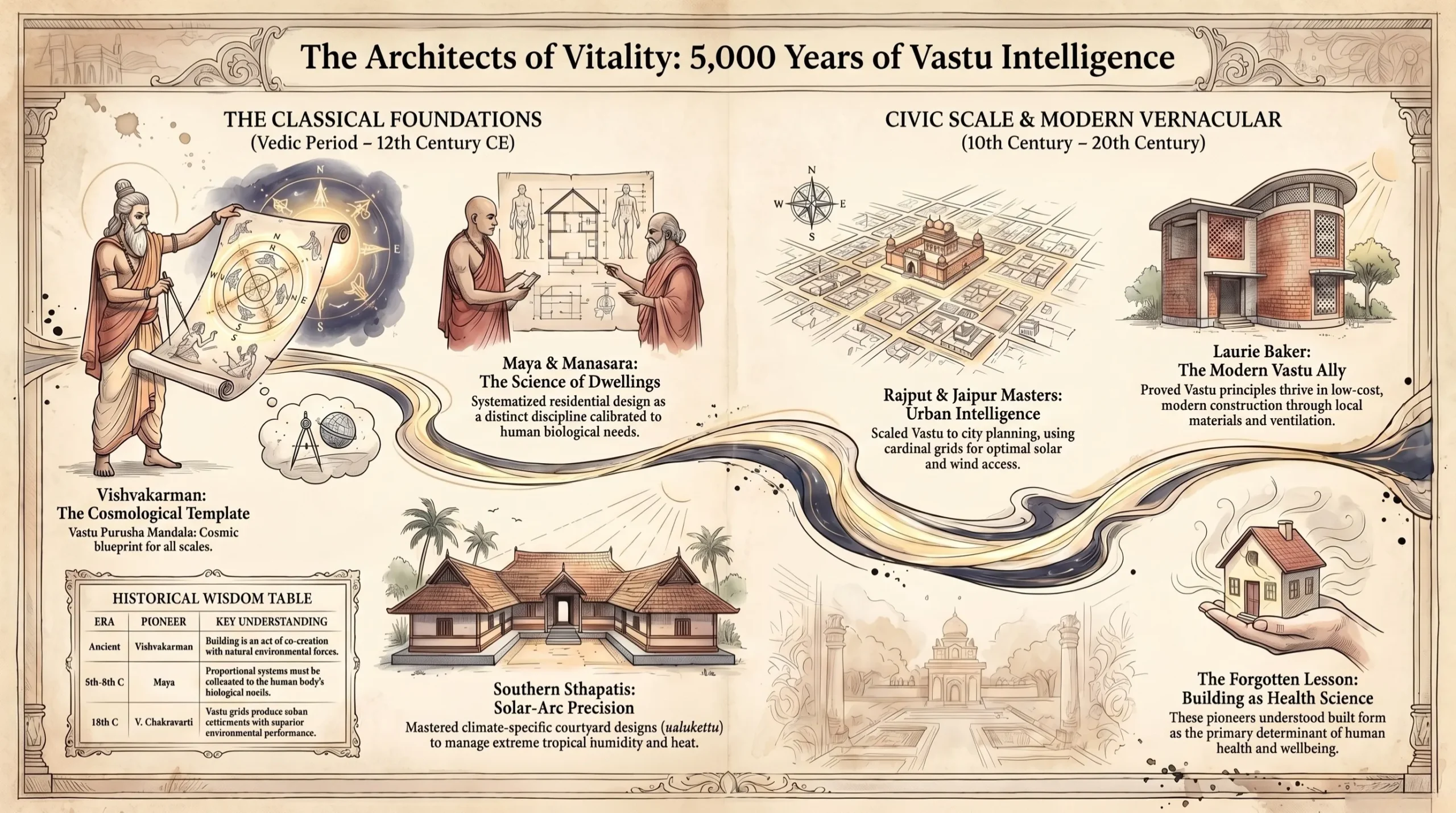
The following table provides a reference guide to eight figures and traditions who made the most historically consequential contributions to Vastu Shastra’s development as a residential and civic building science — from the mythological divine architect Vishvakarman who encoded the tradition’s cosmological foundations, through the classical text authors of the Manasara and Mayamata, the regional master builders of Kerala, Rajasthan, and Tamil Nadu, the urban planner Vidyadhara Chakravarti, and the modern architect Laurie Baker, whose engagement with Kerala’s vernacular tradition represents the most significant twentieth-century extension of Vastu principles.
|
Architect / Sthapati |
Era / Region |
Primary Vastu Contribution |
Surviving Evidence |
What They Understood That Modern Practice Has Forgotten |
|
Vishvakarman (Visvakarma) The divine architect of the Vedic texts |
Vedic period; mythological but encoding real accumulated design wisdom |
The cosmological framework for all built form: the Vastu Purusha Mandala as the organising template for settlement, temple, and dwelling at every scale; the Vishvakarma Prakasha attributed to this figure systematises the earliest complete built environment design theory |
The Vishvakarma Prakasha text; references throughout the Vedic corpus; the surviving architectural tradition of the Vedic yupa (ritual post) with its directional orientation prescriptions |
That built form is not merely functional shelter but a physical encoding of the cosmic order; that building is an act of co-creation with the natural forces of the environment; that the architect’s primary responsibility is to ensure the built environment supports rather than opposes the health of its occupants |
|
Maya (author of Mayamata) The architect-scholar of the early classical period |
Approximately 5th–8th century CE; Tamil Nadu and South India tradition |
The Mayamata text — one of the two primary classical Vastu texts alongside the Manasara — systematises the residential Vastu prescriptions for the Griha (house) in the most practically detailed form available in any classical text; Maya’s specific contribution is the precision of the material prescriptions and the proportional system for residential dwellings |
The Mayamata text, surviving in multiple South Indian manuscript traditions; the architectural tradition of Tamil Nadu residential and temple design that descends directly from this text |
That residential design is a distinct discipline from temple design, requiring its own specific prescriptions for sleeping zone placement, cooking zone character, material selection, and proportional system calibrated to the human body’s biological needs rather than to the cosmic symbolism of sacred architecture |
|
Mañjusri (Manasara tradition) The scholar-architects of the Manasara |
Approximately 3rd–7th century CE; compiled over multiple generations; South and Central Indian tradition |
The Manasara — the most comprehensive Vastu text in the classical tradition — represents the collective architectural scholarship of a lineage of practitioner-scholars who synthesised the tradition’s observational knowledge into its most systematic and most rigorously physical form; the Manasara’s treatment of town planning (Nagara Vinyasa), temple design, palace design, and residential design as a unified physical science is unmatched in the classical literature |
The Manasara text itself, in multiple manuscript versions; the architecture of the classical period throughout South and Central India that reflects its prescriptions; modern scholarly editions by Prasanna Kumar Acharya |
That Vastu Shastra is a comprehensive physical science of the built environment — not a ritual practice, not a spiritual cosmology — whose prescriptions are derivable from physical observation and whose effects are observable in the health and wellbeing of the families who inhabit correctly designed dwellings |
|
The Sthapatis of the Brihadisagama tradition Temple and residential architects of Tamil Nadu |
8th–12th century CE; particularly the Pallava, Chola, and later dynasties |
The development of the South Indian residential design tradition — the nalukettu and illam forms — as the most physically sophisticated application of Vastu residential prescriptions ever realised in building: the courtyard as Brahmasthana, the zone allocations perfectly calibrated to the Tamil Nadu solar arc, the thermal mass character of the laterite and granite construction materials expressing the Pancha Bhuta elemental zone prescriptions in a climate-specific form |
The surviving nalukettu houses of Kerala and Tamil Nadu, many still in occupation and demonstrably excellent in their environmental performance; the temple complexes of Thanjavur, Mahabalipuram, and Madurai as architectural expressions of the same physical principles at sacred scale |
That climate-specific architectural expression of universal Vastu principles produces the most health-generating buildings: the South Indian tradition’s laterite thermal mass, courtyard proportions, and roof overhang specifications are a climate-calibrated Vastu implementation whose environmental performance exceeds that of any non-Vastu building form developed for the same climate |
|
The master builders of the Rajput tradition The sthapatis and raj mistris of Rajasthan |
10th–18th century CE; Rajasthan, Gujarat, and Western India |
The development of the haveli form as the most socially sophisticated Vastu residential expression: the multi-courtyard haveli organises extended family habitation around a hierarchy of Brahmasthana courtyards, with sleeping zones, women’s quarters, reception areas, and service spaces correctly allocated by Vastu zone principles while achieving a spatial and social programme of extraordinary complexity |
The surviving havelis of Jaisalmer, Jodhpur, Bikaner, and Shekhawati — many still inhabited and demonstrably functional as living environments; the architectural manuals of the Rajput building tradition preserved in private and temple collections throughout Rajasthan |
That Vastu principles are scalable from single-family dwelling to complex multi-generational extended family habitation; that the Brahmasthana principle applied hierarchically across multiple courtyards produces the most socially and environmentally functional residential form for large Indian families; that the thermal mass and wind-tower (baori) traditions of Rajput architecture are climate-specific applications of Vastu environmental physics |
|
The Kerala Thachu Shastra masters The architectural scholar-craftsmen of Kerala |
8th century CE through the present; Kerala and Malabar tradition |
The Thachu Shastra — the Kerala regional elaboration of Vastu for the specific climatic, topographic, and material conditions of Kerala — represents the most climate-integrated application of Vastu residential prescriptions available: the nalukettu’s specific courtyard proportions for Kerala’s equatorial solar arc, the sloped roof forms that manage Kerala’s extreme rainfall while creating the Brahmasthana sky connection, the laterite and teak material programme that expresses the Pancha Bhuta elemental prescriptions in Kerala’s specific geological and ecological material vocabulary |
The surviving nalukettu houses of central Kerala; the Thachu Shastra texts preserved in the tharavad (traditional household) libraries of Kerala Nair families; the living tradition of Kerala temple and residential architecture maintained by Vishvakarma caste craftsmen families |
That the regional elaboration of Vastu principles in response to specific climatic, topographic, and cultural conditions produces architectural forms that are more specifically health-generating than the application of undifferentiated pan-Indian Vastu prescriptions; that climate-specific Vastu is the highest expression of the tradition, not a departure from it |
|
Vidyadhara Chakravarti The master planner of Jaipur |
Early 18th century CE (Jaipur founded 1727 CE); Rajasthan |
The planning of Jaipur — the first planned city in India since the Indus Valley — as a direct application of Vastu Nagara Vinyasa principles at urban scale: the cardinal street grid producing solar access to all residential plots; the hierarchical zone allocation placing the royal palace at the city’s symbolic centre; the nine-rectangle grid plan organising the city’s districts according to the Vastu Purusha Mandala’s directional zone system; the integrated water management system placing the primary water bodies in the north and north-east of the city |
The city of Jaipur itself, surviving as an essentially intact eighteenth-century planned city; Vidyadhara’s design documents preserved in the Jaipur royal archives; scholarly analysis of Jaipur’s urban form by Giles Tillotson and others confirming the direct application of Vastu Nagara Vinyasa principles |
That the Vastu Nagara Vinyasa is capable of producing urban settlements whose physical environmental performance — solar access, water management, wind management, spatial legibility — is demonstrably superior to most non-Vastu planned Indian cities; that a professional architect-planner with systematic Vastu knowledge can deliver both cosmological correctness and practical environmental excellence simultaneously |
|
Laurie Baker The British-Indian architect and Vastu ally (1917–2007) |
20th century; Kerala, particularly 1960s–2000s |
Baker’s contribution to the Vastu lineage is indirect but significant: his systematic engagement with Kerala’s vernacular building tradition — deeply informed by Vastu principles even when not explicitly named — and his development of low-cost, climate-responsive residential architecture for Kerala’s specific environmental conditions produced a body of residential work whose passive solar performance, natural ventilation, thermal mass quality, and material expression are among the best available examples of Vastu-aligned modern residential architecture. Baker worked with local masons who carried the Thachu Shastra knowledge practically even when the textual tradition had been set aside |
Baker’s extensive built archive in Kerala; his writings and teaching at the Centre for Development Studies; the many low-cost Kerala homes that remain environmental performance exemplars fifty years after completion |
That Vastu principles can be applied rigorously in modern residential construction without literal adherence to the classical vocabulary; that the physical principles — thermal mass, solar orientation, natural ventilation, proportional human scale — are the substance of the tradition, and that any architect who genuinely implements those principles is practising Vastu science regardless of whether they use its name |
The most important pattern across this table of pioneers is the one in the final column — ‘What They Understood That Modern Practice Has Forgotten.’ In every case, the historical figure understood something that the contemporary construction and design industry has largely abandoned: that the built environment’s physical character is the primary determinant of the health and wellbeing of the people who inhabit it; that building is therefore a health science responsibility, not merely a technical shelter provision challenge; and that the accumulated observational knowledge of how specific building design decisions affect specific human health outcomes is the most valuable practical knowledge a builder can possess.
The tragedy of India’s contemporary residential construction industry — and the opportunity that the Complete Home Health Audit’s assessment services represent — is that this knowledge was not lost because it was disproven. It was lost because the social and economic disruptions of the colonial period, the industrialisation of construction materials, and the professionalization of architectural design in Western models broke the continuity between the traditional master builder traditions and the contemporary construction industry. The knowledge is intact, in the texts and the surviving buildings. The connection between the knowledge and the people who most need it is what has been broken — and that is the connection that every Complete Home Health Audit is designed to restore
What did the Indus Valley urban planners contribute to Vastu's settlement-scale science — and why does it matter today?
The Indus Valley Civilisation — the earliest urban civilisation of the Indian subcontinent, flourishing approximately 2600–1900 BCE in what is now Pakistan, Rajasthan, and Gujarat — represents the most ancient evidence for the application of building health principles at urban scale in the Indian tradition. The planned cities of Mohenjo-daro and Harappa, with their grid street plans, uniform residential standards, and sophisticated sanitation infrastructure, demonstrate that the physical principles Vastu would later systematise as Nagara Vinyasa were already being applied — empirically, practically, and at large scale — two thousand years before the Manasara’s authors gave them textual form.
The Indus Valley cities’ most relevant contribution to the Vastu tradition’s history is the street grid orientation. Archaeological analysis of Mohenjo-daro’s street plan confirms that the primary streets are oriented within approximately ten to fifteen degrees of the cardinal directions — the same orientation that Vastu’s Nagara Vinyasa prescribes for the settlement-scale solar access and wind management benefits that modern urban climatology has independently confirmed. Whether the Indus Valley planners arrived at this orientation through explicit solar reasoning, through the kind of observational trial-and-error that preceded theoretical codification, or through the transmission of earlier wisdom is uncertain. What is certain is that they applied it consistently across multiple urban sites separated by hundreds of kilometres and hundreds of years — evidence of a systematic planning knowledge that produced the same physical outcome across vastly different geographic contexts.
The Indus Valley cities’ sanitation infrastructure — the most sophisticated urban sewage system of any ancient civilisation — is the earliest recorded example of the Vastu zone separation principle applied to health-critical infrastructure. The principle of separating zones of human waste, zones of food preparation, and zones of human rest and sleeping is foundational to both Vastu Shastra and modern public health. The Indus Valley builders applied this principle at urban scale with an engineering sophistication — private bathrooms with drainage connections to covered street sewers running to municipal collection facilities — that most of the world’s cities would not replicate until the nineteenth century CE.
The historical significance of the Indus Valley connection to the Vastu tradition is not merely academic. It demonstrates that the physical health principles encoded in the Vastu texts were not invented by the texts’ authors — they were already operating in the Indian building tradition four thousand years before the Manasara was written, and that the texts represent the codification of accumulated empirical knowledge rather than the creation of new principles. This is the strongest possible historical evidence for the tradition’s empirical character: not a single inspired sage, but four thousand years of careful builders observing what worked and passing the knowledge forward.
What physical health principles do surviving historical Indian buildings demonstrate?
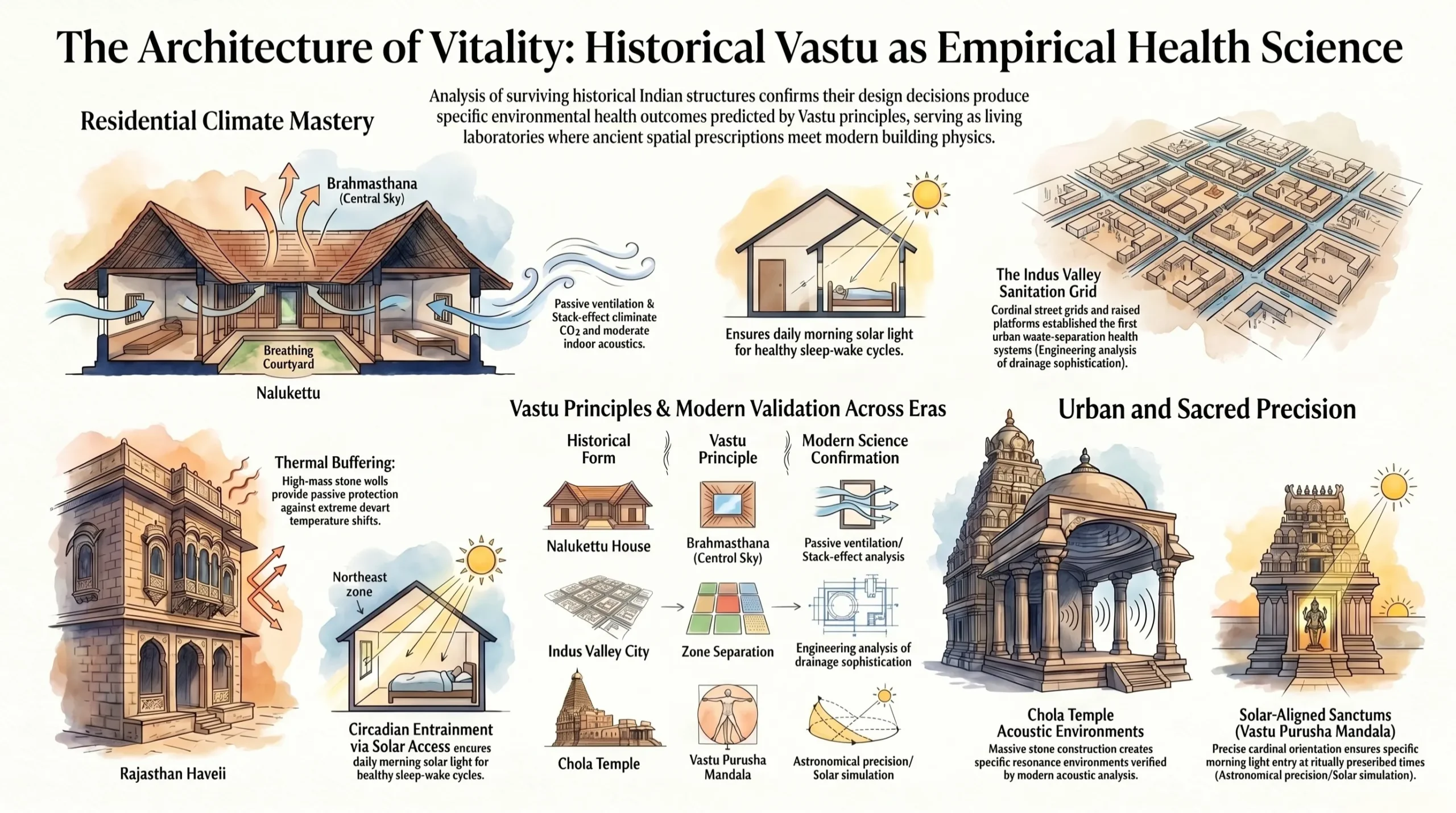
The most compelling argument for Vastu’s historical validity is not textual — it is architectural. The surviving buildings of India’s historical building traditions are available for physical analysis, and that analysis consistently confirms that their design decisions produce the specific environmental health outcomes that the Vastu principles they embody would predict. The following table examines six historical Indian architectural forms, the Vastu principles they express, the physical health mechanisms those principles engage, and the modern building science confirmation available for each.
|
Historical Architectural Form |
Region and Period |
Vastu Principle Expressed |
Physical Health Mechanism |
Modern Building Science Confirmation |
|
Nalukettu courtyard house |
Kerala; 8th century CE through present |
Brahmasthana as the home’s central sky-connected breathing space; SW sleeping zones with maximum thermal mass; NE living and ritual zones with maximum morning solar access |
Stack-effect ventilation through open courtyard eliminates CO2 accumulation; thermal mass in SW walls maintains sleep zone at circadian-appropriate temperature; morning solar light delivers ipRGC circadian entrainment daily to all family members; courtyard acoustic moderation reduces external noise intrusion |
Building physics passive ventilation analysis confirms stack-effect mechanism of Kerala courtyard; thermal mass calculation confirms SW wall performance; daylighting simulation confirms NE zone morning lux delivery; acoustic measurement confirms noise reduction |
|
Haveli of Rajasthan |
Rajasthan; 10th–18th century CE |
Multiple nested Brahmasthana courtyards creating hierarchy of environmental zones; wind towers (baori) for passive cooling; maximum thermal mass construction in desert climate; social zone separation protecting sleeping zone quiet |
Thermal mass construction — typically 600–900 mm thick stone and lime — provides the highest available passive thermal buffering against Rajasthan’s extreme diurnal temperature range (40°C+ day, 15–20°C night in summer); wind towers create passive ventilation without mechanical cooling; courtyard hierarchy provides environmental privacy and acoustic separation for sleeping zones |
Passive cooling research confirms wind tower performance; thermal mass calculation confirms Rajasthan haveli’s temperature stabilisation effectiveness; Building Biology sleeping zone acoustic measurement would confirm low ambient noise in inner courtyard sleeping zone |
|
Indus Valley planned city (Mohenjo-daro, Harappa) |
Indus Valley; approximately 2500–1900 BCE |
Grid street plan with cardinal orientation; raised residential platforms above sewage infrastructure; uniform residential cell standards suggesting standardised spatial prescriptions; central civic and administrative zone at settlement geometric centre |
Sanitation infrastructure separating waste water from living areas — the world’s first urban sewage system in the residential quarters — is the earliest recorded example of the Vastu principle of zone separation applied to health-critical infrastructure; the cardinal street grid produces the solar access prescriptions that Vastu codified as formal principle |
Archaeological analysis confirms cardinal street orientation at Mohenjo-daro; engineering analysis confirms drainage system sophistication; the connection to later Vastu Nagara Vinyasa principles is documented by historians of Indian architecture including Stella Kramrisch |
|
Chola temple complex (Thanjavur Brihadeeswarar) |
Tamil Nadu; 11th century CE; Great Chola period |
Vastu Purusha Mandala applied at the scale of the temple complex: the vimana (main tower) at the Brahmasthana; directional gateway towers; precise cardinal orientation; zone allocation of different ritual functions to their correct directional positions around the complex |
The Brihadeeswarar temple’s precise cardinal orientation ensures that morning solar light enters the main sanctum at specific ritually and cosmically prescribed times; the spatial organisation creates the specific acoustic resonance environment that the ritual chanting tradition exploits; the thermal mass of the stone construction provides the stable thermal environment for the sanctum’s ritual use |
Astronomical analysis confirms the Brihadeeswarar’s cardinal orientation precision to within fractions of a degree; acoustic analysis confirms the ritual spaces’ reverberation characteristics; solar simulation confirms the specific morning light entry into the main sanctum that the cardinal orientation produces |
|
Mughal garden palace (Humayun’s Tomb, Red Fort, Taj Mahal complex) |
Delhi, Agra; 16th–17th century CE; Mughal period |
Persian-Mughal synthesis producing the chahar bagh (four-garden) spatial form that places the primary pavilion at the geometric centre of a cardinal-aligned four-part garden — a direct Brahmasthana expression; north-south and east-west axes providing the directional spatial framework; water features on cardinal axes providing the Jal element in its directional position |
The cardinal orientation of the chahar bagh produces the same solar access benefits that Vastu Nagara Vinyasa prescribes: morning solar access to the north and east garden quadrants, afternoon shade in the south and west. The water features on the cardinal axes produce evaporative cooling of the prevailing wind pathways. The central pavilion’s placement at the Brahmasthana produces the ventilation and thermal moderation that the open central zone principle prescribes |
Environmental analysis of Humayun’s Tomb complex confirms the passive cooling and daylighting benefits of the chahar bagh form; the convergence with Vastu Nagara Vinyasa principles confirms that Mughal architects, working within a different architectural vocabulary, were independently implementing the same physical health environment principles |
|
Vijayanagara urban landscape (Hampi) |
Karnataka; 14th–16th century CE; Vijayanagara Empire |
Large-scale application of Vastu Nagara Vinyasa to the most extensive pre-colonial Indian city: the cardinal street grid; the directional zone allocation of residential, commercial, religious, and royal functions; the placement of the Tungabhadra river to the north of the primary urban settlement; the Brahmasthana civic open space at the settlement’s geometric centre |
The Tungabhadra river to the north of Hampi’s primary urban area is the most precise historical example of Vastu’s north-east water body prescription at urban scale: the river’s evaporative cooling of the prevailing north-east wind produces measurable temperature reduction in the residential zones downwind, exactly as modern urban climatology confirms for correctly positioned urban water bodies |
Urban climatology analysis would confirm the Tungabhadra’s cooling effect on Hampi’s residential zones; the cardinal orientation of the major Hampi streets is confirmed by archaeological survey; the directional zone allocation of religious, commercial, and residential functions has been documented by historians of Vijayanagara architecture |
The pattern across this table is unambiguous. Every surviving historical Indian architectural form that expresses Vastu principles — from the Kerala nalukettu through the Rajasthan haveli, from Mohenjo-daro through the Chola temple, from the Mughal chahar bagh through the Vijayanagara planned city — embodies physical health principles whose mechanisms modern building science has independently characterised and confirmed. These are not coincidences. They are the accumulated physical intelligence of generations of careful observers, encoded in building forms that have demonstrated their environmental performance across hundreds of years of continuous occupation.
For the contemporary Indian family whose new construction decisions are informed by this historical evidence, the message is specific and empowering: the physical principles that produced some of the world’s most environmentally sophisticated residential buildings are available, through the Vastu tradition, to inform the design of every new home built in India today — at modern materials costs and with the additional precision that contemporary instruments and building science provide. The tradition does not require literal reproduction of the nalukettu form or the Rajasthan haveli to deliver its health benefits. It requires understanding the physical principles that made those forms effective and expressing them in the material and spatial vocabulary available to contemporary construction.
What did Vidyadhara Chakravarti teach the world about urban-scale Vastu — and what does his legacy mean for Indian cities today?
Vidyadhara Chakravarti — the chief architect and urban planner of Jaipur, commissioned by Maharaja Sawai Jai Singh II to design and build the city that would become the capital of Jaipur State — is the most specifically documented historical example of a named Vastu practitioner whose work can be analysed, measured, and evaluated against the physical health claims of the tradition. Jaipur, founded in 1727 CE, is the first comprehensively planned Indian city since the Indus Valley period — and it is, in the precision of its application of Vastu Nagara Vinyasa principles at urban scale, among the most intellectually impressive built demonstrations of Vastu’s environmental intelligence available for study.
Vidyadhara’s plan for Jaipur is documented in his own architectural drawings, preserved in the Jaipur royal archives and studied by architectural historians including Giles Tillotson, whose analysis confirms the direct application of the Vastu Purusha Mandala’s nine-rectangle grid to the city’s district plan. The primary streets of Jaipur are oriented within a few degrees of the cardinal directions — producing the solar access benefits that the Vastu Nagara Vinyasa prescribes for residential plots on all street-fronting facades. The city’s water management system — the step-wells, the tanks, and the Jal Mahal water palace — places the primary water bodies in the north and north-east of the urban settlement, exactly as Vastu Nagara Vinyasa prescribes for the evaporative cooling and negative ion generation benefits of north-east water placement on the prevailing wind pathway.
The physical environmental performance of Jaipur’s traditional built fabric — its pink sandstone construction, its proportional street cross-sections producing adequate solar access without wind tunnel effects, its zone-separated residential and commercial areas — has been studied by urban climatology researchers who have confirmed its passive thermal performance advantages over the unplanned urban development that has surrounded the old city in the twentieth century. Jaipur’s historic core, built to Vastu Nagara Vinyasa principles, performs measurably better in passive thermal terms than its contemporary expansion areas — confirming that Vidyadhara’s three-hundred-year-old planning decisions continue to deliver the physical environmental benefits that the Vastu tradition claimed for them.
Vidyadhara’s legacy for Indian cities today is the demonstration that Vastu Nagara Vinyasa is not merely a historical curiosity or a cultural aesthetic preference. It is a physically operational urban planning framework whose application at city scale produces measurable, durable, and clinically relevant environmental health advantages for every family who lives within its correctly planned fabric — advantages that persist for three hundred years and that modern urban climatology can now confirm, mechanism by mechanism, were always the physical reality behind the tradition’s cosmological prescriptions.
What did Laurie Baker demonstrate about Vastu's relevance to modern Indian residential practice?
Laurie Baker — the British Quaker architect who came to India in 1945 and spent sixty years developing a body of residential work in Kerala that is, in its environmental performance and its human scale quality, among the finest modern residential architecture produced anywhere in the world in the twentieth century — is not conventionally described as a Vastu practitioner. He rarely used the vocabulary. But his work is, in its physical substance, one of the most systematic and most successful applications of Vastu residential principles to modern building practice available for study.
Baker’s engagement with Kerala’s vernacular building tradition — the nalukettu, the traditional market buildings, the small village churches that maintain the traditional building scale and material vocabulary — was not archaeological or sentimental. It was a rigorous investigation of what made these buildings work environmentally: what produced their thermal comfort without mechanical cooling; what produced their natural ventilation without mechanical fans; what produced their acoustic quality, their structural resilience, and their occupant health quality that the modern buildings replacing them consistently failed to replicate. The answers he found were the physical principles that the nalukettu masters had been practising for a thousand years: thermal mass in laterite, natural ventilation through courtyard stack-effect, deep roof overhangs for solar shading, natural timber for acoustic and biophilic quality, lime for vapour-open hygienic surfaces.
Baker’s most specific contribution to Vastu’s modern relevance was his demonstration that these principles are cost-neutral or cost-negative in the Indian construction context — that a laterite wall costs less than a concrete block wall, that natural ventilation costs nothing whereas mechanical air conditioning imposes lifetime energy costs, that lime plaster costs comparably to cement plaster while delivering dramatically superior environmental health performance. Baker’s work directly refutes the assumption, pervasive in contemporary Indian construction, that Vastu-aligned natural building is a luxury for the wealthy. It is, in the Indian construction context, often the most economical option — and always the most environmentally healthy one.
Baker’s legacy for the contemporary family seeking a Complete Home Health Audit is the most practically encouraging message in this article’s entire historical survey: the physical principles that the historical Vastu pioneers developed and the historical buildings embody are not beyond reach in contemporary India. They are available in natural materials that can be specified by any architect, built by any skilled contractor, and afforded by any family that is willing to invest in health rather than appearance. The question is not whether the tradition’s physical principles are applicable in contemporary India. It is whether contemporary Indian families, architects, and builders have the knowledge to apply them. The Complete Home Health Audit is designed to provide that knowledge.
What does the continuity of the sthapati tradition reveal about how Vastu knowledge was transmitted across millennia?
The question of how Vastu knowledge was transmitted across the several thousand years that separate the earliest Vedic building practices from the present day is one of the most intellectually interesting questions in the tradition’s history — and its answer reveals something important about the nature of the knowledge itself and about why that knowledge has survived while so much of the Vedic civilisation’s other intellectual heritage has been lost.
The primary transmission mechanism for Vastu knowledge was not the textual tradition — it was the living building tradition of the sthapati craftsmen-architects, whose knowledge of material behaviour, spatial proportion, solar orientation, and earth energy assessment was transmitted through direct apprenticeship from master to student across dozens of generations. The sthapati families — the Vishvakarma caste craftsmen who built the temples, havelis, nalukettu houses, and civic buildings of traditional India — carried the practical knowledge of Vastu in their hands as much as in their minds: in the calibrated experience of how laterite responds to rainfall, how teak behaves across seasonal humidity cycles, how the courtyard proportions need to change as the latitude changes to maintain the solar access and ventilation benefits the design prescribes.
This embodied, practitioner-transmitted knowledge is both the tradition’s greatest strength and its greatest vulnerability. Its strength is that it is calibrated against thousands of real buildings and hundreds of years of observed outcomes — not theoretical speculation but tested empirical knowledge. Its vulnerability is that it requires continuous living transmission: if the generation of master builders who carry it is not followed by an equally skilled and equally engaged generation of apprentices, the knowledge breaks. And in twentieth-century India, the industrialisation of construction materials — the replacement of laterite with concrete block, of teak with plywood, of lime with cement — broke precisely this transmission in the regions where it had been most continuously maintained.
The textual tradition — the Manasara, the Mayamata, the Thachu Shastra, and the other classical Vastu texts — represents the parallel transmission mechanism that preserved the intellectual framework of Vastu’s physical principles when the living building tradition was disrupted. The contemporary Vastu practitioner who works from the classical texts is therefore working with the preserved intellectual framework of a living tradition whose embodied knowledge was partly lost — and the contribution of modern building science, with its instruments and its physical mechanism vocabulary, is to restore the precision that the living tradition’s embodied knowledge provided when it was intact.
What does this historical lineage mean for the family seeking a Complete Home Health Audit today?
The historical survey this article has conducted — from the intellectual culture of the Vedic sthapatis through the nalukettu masters of Kerala, the haveli builders of Rajasthan, the urban planner Vidyadhara, and the modern architect Laurie Baker — leads to a conclusion that is both intellectually satisfying and practically empowering. The Vastu tradition that informs a contemporary Complete Home Health Audit is not a modern invention or a commercial revival. It is the living current of five thousand years of careful, rigorous, empirically grounded investigation into the most important question that any building tradition can address: what physical conditions in the built environment most consequentially affect the health and wellbeing of the people who inhabit it?
The historical practitioners this article has described — whatever their era, region, or specific architectural vocabulary — were all asking and answering the same question. The Manasara’s authors systematised the answer in a comprehensive physical science text. The nalukettu masters expressed the answer in the most climate-calibrated residential building form the Indian subcontinent has produced. Vidyadhara expressed it at the urban scale that no single practitioner has since matched. Laurie Baker expressed it in a demonstration that cost and modernity are no obstacles to its application. And Modern Building Biology, chronobiology, environmental psychology, and biophilia science are expressing it in the physical mechanism vocabulary that the tradition’s founders did not have but would, I am certain, have welcomed as the most complete available confirmation of what they had always known.
For the contemporary Indian family seeking a Complete Home Health Audit, the relevance of this historical lineage is not ceremonial. It is grounding. When the practitioner’s RF meter reads 4,200 microWatt per square metre at the sleeping position and prescribes the router’s relocation outside the bedroom, that prescription stands in a lineage that runs through Laurie Baker’s laterite walls, through the nalukettu masters’ courtyard ventilation, through the Manasara’s sleeping zone prescriptions, through the Indus Valley builders’ separation of waste and living zones — all the way back to the first Vedic practitioner who noticed that families who slept in certain orientations and zones were healthier than those who did not. The instrument is new. The principle is ancient. And the health it protects is the same health that every one of those generations of practitioner-architects was working to support.
This continuity is the source of the confidence with which the Complete Home Health Audit’s 100% satisfaction guarantee is offered. The prescription is not new. It has been tested against the health outcomes of families in millions of dwellings across five thousand years. The instruments are new — and they have added a precision and an accountability to the testing that the historical tradition could not achieve. Together, they produce the most complete and most accountable expression of Vastu’s foundational purpose that the tradition has ever had available to it.
Real Case Study — A Heritage Architect Who Found the History and the Science Inseparable:
An architectural conservationist who specialised in the restoration of Kerala nalukettu houses came to me for a Complete Home Health Audit of the apartment she was living in during a Kochi restoration project. She was, she said, ‘professionally schizophrenic’ — spending her working days restoring buildings whose physical intelligence she deeply respected and whose underlying principles she understood better than most, and spending her personal life in a modern apartment whose building environment she knew was far inferior to the buildings she was restoring.
The assessment found what she expected it to find. Geopathic stress zone beneath her sleeping position — 2.4 microtesla above background. Bedroom router at 3,600 microWatt per square metre. Head-north sleeping orientation. The apartment’s central zone — a generous corridor that would have been the nalukettu’s Brahmasthana — packed with restoration drawings, material samples, and equipment.
During the mechanism explanation, she made the observation that has stayed with me since: ‘Everything you are measuring with your instruments is something the nalukettu masters handled without instruments — through material selection, form, orientation, and the specific proportions of the courtyard. The geomagnetic stress you have found, they avoided through the site assessment. The router they would not have had — but the equivalent problem in their era, the sleeping zone acoustic intrusion from the service areas, they solved through zone separation. The Brahmasthana obstruction I have created in my corridor is exactly what the courtyard was designed to prevent. I am living proof that you can understand this tradition intellectually and still violate every principle it contains the moment you stop living within a building that enforces them structurally.’
She implemented the corrections over one weekend. The corridor was cleared. The router moved. The bed repositioned head-south in the clean field zone.
At six weeks: ‘I am sleeping better in this apartment than I have in the nalukettu houses I have been studying for fifteen years — which says something uncomfortable about my own restoration practice, I think. The nalukettu’s courtyard enforces the correct conditions passively. Your assessment makes the correct conditions achievable in any building. The history and the science are the same project.’
Her contribution to this article: ‘The family that understands why the nalukettu worked — thermally, acoustically, energetically — has the most powerful possible motivation for the corrections your audit prescribes. They are not being asked to comply with tradition. They are being asked to implement the same physical intelligence that produced some of the world’s healthiest residential buildings, in the building they actually have to live in.’
What the Surviving Buildings Prove That the Texts Cannot:
The strongest argument for Vastu’s validity is not the Manasara. It is the nalukettu houses of Kerala that have been continuously inhabited for six hundred years and remain, by any environmental performance measure, more comfortable, more healthy, and more sustainable than the concrete apartments being built in the same region today. It is the havelis of Jaisalmer whose thick stone walls and courtyard ventilation maintain interior temperatures thirty degrees below the desert exterior at noon without any mechanical cooling. It is the planned city of Jaipur whose street grid produces solar access to every residential plot three hundred years after it was laid out.
Texts can be argued about. They can be interpreted differently, translated variously, and contextualised into irrelevance by scholars with competing agendas. Buildings cannot. The nalukettu either maintains its interior at comfortable temperature without mechanical cooling or it does not. The haveli either achieves thirty-degree passive cooling or it does not. Jaipur’s historic street grid either provides solar access to all its residential facades or it does not. These are physical measurements, not interpretations.
Every one of these buildings performs as Vastu’s physical principles predict it should — because the tradition’s historical practitioners designed them to. And every one of them is measurable, analysable, and confirmable by any building physicist, environmental engineer, or acoustic consultant who cares to study them.
The historical buildings are Vastu’s most eloquent argument — not because they are beautiful (though many are), not because they are culturally significant (though all are), but because they demonstrate, in physical performance terms that five hundred years of continued successful occupation documents, that the people who built them understood something about the relationship between building design and human health that contemporary India has forgotten and urgently needs to remember.
Five Thousand Years of Building Intelligence — Now Available for Your Home, Today.
The tradition whose history this article has traced — from the Vedic sthapatis through the nalukettu masters, from the Manasara’s authors through Vidyadhara’s Jaipur, from Laurie Baker’s laterite walls through the modern Building Biology instruments — converges on a single practical conclusion: the physical conditions that most consequentially affect the health of your family in your home are identifiable, measurable, and correctable. And the knowledge required to identify, measure, and correct them has been refined across five thousand years of the most sustained and most carefully observed building health research any civilisation has ever conducted.
Your Complete Home Health Audit delivers that knowledge for your specific home — in specific measurements, against internationally referenced standards, with specific predicted outcomes in specific biological timelines, and guaranteed by a 100% satisfaction commitment.
Your Complete Home Health Audit delivers:
- Patented photo-scanning analysis — the tradition’s accumulated directional and spatial wisdom applied systematically to your home’s photographs and floor plan; top 5 critical defects identified by Mukesh Shah personally
- Geopathic stress magnetometer survey — the Bhumi Pariksha earth assessment tradition expressed in microtesla; instrument-confirmed clean field zone for every sleeping position
- RF and ELF electromagnetic assessment — the modern equivalent of the classical sleeping zone prana quality assessment; bedroom device burden quantified and corrected
- Sleeping orientation — the most continuously validated Vastu prescription across five thousand years of observation; compass-bearing confirmation for every family member
- Nine-zone Vastu Purusha Mandala assessment — the Manasara’s directional zone framework applied to your floor plan; classical textual source cited for every prescription
- Brahmasthana integrity — the nalukettu masters’ central courtyard principle assessed in your home; ventilation, acoustic, and spatial assessment
- Natural material assessment — the nalukettu tradition’s Pancha Bhuta material intelligence applied to your home’s indoor air quality and biophilic quality
- Mechanism explanation — every finding linked to the physical mechanism that the historical tradition discovered observationally and modern science has confirmed instrumentally
- One-on-one consultation with Mukesh Shah personally
- Detailed written report — classical sources, physical mechanisms, instrument readings, corrections, and predicted outcomes
- 30 days of priority support through your implementation
- 100% satisfaction guarantee
The Manasara’s authors. The nalukettu masters. Vidyadhara’s planned city. Baker’s laterite walls. Five thousand years of the same intelligence, now measured in microtesla and microWatt per square metre. For your family’s health — tonight.
Book your Complete Home Health Audit today at vastumyhome.com
Vastu Shastra’s development involved multiple pioneering figures across thousands of years. The mythological architect Vishvakarman encoded the tradition’s cosmological foundations in the Vishvakarma Prakasha. The authors of the Manasara (approximately 3rd–7th century CE) systematised the most comprehensive classical Vastu text, treating the built environment as a physical science at every scale. The authors of the Mayamata provided the most detailed residential Vastu prescriptions. The Kerala Thachu Shastra sthapati masters developed the nalukettu house form as the most climate-calibrated application of Vastu residential principles ever realised in building. Vidyadhara Chakravarti applied Vastu Nagara Vinyasa at urban scale in Jaipur (1727 CE). Laurie Baker demonstrated its applicability in modern Indian residential construction.
The Manasara is the most comprehensive classical Vastu text, covering every scale of the built environment from site selection and town planning through temple and palace design to residential design — all within a single unified physical framework. Unlike other classical texts that address specific building types, the Manasara’s authors (working in the South and Central Indian tradition, approximately 3rd–7th century CE) integrated solar orientation, thermal mass, natural ventilation, acoustic design, and earth energy assessment into a single coherent built environment science. Its prescriptions are accompanied by physical reasoning — not merely cosmological assertion — making it the text most directly applicable to contemporary physical evidence-based Vastu assessment. Prasanna Kumar Acharya’s scholarly editions made it accessible to modern research.
The nalukettu (‘four wings’) house of Kerala is the most physically sophisticated application of Vastu residential principles ever built. Its central courtyard (Brahmasthana) creates stack-effect passive ventilation that manages Kerala’s extreme humidity without mechanical systems. Its deep roof overhangs shade walls from the near-vertical equatorial sun while admitting low-angle morning solar prana. Its laterite block walls provide the thermal mass that stabilises sleeping zone temperatures. Its teak and rosewood timber programme provides the biophilic, acoustically absorbing, VOC-neutral material environment that the Pancha Bhuta material prescription and modern Building Biology both recommend. Surviving nalukettu houses, many still in occupation after four to six hundred years, demonstrate by their continued excellent performance that the Vastu principles they embody are physically correct.
Vidyadhara Chakravarti, chief architect to Maharaja Sawai Jai Singh II, designed Jaipur (founded 1727 CE) as a direct application of Vastu Nagara Vinyasa at urban scale. The city’s primary street grid is oriented within a few degrees of cardinal directions, producing solar access to all residential plots on north-south and east-west streets. The city’s district plan follows the Vastu Purusha Mandala’s nine-rectangle grid, with the royal palace at the symbolic centre. Primary water bodies — the Jal Mahal and key tanks — are placed in the north and north-east of the settlement, consistent with Vastu’s north-east water placement prescription for evaporative cooling on the prevailing wind pathway. Physical analysis of Jaipur’s historic core confirms measurably superior passive thermal performance compared to the unplanned development surrounding it.
The Complete Home Health Audit draws directly on the five-thousand-year lineage described in this article. The geopathic stress magnetometer survey is the instrument-based expression of the classical Bhumi Pariksha earth assessment tradition. The RF meter assessment is the modern equivalent of the classical sleeping zone prana quality assessment, addressing the electromagnetic dimension the classical tradition could not access instrumentally. The zone allocation assessment draws on the Manasara’s nine-zone Vastu Purusha Mandala, with classical textual source cited for every prescription. The natural material assessment draws on the nalukettu masters’ Pancha Bhuta material intelligence, now confirmed by Building Biology and biophilia science. The entire service connects five thousand years of accumulated observational wisdom about the relationship between home design and human health to the specific physical conditions of the specific family’s specific home — in instrument-measured units, with specific predicted outcomes, and a 100% satisfaction guarantee.
I Would Love to Hear From You
I would love to hear your story or questions in the comments below. Have you experienced the impact of Vastu in your own home? Are you noticing any of the common defects I described above in your space? Share openly — every question is a step towards greater harmony.
Disclaimer: Vastu analysis and energy corrections are for harmonising your space and personal growth. They are not a substitute for professional medical, financial, legal or architectural advice.