
What Ethical Aspects Guide Vastu Consulting? How to Choose an Honest Practitioner | Vastu My Home
Namaste. I am Mukesh Shah. Of all the articles I have written about Vastu Shastra — its science, its history, its mechanisms, its remedies — this is the one I feel most personally called to write, and the one I suspect will be most useful to the largest number of Indian families. Not because ethics in Vastu consulting is an abstract philosophical topic, but because the ethical failures that occur in the Vastu marketplace today are causing real harm to real families — financial harm, psychological harm, and in some cases genuine health harm — and because the families most at risk are precisely those who are most sincere in their search for genuine help with the environmental health challenges of their homes.
I have practised Vastu consulting for over twenty years. In that time I have met thousands of families, and I have heard, with painful regularity, accounts of their previous encounters with Vastu practitioners who sold them expensive commercial objects that produced no observable effect; who created fear and dependency and demanded ongoing ritual services; who prescribed demolitions and structural changes before any of the simpler, more powerful physical corrections had been attempted; who claimed their assessments could diagnose or cure specific medical conditions; who refused to explain the physical mechanism for any recommendation and responded to reasonable questions with spiritual intimidation. These are not rare, exceptional cases. They describe a substantial portion of what passes for Vastu consulting in the Indian market today.
The purpose of this article is threefold. First, to articulate clearly what the ethical principles guiding genuine Vastu consulting should be — the standards that the tradition itself, at its intellectually finest and most empirically grounded, demands of its practitioners. Second, to give families the specific knowledge they need to identify ethical and unethical practitioners before engaging them — the precise questions to ask, the specific red flags to watch for, and the specific behaviours that distinguish a practitioner who is genuinely serving the family’s interest from one who is primarily serving their own. Third, to explain how these ethical principles shape every dimension of our own practice — and why they are the reason the Complete Home Health Audit is designed the way it is.
I write this not from a position of self-congratulation but from a position of deep professional concern. The Vastu tradition is too important, too genuinely valuable, and too consequential for the health of Indian families to be left to practitioners who exploit its authority for commercial gain. If this article helps one family avoid a damaging Vastu experience and find a genuinely helpful one, it will have served its purpose.
Why does ethics matter more in Vastu consulting than in most professional services?
Ethics matters in every professional service — but it matters more acutely, and the consequences of its absence are more damaging, in Vastu consulting than in most professional fields, for three specific reasons that are worth understanding clearly before anything else in this article.
The first reason is the information asymmetry between practitioner and client. A family seeking Vastu consultation is, by definition, in a state of limited knowledge about the tradition’s principles, its evidence base, its classical prescriptions, and the distinction between its genuinely validated core and its commercially motivated periphery. They are engaging the practitioner precisely because the practitioner has knowledge they lack. This information asymmetry — the same one that makes medical and legal ethics so important — creates an extraordinary opportunity for exploitation. A family that does not know that commercial Vastu objects have no grounding in the classical texts and no scientific validation cannot protect themselves from a practitioner who sells these objects with authority. A family that does not know that Vastu correction cannot cure disease cannot protect themselves from a practitioner who implies it can.
The second reason is the emotional vulnerability of the families most likely to seek Vastu help. Families come to Vastu consultation in the context of chronic health difficulties, persistent financial struggles, family discord, treatment-resistant illness, and the accumulated anxiety of years of inexplicable difficulty that no mainstream professional has been able to explain or resolve. This emotional vulnerability is not a weakness — it is the natural consequence of genuine suffering in search of genuine relief. But it is also the precise vulnerability that unethical practitioners exploit most effectively, through fear-creation, dependency-manufacturing, and the promise of cosmic authority to resolve earthly suffering if only the family complies with the practitioner’s prescriptions.
The third reason is the genuine power of the tradition when it is practiced ethically. Vastu Shastra, applied through the Scientific Vastu methodology with the precision and the honesty that genuine building science demands, produces real, measurable, life-changing improvements in the physical environments of the families it serves. Sleep quality improves. Immune function restores. The chronic environmental stressors that were quietly undermining the family’s health are identified and corrected. This genuine power is what makes the ethical stakes so high: the same authority that, in ethical hands, delivers genuine health benefit can, in unethical hands, deliver costly, dependency-creating, health-irrelevant or even health-damaging interventions in its place. The tradition deserves practitioners who are worthy of the trust families place in it.
Ethics in Vastu consulting is therefore not a nice-to-have professional courtesy. It is the fundamental condition that determines whether the tradition’s genuine power reaches the families who need it — or is captured for the commercial benefit of practitioners who have learned to use the tradition’s cultural authority without internalising its intellectual integrity.
What is the first and most foundational ethical principle of genuine Vastu consulting?
The first and most foundational ethical principle of genuine Vastu consulting is intellectual honesty — specifically, honesty about what is known, what is uncertain, and what has no evidence at all. This principle sounds obvious when stated plainly. But its application in a consulting context where the practitioner’s authority derives in part from the tradition’s ancient cultural prestige, and where clients are predisposed to trust the practitioner’s expertise, requires a degree of active, proactive transparency that goes considerably beyond simply avoiding deliberate falsehood.
Intellectual honesty in Vastu consulting means distinguishing clearly, in every assessment and every recommendation, between three categories of prescription: those with strong, independently validated physical mechanisms — the geomagnetic basis of sleeping orientation, the Building Biology research on geopathic stress, the chronobiology of morning light and circadian health, the passive solar design basis of directional zone prescriptions; those with plausible theoretical mechanisms but limited independent validation — some elemental activation prescriptions, some directional colour associations; and those with no identified physical mechanism and no grounding in the classical texts — commercial objects, ritual procedures presented as physical corrections, and the many accumulated accretions of the post-1990s commercial Vastu revival.
An intellectually honest practitioner names these distinctions explicitly. They say: this prescription — move your bed away from the Hartmann Grid intersection we have identified beneath your sleeping position — has this specific physical mechanism, validated by this specific body of Building Biology research, and I predict these specific observable outcomes in this timeline. And they also say: this prescription — the placement of this specific plant in the north-east corner — has a biophilic and air quality basis that is moderately supported by environmental science, but I am prescribing it as a supplementary, not a primary, correction. And they also say — if they have genuine intellectual integrity: the commercial object that a previous practitioner recommended has no identified physical mechanism, no grounding in any classical text, and in my assessment is not worth your investment or your trust.
This tiered honesty — this willingness to say not only ‘this is what I recommend’ but ‘this is how confident I am in this recommendation and why’ — is the mark of the practitioner who has genuinely internalised the Vastu tradition’s own standard. The Manasara itself distinguishes between Vastu Shastra (physical science) and Vastu Vidha (ritual practice). The tradition’s own foundational text demands this distinction. A practitioner who cannot or will not make it is failing the tradition’s own standard, not merely an external professional one.
How does commercial conflict of interest corrupt Vastu consulting — and what does it look like?
Commercial conflict of interest — the situation in which a practitioner’s financial incentives are misaligned with the client’s genuine interest — is the most pervasive and the most practically damaging ethical failure in the Vastu consulting marketplace. It takes several specific forms, each of which is worth naming precisely so that families can recognise and protect themselves from each one.
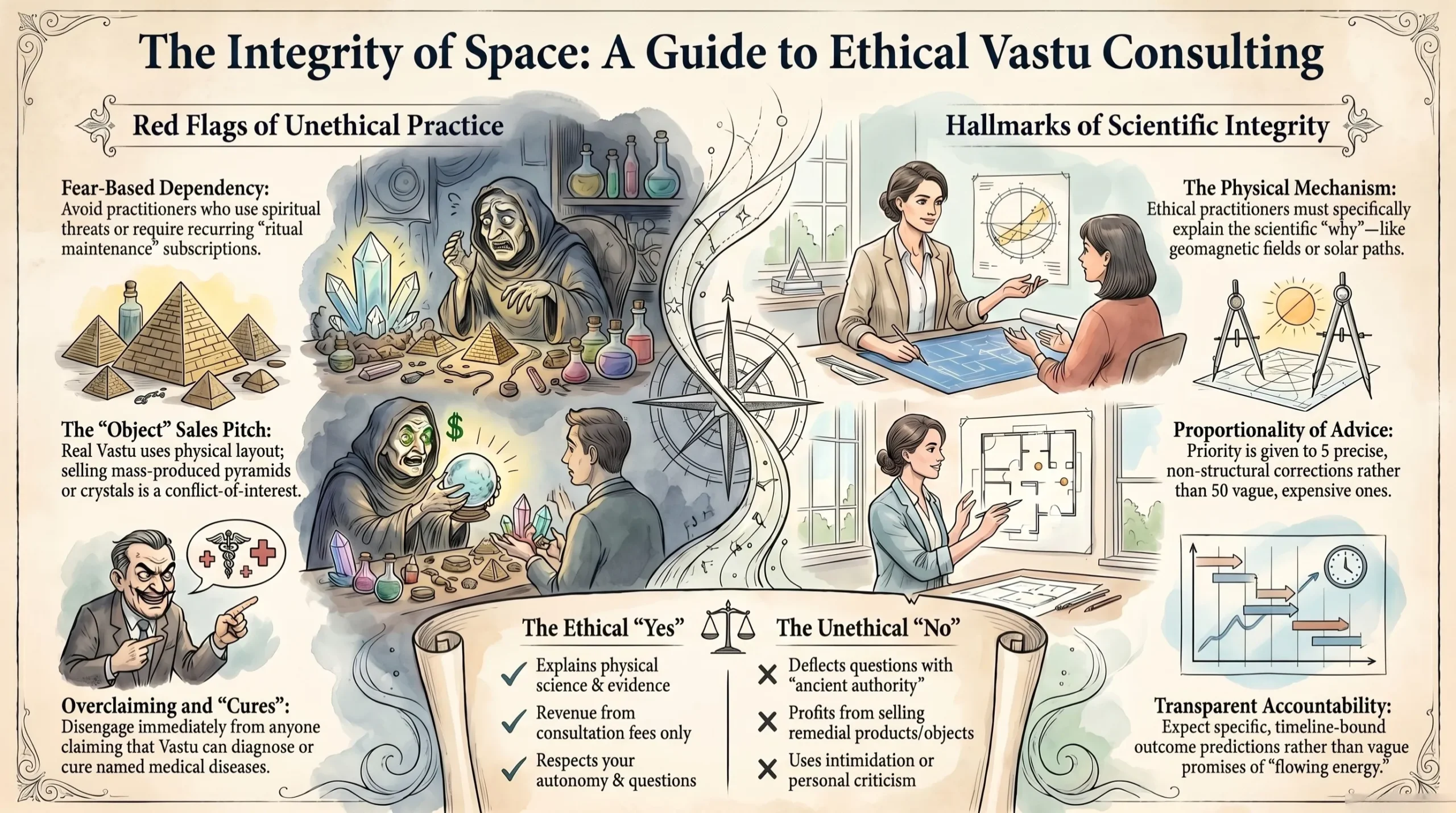
The most common and most transparent form is the sale of commercial Vastu objects as part of the consultation service. The practitioner arrives at the home, conducts an assessment of varying depth and quality, and concludes by recommending — and often selling on the spot — a range of metal pyramids, crystal arrangements, specific yantras, copper-plated remedial plates, or other manufactured objects whose alleged energy-correcting properties are presented as essential components of the assessment’s correction programme. The family, in the information-asymmetric position of the consulting relationship, has no basis on which to evaluate these recommendations independently. They trust the practitioner’s authority. They purchase the objects.
The facts about these objects are unambiguous and should be stated plainly. No classical Vastu text — not the Manasara, not the Mayamata, not the Brihat Samhita, not the Vishvakarma Prakasha — prescribes any mass-produced metal or crystal object as a Vastu remedy. These objects are entirely a commercial invention of the post-1990s urban Vastu revival — manufactured, marketed, and sold through distribution networks in which Vastu practitioners are often enrolled as retail agents. They have no identified physical mechanism, no peer-reviewed validation, no classical textual grounding, and in the assessments I conduct across thousands of homes, no consistent observable effect that distinguishes homes where they are present from homes where they are absent. A practitioner who sells them is not providing Vastu correction. They are providing commercial product sales under the cover of Vastu authority.
What are the subtler forms of commercial conflict of interest that families may not immediately recognise?
Beyond object sales, commercial conflict of interest in Vastu consulting takes subtler forms that are harder to identify but equally damaging to the families who encounter them. The most insidious of these is the creation of artificial ongoing dependency — the practice of implying that the home’s energy requires regular ‘maintenance’, ‘refreshing’, or ‘realignment’ that only the practitioner can provide, and that failure to engage in these ongoing services will allow the home’s energy to degrade and the family’s difficulties to return.
This dependency model is a pure revenue extraction mechanism. A correctly identified and correctly implemented physical Vastu correction — moving a bed away from a geopathic stress zone, removing a router from a sleeping zone, exchanging the master bedroom to the south-west, clearing the Brahmasthana — is a one-time physical intervention whose effects are permanent. The bed does not drift back onto the stress zone. The bedroom does not return to the north-east. The Brahmasthana does not re-obstruct itself. There is no energetic mechanism by which correctly implemented physical corrections require regular practitioner renewal. The practitioner who implies otherwise is manufacturing a recurring revenue stream, not providing a service.
A third subtle form of commercial conflict occurs when practitioners prescribe expensive structural interventions — demolitions, wall removals, room additions, architectural reconfigurations — as the primary or first response to the home’s defects, before any non-structural physical corrections have been attempted. The structural prescription may occasionally be genuinely necessary in severe cases. But in the large majority of residential assessments, the most significant and most health-impactful corrections are achievable through non-structural means: repositioning furniture, relocating electronic devices, exchanging room functions, clearing obstructions. A practitioner whose first recommendation is structural reconstruction should be asked, directly and explicitly: ‘Have all non-structural corrections been attempted and found insufficient? And what specific outcome do you predict from this structural change, in what timeline, that the non-structural corrections could not achieve?’
The ethical practitioner’s commercial interest and the client’s interest are perfectly aligned: the client’s best outcome — specific, measurable health and wellbeing improvements from well-targeted, well-implemented physical corrections — is also the best advertisement, the best referral source, and the most enduring basis for a reputable practice. The unethical practitioner’s commercial interest and the client’s interest are misaligned at every point: the client’s dependency, the client’s fear, and the client’s willingness to purchase objects and services whose value cannot be evaluated are the revenue model. Knowing which model you are engaging is the most important due diligence any family can conduct before inviting a Vastu practitioner into their home.
What is the complete ethical framework for genuine Vastu consulting — and how does it apply in practice?
The following table maps eight ethical dimensions of Vastu consulting — from honesty about evidence through to outcome accountability — showing specifically what an ethical practitioner does, what an unethical one does, how to identify the difference before you engage, and what action you as a client can take to protect yourself. I have designed this table to be a practical client protection tool, not an abstract ethical taxonomy.
|
Ethical Dimension |
What an Ethical Practitioner Does |
What an Unethical Practitioner Does |
How to Identify the Difference |
Client Protection Action |
|
Honesty about evidence |
Clearly distinguishes prescriptions with strong physical mechanism from those with limited or no evidence; names the evidence source; acknowledges uncertainty where it exists |
Claims certainty for all prescriptions regardless of evidence; uses authority and tradition to silence questions; conflates well-validated and unvalidated recommendations |
Ask: ‘What is the physical mechanism for this recommendation?’ — an ethical practitioner can answer specifically; an unethical one deflects |
Request mechanism explanation for every significant recommendation before implementing |
|
Commercial integrity |
Recommends only corrections the family needs; does not sell objects, products, or unnecessary remedies; separates consultation fee from any material recommendation |
Sells commercial Vastu objects (pyramids, crystals, yantras) as part of the consultation; earns commission from product sales; creates dependency through ongoing ritual services |
Ask: ‘Do you sell any products or earn commission from materials you recommend?’ — yes is a conflict of interest |
Engage consultants whose revenue is entirely from consultation fees, not product sales |
|
Proportionality of advice |
Prescribes the minimum necessary corrections to address the identified defects; prioritises by health impact; explains why each correction is needed and what it will change |
Generates long, impressive-looking lists of corrections; recommends structural changes and expensive interventions before simpler physical corrections have been tried |
Ethical consultants give fewer, more specific recommendations; unethical ones give many, vague ones |
Ask for corrections in priority order with specific expected outcomes — five precise corrections outperform fifty vague ones |
|
Transparency about limitations |
Acknowledges what the assessment cannot determine; recommends professional medical, structural, or legal consultation where relevant; does not claim Vastu can replace any professional discipline |
Claims Vastu assessment can diagnose medical conditions; implies that Vastu correction can cure specific diseases; positions themselves as a substitute for medical consultation |
Red flag: any claim that Vastu correction will cure a named medical condition |
Disengage immediately from any practitioner who claims to diagnose or cure disease through Vastu assessment |
|
Respect for client autonomy |
Explains every finding and every recommendation; invites questions; provides enough information for the client to make their own informed decision; accepts that the client may choose not to implement |
Creates dependency, fear, or anxiety as a mechanism for compliance; implies terrible consequences if recommendations are not followed precisely; discourages independent judgment |
Does the practitioner encourage your questions and independent judgment — or discourage them? |
Any practitioner who responds to questions with intimidation, spiritual threats, or personal criticism of your judgment is not trustworthy |
|
Ongoing support without dependency |
Provides 30-day support for implementation guidance; makes themselves available for follow-up questions during the correction period; does not manufacture ongoing dependency |
Schedules unnecessary quarterly or annual ‘energy maintenance’ visits; implies the home requires ongoing ritual attention that only they can provide; creates a recurring revenue model through dependency |
An ethical practitioner’s goal is that you implement the corrections and need no further Vastu attention for years; dependency-creation is a business model, not a service |
Confirm the assessment is a one-time comprehensive service with defined support — not a subscription |
|
Cultural and religious sensitivity |
Treats Vastu as a physical science compatible with any cultural background; does not impose religious practices; respects the family’s spiritual tradition whether Hindu, Muslim, Christian, or secular |
Imposes specific religious rituals as mandatory Vastu requirements; implies the tradition is only for Hindu families; uses religious language to establish authority over non-religious families |
Does the practitioner require you to perform specific religious rituals as part of the Vastu process? |
Physical corrections require no religious participation — any mandatory ritual requirement is beyond the scope of genuine Vastu science |
|
Outcome accountability |
States specific, measurable, timeline-bound expected outcomes for each correction; follows up to assess actual outcomes; adjusts recommendations if predicted outcomes are not observed |
Makes vague outcome promises (‘your life will improve’, ‘positive energy will flow’); does not follow up; cannot be held accountable for specific predicted outcomes |
Can the practitioner state specifically what improvement you should observe, in which family member, within what timeline? |
Require specific, observable outcome predictions before committing to any significant correction |
Reading this table, I want you to notice that every ethical dimension has a specific, observable behaviour associated with it — something the practitioner does or does not do that you can assess before, during, and after the consultation. Ethics in a professional context is not a matter of the practitioner’s inner virtue, which is invisible to you. It is a matter of specific, observable professional behaviours that either do or do not meet the standard that the tradition’s genuine intellectual integrity demands.
The most powerful client protection tool in this table is the question in the ‘How to Identify the Difference’ column: ‘What is the physical mechanism for this recommendation?’ This single question separates, with remarkable reliability, the practitioners whose recommendations are grounded in physical science from those whose recommendations are grounded in commercial interest, cultural tradition without physical basis, or personal authority without accountability. An ethical practitioner answers this question specifically, fluently, and with appropriate humility about the limits of current evidence. An unethical practitioner deflects it, responds with appeals to ancient authority, or implies that your asking the question reflects a spiritual deficiency on your part.
What does the ethical principle of proportionality mean in Vastu consulting practice?
Proportionality — the ethical principle that the scale of the recommended intervention should be proportional to the scale and severity of the identified defect, and no larger than necessary to achieve the desired correction — is among the most practically important and most frequently violated ethical principles in contemporary Vastu consulting. Its violation is both a commercial and an intellectual failure: commercially, because disproportionate recommendations serve the practitioner’s interest in generating large or complex correction projects; intellectually, because they reflect either poor assessment methodology (inability to distinguish which defects are most consequential) or poor knowledge of the correction hierarchy (unawareness that physical corrections are typically achievable without structural intervention).
The correct application of proportionality in Vastu consulting produces a correction plan that looks like this: first, the simplest, most non-invasive, and most immediately verifiable corrections — sleeping orientation, router relocation, circuit breaker protocol — are prescribed as the first priority, with clear predicted outcomes and clear timelines for observation. Second, slightly more involved but still non-structural corrections — sleeping position relocation, bedroom function exchange, Brahmasthana clearance — are prescribed as the second priority, again with specific predicted outcomes. Third, and only if the first two categories have been implemented and found insufficient for the specific defect being addressed, structural or investment-significant corrections are considered. This sequence respects the family’s financial resources, allows progressive verification of the correction’s effect, and avoids the common error of prescribing maximum intervention for defects that could be addressed with minimum effort.
Proportionality also applies to the number of corrections recommended. A long list of corrections — twenty, thirty, or more items, as some commercial Vastu reports contain — is itself an ethical red flag. In practice, most homes that need Vastu correction have between three and seven primary defects that account for the large majority of the environmental impact on the family’s health and wellbeing. A practitioner who identifies twenty or thirty significant defects in the same home is either applying an extremely lenient threshold for what constitutes a defect (inflating the correction list to impress the client), applying multiple competing analytical frameworks simultaneously (the Vastu Purusha Mandala, Feng Shui Bagua, numerological overlays, astrological considerations — each generating its own correction list), or applying a business model in which the length and complexity of the correction report is itself the value proposition. None of these serves the client.
The most useful correction list is the shortest one that addresses the most consequential defects. Five precisely targeted, mechanism-explained, priority-ranked corrections that address the specific geopathic stress, electromagnetic burden, directional zone violation, and elemental imbalance most affecting this specific family are worth more than fifty vague recommendations that leave the client unsure where to start, uncertain what to expect, and unable to verify whether any improvement has occurred.
How should an ethical Vastu practitioner handle the boundary between Vastu science and medical advice?
The boundary between Vastu science and medical advice is among the most ethically critical boundaries in the entire consulting practice — and among the most frequently and most harmfully violated. The violation can take two directions, each damaging in its own way, and each reflecting a different form of professional irresponsibility.
The first direction of violation is overclaiming: the practitioner who implies, suggests, or directly states that Vastu correction can diagnose or cure specific medical conditions. This overclaiming takes many forms in the Vastu marketplace — from the relatively mild claim that ‘correcting the south-west bedroom defect will help with your thyroid condition’ to the more serious assertion that ‘the geopathic stress zone beneath your sleeping position is the cause of your cancer, and relocating the bed will allow your body to heal.’ Both claims — even if the underlying environmental observations are accurate — are ethically indefensible. Vastu is not medicine. Vastu correction can improve the environmental conditions that support the body’s own health and healing processes. It cannot and should not claim to diagnose or treat any medical condition. A practitioner who makes such claims is operating outside their professional competence, raising false hopes in vulnerable people, and creating a risk that clients will delay or forgo appropriate medical treatment in favour of Vastu correction.
The second direction of violation is equally damaging but less often discussed: the practitioner who is so afraid of medical overclaiming that they fail to communicate the genuine health relevance of the environmental corrections they are prescribing. The family whose geopathic stress zone beneath the sleeping position is contributing to immune depletion, hormonal dysregulation, and chronic fatigue deserves to know that the correction they are implementing has documented health-relevant effects — that Building Biology research documents immune function improvement following sleeping position relocation, that melatonin research documents sleep quality restoration following bedroom RF elimination. Not telling them this, out of excessive caution about the medical-Vastu boundary, denies them the health-relevant context that is the most important and most motivating dimension of the correction they are undertaking.
What is the correct language for communicating the health relevance of Vastu corrections?
The correct language for communicating the health relevance of Vastu corrections is precise, humble, and mechanism-grounded. It sounds like this: ‘The correction I am prescribing will improve the physical environmental conditions in your sleeping zone by reducing the geomagnetic field distortion that Building Biology research associates with impaired delta-wave sleep and progressive immune depletion. Many families who implement this correction report significant improvements in sleep quality within two to four weeks, and improvements in immune resilience over two to six months. I cannot and do not predict what this will mean for your specific medical situation — that requires a medical professional’s assessment. What I can say is that removing a documented environmental stressor from the space your body depends on for its nightly restoration is always worth doing, regardless of your current medical condition.’
This language communicates the genuine health relevance of the correction — the documented environmental mechanism, the research basis, the observed outcomes across the practitioner’s clinical experience — while maintaining the clear boundary between environmental correction and medical treatment. It respects the client’s intelligence and their right to accurate information about what the correction is expected to achieve. And it positions Vastu correction correctly: as a complement to, not a substitute for, appropriate medical care — the environmental foundation on which all other health interventions rest more effectively.
The ethical practitioner’s relationship with the medical profession is one of respectful collaboration, not competition. Vastu correction removes environmental obstacles to the body’s healing intelligence; medicine addresses the specific medical conditions that require clinical diagnosis and treatment. Both are necessary. Neither is sufficient alone. And the practitioner who understands and communicates this clearly is providing a service that enhances, rather than undermines, the client’s full healthcare.
What ethical obligations does a Vastu practitioner have to the client's psychological wellbeing?
The psychological wellbeing of the consulting client is an ethical responsibility that many Vastu practitioners — including well-intentioned ones — handle inadequately, because the tradition’s framework naturally incorporates dimensions of cosmic significance, directional auspiciousness, and elemental alignment that can, in the hands of practitioners who do not think carefully about their psychological impact, create or amplify anxiety, guilt, superstition, and dependency in clients who are already in a vulnerable state.
The most important psychological ethical obligation is the prohibition on fear-creation as a compliance tool. Some Vastu practitioners — particularly those operating in the more ritually oriented tradition — communicate their findings in terms designed to create urgency and fear: ‘this defect is extremely serious and will cause great harm to your family if not corrected immediately’; ‘the negative energy in your home is actively working against every member of your household’; ‘your children are at risk until this is corrected.’ These communications are not honest assessments of physical environmental defects with specific documented effects. They are fear amplification designed to overwhelm the client’s critical judgment and ensure compliance with the practitioner’s recommendations — including, often, the purchase of remedial objects or services whose urgency the fear-creation has manufactured.
Genuine environmental defects are serious — but their seriousness is specific and communicable in calm, precise terms without theatrical urgency. A geopathic stress zone beneath a sleeping position that has been active for ten years will have been progressively impairing sleep quality and immune function for those ten years. This is genuinely significant. But it is not an emergency requiring immediate panicked action. It is a chronic environmental stressor requiring prompt, specific, non-dramatic physical correction. The practitioner who communicates this calmly, specifically, and with clear predicted outcomes after correction is providing a service that informs and empowers the client. The practitioner who communicates it dramatically, vaguely, and with apocalyptic overtones is providing a service that frightens, disempowers, and exploits.
The ethical practitioner is also attentive to the risk of superstition amplification — the process by which a client who arrives with some cultural belief in Vastu leaves the consultation with that belief reinforced into a comprehensive superstitious framework that makes them fearful of every directional choice in the home and dependent on the practitioner’s ongoing guidance to navigate it. The ethical practitioner’s goal is the opposite: to leave the client more informed, more confident in their own understanding of the physical principles at work in their home, and more capable of making their own well-reasoned decisions about their living environment — not more dependent, more anxious, or more superstition-bound than they arrived.
What specific red flags should a family look for when evaluating a Vastu practitioner?
The most practically useful thing I can offer any family seeking Vastu consultation — and particularly any family who has had a previous experience with a practitioner they are uncertain about — is a specific, observable checklist of the behaviours that signal an unethical practitioner. The following table provides exactly that: eight specific red flag behaviours, why each is ethically problematic, what it usually signals about the practitioner’s commercial model or professional limitations, and what you should do if you encounter it.

|
Red Flag Behaviour |
Why It Is Unethical |
What It Usually Signals |
What to Do |
|
Sells Vastu objects (pyramids, crystals, yantras) during or after the assessment |
Creates commercial conflict of interest; no classical text prescribes these objects; no peer-reviewed evidence supports them |
Revenue model depends on product sales, not assessment quality |
Decline all object purchases; engage a fee-only practitioner |
|
Claims specific diseases will be cured by Vastu correction |
Vastu is not medicine; diagnosing or treating disease requires medical qualification; this claim is legally and ethically indefensible |
Exploiting vulnerable families’ health anxiety for commercial or authority gain |
Disengage immediately; Vastu supports health environment, it does not cure disease |
|
Creates fear — ‘terrible things will happen if you don’t act now’ |
Fear is a manipulation tactic, not a professional assessment communication; ethical urgency is specific and evidence-based, not generalised and emotional |
Using psychological vulnerability to accelerate purchase decisions |
Disengage; genuine defects are serious but do not require panic — they require specific, calm, prioritised correction |
|
Refuses to explain the physical mechanism for any recommendation |
Physical mechanisms are the basis of Scientific Vastu; refusal to explain them means the practitioner either does not know them or the recommendation has none |
Either professional limitation or recommendation without evidence basis |
Ask directly: ‘What physical mechanism produces this effect?’ If unable to answer, do not implement the recommendation |
|
Prescribes demolition or major structural changes as first steps |
Physical Vastu corrections are overwhelmingly non-structural; major reconstruction is virtually never the correct first-line response |
Either poor assessment methodology or interest in generating large project fees |
Refuse structural recommendations until all non-structural corrections have been tried and evaluated |
|
Demands payment for individual remedies beyond the agreed consultation fee |
A comprehensive assessment should include all recommendations; unbundling corrections into separately payable components is a revenue extraction tactic |
Subscription or drip-revenue model disguised as consultation |
Agree all fees upfront; the consultation fee covers all findings and recommendations, with no additional charges per correction |
|
Implies only they can maintain the home’s energy and must return regularly |
Correctly implemented physical corrections are permanent; no ongoing practitioner visits are needed; dependency creation is a business model not a service |
Artificial dependency creation for recurring revenue |
An ethical practitioner’s goal is to correct your home once, completely, and then be available for questions — not to make recurring visits necessary |
|
Makes astrological predictions about when to implement or what will happen to specific family members |
Vastu is building science, not astrology; predicting personal events from building assessment is outside the discipline’s scope and is the hallmark of charlatanism |
Practitioner conflating Vastu with Jyotish and using astrology’s predictive authority to bolster Vastu compliance |
If astrological predictions are offered as part of a Vastu assessment, the practitioner is operating outside genuine Vastu science |
The Most Important Single Question to Ask Any Vastu Practitioner:
Before engaging any Vastu practitioner — and before implementing any recommendation they make — ask this one question: ‘What is the specific physical mechanism by which this correction will produce the improvement you are predicting?’
An ethical, scientifically grounded practitioner will answer this question clearly, specifically, and with appropriate acknowledgment of where the evidence is strong and where it is more preliminary. They will say: the bed relocation removes your sleeping body from the geomagnetic field distortion produced by the underground water course beneath your sleeping zone, and the research on geopathic stress and sleep quality documents the expected improvement in delta-wave sleep depth and immune function that this correction consistently produces.
An unethical practitioner — or one whose recommendations are not grounded in physical science — will respond with one of the following: a vague appeal to ‘ancient wisdom’ or ‘Vedic science’ without specific mechanism; a spiritual claim that the energy will improve without physical explanation; an assertion that the mechanism is too complex to explain; or a suggestion that your asking the question reflects a lack of faith in the tradition. None of these is an acceptable answer. All of them are signals to disengage.
The physical mechanism question is the most powerful quality filter available to any family seeking genuine Vastu consultation. Use it without apology.
How do the ethical principles of Vastu consulting shape the Complete Home Health Audit?
Every ethical principle I have described in this article is directly and specifically reflected in how our Complete Home Health Audit is designed, delivered, and followed up. This is not incidental — the audit’s design emerged directly from my awareness of the ethical failures most common in the Vastu marketplace, and from my determination to build a service whose every dimension is a specific response to those failures.
The intellectual honesty principle shapes our evidence communication standard: every finding in the Complete Home Health Audit is accompanied by its specific physical mechanism, its research basis, its evidence quality, and a specific, timeline-bound prediction of the expected improvement. We do not prescribe any recommendation for which we cannot provide a mechanism explanation. We do not present preliminary or limited-evidence prescriptions with the same certainty as well-validated ones. We name the difference, and we let families make their own informed decisions about which corrections to prioritise.
The commercial integrity principle shapes our business model: our revenue comes entirely from consultation fees, not from product sales, commission arrangements, or ongoing ritual service subscriptions. We recommend no commercial Vastu objects — not because we have not encountered them, but because they have no classical textual grounding, no physical mechanism, and no consistent observable effect. We have built our practice’s reputation on the quality of our physical assessments and the measurable outcomes they produce — not on the volume of products we move or the dependency we create.
The proportionality principle shapes our correction methodology: every Complete Home Health Audit produces a correction plan that is prioritised by health impact, sequenced from simplest to most complex, and designed to achieve the maximum observable improvement with the minimum necessary intervention. We will not prescribe structural changes when non-structural corrections are sufficient. We will not inflate correction lists to impress clients. Five precise corrections that address the home’s most consequential defects are the standard — not fifty vague recommendations that leave the family uncertain where to begin.
The outcome accountability principle shapes our follow-up support: the thirty days of priority support included with every Complete Home Health Audit is not a service extension or a dependency-creation mechanism. It is the specific period during which families are implementing corrections, observing their effects, and inevitably encountering questions that require expert guidance. Our goal at the end of those thirty days is a family that has implemented their corrections, observed the predicted improvements, and understands their home’s energy environment well enough that they do not need to call us again — except, perhaps, years later when life circumstances change the home’s configuration significantly. The satisfaction guarantee is the accountability mechanism: if the predicted improvements are not observed, we engage until they are, or we do not claim the fee. This is what accountability looks like in practice.
Real Case Study — A Family Who Had Been Through Three Unethical Practitioners Before Finding Genuine Help, Hyderabad:
A family in Hyderabad — a couple in their early fifties with two adult children — came to me after what the husband described as ‘three years of being taken advantage of by people claiming to practise Vastu.’
The first practitioner had charged a substantial consultation fee and then sold them twelve commercial Vastu objects — copper pyramid, crystal set, specific metal yantras for each room — at prices that brought the total expenditure to more than double the consultation fee. Six months of no observable improvement.
The second practitioner had recommended demolishing the compound wall on the south-west side to ‘release blocked energy’ and rebuilding it at a different height — a structural project that would have cost them significantly. When the husband asked for the physical reason, the practitioner replied that it was ‘a matter of cosmic vibration that cannot be explained in scientific terms.’ The family wisely declined.
The third practitioner had conducted what seemed like a more thorough assessment — using a Luopan compass and Ba Gua overlay — and produced a thirty-four-point correction list with no priority ranking, no mechanism explanation, and no predicted outcomes. The family had implemented eleven of the thirty-four items over eight months and noticed nothing.
My assessment took a different approach from the beginning. I identified four primary defects: a geopathic stress zone beneath the master bedroom sleeping position (magnetometer confirmed); the master bedroom in the apartment’s north-east zone; sleeping orientation head-north-west; and a router mounted at sleeping height on the bedroom shared wall.
I prescribed four corrections, with priority ranking, mechanism explanation for each, and specific predicted outcomes with timelines. The family asked, with some suspicion: ‘Just four? The last consultant gave us thirty-four.’ I replied: ‘These are the four defects most affecting your family’s health. We will implement them, observe the outcomes I have predicted, and if the outcomes are not observed in the stated timelines, we discuss further. You do not pay for what does not work.’
Six-week follow-up: the husband’s sleep — which had been severely disturbed for three years across all three previous practitioners’ involvement — had become continuous and deep for the first time. The wife’s persistent morning fatigue had substantially lifted. The daughter, who was also sleeping in the flat, reported the best sleep of her adult life. Total cost of corrections: the cost of an ethernet cable and one afternoon of furniture moving.
The husband’s reflection: ‘Three years. Three practitioners. Thousands of rupees on objects and advice. And what actually worked was moving a bed, a router, and switching the rooms. I want every Indian family to know that this is what genuine Vastu looks like.’
What does an ethically exemplary Vastu consultation look like from beginning to end?
Having described the ethical failures that afflict a substantial portion of the Vastu marketplace, I want to close with a positive account of what an ethically exemplary Vastu consultation looks like — from the moment of first contact through to the completion of the correction implementation and the follow-up support period. This account is not an idealised aspiration. It is a description of the standard we have maintained across twenty years and thousands of client assessments, and the standard I believe every family deserves when they trust a practitioner with their home and their health.
The first contact is transparent about what the service is and is not. We state clearly that our methodology is Scientific Vastu — grounded in the classical Vastu texts, validated by Building Biology and modern physical science, and delivered with instrument-based assessment. We state clearly that we do not sell products, that our fee is entirely for the assessment and correction guidance, and that our predictions are specific and our outcomes are guaranteed. We invite the prospective client to read our previous clients’ outcomes, to ask any questions they have about methodology or evidence, and to make their own informed decision about whether to engage.
The assessment itself is specific and instrument-supported. We do not make sweeping pronouncements about the home’s energy character without physical measurement. Every finding about geopathic stress is confirmed by magnetometer. Every finding about bedroom EMF is confirmed by RF and ELF measurement. Every directional zone assessment is grounded in the Vastu Purusha Mandala’s classical prescriptions with the solar arc and geomagnetic field context of the specific home’s geographic location. And every finding is accompanied, in the consultation, by an explanation of the specific physical mechanism that makes it significant — so that the family understands not just what we have found but why it matters.
The correction plan is prioritised, sequenced, specific, and measurably predictive. We name the top five defects, rank them by health impact, and prescribe for each a specific, non-structural correction where possible, a structural correction only where necessary and justified, a mechanism explanation, a predicted outcome, and a predicted timeline. We do not recommend anything we cannot explain, cannot justify through a physical mechanism, and cannot hold ourselves accountable for through a specific predicted outcome.
The follow-up support is attentive, accessible, and goal-oriented. We are available for thirty days to answer every question that arises during implementation — not to generate additional recommendations, not to create new concerns, but to ensure that the corrections are implemented correctly and that the predicted outcomes are observed. Our measure of success is not the size of the correction plan or the scale of the family’s ongoing engagement with us. It is the specific health and wellbeing improvements observed by the family in the weeks and months following the assessment — improvements that they can describe, their doctors can observe, and that stand as the most compelling evidence available that genuine Vastu science, practiced with intellectual honesty and commercial integrity, delivers what it promises.
The Ethical Standard the Tradition Itself Demands:
When I read the Manasara — the foundational classical Vastu text — I am struck, every time, by how emphatically it distinguishes between Vastu Shastra (the physical science of building in harmony with natural forces) and what it regards as unsupported ritual embellishment. The tradition’s own finest text is its own most demanding critic. It does not accept vague cosmological authority as a substitute for physical understanding. It demands that every prescription be grounded in the observable relationship between building design and human health outcome.
The ethical standards I have described in this article are not external impositions on the Vastu tradition from modern professional ethics. They are the standards the tradition’s own intellectual finest have always demanded of its practitioners. The commercial practitioner who sells pyramids and creates dependency is not failing an external professional standard. They are failing the Manasara’s own standard — the standard of a tradition that was always, at its best, a rigorous empirical science of the built environment, not a mystical performance for commercial gain.
Every Indian family who has ever been sold a Vastu pyramid, frightened into a structural demolition, or given a thirty-item correction list with no priority ranking and no mechanism explanation deserves to know that the tradition they were seeking help from did not sanction any of this. The genuine Vastu tradition demands better. And the families who are its stewards — who engage with it seriously, question its practitioners rigorously, and hold it to the standard of physical science that its finest classical authors always intended — are the tradition’s best protectors.
This is why I write about ethics in Vastu consulting. Not to criticise my colleagues, but to protect the tradition I have devoted twenty years to — and the families whose health and wellbeing depend on finding it in its genuinely helpful form.
You Deserve a Vastu Consultation That Is Honest, Specific, and Fully Accountable.
Every ethical principle in this article is a design principle of our Complete Home Health Audit. Intellectual honesty about what is known and what is not. Commercial integrity with no product sales, no commissions, no dependency creation. Proportionality — specific corrections prioritised by health impact, sequenced from simplest to most comprehensive. Clear medical boundaries — health relevance communicated precisely without overclaiming. Outcome accountability — specific, timeline-bound predicted improvements, with a 100% satisfaction guarantee. Psychological respect — calm, empowering, fear-free communication of every finding.
This is what the Vastu tradition has always demanded of its practitioners at their best. This is what you deserve when you trust a practitioner with your home and your family’s health.
Your Complete Home Health Audit delivers:
- Patented photo-scanning energy analysis — top 5 critical Vastu and energy defects identified by Mukesh Shah personally
- Geopathic stress magnetometer survey — instrument-confirmed stress zone mapping; specific relocation prescription with stress-free zone confirmed
- Electromagnetic environment — RF at sleeping position; ELF from bedroom wiring; all corrections non-structural and non-product-based
- Sleeping orientation — head-South or head-East prescription; geomagnetic mechanism explained for every family member
- Nine-zone Vastu Purusha Mandala — directional zone analysis; room function corrections; elemental balance
- Mechanism explanation for every finding — specific physical basis for every recommendation; evidence quality stated
- Priority-ranked correction plan — ordered by health impact; non-structural corrections first; structural only where genuinely indicated
- Specific outcome predictions — what you should observe, in which family member, in what timeline, for each correction
- No product sales — our revenue is entirely from the consultation fee; no objects, no commissions, no ongoing subscriptions
- One-on-one consultation with Mukesh Shah personally
- Detailed written report — all findings, corrections, mechanisms, evidence basis, and predicted outcomes in clear, implementable form
- 30 days of priority support — every implementation question answered until the corrections are complete and outcomes observed
- 100% satisfaction guarantee — if predicted outcomes are not observed, we engage until they are Genuine Vastu. Physical science. Ethical practice. The three together — and nothing less.
Book your Complete Home Health Audit today at vastumyhome.com
The most important ethical standards are: intellectual honesty — clearly distinguishing well-validated prescriptions from those with limited or no evidence; commercial integrity — earning revenue from consultation fees only, with no product sales or commission arrangements; proportionality — prescribing the minimum necessary corrections to address the most significant defects; respect for medical boundaries — communicating health relevance without overclaiming diagnostic or curative capacity; client autonomy — empowering the client with understanding rather than creating fear or dependency; and outcome accountability — making specific, timeline-bound improvement predictions and standing behind them with a satisfaction guarantee.
The most significant red flags are: selling commercial Vastu objects (pyramids, crystals, yantras) during or after the consultation; claiming that Vastu correction will cure specific medical conditions; creating fear or urgency as a compliance mechanism; refusing or being unable to explain the physical mechanism for any recommendation; prescribing structural demolition or major reconstruction before non-structural corrections have been attempted; charging separately for individual corrections beyond the agreed consultation fee; implying that regular ongoing visits are needed to maintain the home’s energy; and making astrological predictions about specific family members’ futures as part of the Vastu assessment.
No — and the classical Vastu texts are unambiguous on this point. No classical Vastu text (Manasara, Mayamata, Brihat Samhita, or any other) prescribes mass-produced metal or crystal objects as Vastu remedies. These objects are a commercial invention of the post-1990s urban Vastu revival with no classical textual grounding, no identified physical mechanism, and no peer-reviewed validation. A practitioner who sells them has a commercial conflict of interest: their revenue depends on product sales, not assessment quality. An ethical Vastu practitioner’s revenue comes entirely from consultation fees, and they recommend no objects whose physical efficacy cannot be mechanism-explained.
No — it is not ethical for a Vastu practitioner to claim that Vastu correction can diagnose or cure any medical condition. Vastu is building science, not medicine. Ethical Vastu correction improves the physical environmental conditions that support the body’s own health and healing processes — addressing documented environmental stressors like geopathic stress, bedroom EMF, incorrect sleeping orientation, and poor indoor air quality. These corrections can meaningfully improve sleep quality, immune function, and overall wellbeing. But they do not diagnose or treat specific medical conditions, and a practitioner who claims otherwise is operating outside their professional competence and potentially causing harm by diverting vulnerable people from appropriate medical care.
The Complete Home Health Audit is designed around every ethical principle this article describes. It provides: instrument-based physical assessment (magnetometer for geopathic stress; RF and ELF meters for electromagnetic environment) rather than intuitive or ritual assessment; mechanism explanation for every finding with evidence quality stated; a priority-ranked correction plan with a maximum of five primary defects rather than inflated lists; specific, timeline-bound predicted outcomes for each correction; no product sales of any kind — revenue is entirely from the consultation fee; one-on-one consultation with Mukesh Shah personally; a detailed written report; 30 days of priority support; and a 100% satisfaction guarantee. It is what ethical Vastu consulting looks like in practice.
I Would Love to Hear From You
I would love to hear your story or questions in the comments below. Have you experienced the impact of Vastu in your own home? Are you noticing any of the common defects I described above in your space? Share openly — every question is a step towards greater harmony.
Disclaimer: Vastu analysis and energy corrections are for harmonising your space and personal growth. They are not a substitute for professional medical, financial, legal or architectural advice.