

How Do Climates Affect Vastu Applications? India’s 7 Climate Zones Explained | Vastu My Home
Namaste. I am Mukesh Shah. Among the questions that architects, engineers, and families building new homes in India’s diverse climate zones ask me most regularly, few are more practically important and more intellectually interesting than this one: does climate affect how Vastu principles are applied? The family building in Kochi’s tropical wetness, the family building in Jaisalmer’s extreme desert heat, the family building in Delhi’s humid subtropical complexity, and the family building in Shimla’s cool highland — should all four receive the same Vastu design brief? Or does climate calibrate the application of the tradition’s principles in ways that a serious practitioner must understand and address?
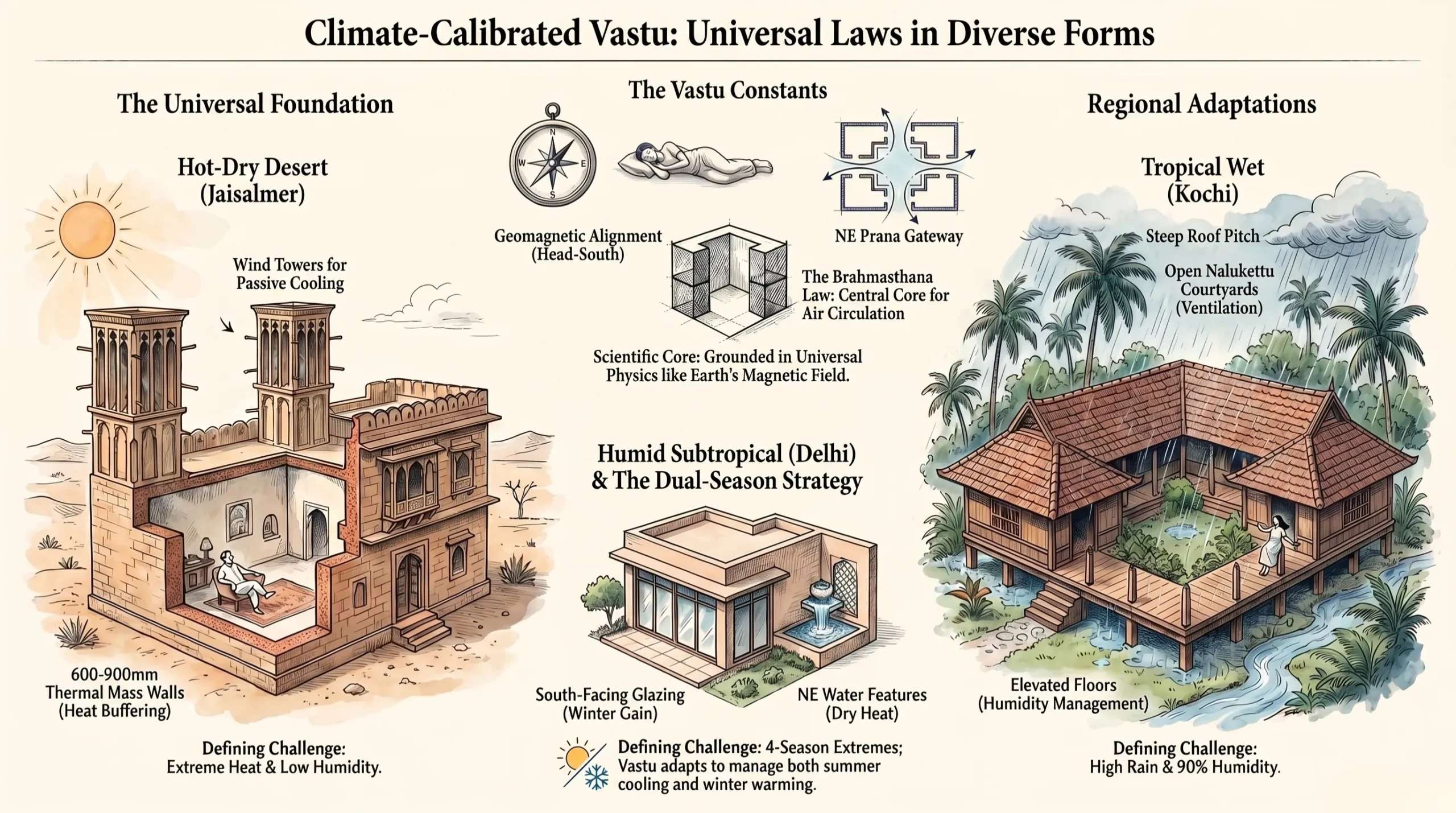
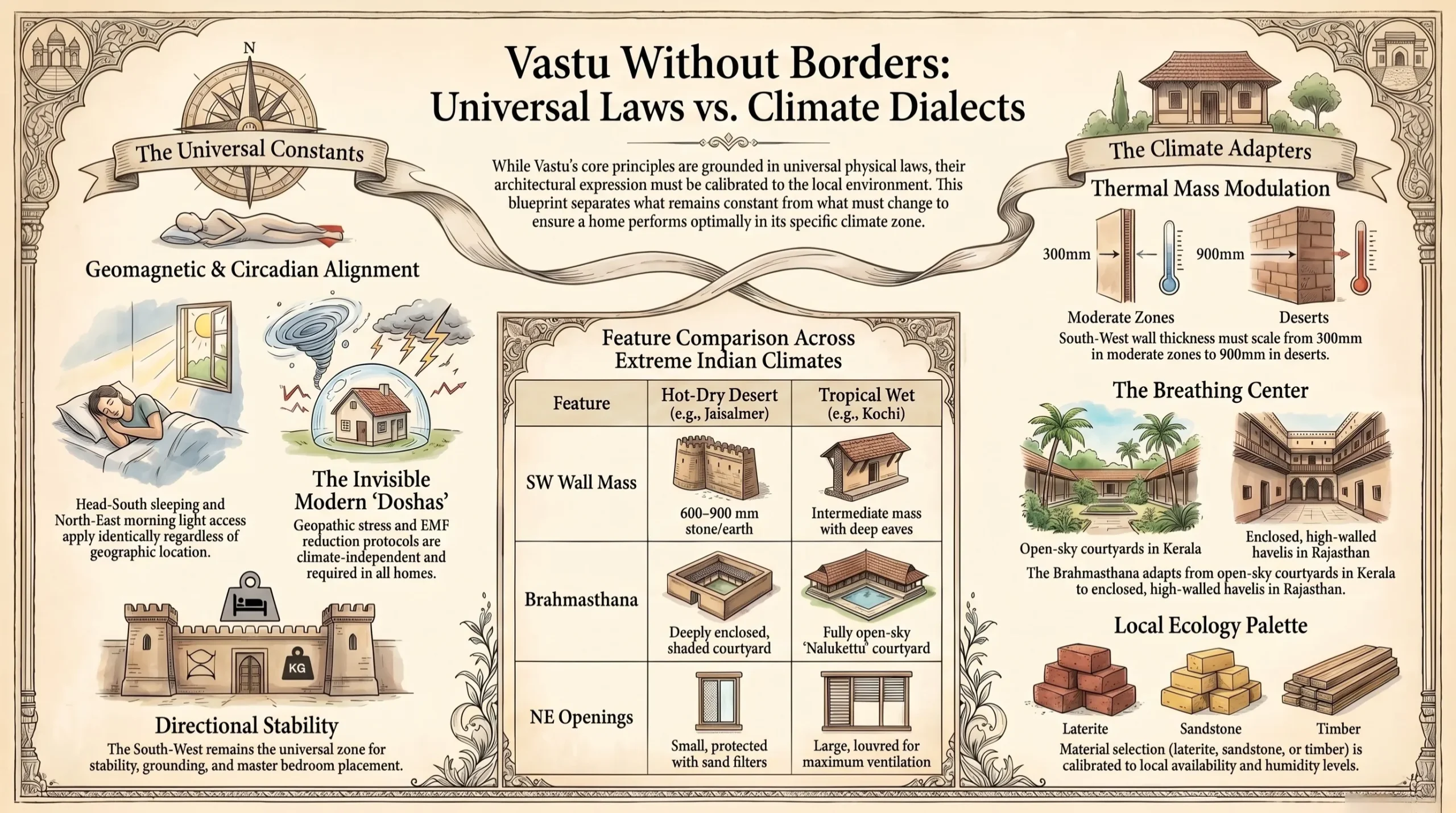
My answer, developed through twenty years of assessments across India’s full climatic range and through serious engagement with passive solar design, Building Biology, and climate-responsive architecture, is: both. The physical principles that Vastu’s core prescriptions address — the geomagnetic field, the electromagnetic environment, the morning solar spectrum’s circadian effects, the thermal stability requirements of the sleeping zone — are universal physical laws whose application to human health is identical in every climate. But the specific material, proportional, and configurational prescriptions that implement those universal principles in built form are, and must be, calibrated to the specific climate of each building’s location. A Rajasthan desert house that implements the Brahmasthana ventilation principle through a deeply enclosed, high-walled courtyard is implementing the same physical principle as a Kerala house that implements it through a fully open nalukettu courtyard — because both are responding to the same Brahmasthana physics (convective air circulation through a central open zone) in forms that are appropriate to their specific climatic challenges.
The classical Vastu texts understood this climate calibration deeply. The Manasara’s Nagara Vinyasa chapters treat different regional building types differently. The Kerala Thachu Shastra is explicitly a regional elaboration of Vastu principles for Kerala’s specific climate. The Rajasthani haveli tradition’s wind towers, deep enclosed courtyards, and maximum thermal mass walls are not departures from Vastu’s universal principles — they are the most precisely climate-calibrated expressions of those principles available in any Indian regional building tradition. Modern Vastu consulting that applies a single uniform prescription regardless of climate is therefore not faithfully following the tradition. It is misapplying it.
For families currently planning new construction on a new plot — the families for whom the Vastu for New Plots & Construction service is specifically designed — understanding how climate affects Vastu applications is the most practically important knowledge available at the design stage. Because the climate-specific design decisions that need to be made correctly — wall thickness and thermal mass, opening size and protection, courtyard depth and configuration, material selection for the local ecology — are among the most consequential and the most irremediable structural decisions in the entire construction process. They must be made correctly the first time, because correcting them later requires demolition.
What is the relationship between Vastu's universal physical principles and their climate-specific expressions?
To understand how climate affects Vastu applications, it is necessary to first establish clearly what is universal in the tradition’s prescriptions and what is climate-dependent. This distinction is the intellectual foundation of climate-calibrated Vastu practice — and confusing the two is the most common error that both rigid traditionalists (who apply all prescriptions uniformly regardless of climate) and casual eclecticists (who treat all prescriptions as culturally relative and therefore optional) make when engaging with the tradition.
The universal principles are those grounded in physical laws that operate identically regardless of geographic location, climate zone, or building type. The Earth’s geomagnetic field flows south-to-north everywhere — so the head-South sleeping prescription is identical in Kochi and Jaisalmer and Delhi and Shimla. Geopathic stress zones occur wherever the geological conditions that produce them exist — everywhere in India and everywhere on Earth. The ipRGC melanopsin circadian pathway responds to the same morning solar spectrum with the same circadian calibration effect at every Indian latitude — so the north-east orientation of the primary morning light entry is universally prescribed. Radiofrequency electromagnetic fields suppress melatonin through the same calcium ion channel pathway in every climate and every region.
The climate-dependent applications are those that implement the universal principles in physical built forms whose specific material, proportional, and configurational details must be calibrated to the specific thermal, hydrological, solar, and wind environment of the building’s climate zone. The universal principle that the Brahmasthana must provide convective air circulation through the central zone of the building is expressed in radically different built forms in different climates — the open-sky nalukettu courtyard of Kerala, the deeply enclosed walled courtyard of Rajasthan, the operable central skylight of a Delhi terrace house — because the climatic challenges that each built form is responding to are radically different. The principle is the same. The climate-calibrated expression is specific to each zone.
This distinction — universal principle implemented in climate-specific form — is the most important conceptual tool available for understanding how climate affects Vastu applications. It explains why the Kerala nalukettu and the Rajasthan haveli are both faithful expressions of Vastu’s Brahmasthana principle despite looking completely different: they are both correct answers to the question ‘how do I implement an open, convective central zone that manages the building’s air quality and thermal character?’ in their respective climates. And it explains why a practitioner who insists on applying the Kerala courtyard proportion in a Rajasthan desert context, or the Rajasthan enclosed courtyard in a Kerala tropical context, is misunderstanding the tradition as profoundly as the practitioner who ignores the Brahmasthana principle entirely.
How does India's extraordinary climatic diversity challenge and enrich the Vastu tradition?
India contains, within a single country, one of the most extraordinary ranges of climate on Earth — from the hyper-arid Thar Desert of Rajasthan (less than 100 mm annual rainfall, extreme heat, and very low humidity) to the hyper-humid Western Ghats of Kerala and the Meghalaya hills (more than 12,000 mm annual rainfall in Cherrapunji, the world’s wettest inhabited place). Between these extremes lie the cold Himalayan highlands, the fertile Indo-Gangetic plain with its dramatic seasonal extremes, the subtropical coastal cities of the east and west, the semi-arid Deccan Plateau, and the dry-tropical peninsular South. No single building type serves all of these climates, and no single set of material specifications produces the correct physical performance across all of them.
This extraordinary climatic diversity is, from the perspective of Vastu’s historical development, both a challenge and an intellectual enrichment. It is a challenge because any tradition that aspires to provide practical building guidance across the entire subcontinent must either develop a genuinely climate-calibrated framework or accept that its prescriptions will be sub-optimal for some or most of the climates it attempts to serve. It is an enrichment because each of India’s major regional building traditions has, over centuries of empirical observation and building practice, developed the most precisely climate-calibrated expression of Vastu’s universal principles available for its specific climate zone. The Kerala nalukettu, the Rajasthan haveli, the Tamil Nadu tiled courtyard house, the Bengali earthen house, the Ladakhi stone dwelling — each is, in its physical substance, a masterclass in climate-calibrated Vastu that the tradition’s most thoughtful practitioners can learn from and apply.
The contemporary Indian family building a new home faces a specific and practically urgent version of this challenge: they are building in a specific climate zone whose physical characteristics are well-understood, but the construction industry they are working with typically applies generic specifications — reinforced cement concrete structure, cement block infill walls, synthetic plaster, glass windows without shading, split air conditioning for comfort management — that are essentially climate-agnostic. These generic specifications are not wrong in the sense of being structurally unsound. They are wrong in the sense of failing to exploit the specific climate’s most valuable natural resources for building performance — its prevailing winds, its solar radiation patterns, its natural material ecology — and failing to protect against its specific climatic challenges. Climate-calibrated Vastu at the new construction stage is, fundamentally, the application of the accumulated wisdom of centuries of regional building practice to the contemporary construction context.
The Vastu for New Plots & Construction service’s climate calibration component is the translation of this accumulated regional wisdom into the specific design brief and material specification programme that the family’s architect needs to implement their new home correctly for the specific climate zone where it will be built. This is the contribution that neither standard Vastu consultation nor standard architectural practice typically provides: the specific, climate-calibrated physical performance specification that bridges five thousand years of Indian climatic building intelligence and the contemporary construction site’s material and structural decisions.
How does the hot-dry desert climate of Rajasthan demand the most dramatic Vastu material and form adaptations?
The hot-dry desert climate of Rajasthan — exemplified by Jaisalmer, Jodhpur, and Bikaner, and representing the most extreme climatic challenge that Vastu building practice faces on the Indian subcontinent — demands the most dramatic departures from the generic construction specifications of contemporary Indian residential building and the most dramatic expressions of Vastu’s climate-calibrated physical principles. Understanding how the traditional Rajasthan building tradition implements Vastu in this extreme context illuminates, by contrast, the adaptations that every other Indian climate zone requires — though in less extreme forms.
The fundamental climatic challenge of the hot-dry desert is the extreme diurnal temperature range: the difference between the daytime maximum (45°C or above in peak summer) and the overnight minimum (20–25°C in summer, as low as 5°C in winter) is one of the largest in the world. A building material with insufficient thermal mass will heat up rapidly during the day, pass the heat load to the interior by late afternoon, and then cool overnight — producing the uncomfortable pattern of extreme heat in the living and sleeping zones from late afternoon through the early night that makes sleep architecturally impossible. A building material with sufficient thermal mass — the 600 to 900 mm thick compressed sandstone and lime construction of the Rajasthan haveli — absorbs the daytime solar heat load, delays its transmission through the wall fabric by twelve to eighteen hours, and releases it to the exterior during the cooler overnight hours when it serves no useful purpose to the building’s occupants. The result is a remarkably stable interior temperature that remains twenty to thirty degrees below the exterior peak in summer — without any mechanical cooling.
The wind tower — the baori or badgeer that is the most visually distinctive element of Rajasthan desert architecture — is the Brahmasthana ventilation principle expressed in the form demanded by the desert climate. The traditional wind tower catches the prevailing wind at roof level (where temperature is still somewhat moderated by movement), channels it down through the tower shaft, and delivers it to the building’s interior at a temperature several degrees cooler than the ambient outdoor air — both through convective cooling in the shaft and through evaporative cooling if a water surface is placed at the base of the shaft. The same Brahmasthana physics that the Kerala nalukettu courtyard exploits through thermal buoyancy is exploited by the Rajasthan wind tower through wind pressure and evaporative cooling — two climate-specific expressions of the same universal principle.
What does the Rajasthan material programme teach about climate-calibrated natural material selection?
The Rajasthan traditional building tradition’s material programme is a masterclass in the application of the Pancha Bhuta elemental material prescription to a specific ecological context. The compressed yellow sandstone of Jaisalmer, the pink sandstone of Jaipur, the basalt and limestone of Jodhpur — these are not aesthetic choices. They are the precise local geological materials whose specific thermal, structural, and optical properties make them optimal for the desert climate’s building challenges. The pale, reflective surface colours of Rajasthan stone reflect a significant proportion of the solar radiation that darker surfaces would absorb, reducing the total heat load on the building envelope. The stone’s density and specific heat capacity — typically 1,800 to 2,100 J/kg·K — provides exactly the thermal mass performance that the desert’s extreme diurnal range requires.
The lime mortar and lime plaster programme that binds and finishes the stone construction is equally climate-calibrated. Lime’s hygroscopic properties regulate the desert interior’s low humidity, absorbing moisture during the cooler, relatively more humid evenings and releasing it during the peak heat of the day — producing a passive indoor humidity management system that maintains the interior’s relative humidity closer to the respiratory comfort range (40–60%) than the 10–20% typical of the desert exterior. The family sleeping in a correctly constructed Rajasthan stone-and-lime bedroom is protected not only from thermal extremes by the thermal mass but from the respiratory stress of very low humidity by the hygroscopic wall management.
The lesson for the contemporary family building in a hot-dry climate is direct and specific: the generic cement block, cement plaster, and synthetic paint specification of contemporary Indian construction fails every performance dimension that the climate demands — thermal mass is inadequate, hygroscopic management is absent, and the result is a home that requires continuous air conditioning to be habitable rather than a home that uses the climate’s own physical resources to maintain comfort passively. The Vastu for New Plots & Construction service translates the traditional material programme into the contemporary construction specification that the family’s builder can implement — not requiring literal reproduction of the traditional haveli form, but requiring the specific thermal mass wall thicknesses, lime plaster finishes, and natural stone or compressed earth flooring that replicate the traditional programme’s performance in a contemporary building.
What is the complete climate-calibrated Vastu application guide for India's major climate zones?
The following table provides a comprehensive reference for the seven major Indian climate zones — specifying the defining climatic challenges, the Vastu principles applied identically across all zones, the climate-specific adaptations required, and the priority construction decisions for each zone. This is the reference framework that the Vastu for New Plots & Construction service applies to every new construction assessment in India.
|
Indian Climate Zone |
Representative Cities |
Defining Climate Challenges |
Universal Vastu Principles Applied Identically |
Climate-Specific Vastu Adaptations |
Priority Construction Decision |
|
Hot-Dry Desert (BWh) (extreme heat, very low humidity, minimal rainfall) |
Jaisalmer, Barmer, Bikaner, Jodhpur |
Extreme diurnal temperature range (15–40°C seasonal swing); very low humidity (10–30% RH) causing respiratory stress; dust and sand infiltration; intense solar radiation with minimal cloud cover; minimal natural water availability |
Sleeping orientation head-South; geopathic stress survey; SW master bedroom zone placement; NE prana gateway morning light; Brahmasthana for air circulation |
Maximum thermal mass in all external walls — 600–900 mm compressed stone or rammed earth to buffer extreme diurnal swing; wind towers (baori/badgeer) for passive cooling; small high windows to admit light while minimising solar gain and dust; traditional courtyard deeply enclosed to create sheltered microclimate; NE morning air entry combined with south-west wind tower exhaust; lime and earth plaster throughout for hygroscopic humidity regulation |
Maximum thermal mass wall specification; wind tower passive cooling design; courtyard depth-to-height ratio for microclimate shelter; natural hygroscopic surface materials throughout |
|
Hot Semi-Arid (BSh) (hot dry season, brief monsoon, moderate winters) |
Hyderabad, Nagpur, Aurangabad, Solapur, Pune (inland) |
Hot dry period (March–June, 38–45°C); brief but intense monsoon; mild winters; moderate humidity variation (20–60% RH seasonal); intense afternoon solar radiation on west and south faces |
Sleeping orientation; geopathic stress survey; NE entrance; SW bedroom; Brahmasthana ventilation axis |
Significant thermal mass on south and west walls to buffer afternoon solar load; deep roof overhangs (0.9–1.2 m minimum) to shade south and west walls from direct solar penetration; NE and north cross-ventilation to drive monsoon-season natural cooling; evaporative cooling in NE zone using water feature for pre-monsoon temperature moderation; natural stone or terracotta flooring for thermal mass contribution at floor level |
Deep roof overhang specification; south and west wall thermal mass; NE water feature for evaporative cooling in pre-monsoon period; cross-ventilation pathway design |
|
Tropical Wet (Af/Am) (high rainfall, high humidity year-round, equatorial sun) |
Kochi, Thiruvananthapuram, Mangalore, coastal Goa, Port Blair |
Very high rainfall (2,000–4,000 mm+); high humidity year-round (70–90% RH); equatorial solar arc (near-vertical noon sun); high temperatures without extreme peaks; biological growth and moisture management critical; ventilation essential for humidity control |
Sleeping orientation; geopathic stress survey; SW bedroom; NE prana gateway |
Elevated floor construction to protect from surface flooding and damp; steep roof pitch for rapid rainfall shedding; deep overhanging eaves (1.0–1.5 m) to shade walls while allowing low-angle morning solar entry; open central courtyard (nalukettu form) as Brahmasthana for critical humidity-driven stack-effect ventilation; natural laterite and timber construction for hygroscopic humidity regulation; maximum ventilation apertures with louvre and shutter control for monsoon management; north-east wind-driven cross-ventilation through Brahmasthana as primary health strategy |
Steep roof and deep eave specification; nalukettu courtyard form as Brahmasthana; elevated floor; maximum louvre-controlled ventilation apertures; laterite and timber natural material programme |
|
Tropical Wet-Dry / Savannah (Aw) (distinct wet and dry seasons, moderate to high temperatures) |
Chennai, Bengaluru (outer), Bhubaneswar, Visakhapatnam, Madurai |
Hot dry season (March–June); north-east or south-west monsoon (seasonal variation); moderate to high humidity in monsoon; warm and dry in winter; intense solar radiation; urban heat island significant in Chennai and similar cities |
Sleeping orientation; geopathic stress survey; SW bedroom; NE prana gateway; Brahmasthana ventilation |
Intermediate thermal mass on south and west walls; moderate roof overhang (0.6–0.9 m); cross-ventilation designed for both SW and NE monsoon wind directions depending on location; solar shading devices (horizontal fins) on south face; NE morning light priority maintained; natural stone flooring throughout for thermal mass and hygroscopic contribution; rain-harvesting integration in NE zone for water feature and aquifer recharge |
Dual-monsoon cross-ventilation design; solar shading fin specification for south face; rain-harvesting NE zone integration; moderate thermal mass south and west |
|
Humid Subtropical (Cwa) (hot humid summers, mild winters, monsoonal rainfall) |
Delhi, Lucknow, Jaipur, Varanasi, Patna, Bhopal, most of the Indo-Gangetic plain |
Hot humid monsoon season (July–September); hot dry period (April–June); cold dry winters (December–January); significant diurnal range in winter (5–30°C); intense solar radiation in summer; dust in spring |
Sleeping orientation; geopathic stress survey; SW bedroom; NE morning prana; Brahmasthana |
Dual seasonal strategy: thermal mass for summer cooling and winter solar gain; south-facing glazing with horizontal shading for winter solar gain capture; north and east openings for summer monsoon cooling; winter wind shelter on north and north-west with deciduous planting; evaporative cooling potential in pre-monsoon dry heat period through NE water feature; roof insulation essential for both summer cooling and winter heat retention; natural material programme with seasonal flexibility |
Dual-season thermal strategy specification; south-facing winter solar gain glazing with summer shading; north wind shelter; roof insulation; natural material programme with hygroscopic regulation |
|
Highland / Montane (Cwb) (cool temperatures year-round, high rainfall, low oxygen at altitude) |
Shimla, Darjeeling, Mussoorie, Ooty, Munnar, Kodaikanal |
Cool to cold temperatures year-round (5–22°C); very high rainfall (1,500–3,000 mm); low solar angle due to latitude and elevation; frost risk at higher elevations; low oxygen at altitude affects respiratory function; steep topography limits site options |
Sleeping orientation; geopathic stress survey; SW master bedroom; NE morning light |
Maximum south-facing solar gain through large south-facing windows for primary solar heating; minimum north-facing openings to reduce cold wind penetration; steep roof for snow-load management and rapid rainfall shedding; thermal mass floor (stone or terracotta) for solar heat retention; earth-sheltering or hillside cutting for thermal buffer on north and west faces; site selection on south-facing slopes for maximum solar access; natural timber and stone for thermal and biophilic quality; sleeping zone thermal mass critical for preventing cold-environment sleep disruption |
Maximum south-facing solar gain glazing; earth-sheltering north-west specification; thermal mass floor for heat retention; site selection on south-facing slope; steep roof specification |
|
Semi-Arid Coastal (BSk/Bsh transitional) (moderate temperatures, coastal breezes, seasonal aridity) |
Mumbai (suburban inland), Pune (coastal influence), Surat, Vadodara, Ahmedabad (more arid) |
Moderate temperatures moderated by coastal influence; seasonal aridity followed by intense monsoon; sea breeze from south-west in summer (Mumbai characteristic); risk of humidity-related mould in monsoon; intense monsoon rainfall (Mumbai 2,000+ mm) |
Sleeping orientation; geopathic stress survey; SW master bedroom; NE morning light; Brahmasthana |
South-west sea breeze management: cross-ventilation from south-west in pre-monsoon and early monsoon captures cooling sea breeze; Brahmasthana aligned with prevailing south-west breeze pathway; monsoon moisture management through hygroscopic lime plaster and elevated flooring; moderate thermal mass for temperature moderation without excessive heat absorption; NE water feature aligned with sea breeze path for evaporative enhancement; deep overhangs for monsoon rain management |
SW sea breeze cross-ventilation pathway; Brahmasthana aligned with prevailing breeze; hygroscopic lime plaster throughout; moderate thermal mass; monsoon rain management overhangs |
The most important pattern across this table is in the ‘Universal Vastu Principles Applied Identically’ column: sleeping orientation, geopathic stress survey, SW master bedroom zone, NE prana gateway, and Brahmasthana ventilation appear in every climate zone without exception. These are the universal physical principles whose application is identical everywhere. The climate-specific column then adds the crucial implementation detail — how thick the south-west wall should be, how large and protected the north-east opening should be, what form the Brahmasthana should take, which natural materials are available and optimal in the local ecological context.
The second most important pattern is in the ‘Priority Construction Decision’ column: in every climate zone, the most consequential decisions are the structural and material ones — wall thickness and material, opening size and protection, roof form and insulation, courtyard configuration. These are the decisions that must be made correctly at the structural stage because they cannot be changed without demolition. This is precisely why the Vastu for New Plots & Construction service engages before the architect’s design is committed to structural drawings — because the climate-calibrated Vastu design brief needs to inform those structural decisions before they become irremediable.
How does Kerala's tropical humid climate produce the most sophisticated climate-Vastu integration in any Indian regional tradition?
If I were asked to identify the single regional building tradition in India that most completely integrates Vastu’s universal principles with climate-specific built form, I would choose the Kerala nalukettu tradition without hesitation. The Kerala house is, in my view, the most sophisticated climate-calibrated expression of Vastu residential science available for study — a building form that has been refined over a thousand years of continuous building practice in one of the world’s most challenging tropical humid climates, and that solves every climate challenge it faces using the same physical principles that Vastu’s core prescriptions address.
Kerala’s primary climatic challenge is not heat — the temperature range is relatively moderate by Indian standards (25–35°C typically). It is moisture: the combination of very high annual rainfall (2,000–4,000 mm across most of Kerala), year-round high relative humidity (75–90% RH), and the biological growth that these conditions produce if a building fails to manage moisture infiltration, condensation, and indoor air hygroscopic quality. A building that fails to manage moisture in Kerala produces not merely discomfort but structural damage, biological contamination of indoor air, and the chronic respiratory health effects of mould, dust mites, and elevated airborne microbial concentrations.
The nalukettu’s response to this moisture management challenge is simultaneously the most complete implementation of Vastu’s Brahmasthana principle and the most sophisticated passive climate engineering available in any Indian traditional building type. The central open-sky courtyard — the Brahmasthana expressed in its most fully open form — serves multiple moisture management functions simultaneously. It admits the overhead sky, providing the vertical sky connection that the Brahmasthana principle requires for both symbolic and physical reasons. It creates the temperature differential (the uncovered central courtyard surface heats more rapidly in morning sun than the shaded surrounding rooms) that drives the stack-effect ventilation pulling humid indoor air upward and outward and replacing it with the somewhat drier, fresher air from the outer perimeter openings. It provides natural daylighting to all surrounding rooms without direct solar penetration, maintaining interior visual quality without the heat gain that direct sun would bring. And it acts as the building’s rain collection point — the gently sloped courtyard floor drains monsoon rainfall efficiently to the cistern below, collecting the water resource that the nalukettu’s Jal zone placement in the north-east zone facilitates.
The nalukettu’s structural material programme is equally moisture-calibrated. Laterite block — the porous, hygroscopic iron-rich stone that forms naturally across Kerala’s volcanic geology — provides the wall material that breathes: it absorbs excess humidity from the indoor air and releases it to the exterior when conditions are drier, regulating the indoor relative humidity passively without mechanical dehumidification. Teak timber — the oil-rich, naturally termite-resistant, dimensionally stable tropical hardwood native to Kerala’s forests — provides the structural timber, the window and door frames, and the roof structure whose natural oil content and dimensional stability under extreme humidity variation makes it the optimal timber material for tropical building. Shell-lime plaster — made from calcined sea shells collected from Kerala’s extensive coastline — provides the wall finish whose alkaline surface chemistry makes it naturally resistant to the mould colonisation that would rapidly develop on cement plaster under Kerala’s humidity conditions.
The Kerala nalukettu is available for study, in its physical performance terms, as a thousand-year building science experiment whose results are visible in the buildings themselves: houses built four hundred years ago that remain structurally sound, thermally comfortable without mechanical cooling, and biologically healthy in one of the world’s most challenging tropical climates. This is the building intelligence that the Vastu for New Plots & Construction service translates into the modern construction specification for families building in Kerala and other tropical humid climate zones — not the reproduction of the nalukettu form, but the implementation of its physical principles in the building materials and configurations appropriate to contemporary construction.
What does the humid subtropical Delhi climate require that neither the Rajasthan nor the Kerala tradition provides?
The Delhi climate — the humid subtropical type that also characterises most of the Indo-Gangetic plain, from Punjab through Uttar Pradesh and Bihar to Bengal — presents the most complex single climatic brief in India, because it is not one climate but four: a hot dry pre-monsoon (April–June), an intense hot humid monsoon (July–September), a warm post-monsoon (October–November), and a cold dry winter (December–February). A building that optimises for one of these seasons will typically under-perform in at least one other. The Delhi climate demands a genuinely dual-season building strategy — one whose thermal, ventilation, and moisture management systems can address both the summer cooling challenge and the winter warming challenge without either conflicting with each other or requiring expensive mechanical systems to bridge the seasonal gap.
The winter challenge in Delhi is significant and consistently underappreciated in contemporary Indian residential design. January temperatures fall to 5°C or below, with minimum heating degree days that require active thermal management in any home whose occupants expect comfort without continuous electrical heating. The traditional Delhi and North Indian residential form — the haveli with south-facing courtyard openings for winter solar gain and north-facing wind sheltered walls — is a dual-season building design that captures both the summer cooling benefits of the courtyard’s stack-effect ventilation and the winter solar heating benefits of the south-facing glazing that the courtyard’s northern wall can accommodate. This south-facing winter solar gain strategy is entirely consistent with Vastu’s universal solar orientation principles, but it requires a specific addition to the basic Vastu zone prescription: the south-facing courtyard or south-facing large glazing that is not part of the standard Vastu prescription for warmer climates becomes essential in Delhi’s winter season.
The humidity management challenge of the Delhi monsoon is different from Kerala’s year-round humidity challenge. Delhi’s monsoon humidity is intense but temporary — two to three months of very high humidity followed by very dry conditions in winter. The building material programme must therefore manage both the monsoon humidity (preventing mould, managing indoor relative humidity) and the winter dryness (maintaining respiratory comfort without adding mechanical humidification). Lime plaster — with its hygroscopic properties that absorb excess moisture during the monsoon and release it slowly during the dry season — is as precisely suited to the Delhi seasonal humidity cycle as it is to Kerala’s continuous humidity, and for exactly the same physical reasons.
The Vastu for New Plots & Construction assessment for a Delhi or Indo-Gangetic plain location includes the dual-season thermal strategy as a specific design brief element: south-facing openings sized and shaded for winter solar gain with summer shading by deciduous planting or horizontal fins; north-facing wind shelter against the December–January cold north wind; thermal mass walls calibrated for both summer cooling and winter heat retention; roof insulation for both summer heat exclusion and winter heat retention; and natural ventilation designed for the monsoon cooling cross-ventilation that the summer monsoon’s south-west wind enables.
Which Vastu prescriptions are universal across climates, and which require climate-specific adaptation?
The following table provides the most practically useful distinction for any family planning new construction: it separates Vastu’s prescriptions into those that are universal across all Indian climates and those that require climate-specific adaptation — specifying the physical reason for each, what changes and what stays the same, and which climate zones require the most significant adaptation.
|
Vastu Prescription |
Universal or Climate-Adapted? |
Physical Reason for Universality / Adaptation |
Adaptation Required in Which Climate? |
What Changes and What Stays the Same |
|
Head-South or head-East sleeping orientation |
Universal |
Geomagnetic field flows south-to-north at every latitude; HRV research confirms head-South superiority across multiple geographic contexts tested |
None — applies identically in Kochi, Delhi, Jaisalmer, Shimla, and internationally |
Compass bearing of head-South stays the same everywhere; the geomagnetic mechanism is independent of climate, latitude, and season |
|
Geopathic stress avoidance at sleeping position |
Universal |
Underground water courses, geological faults, and Hartmann Grid intersections produce geomagnetic field distortions at every latitude in every climate; the biological effects are independent of climate |
None — geopathic stress features occur in all Indian climate zones; magnetometer assessment required everywhere |
The instrument (magnetometer) and the threshold (Building Biology SBM) are the same everywhere; what changes is the specific location and pattern of stress zones, which varies by local geology |
|
Bedroom electromagnetic prana quality (RF/ELF reduction) |
Universal |
Wi-Fi routers, smartphones, and power wiring produce RF and ELF fields through the same physical mechanism in every climate; the melatonin suppression pathway operates identically in any climate or temperature |
None — the electromagnetic burden of the modern home is climate-independent; the same corrections apply everywhere |
RF and ELF measurement and correction protocol is identical in every climate; what changes is the specific device configuration in each home |
|
South-west master bedroom placement |
Universal in direction; climate-adapted in material specification |
The SW zone’s geomagnetic stability and earth-element character are universal; the SW wall’s thermal mass requirement is climate-modulated — the thickness and material of the thermal mass wall changes by climate severity |
Material specification changes: 300 mm in moderate climates; 600–900 mm in Rajasthan desert; specific heat capacity calculation per climate zone; SW sleeping zone temperature target (18–20°C) is universal but how to achieve it varies by climate |
Direction (SW) is universal; wall material, thickness, and thermal mass specification is climate-adapted; sleeping zone temperature target is universal; method of achieving it varies |
|
North-east prana gateway — primary openings |
Universal in direction; climate-adapted in size and protection specification |
The circadian biology of morning solar light is universal; the ipRGC melanopsin pathway responds to the same morning solar spectrum at every latitude; the NE direction gives the earliest morning solar access everywhere in the Northern Hemisphere |
Opening size, shading, and protection varies: Kerala needs large louvred openings with deep eaves for monsoon management; Rajasthan needs small protected NE openings with sand filtering; Delhi needs medium openings with seasonal shading; all need maximum morning solar access as the goal |
NE direction is universal; opening size, protection specification, and seasonal management is climate-adapted |
|
Open Brahmasthana — central zone ventilation axis |
Universal in principle; climate-adapted in configuration |
The stack-effect ventilation mechanism operates in every climate where temperature differentials exist between the indoor and outdoor environment; the central open zone creates the convective pathway everywhere |
Configuration varies: Kerala nalukettu requires a fully open-sky courtyard; Rajasthan haveli requires a deeply enclosed, shaded courtyard with high walls; Delhi requires a seasonally operable skylight; all express the same ventilation and light-distribution function |
Central zone is universally open; its specific form — fully open sky, covered courtyard, operable skylight — is climate-adapted to manage solar gain, dust, rainfall, and temperature extremes while preserving the ventilation function |
|
Natural material prescription — Pancha Bhuta palette |
Universal in principle; climate-adapted in specific materials |
The biophilic, hygroscopic, VOC-neutral, and thermally appropriate character of natural materials is universally beneficial; but the specific natural materials available and climatically appropriate differ by region |
Laterite for Kerala and coastal humid zones; local sandstone or compressed earth for Rajasthan desert; lime throughout; teak and sal timber in appropriate climate zones; terracotta tile universally; specific timber species and stone types are climate and ecologically calibrated |
Natural material category is universal; specific species, stone types, and material combinations are climate-adapted to performance and ecological availability in each zone |
|
Water feature placement in NE (Jal zone) |
Universal in direction; climate-adapted in scale and form |
The Jal element in the NE direction is universally prescribed for its biological and elemental rationale; the evaporative cooling and negative ion generation benefits operate in every climate; but the scale and form of the water feature must be climate-calibrated |
Desert climates: larger water features for evaporative cooling are highly beneficial and can significantly reduce indoor temperature; humid climates: small, moving water features for negative ionisation without additional humidity contribution; moderate climates: medium water features |
NE placement is universal; scale, water surface area, and evaporation control are climate-adapted to the specific humidity management challenge of each zone |
The pattern in this table is the most practically actionable finding for any family working with a Vastu practitioner and an architect: the geomagnetically grounded prescriptions (sleeping orientation, geopathic stress, electromagnetic environment) are universal and apply identically to the design brief regardless of climate. The solar arc and climate-dependent prescriptions (wall thermal mass specification, opening size and protection, courtyard form, natural material selection) require climate-specific adaptation that is the most consequential and the most architecturally specific component of the Vastu for New Plots & Construction design brief.
Every architect working with the Vastu for New Plots & Construction service’s design brief receives two categories of specification: universal specifications that apply identically regardless of climate, and climate-adapted specifications that are specific to the building’s location — with the physical reasoning for each specification stated in terms that any architect or structural engineer can evaluate. This combination produces the most complete and most practically implementable Vastu design brief available for any new construction project in India.
How does urban microclimate affect Vastu applications in Indian cities — and what should new construction accounts for?
The discussion of climate and Vastu applications has so far addressed regional macro-climates — the broad climate zones that characterise different parts of India. But for the large majority of contemporary Indian families who are building or buying in urban environments, the relevant climate is not just the regional macro-climate but the specific urban microclimate of the site: the local temperature and wind modifications produced by the density of surrounding buildings, the thermal mass of hard urban surfaces, the albedo of the urban fabric, and the spatial distribution of green space and water bodies. Understanding urban microclimate is an essential component of climate-calibrated Vastu site assessment.
The urban heat island effect — the systematic elevation of urban temperatures above regional rural temperatures produced by the concentration of thermal mass, heat-generating activity, and reduced evapotranspiration in cities — is the most significant urban microclimate factor affecting Vastu applications in Indian cities. Urban heat island temperatures in dense Indian cities like Mumbai, Delhi, Bengaluru, and Hyderabad routinely exceed surrounding rural temperatures by 3–8°C, and the difference is most pronounced at night — precisely when the sleeping zone’s thermal stability is most critical for circadian sleep quality. A south-west bedroom that would maintain comfortable sleeping temperatures without mechanical cooling in a rural or suburban context may require additional thermal mass or ventilation assistance in a dense urban microclimate where the surrounding buildings and paved surfaces are radiating stored heat through the night.
The urban wind environment is equally important for Vastu’s Brahmasthana ventilation prescription. The prevailing wind directions that regional climate maps describe are significantly modified by the built fabric of the city: tall buildings create wind shadows and wind channelling effects that redirect, accelerate, or impede the natural ventilation pathways that the Brahmasthana ventilation strategy depends on. A site that should receive north-east morning breezes based on its regional climate position may actually experience a wind shadow from an adjacent tower that eliminates the natural ventilation benefit at the building’s north-east face. The Vastu for New Plots & Construction site assessment includes a specific wind environment evaluation — identifying the actual local wind pathways at the specific urban site rather than relying on regional climate data that may not reflect the site’s specific urban microclimate.
The most practically important urban microclimate consideration for new construction in Indian cities is the overshadowing of the north-east prana gateway by adjacent buildings. The circadian morning solar light that the north-east zone must deliver is blocked by any building that casts shadow on the north-east facade at sunrise and in the first two hours after sunrise — and in dense Indian cities, the probability of such overshadowing is high and increasing with densification. The Vastu for New Plots & Construction site assessment includes a specific shadow analysis of the north-east facade at sunrise for each month of the year, identifying the actual morning solar access available and prescribing design responses — roof-level north-east openings, light wells, reflective surfaces — that maximise morning solar delivery to the living zones despite urban overshadowing.
What are the most consequential climate-Vastu decisions for families building in South India's tropical zone?
South India’s tropical coastal zones — encompassing Kerala, coastal Karnataka, coastal Tamil Nadu, coastal Andhra Pradesh, and the Andaman Islands — present a specific and highly consequential set of Vastu-climate integration decisions whose correct implementation is among the most significant architectural challenges available to any family building new construction in India. The combination of high temperatures, very high humidity, intense monsoonal rainfall, and the availability of some of the world’s most climate-appropriate natural building materials makes South India both the context where climate-calibrated Vastu is most important and the context where the tradition’s regional building wisdom is most richly developed.
The three most consequential climate-Vastu decisions for South Indian tropical construction are: the Brahmasthana courtyard configuration and ventilation design; the roof form, pitch, and material; and the structural material programme. Each of these decisions is both a Vastu prescription and a climate engineering decision, and the two frameworks agree precisely on the optimal specification.
The Brahmasthana configuration for South Indian tropical climates should be, whenever structurally achievable, the fully or substantially open-sky central courtyard of the nalukettu tradition — because this is the form that most efficiently drives the stack-effect humidity management ventilation that the tropical climate’s indoor air quality challenge requires. A partially covered Brahmasthana — with a translucent rooflight rather than an open sky — partially serves this function but reduces the ventilation performance by limiting the temperature differential between the courtyard and the surrounding rooms that drives the convective flow. A fully obstructed Brahmasthana — as virtually all contemporary South Indian apartment plans provide — eliminates the function entirely, requiring the mechanical ventilation and air conditioning that produces the sealed, CO2-accumulated indoor environment that the Harvard cognitive performance research documents as significantly impairing to the occupants’ decision quality.
The roof form and material decision is equally critical. The traditional South Indian steep-pitch clay tile roof — with its 35–45 degree pitch, its double-layer ventilated roof space, and its natural clay tile’s thermal mass and hygroscopic character — performs multiple climate functions simultaneously: the steep pitch sheds the monsoon rainfall immediately, preventing the ponding and penetration that flat concrete roofs produce; the double-layer construction with ventilated air space provides the thermal insulation that keeps solar heat from penetrating to the living zones below; and the clay tile’s hygroscopic surface manages the moisture cycling of the monsoon-to-dry-season transition. The contemporary flat concrete roof — almost universal in new South Indian construction because of its structural convenience and multi-story construction compatibility — performs none of these functions adequately and is directly responsible for the overheating, moisture infiltration, and indoor air quality problems that the air conditioning systems in these buildings are installed to partially compensate for.
The practical case for clay tile roofs in South Indian tropical new construction is one of the clearest and most directly financially compelling climate-Vastu arguments available. A steep-pitch clay tile roof costs modestly more than a flat concrete roof at time of construction and saves the family’s entire lifetime air conditioning electricity cost — because it delivers the indoor thermal and hygroscopic conditions that air conditioning provides, passively and without ongoing energy cost, through the same physical mechanisms that the Kerala building tradition has exploited for a thousand years. The Vastu for New Plots & Construction service’s South Indian climate brief includes the clay tile roof specification as one of its highest-priority recommendations because no other single construction decision has a larger combined impact on Vastu compliance, climate performance, and whole-life cost.
What does the Vastu for New Plots and Construction service deliver for climate-calibrated building?
The Vastu for New Plots & Construction service is, in its climate calibration dimension, the translation of India’s most climate-specific regional Vastu building wisdom into the contemporary construction specification for the specific climate zone where the family’s new home will be built. It is not the reproduction of the traditional building form — the nalukettu, the haveli, the Mughal baoli — but the implementation of those forms’ physical principles in the materials, proportions, and configurations that contemporary construction can achieve with the performance outcomes that the traditional forms demonstrate.
The climate calibration component of the service begins with the site assessment: the plot’s specific location is analysed for its regional climate zone, its urban microclimate modifications (overshadowing, wind channels, urban heat island contribution), and its specific solar arc at the latitude of the site. The prevailing wind directions at the site are confirmed against both regional climate data and local wind environment analysis. The specific geopathic stress survey of the site is conducted — because geopathic stress features are geological and are not directly related to climate, but the sleeping zone placement that the climate brief may recommend must be confirmed against the earth energy assessment.
The design brief that emerges from this integrated assessment addresses the universal prescriptions identically regardless of climate (sleeping orientation, geopathic stress avoidance, electromagnetic hygiene, NE morning light access) and the climate-adapted prescriptions specifically for the site’s climate zone (wall thermal mass thickness and material, opening size and protection specification, Brahmasthana form and configuration, roof specification, natural material programme for the local ecology). Every specification is accompanied by the physical reasoning that allows the architect to evaluate it independently and the builder to price and implement it accurately.
The family that engages the Vastu for New Plots & Construction service before their architect’s design is committed receives the most complete, most precisely climate-calibrated, and most physically grounded Vastu design brief available for their specific site and climate. They receive both the universal health-generating prescriptions that five thousand years of accumulated observational intelligence have validated and the climate-specific implementation guidance that the most sophisticated regional building traditions in India have developed over centuries — translated into the language and format that contemporary construction professionals can immediately and confidently implement. This is what a correctly built home looks like: not merely oriented correctly and zoned correctly, but built from the right materials, in the right forms, for the specific climate that will test its performance every day of the family’s occupation.
Real Case Study — A Kerala Family Who Built Climate-Correctly and Never Installed Air Conditioning:
A family in Thrissur, Kerala — both partners architects, their children aged six and nine — came to us at the design stage of their new family home. They had a specific brief: they wanted to build a home that did not require air conditioning. Not for environmental reasons alone, though they cared about that. For health reasons: ‘We have seen too many Kerala homes where the children never experience natural ventilation, natural humidity, or the morning air. We want our children to grow up in a house that breathes.’
The site assessment confirmed excellent conditions: no geopathic stress in any of the candidate sleeping zones; north-east solar access unobstructed in the morning hours; a natural slope of the plot toward the north-east consistent with the Vastu Bhumi Pariksha optimal grading.
The climate brief I developed with their architect specified the following: a one-storey nalukettu-influenced layout with a central open-sky Brahmasthana courtyard, minimum 4 metres x 5 metres, unroofed; laterite block walls at 350 mm thickness throughout; steep-pitch Mangalore clay tile roof at 40-degree pitch with double-layer ventilated roof space; deep eave overhangs at 1.2 metres on all faces; shell-lime plaster internally throughout; Kerala teak timber for all window and door frames and joinery; natural stone flooring in laterite and granite; NE zone large louvred windows with traditional wood louvre shutters; no internal synthetic materials in any primary living or sleeping zone.
Construction was completed approximately fourteen months after our initial engagement. The family moved in eighteen months ago. They have not installed air conditioning. In Kerala’s monsoon season, the indoor temperature maintains 26–28°C with natural ventilation. In the dry season, the indoor temperature maintains 28–30°C — warm but comfortable, with natural air movement. The indoor relative humidity, measured by their own sensors, stays within 55–65% year-round — below the mould threshold even during the peak monsoon.
The wife architect’s assessment at eighteen months: ‘The house performs exactly as the Vastu climate brief predicted. The courtyard temperature differential drives cross-ventilation continuously. The clay tile roof keeps the bedrooms 5–7°C below the external air temperature during peak afternoon heat. The laterite walls absorb the morning humidity and release it slowly through the day. My children wake to morning light and natural air every day. This is the home we imagined. It is the home the tradition always knew how to build. We just needed someone to tell us how to build it now.’
The family’s energy bill from air conditioning: zero. The premium for climate-correct materials and construction over a standard contemporary specification: approximately eight percent of total construction cost. The physical health and thermal comfort return on that investment: every day of the family’s thirty-year occupation.
What India’s Climate Diversity Teaches About the Wisdom of Climate-Calibrated Vastu:
India’s climatic range — from Jaisalmer’s hyper-aridity to Cherrapunji’s hyper-humidity, from Shimla’s highland cold to Kochi’s equatorial warmth — is, from the perspective of building science, one of the most demanding and most instructive climatic test beds on Earth. Every building technology that has survived and been refined across centuries of Indian climatic challenge has been climate-tested at a severity that few other countries’ building traditions face.
The buildings that have survived and thrived in this climatic test — the Rajasthan haveli, the Kerala nalukettu, the Ladakhi stone dwelling, the Tamil Nadu tank-house — are, without exception, buildings whose physical design aligns with the same Vastu principles whose application I have described in this article. Maximum thermal mass where the climate demands it. Maximum natural ventilation where the climate enables it. Natural hygroscopic materials wherever the climate produces humidity that must be managed. South-facing solar gain where the climate requires winter heating. North-east morning solar access universally preserved.
These buildings are not beautiful by accident. Their beauty is the expression of physical correctness — of form following climate with the precision that centuries of observation, failure, refinement, and accumulated intelligence produce. The contemporary Indian family who chooses to build climate-correctly is not choosing to build like a museum piece. They are choosing to access the most sophisticated, most thoroughly tested, and most consistently health-generating building intelligence available on the Indian subcontinent — and to express it in the materials and forms that contemporary construction makes possible.
The Vastu for New Plots & Construction service exists to make that choice available to every family who builds a new home in India — regardless of their climate zone, regardless of their budget, and regardless of whether they have ever seen a nalukettu or a haveli. The intelligence that those buildings embody is accessible, translatable, and, in every Indian climate zone, capable of producing the healthiest, most comfortable, and most sustainable new homes that contemporary Indian construction can build.
Your Climate Has a Vastu Prescription. Your New Home Should Express It.
The Vastu for New Plots & Construction service brings five thousand years of India’s most sophisticated climate-calibrated building intelligence to your specific site, your specific climate zone, and your specific construction stage — before any structural decision becomes irremediable.
Your Vastu for New Plots & Construction service delivers:
- Site climate zone assessment — regional climate classification; urban microclimate modification analysis; prevailing wind direction confirmation; urban heat island contribution assessment; solar arc calculation for specific latitude
- Geopathic stress magnetometer survey — climate-zone-independent earth energy assessment; sleeping zone placement confirmed in clean field zone regardless of climate
- Morning solar access shadow analysis — north-east facade shadow pattern for every month of the year; urban overshadowing identification; light well and reflective surface prescriptions where needed
- Universal Vastu prescriptions applied identically — sleeping orientation, geopathic stress avoidance, electromagnetic hygiene brief, NE morning light priority; all independent of climate
- Climate-adapted thermal mass specification — wall thickness and material specification calculated for specific climate zone’s diurnal temperature range; sleeping zone temperature target 18–20°C; material specification in contractor-ready format
- Climate-adapted opening specification — north-east opening size, form, and shading appropriate to climate zone; south and west opening shading for solar heat management; seasonal operable specification where required
- Brahmasthana climate form specification — open-sky courtyard (tropical wet); enclosed high-walled courtyard (hot dry); operable skylight (subtropical); appropriate form for each climate; ventilation performance prediction
- Climate-calibrated natural material programme — local natural materials assessed for thermal mass, hygroscopic quality, and VOC character; specific material specification by zone; ecological and climate appropriateness confirmed
- Roof specification — pitch, material, overhang, and insulation specification for climate zone; passive thermal and moisture management performance prediction
- Regional building tradition intelligence — Kerala nalukettu, Rajasthan haveli, Tamil Nadu tradition, or relevant regional wisdom translated to contemporary specification for each climate zone
- Vastu Purusha Mandala zone allocation — climate-calibrated zone allocation brief for architect; every zone’s function, orientation, and material programme specified
- Architect and structural engineer liaison — all specifications in professional format; climate-performance reasoning provided for each specification; contractor-ready material and structural brief
- Construction stage milestone reviews — climate-critical structural and material decisions confirmed at design, foundation, structure, and fit-out stages
- One-on-one consultation with Mukesh Shah personally
- Detailed written brief — all climate-universal and climate-adapted specifications with physical reasoning; contractor-ready in every format required
- 30 days of priority support through design and construction
- 100% satisfaction guarantee
Five thousand years of Indian climate building wisdom. Modern building physics. The right home for your climate — built correctly, once, from the first foundation stone.
Start your Vastu for New Plots & Construction today at vastumyhome.com.
Vastu has two categories of principles: universal principles grounded in physical laws that are identical everywhere (sleeping orientation, geopathic stress avoidance, electromagnetic environment, north-east morning solar access as a direction), and climate-adapted principles whose specific material, proportional, and configurational expression varies by climate zone. The sleeping orientation head-South is identical in Kochi, Delhi, and Jaisalmer because the geomagnetic field is universal. But the south-west wall’s thermal mass specification varies dramatically — 300 mm in a moderate Pune climate, 600–900 mm in Rajasthan’s desert — because the diurnal temperature range the wall must buffer varies dramatically. Climate affects how Vastu principles are implemented in built form, not whether the principles apply.
The Kerala nalukettu’s central open-sky courtyard is the most complete expression of Vastu’s Brahmasthana ventilation principle for a tropical humid climate. The open courtyard creates the temperature differential between the sun-heated central space and the shaded surrounding rooms that drives continuous stack-effect convective ventilation — pulling humid indoor air upward and replacing it with fresher, slightly drier perimeter air. This passive ventilation manages Kerala’s very high year-round humidity without mechanical dehumidification. The same physical principle — central open zone drives convective air circulation — is implemented differently in a Rajasthan desert context (deeply enclosed high-walled courtyard with wind tower) because the climatic challenge differs, but the Brahmasthana principle is expressed in both.
For hot-dry Rajasthan climates, the three most important Vastu material decisions are: first, wall thermal mass — 600–900 mm of compressed local sandstone or rammed earth with lime mortar, providing the thermal buffering that keeps the interior 20–30°C cooler than the exterior peak temperature without mechanical cooling. Second, lime plaster throughout — providing the hygroscopic humidity regulation that prevents the respiratory stress of the desert’s very low outdoor humidity (10–20% RH) from penetrating to the indoor air. Third, wind tower design for passive cooling — the baori/badgeer principle catches roof-level wind and delivers it to the interior at 4–8°C below ambient temperature. These specifications, together with the universal Vastu zone prescriptions, produce a home whose environmental performance significantly exceeds any air-conditioned contemporary house at a fraction of the lifetime energy cost.
Delhi’s four-season climate (hot dry pre-monsoon, hot humid monsoon, warm post-monsoon, cold winter) requires a dual-season building strategy that neither the tropical-humid Kerala nalukettu nor the desert-focused Rajasthan haveli provides alone. The Delhi Vastu brief requires: south-facing glazing sized and shaded for winter solar gain (capturing the low winter sun for passive heating) with summer shading by horizontal fins or deciduous planting; north-facing wind shelter against the December–January cold north winds; thermal mass walls calibrated for both summer heat exclusion and winter heat retention; natural ventilation designed for the south-west monsoon cooling wind; and lime plaster for the monsoon-to-winter hygroscopic humidity cycling. The universal prescriptions (sleeping orientation, geopathic stress, NE morning light) apply identically — the dual-season thermal strategy is the climate-specific addition.
The service delivers a climate-calibrated Vastu design brief that separates universal prescriptions (applied identically regardless of climate) from climate-adapted prescriptions (specific to the building site’s climate zone). It includes: site climate zone assessment; urban microclimate modification analysis; north-east shadow analysis for every month; geopathic stress survey; climate-adapted thermal mass specification with contractor-ready wall material and thickness; climate-adapted opening specification; Brahmasthana form specification appropriate to climate; climate-calibrated natural material programme drawing on local building ecology; roof specification for climate; and the relevant regional building tradition intelligence (Kerala nalukettu, Rajasthan haveli, etc.) translated to contemporary construction specification. Delivered with architect and builder liaison, construction stage milestone reviews, one-on-one consultation with Mukesh Shah, detailed written brief in contractor-ready format, 30 days of priority support, and a 100% satisfaction guarantee.
I Would Love to Hear From You
I would love to hear your story or questions in the comments below. Have you experienced the impact of Vastu in your own home? Are you noticing any of the common defects I described above in your space? Share openly — every question is a step towards greater harmony.
Disclaimer: Vastu analysis and energy corrections are for harmonising your space and personal growth. They are not a substitute for professional medical, financial, legal or architectural advice.