

How Does Vastu Embody Universal Energy Principles? The Physics Behind Prana | Vastu My Home
How Does Vastu Embody Universal Energy Principles? The Physics Behind Prana | Vastu My Home
Namaste. I am Mukesh Shah. I want to begin this article with a question that I receive, in various forms, from the most philosophically curious families I work with — and that I find myself returning to after twenty years of practice: is there something genuinely universal about Vastu’s energy principles, or are they specifically Indian cultural formulations whose application is appropriately limited to the Indian subcontinent and the Hindu cosmological framework that gave birth to them?
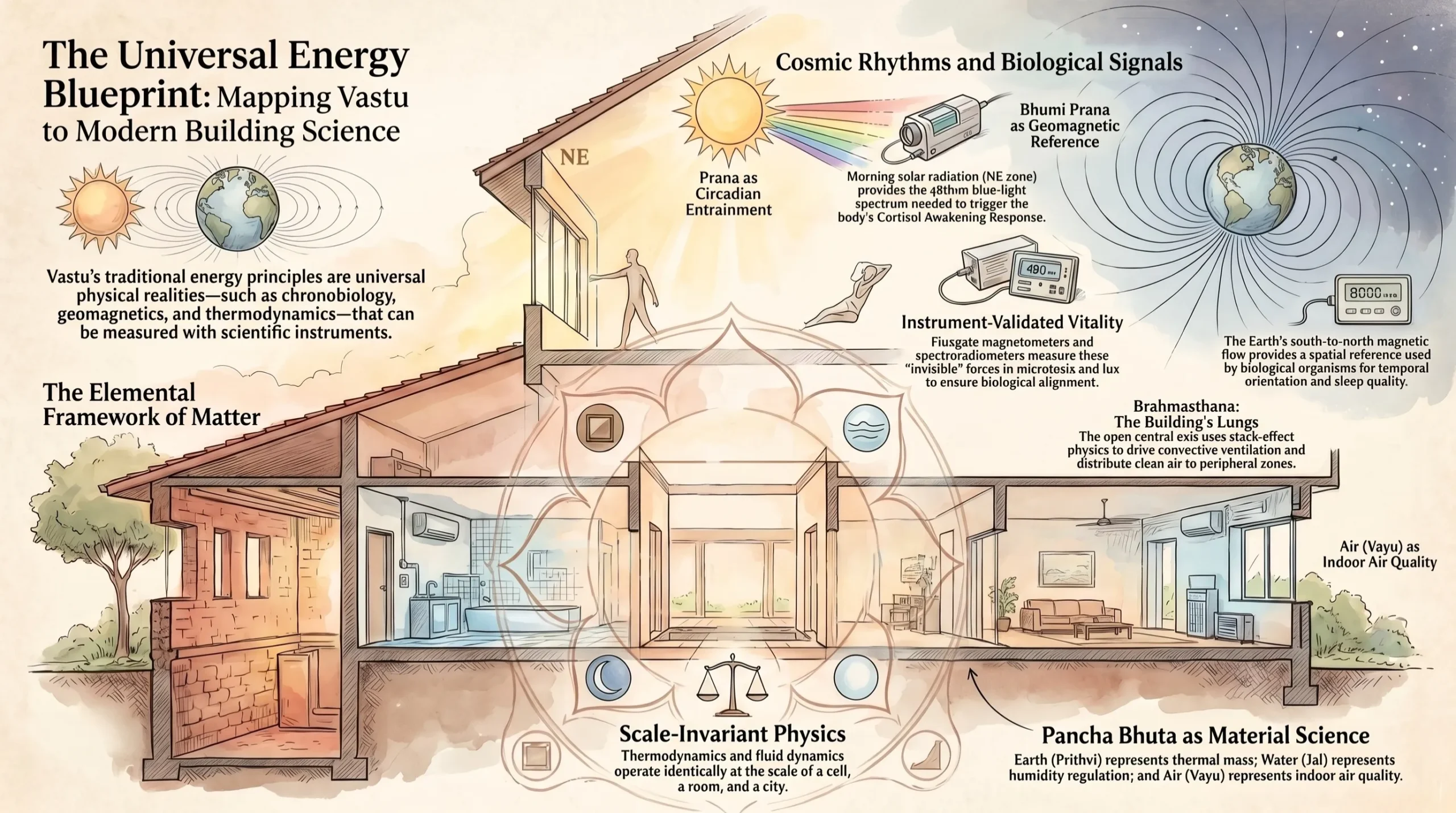
My answer — developed through deep engagement with the tradition’s classical texts, through twenty years of practice across India’s full climatic and cultural range, and through serious study of the physical sciences that have independently characterised the phenomena that Vastu’s energy vocabulary describes — is that Vastu’s core energy principles are universal in the most precise and most verifiable sense available: they describe physical realities whose operation is identical at every latitude, in every culture, in every building type, and in every era. The morning solar prana that the north-east zone delivers is the same circadian entrainment signal whose molecular mechanism won the Nobel Prize in Physiology or Medicine in 2017. The earth-element stability of the south-west zone’s thermal mass is the same thermodynamic reality whose physics govern building thermal performance in every climate. The electromagnetic prana quality of the sleeping zone is the same bioelectromagnetic phenomenon whose mechanisms are documented in peer-reviewed journals published on every continent.
The energy vocabulary that Vastu uses — prana, Pancha Bhuta, Vastu Purusha — is not the only vocabulary available for these physical realities. Chronobiology uses different words. Building physics uses different words. Biophilic design science uses different words. But these are vocabularies, not realities. The reality that every vocabulary is attempting to describe — the specific ways in which the Earth’s rotation, its geomagnetic field, its solar radiation patterns, and the physical properties of its natural materials interact with the biological systems of the human beings who build their homes on its surface — is one physical reality. And Vastu’s energy principles describe that reality with a comprehensiveness, a practical specificity, and a proven track record of health-generating application that is, in the global history of built environment health science, unmatched.
The Complete Home Health Audit is the most precise contemporary expression of these universal energy principles — translating Vastu’s classical energy vocabulary into the instrument measurements and physical mechanism explanations that demonstrate, for every family in every home, that the tradition they are engaging with is not describing cultural conventions but physical realities that the universe maintains consistently and that a correctly designed and correctly assessed home can be aligned with for the measurable benefit of every person who lives in it.
What makes an energy principle genuinely universal rather than culturally specific?
The distinction between a genuinely universal energy principle and a culturally specific belief system is the most important intellectual question in the evaluation of any traditional knowledge tradition — including Vastu. It is a question that deserves a precise answer rather than a diplomatic one, because the integrity of the tradition depends on it. A tradition that claims universal validity for principles that are actually culturally specific is making claims it cannot defend. A tradition that presents genuinely universal principles as culturally specific beliefs is underselling what it knows. The distinction matters.
A genuinely universal energy principle is one whose operation can be confirmed by independent investigation from any starting point — any culture, any methodology, any era — and whose physical mechanism does not depend on accepting any particular cosmological framework, religious tradition, or cultural convention. The Earth’s rotation producing a twenty-four-hour solar cycle whose specific light spectrum and timing affects the human circadian system through the ipRGC melanopsin pathway is a universal principle: the mechanism operates identically regardless of whether one is Hindu, Buddhist, Christian, or atheist; regardless of whether the observer is Indian, Chinese, European, or African; regardless of whether the investigation uses the vocabulary of prana, Qi, chi, or circadian biology.
The test for a genuinely universal energy principle is, in essence, the test that this entire series of articles has applied to every Vastu prescription: can the principle be derived from physical laws that operate independently of any cultural framework? Can it be confirmed by independent investigation using tools other than the tradition’s own methodology? Is it falsifiable — and has it survived falsification attempts? Does its operation produce the same outcomes regardless of the observer’s cultural background, religious beliefs, or prior expectations?
Vastu’s core energy principles — the solar prana principle, the geomagnetic field principle, the Pancha Bhuta elemental principle, the Brahmasthana central axis principle, the natural material principle, and the direction-function principle — all meet this test. Every one of them can be derived from physical laws that operate independently of any cultural framework. Every one of them has been confirmed by independent investigation from multiple disciplinary starting points. Every one of them produces the same physical outcomes regardless of the occupant’s cultural or religious background. And every one of them has been tested against the outcomes of thousands of homes assessed over five thousand years of practice — the most extensive natural experiment in built environment health science available.
This is what makes Vastu’s energy principles genuinely universal: not the cultural authority of an ancient Indian tradition, not the philosophical sophistication of the Vedic cosmological framework within which they were developed, and not the claim of any single practitioner or text. They are universal because the physical realities they describe are universal — and the universality of those physical realities is confirmed every time a magnetometer measures a geopathic stress zone in a Mumbai apartment or a London bedroom, every time a lux meter confirms inadequate morning solar access in a Bengaluru flat or a Singapore office, and every time a family’s improved sleep quality following sleeping zone corrections demonstrates that the physical environment of the home affects the biological state of the people who live in it regardless of what cultural tradition informed the correction.
How does the Pancha Bhuta framework embody the most fundamental physical properties of matter?
The Pancha Bhuta — the five-element framework that is simultaneously Vastu’s material philosophy, Ayurveda’s constitutional framework, and the Vedic tradition’s most fundamental account of the composition of physical reality — is, in my view, the most intellectually extraordinary pre-scientific physical classification system developed by any civilisation. Not because it is mystically inspired. Because it is empirically grounded: it identifies, with remarkable precision, the five physically distinct categories of material property that are most consequential for the built environment’s effect on human health, and it develops a practical building science from those five categories that is more comprehensive and more health-generating than any comparable classification system available in the global building tradition.
Earth (Prithvi) is, in the physical vocabulary of building science, thermal mass and structural density — the specific heat capacity and thermal time constant that dense solid materials provide for buffering temperature extremes, the structural mass that provides the gravitational stability and electromagnetic shelter of solid construction, and the geomagnetic field coherence of undisturbed stable geological substructure. Water (Jal) is hygroscopic moisture management — the ability of specific materials (lime, clay, laterite) to absorb and release moisture to regulate indoor relative humidity, and the evaporative cooling that water features and moisture-permeable materials provide. Fire (Agni) is solar thermal energy and metabolic activation — the morning solar radiation that activates the circadian cortisol awakening response and serotonin synthesis, the cooking fire of the kitchen, and the transformative metabolic energy that directs all biological and productive activity.
Air (Vayu) is indoor air quality and ventilation — the CO2 concentration, VOC burden, oxygen availability, humidity, and air movement quality of the indoor environment; the convective air circulation that the open Brahmasthana drives; the acoustic transmission medium that zone separation manages. And Space (Akasha) is volumetric spatial character — the proportional relationship between room dimensions and human scale, the acoustic resonance that spatial geometry produces, the sky connection that the Brahmasthana’s open centre provides, and the psychological spaciousness that correct zone proportions deliver.
These five categories — thermal mass, hygroscopic management, solar activation, air quality, and spatial volume — are, from the perspective of contemporary building physics, environmental psychology, and indoor air quality science, precisely the five most consequential physical categories of built environment quality for human health. The Pancha Bhuta framework did not arrive at this classification through systematic building science analysis. It arrived through thousands of years of empirical observation of which physical building properties most consequentially affected the health of the people who lived in correctly versus incorrectly designed buildings — and the classification that observation produced aligns, with a precision that I find extraordinary, with what modern building science would independently derive from first principles.
The specific genius of the Pancha Bhuta as a practical building science framework is that it provides not only the classification of the most important physical properties but the spatial allocation system — the Vastu Purusha Mandala — that specifies which directional zones should most completely express which elemental properties, based on the observed solar arc geometry, prevailing wind patterns, and geomagnetic field character of the Indian subcontinent. The result is a complete physical design framework that tells the builder what physical property each zone should optimise for, which materials best express that property in the local ecology, and what the health consequences will be if the elemental balance is disrupted. This framework is, in its physical substance, the most complete traditional building physics theory available in any world culture.
How does the Vastu Purusha Mandala encode the solar arc as a universal energy map?
The Vastu Purusha Mandala — the nine-square grid that forms the spatial-energetic foundation of Vastu’s zone allocation system — is, at its physical core, a map of the solar arc’s energy distribution across the building’s compass faces. Every zone allocation in the Manasara can be derived from the physical observation of which compass faces receive which solar loads at which times of day at Indian latitudes, and from the health consequences of different activities conducted in environments with different solar energy characters.
The north-east zone — the Ishanya direction, the zone of the divine, of morning prana, of the home mandir, of the primary entry — receives the earliest morning solar radiation at Indian latitudes. Before sunrise, the north-east sky begins to brighten with the scattered blue-spectrum light that represents the most potent circadian entrainment wavelength available in the solar spectrum. At sunrise, the first direct solar radiation reaches the north-east face’s windows before any other face. This early morning solar light — with its specific spectral composition, its low angle, and its circadian effectiveness — is what the Vastu Purusha Mandala identifies as the most health-generating directional energy in the home, and what chronobiology identifies as the most potent circadian zeitgeber available in the residential built environment.
The south-west zone — the Nairiti direction, the zone of earth element stability, of the master bedroom, of the most senior family member — receives the heaviest afternoon solar heat load of any compass face at Indian latitudes. The south-west wall’s exposure to the afternoon sun (typically 2 PM to sunset) creates the thermal load that, without adequate thermal mass to buffer it, would make the south-west zone the hottest and most thermally unstable zone in the home — the worst possible sleeping environment. With adequate thermal mass — the 300 to 900 millimetre stone or rammed earth construction that the Vastu prescription specifies — the south-west zone becomes the most thermally stable zone in the home, releasing its absorbed afternoon heat slowly through the night in a pattern that supports rather than opposes the sleeping body’s circadian temperature programme.
The north zone — Kubera’s direction, the zone of knowledge, wealth, and consistent intellectual activity — receives only diffuse northern sky illumination throughout the year, with no direct solar penetration at Indian latitudes. This diffuse, consistent, glare-free northern light is the specific light quality that Vastu identifies as most supportive of knowledge work, financial transactions, and the calm, productive activities that require consistent illumination without the arousal, glare, and thermal load of direct solar radiation. Commercial and study Vastu’s north zone prescription for these activities is a direct expression of the solar geometry that makes northern illumination the most consistent and most comfortable natural light for sustained cognitive work.
The Vastu Purusha Mandala is not a cosmological diagram imposed on the building from above. It is a solar energy map derived from the observation of the solar arc at Indian latitudes — and every zone allocation in it can be traced directly to the specific solar energy character of the corresponding compass face. The cosmic is the physical. The Vastu Purusha Mandala encodes in a single diagrammatic form the complete solar energy distribution of a correctly oriented Indian home — and every zone prescription it generates is a specific physical health prescription whose rationale is the observed solar and geomagnetic energy character of that compass direction at those latitudes.
What is the complete map of Vastu's universal energy principles and their physical expressions?
The following table provides a comprehensive reference for eight of Vastu’s most fundamental energy principles — specifying the Vastu vocabulary, the physical science vocabulary, the physical phenomenon both describe, the scale at which it operates, and how the Complete Home Health Audit measures it.
|
Universal Energy Principle |
Vastu Vocabulary |
Physical Science Vocabulary |
The Physical Phenomenon Both Describe |
Scale at Which It Operates |
How the Complete Home Health Audit Measures It |
|
The daily solar cycle as the primary biological organiser |
Prana — the life force carried by morning solar radiation; Surya (sun) as the primary cosmic energy source; the Brahma Muhurta (period before and after sunrise) as peak prana availability |
Chronobiology — the circadian clock molecular mechanism (CLOCK/BMAL1 feedback loop); ipRGC melanopsin pathway; cortisol awakening response; peripheral clock synchronisation; Nobel Prize 2017 mechanism |
The Earth’s rotation on its axis produces a twenty-four-hour cycle of solar radiation intensity and spectrum that the human body’s molecular timekeeping mechanism uses as its primary calibration signal; morning solar light is the most potent circadian entrainment input available in the built environment |
Universal — operates identically at every inhabited latitude through the same molecular mechanism; culturally expressed differently but physically identical everywhere on Earth |
Lux meter and spectroradiometer — morning solar lux and 480 nm spectral quality at NE zone measured; circadian entrainment adequacy assessed against chronobiology research thresholds |
|
The Earth’s geomagnetic field as a biological reference |
Bhumi Prana — the earth’s life force; the direction quality of each compass zone; sleeping orientation as a health prescription; the south-west as the zone of greatest earth-energy stability and shelter |
Geomagnetic biophysics — the Earth’s dipole magnetic field; magnetite-based and cryptochrome-based magnetoreception in biological organisms; HRV research on sleeping orientation; geopathic stress as local field distortion; Building Biology SBM standard |
The Earth’s geomagnetic field — produced by convective motion of molten iron in the outer core — flows south-to-north and provides the geomagnetic reference that biological organisms from migrating birds to sleeping human beings use for spatial and temporal orientation; local field distortions from underground water and geological faults disrupt this reference and impair the biological processes that depend on it |
Universal — the Earth’s geomagnetic field exists everywhere on Earth’s surface; geopathic stress zones occur wherever the geological conditions that produce them exist; the head-South sleeping prescription is correct everywhere in the Northern Hemisphere |
Fluxgate magnetometer — local geomagnetic field measured at sleeping positions in microtesla; anomaly delta calculated against room background; SBM threshold comparison; sleeping orientation confirmed in compass degrees |
|
The five-element constitution of material reality |
Pancha Bhuta — the five elements (Earth/Prithvi, Water/Jal, Fire/Agni, Air/Vayu, Space/Akasha) that constitute all matter and all living systems; elemental zone allocation in the Vastu Purusha Mandala; material prescription by elemental zone |
Matter and energy in physics — the states of matter (solid, liquid, gas, plasma, field) and their thermodynamic, electromagnetic, and acoustic properties; the correspondence between elemental character and physical material properties (thermal mass = Prithvi; hygroscopic regulation = Jal; activation energy = Agni; convective movement = Vayu; volumetric spaciousness = Akasha) |
The five elements are not a mystical taxonomy but a pre-scientific vocabulary for the five physically distinct categories of material property that most consequentially affect the built environment’s effect on human health: thermal mass and grounding (Earth), moisture management and cooling (Water), activation and metabolic energy (Fire), ventilation and movement (Air), and spatial openness and volume (Space) |
Universal — the five material properties the elements describe operate identically in all climates and all cultures; specific materials that best express each property vary by climate and ecology but the property categories are universal |
Thermal imaging (Earth element — thermal mass performance), CO2 monitor and hygroscopic material assessment (Water and Air elements), lux meter (Fire element — morning solar activation), zone allocation and Brahmasthana assessment (Space element — spatial openness) |
|
The central axis principle — the home’s heart as its organising energy |
Brahmasthana — the home’s central zone as the axis connecting the domestic space to the cosmic vertical; Akasha element expression; energy distribution hub; the home’s primary breathing space |
Building physics and environmental psychology — stack-effect convective ventilation through the central open zone; thermal comfort through central air circulation; attention restoration through visual relief from environmental complexity; acoustic moderation through central diffusion space |
The geometric centre of any enclosed human space is the point from which the space’s environmental quality — air circulation, thermal distribution, acoustic character, visual organisation — is most completely and most efficiently distributed to every peripheral zone; keeping this centre open and unobstructed is the single most efficient environmental health investment available in any residential or commercial building |
Universal — the physics of convective ventilation, thermal distribution, and acoustic diffusion are identical in all buildings at all latitudes; the geometric centre is always the optimal air circulation driver; the open centre is always the most efficient environmental quality distribution point |
CO2 monitoring in primary living zones during occupation to verify Brahmasthana ventilation function; lux measurement to verify light distribution quality; acoustic assessment to confirm diffusion character |
|
Electromagnetic fields as a dimension of the energy environment |
The sleeping zone’s prana quality includes freedom from artificial electromagnetic disturbance; the tradition’s prescription for sleeping zone prana preservation implies elimination of energy fields that disturb the body’s natural bioelectromagnetic alignment |
Bioelectromagnetics — RF fields activating voltage-gated calcium ion channels; melatonin suppression through AANAT inhibition; ELF fields from power wiring; biological magnetoreception disruption by artificial fields; Building Biology SBM standard for residential electromagnetic environment |
Electromagnetic fields — whether from natural sources like the Earth’s geomagnetic field or artificial sources like RF transmitters and power wiring — interact with the body’s own bioelectromagnetic systems through specific physical mechanisms that affect melatonin synthesis, autonomic nervous system function, calcium signalling, and the geomagnetic reference used for sleeping orientation |
Universal — the biological effects of artificial electromagnetic fields operate through the same molecular mechanisms at all latitudes and in all cultures; the AANAT melatonin suppression pathway is the same in a Mumbai bedroom and a London bedroom |
RF meter (µW/m² at sleeping position), ELF Gauss meter (mG from bedroom wiring); Building Biology SBM standard applied; melatonin suppression mechanism quantified |
|
The natural material principle — physical alignment between the body and its material environment |
Pancha Bhuta natural material prescription — the Vastu tradition’s insistence on natural stone, natural timber, lime plaster, terracotta, and natural textiles because these materials express the elemental properties appropriate to each zone and are in elemental harmony with the human body itself, which is also constituted from the same five natural elements |
Biophilic design science — the human organism’s evolved biological preference for natural environments and natural environmental qualities; the koniocellular visual pathway’s activation by natural patterns; Ulrich’s stress recovery theory; VOC toxicology of synthetic building materials; hygroscopic performance of natural versus synthetic surfaces |
Human beings evolved in natural material environments over millions of years; the body’s neural systems, immune systems, and stress-regulatory systems are calibrated to natural material sensory inputs; synthetic materials produce sensory inputs that the evolved biological systems have no adaptive framework for — producing the stress response that biophilia research documents as the primary mechanism of synthetic environment health impairment |
Universal — biophilic responses to natural versus synthetic materials operate through the same neural pathways in all human beings regardless of culture or geography; the VOC toxicology of synthetic materials is culture-independent |
VOC and material quality assessment; biophilic quality evaluation; CO2 hygroscopic regulation assessment of natural versus synthetic finish materials |
|
The direction-function principle — different cosmic directions carry different energy qualities |
Vastu Purusha Mandala — the nine-zone directional system that allocates specific functions to specific compass directions based on the elemental and solar energy character of each direction; the north-east as maximum prana delivery; the south-west as maximum earth-energy stability; the north as the direction of consistent, cooling, knowledge-supporting energy |
Solar geometry and thermal physics — the solar arc at Indian latitudes produces specific solar load patterns on different compass faces at different times of day; the north-east face receives the most morning solar radiation; the south-west face receives the most afternoon thermal load; the north face receives only diffuse sky illumination; these physical solar arc characteristics produce measurable thermal and light quality differences between compass zones |
The energy quality of each compass direction is not symbolic or cosmological but physically real: the north-east face receives early morning solar radiation with the spectral composition most effective for circadian entrainment; the south-west face absorbs the most afternoon heat and requires maximum thermal mass; the north face provides the most consistent, most glare-free, most colour-accurate natural illumination; these physical facts are expressed in different vocabularies by different traditions but are always the same physical reality |
Universal in principle for all Indian latitudes; requires solar arc recalibration for significantly different latitudes internationally |
Compass and solar bearing calculator — building orientation and zone allocation confirmed against the solar arc at the specific assessment latitude; NE morning solar access lux measured; SW thermal mass performance assessed |
|
The scale-correspondence principle — the same energy principles operate at every spatial scale |
From the body’s energy centres (chakras), to the room’s elemental zones, to the building’s Vastu Purusha Mandala, to the settlement’s Nagara Vinyasa, to the solar system — the same five elemental principles operate at every scale of physical reality, creating the correspondence that Vastu uses to align built form with cosmic order |
Scale-invariant physical principles in building physics and ecology — thermal mass performance scales from the room to the building to the city; stack-effect ventilation scales from the room courtyard to the urban canyon; solar orientation principles are equivalent from the room window to the city street grid; the same passive solar and natural ventilation physics operate at every scale of the built environment |
The most fundamental physical laws — thermodynamics, electromagnetism, fluid dynamics, geomagnetics — are scale-invariant: they operate identically at the scale of a cell, a sleeping body, a bedroom, a house, a city, and a planet; the energy principles that Vastu identifies at the home scale are the same principles that operate at the urban scale (Nagara Vinyasa) and at the biological scale (the body’s own energy systems) |
Universal — scale-invariant physical laws operate identically at every spatial scale; Vastu’s scale-correspondence principle is a practical expression of the physical reality that the same thermodynamic and electromagnetic principles operate at the cell level and the city level |
The Complete Home Health Audit assesses the home scale; the Vastu for New Plots & Construction service extends the same principles to site and urban scale; the principles are the same at both scales |
Reading this table as a whole, the most striking pattern is in the ‘Scale at Which It Operates’ column: in every case, the universal energy principle operates at the universal scale — ‘identical at every inhabited latitude,’ ‘everywhere on Earth’s surface,’ ‘in all climates and all cultures.’ These are not Indian principles. They are Earth principles — physical facts about the planet whose surface every human being inhabits and whose physical laws every human body must work within.
The second most striking pattern is in the ‘How the Complete Home Health Audit Measures It’ column: every principle in the table is measurable. Universal energy principles whose operation is identical everywhere on Earth are, by that very universality, physically real — and physical realities are measurable. The magnetometer reads the geomagnetic principle in microtesla. The lux meter reads the solar prana principle in lux and nanometres. The CO2 monitor reads the Vayu element principle in parts per million. The RF meter reads the electromagnetic prana quality principle in microWatt per square metre. The instruments are the tools that make the tradition’s universal energy principles not merely intellectually credible but practically accountable.
How does the Brahmasthana principle express the universal physics of the central axis?
The Brahmasthana — Vastu’s prescription for an open, unobstructed central zone at the home’s geometric heart — is, in my view, the single most elegant expression of a universal energy principle available in any building tradition: the principle that the central axis of any enclosed space is the physical location from which the space’s environmental qualities are most completely and most efficiently distributed to every surrounding zone. This principle operates identically in a Kerala nalukettu courtyard, a Rajasthan haveli, a Gothic cathedral, a Roman atrium house, and a contemporary Indian apartment — because it is grounded in the same thermodynamic, aerodynamic, and acoustic physics everywhere.
The thermodynamic expression of the central axis principle is the stack-effect ventilation mechanism: when the central zone of a building is open to the sky (or to a higher temperature than the surrounding enclosed zones), the temperature differential between the central zone and the peripheral zones creates a pressure gradient that drives convective air circulation from the peripheral zones’ low openings, upward through the central zone, and out through the central zone’s high opening. The rate of this convective circulation — and therefore the effectiveness of the building’s passive ventilation — is a direct function of the height of the central zone, the temperature differential, and the unobstructed area of the vertical air column. Obstructing the central zone with furniture, equipment, or enclosed rooms eliminates this convective pathway and replaces passive ventilation with stagnant, CO2-accumulating air.
The acoustic expression of the central axis principle is the acoustic diffusion that an open central zone provides: the reflective geometry of a symmetric central open space distributes acoustic energy from any source more uniformly throughout the building than any arrangement of enclosed peripheral rooms, reducing the standing wave patterns that produce the room mode resonances that make some spaces acoustically comfortable and others acoustically fatiguing. The nalukettu’s central courtyard is not merely a ventilation system — it is an acoustic moderator whose open symmetric geometry produces the ambient acoustic character that makes traditional Indian domestic space feel acoustically easy and unconfined.
The electromagnetic expression of the central axis principle is the most subtle but not the least important: the open central zone of the correctly designed Vastu home is a zone of minimum artificial electromagnetic field concentration — because no electrical services run through it, no appliances are installed in it, and no wireless devices are placed within it. The Brahmasthana is, in electromagnetic terms, the home’s clean field zone — the space of minimum RF and ELF burden, from which the sleeping zones’ field quality benefits by proximity and from which the family’s daily electromagnetic burden is reduced by the natural separation of device-dense activity zones from the open centre.
The Brahmasthana principle is universal not because the Vastu tradition asserts its cosmic significance but because the thermodynamic, acoustic, and electromagnetic physics that it exploits are universal. Every building on Earth would benefit from an open, unobstructed central zone for exactly the same physical reasons that the nalukettu’s courtyard has been benefiting its occupants for a thousand years — and the Complete Home Health Audit’s CO2 monitoring and Brahmasthana clearance assessment makes those benefits measurable in every home it assesses.
How do the Pancha Bhuta elements express universal physical properties in the built environment?
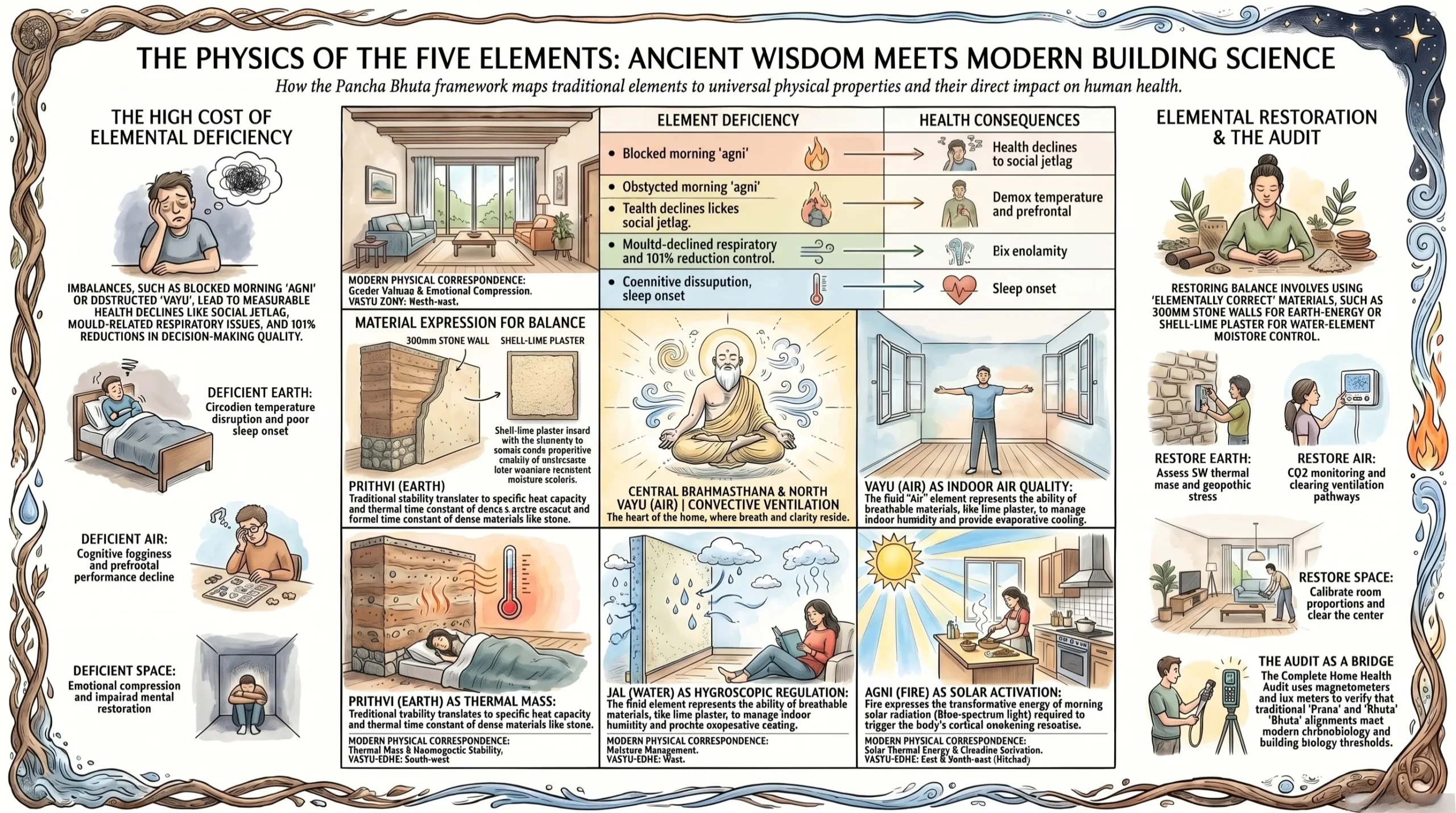
The following table provides the most complete available reference for the five Pancha Bhuta elements — specifying their classical Sanskrit properties, their modern physical correspondences, their Vastu zone allocation, the correct material expression of each in a correctly built home, the health consequence when the element is deficient, and how the Complete Home Health Audit restores elemental balance.
|
Element (Bhuta) |
Classical Sanskrit Properties |
Modern Physical Correspondence |
Zone Allocated in Vastu |
Material Expression in Correct Home |
Health Consequence When Deficient |
How the Audit Restores Balance |
|
Prithvi (Earth) |
Heavy, stable, dense, grounding, cool, restorative; the element of shelter, containment, and biological restoration; the body’s solid structures; bones, muscles, dense tissues |
Thermal mass — the specific heat capacity and thermal time constant of dense solid materials; structural mass; gravitational stability; electromagnetic shelter; geomagnetic field coherence of stable geological substructure |
South-west zone (master bedroom) — the zone of maximum earth-element expression in the home; maximum wall mass; maximum structural density; maximum geomagnetic field stability where the site is free of geopathic disturbance |
300–900 mm compressed stone, rammed earth, or dense brick walls; natural stone flooring; terracotta tile; natural timber structural elements; lime and earth plaster |
Insufficient thermal mass in sleeping zone: core body temperature decline impaired; sleep onset difficulty; circadian temperature programme disrupted; the body lacks the earth-element environmental grounding that its own earth-element tissues require for overnight restoration |
SW thermal mass assessment; geopathic stress magnetometer survey; sleeping position confirmed in clean Prithvi-quality earth-energy zone; earth-element material corrections prescribed |
|
Jal (Water) |
Fluid, cooling, reflective, hygroscopic, northward-flowing, purifying; the element of emotional balance and nourishing flow; the body’s fluids, blood, lymph, reproductive energy |
Hygroscopic moisture management — the ability of building materials to absorb and release moisture to regulate indoor relative humidity; evaporative cooling; water body ionisation and negative ion generation; the electromagnetic cooling that north zone diffuse light provides |
North and north-east zones — the direction of the water element’s cooling, nourishing, knowledge-associated energy; water features belong in the north-east zone where evaporative cooling enhances the prevailing wind’s cooling effect; north zone for consistent, cool, non-glare illumination |
Shell-lime plaster (hygroscopic); natural clay tile (hygroscopic); laterite block (hygroscopic in humid climates); water feature in NE zone; northern sky light for cool diffuse illumination |
Insufficient moisture regulation: indoor humidity extremes impairing respiratory health and promoting mould growth; north zone obstruction impairing the cool, consistent illumination quality that knowledge work and emotional stability require; water feature misplacement reducing its evaporative and negative-ion benefits |
Hygroscopic material assessment; north-east water feature position confirmation; northern zone illumination quality measurement; indoor humidity assessment |
|
Agni (Fire) |
Hot, transformative, activating, metabolic, digestive, purifying; the element of energy, motivation, digestion, and the will that transforms potential into action; the body’s digestive fire, metabolism, vision |
Solar thermal energy — the heat carried by direct solar radiation; metabolic activation from morning solar prana (cortisol awakening response, serotonin synthesis, dopaminergic reward pathway activation from natural light); kitchen fire and food preparation energy; the east and south-east’s morning solar activation quality |
South-east zone (kitchen) — the direction of the fire element’s transformative activation energy; east and north-east for morning solar prana delivery to living zones; the rising sun’s energy available first in the eastern zones |
Terracotta tile (fire-element material); natural copper and brass (Agni metals); morning solar light through east and south-east windows; cooking fire in south-east zone; warm amber-gold colour programme in fire-element zones |
Blocked morning solar prana: blunted cortisol awakening response; reduced serotonin synthesis; low morning motivation and metabolic activation; social jetlag from inadequate morning light entrainment; the body’s Agni (metabolic fire) cannot ignite properly without the morning solar Agni of the north-east zone |
Lux meter morning solar quality assessment in NE and east zones; CAR activation potential measured against chronobiology thresholds; kitchen zone placement assessment; morning light correction prescribed |
|
Vayu (Air) |
Light, mobile, subtle, spacious, connecting, the medium of prana transmission; the element of breath, nervous system activity, and the subtle life force; the body’s breath, nervous impulses, pranic flow |
Indoor air quality — oxygen concentration, CO2 level, VOC burden, particulate matter, humidity, and air movement; the convective air circulation that the open Brahmasthana drives; the ventilation pathways that connect zones; the acoustic transmission medium that zone separation manages |
Central Brahmasthana and north zones — the air element’s primary expression in the home is the open central zone that circulates clean air throughout the building; the north zone’s consistent air quality and gentle movement support the Vayu element’s nourishing flow |
Open central Brahmasthana (zero obstruction); natural ventilation pathways unblocked; natural material surfaces without VOC burden; ventilated roof space; louvre-controlled openings for monsoon management; acoustic zone separation protecting Vayu-element zones from noise intrusion |
Blocked Brahmasthana and elevated CO2: prefrontal cognitive performance impaired (Harvard: 101% decision quality reduction); oxygen-impoverished sleeping zone; VOC accumulation from synthetic materials; the body’s Vayu element (nervous system, breath, pranic flow) depleted by poor environmental Vayu |
CO2 monitoring during occupation; VOC material assessment; Brahmasthana clearance assessment; natural ventilation pathway analysis; indoor air quality correction programme |
|
Akasha (Space) |
Infinite, all-pervading, the medium for light and sound; the element of consciousness, expansion, and the subtle field that pervades all other elements; the body’s internal spaces — cavities, channels, consciousness itself |
Spatial volume and acoustic field — the volumetric character of spaces; their proportional relationship to human scale; the acoustic resonance that spatial dimensions produce; the electromagnetic field quality of the open space (distinct from material surfaces); the sky connection that the Brahmasthana provides |
Brahmasthana as the home’s primary Akasha expression — the sky-connected central space that is the physical presence of infinite space within the finite home; the proportional system that ensures each room’s ceiling height, width, and length creates the volumetric character appropriate to its function |
Proportionally correct room dimensions (Manasara Tala system); open Brahmasthana sky connection; appropriate ceiling heights by zone (generous in living and study zones, contained in sleeping zones); minimum internal partition depth; natural acoustic character of open proportional spaces |
Acoustically cluttered or volumetrically compressed spaces: the Akasha element’s spatial and acoustic quality depleted; default mode network restoration impaired (neuroaesthetics); emotional spaciousness reduced; the sense that the home is ‘too much’ — too dense, too busy, too compressed — is the experiential expression of Akasha deficiency |
Spatial proportion assessment against Vastu zone prescription; acoustic character measurement; Brahmasthana volumetric quality; ceiling height adequacy by zone function; spatial openness and visual relief assessment |
Reading this table as a whole, the most practically valuable pattern is in the ‘Health Consequence When Deficient’ column: in every case, the elemental deficiency produces a specific, clinically recognisable health pattern that the family may already be experiencing without understanding its environmental root. Prithvi deficiency produces the thermal instability and geopathic stress that impairs the sleeping body’s overnight restoration. Jal deficiency produces the respiratory challenges and emotional imbalance from humidity extremes and inadequate cooling illumination. Agni deficiency produces the blunted morning motivation, low serotonin, and circadian misalignment from blocked morning solar prana. Vayu deficiency produces the cognitive fatigue and air quality impairment from CO2 accumulation. Akasha deficiency produces the spatial and acoustic compression that impairs cognitive restoration and emotional spaciousness.
The Pancha Bhuta assessment is, therefore, not a cosmological diagnosis but a physical environment health assessment expressed in the most comprehensive and most practically actionable vocabulary available — one that connects every identified deficiency to both its elemental root in the traditional framework and its specific instrument-measurable physical expression in the assessment protocol. The family who understands both vocabularies has access to the deepest possible understanding of why their home is affecting their health the way it is — and the most complete possible guidance on what to do about it.
Why does Vastu treat the human body and the built environment as expressions of the same energy system?
One of Vastu’s most philosophically distinctive and most physically substantive claims is the claim that the human body and the built environment are not separate systems in interaction but expressions of the same underlying energy system — that the Pancha Bhuta elements that constitute the body are the same elements that constitute the built environment, and that the health of the body depends on the alignment between its own elemental constitution and the elemental character of the built environment it inhabits. This claim sounds, in the language of modern science, like a metaphor. In the language of physical science, it is not.
The human body is, in its physical substance, a product of the Earth’s geology, hydrology, atmospheric chemistry, and solar radiation. The calcium in the bones (Prithvi/Earth) is the same calcium as the calcium in the limestone from which the family’s house is built. The water in the blood and tissues (Jal/Water) is the same water that flows through the aquifer beneath the family’s plot. The energy in the metabolic processes (Agni/Fire) is the same solar energy that the morning solar radiation delivers to the body’s circadian system and to the kitchen’s cooking surface. The air in the lungs (Vayu/Air) is the same air that the Brahmasthana’s ventilation system circulates through the home. The space that consciousness occupies (Akasha/Space) is the same volumetric space that the Brahmasthana opens to the sky.
This physical correspondence is not a poetic metaphor. It is the recognition, encoded in the Vedic tradition five thousand years before modern biochemistry, that the body and its environment are constituted from the same physical substances — and that the body’s health depends on the quality of those substances in both their internal and external expressions. A body living in a home whose elemental character does not support the body’s own elemental constitution is a body working against its physical context — and the health consequences of this elemental misalignment are the specific patterns that Vastu assessment identifies and corrects.
What does this elemental body-environment correspondence mean for the interpretation of health symptoms?
The elemental body-environment correspondence is not only a theoretical framework. It is a practical diagnostic tool for identifying the environmental root of specific health patterns. When a family member presents with the specific Prithvi-deficiency symptoms — chronic cold sensitivity, difficulty warming up in the morning, restless undirected energy, feelings of ungroundedness and instability — the first environmental question is whether the sleeping zone has adequate earth-element character: thermal mass, geopathic field stability, sleeping orientation alignment, structural enclosure. When the symptoms are Vayu-deficiency patterns — cognitive fogginess, mental restlessness, difficulty concentrating, sensitivity to noise and overstimulation — the first environmental question is whether the indoor air quality (CO2, VOC, humidity) and the acoustic character of the study and sleeping zones are adequate.
This elemental diagnostic framework is, in its application, the integration of Ayurveda’s constitutional assessment with Vastu’s environmental assessment that the previous article in this series described. The body’s elemental imbalance and the environment’s elemental deficiency are not separate problems requiring separate solutions. They are the two faces of the same elemental condition — and addressing both simultaneously, through Ayurvedic therapeutic support for the body’s elemental balance and Vastu environmental correction for the home’s elemental character, produces the most complete health restoration available.
The Complete Home Health Audit’s Pancha Bhuta elemental assessment is not an additional layer added on top of the instrument-based assessment. It is the integrative framework that connects the instrument findings — the geopathic stress reading (Prithvi deficiency), the CO2 concentration (Vayu deficiency), the lux meter reading (Agni deficiency), the hygroscopic material assessment (Jal deficiency), the Brahmasthana volumetric assessment (Akasha deficiency) — into a single coherent elemental picture of the home’s environmental health character. The family that understands their home’s elemental picture has the most complete available explanation of their home’s effect on their health — and the most motivating possible framework for implementing the corrections that will restore the elemental balance.
How does the Vastu Purusha embody the universal principle of the human body's alignment with cosmic order?
The Vastu Purusha — the cosmic being whose body fills the Vastu Purusha Mandala, lying diagonally with head in the north-east and feet in the south-west, and whose body parts correspond to specific zones in the nine-square grid — is Vastu’s most vivid expression of the principle that the built environment is, at its deepest level, a physical extension of the human body into space. The prescription is that buildings should be designed to support and extend the Vastu Purusha’s body — which is simultaneously the cosmic order, the human body, and the home’s energy map — in the same way that the human body itself is designed to align with the cosmic order of the Earth’s rotation, its geomagnetic field, and its solar radiation patterns.
The philosophical content of the Vastu Purusha image is rich. But its physical content is even richer. The Vastu Purusha’s head in the north-east is the physical prescription that the home’s primary energy reception point — the morning solar prana, the morning activation zone, the most alert and cognitively active zone of the home — should be at the north-east. This corresponds to the human body’s own most energy-receptive location: the eyes and the brain, which are the primary receivers of the morning solar prana through the ipRGC melanopsin pathway and the SCN circadian calibration mechanism. The zone where prana enters the home is the zone corresponding to the zone where prana enters the body — through vision and consciousness.
The Vastu Purusha’s feet in the south-west is the prescription that the home’s most grounded, most stable, most sheltered location — the earth-element zone — should be at the south-west. This corresponds to the human body’s own most grounded physical location: the feet, which bear the body’s weight, maintain contact with the Earth, and provide the gravitational stability on which all the body’s higher functions depend. The master bedroom in the south-west is literally the position of the Vastu Purusha’s feet — the most grounded, most stable, most earth-element location available, which is precisely what the sleeping body requires for the deepest possible nightly restoration.
The Vastu Purusha is, in its physical substance, the most comprehensive single image available for understanding why the home’s energy map must align with the human body’s energy map: because they are both expressions of the same physical reality — the Earth’s rotation, its geomagnetic field, its solar arc, its material composition — and the alignment between them is not a metaphysical aspiration but a physical necessity. The home that is aligned with the Vastu Purusha is the home that is aligned with the physical reality that the human body itself is always in — and the Complete Home Health Audit, by assessing every dimension of that alignment with instrument precision, ensures that the family’s home is supporting rather than opposing the physical context in which the human body has evolved to function.
What does the scale-correspondence principle reveal about Vastu's place in the universal order?
One of the most philosophically compelling and most physically substantive dimensions of Vastu’s universal energy framework is its scale-correspondence principle — the recognition that the same five elemental principles and the same directional energy map operate at every scale of physical reality, from the individual cell through the sleeping body, through the room, through the home, through the neighbourhood, through the city, to the planet and the cosmos. This principle is not merely a philosophical aspiration. It is a physical description of the scale-invariant character of the thermodynamic, electromagnetic, and geomagnetic laws that determine the built environment’s effect on human health at every scale.
At the cellular scale, the Pancha Bhuta elements are expressed in the cell’s own physical constituents: the calcium in the cell’s structural proteins (Prithvi), the water in the cytoplasm (Jal), the ATP energy of metabolism (Agni), the oxygen and CO2 of cellular respiration (Vayu), and the volumetric space of the cell’s own organisation (Akasha). At the body scale, these elements are expressed in the tissues and organ systems: dense bone and muscle (Prithvi), blood and lymph (Jal), metabolic fire and digestion (Agni), breath and nervous impulse (Vayu), body cavities and consciousness (Akasha). At the room scale, they are expressed in the wall materials, water features, morning light, ventilation, and spatial proportions. At the building scale, they are expressed in the zone allocation of the Vastu Purusha Mandala. At the urban scale, they are expressed in the Nagara Vinyasa city planning principles. At every scale, the same five elements, the same directional logic, the same physical prescriptions.
This scale-correspondence is physically real — not because all scales are literally composed of the same substances in a mystical sense, but because the same physical laws operate at every scale. The thermodynamic principle that determines the cell’s membrane temperature regulation is the same principle that determines the bedroom’s thermal mass performance and the city’s urban heat island management. The electromagnetic principle that determines the cell’s calcium signalling is the same principle that determines the bedroom router’s melatonin-suppressing effect. The convective principle that determines the nasal passages’ air circulation is the same principle that determines the Brahmasthana’s stack-effect ventilation. Physics is scale-invariant, and Vastu’s scale-correspondence principle is the practical expression of this physical reality.
The philosophical implication of the scale-correspondence principle for the family engaging the Complete Home Health Audit is, I think, the most personally meaningful in this entire article: when the assessment finds a Prithvi deficiency in the sleeping zone — inadequate thermal mass, geopathic stress, insufficient earth-element shelter — it is finding a physical deficiency that resonates at the cellular scale, the body scale, and the room scale simultaneously. Correcting the home’s Prithvi character is not merely improving a building specification. It is restoring the physical alignment between the body’s own elemental constitution and the elemental character of the environment that the body inhabits for the most biologically important eight hours of every day. This is the universal energy principle that Vastu embodies — and the Complete Home Health Audit delivers it, with instrument precision, for every family whose home it assesses.
What does the Complete Home Health Audit deliver as an assessment of universal energy alignment?
The Complete Home Health Audit is, in its deepest philosophical and its most practical physical sense, an assessment of the alignment between the universal energy principles that the built environment expresses and the universal energy requirements that the human body maintains. Every instrument it uses, every prescription it delivers, and every health improvement it predicts is an expression of this alignment assessment — translated from the vocabulary of universal energy into the vocabulary of instrument measurement and physical mechanism.
The magnetometer’s reading at the sleeping position is an assessment of the Prithvi principle’s geomagnetic expression: is the Earth’s stable magnetic field available at this position to provide the biological reference that the sleeping body’s orientation and autonomic circadian programme depend on, or is it disturbed by underground water or geological stress? The RF meter’s reading is an assessment of the electromagnetic prana quality: is the sleeping zone free of the artificial electromagnetic disturbance that suppresses melatonin and fragments the circadian immune programme, or is it burdened by the technology infrastructure of the modern home? The CO2 monitor is an assessment of the Vayu element’s air quality expression: is the home’s central zone providing the clean, free-flowing air that the body’s respiratory and cognitive systems require, or is the Brahmasthana obstructed and the air quality depleted?
The lux meter is an assessment of the Agni principle’s morning solar expression: is the north-east prana gateway delivering the morning solar spectrum at the quality and intensity that activates the body’s circadian clock and metabolic fire, or is the zone blocked, obstructed, or oriented away from the sunrise? The sleeping orientation assessment is a Prithvi-Vayu alignment check: is the body’s longitudinal axis aligned with the Earth’s geomagnetic field in the orientation that produces the highest nocturnal parasympathetic dominance and the most complete circadian autonomic recovery, or is it misaligned with the field that the body’s biological compass systems depend on? The zone allocation assessment is the full Vastu Purusha Mandala alignment check: is the home’s elemental zone character aligned with the universal energy map that the solar arc, the geomagnetic field, and the natural ventilation principles together determine, or is there a structural elemental imbalance that is creating the specific health challenges the family presents with?
Every finding the assessment makes is a specific, instrument-confirmed misalignment between the home’s physical energy character and the universal energy requirements of the human body. Every correction it prescribes is a specific restoration of alignment. And every predicted health improvement is the biological consequence of restoring the physical alignment between the body and its most intimate environment — the home where it spends a third of its life in the most biologically vulnerable and most restorative state available to it. This is what Vastu’s universal energy principles ultimately mean for the family whose home the Complete Home Health Audit assesses: not mystical alignment with cosmic forces beyond their ken, but precise physical alignment with the specific environmental conditions that the human body has evolved to require — and that the tradition of five thousand years and the science of the present day both confirm, in their different vocabularies, are exactly the conditions that a correctly designed home can and should provide.
Real Case Study — A Chennai Philosopher Who Found That the History and the Science Are the Same Project:
A professor of philosophy from a Chennai university — who taught comparative religion and had spent three decades studying the epistemology of traditional knowledge traditions — came to me for a Complete Home Health Audit not because he had health concerns but because he had an intellectual one. ‘I have written about Vastu as a cultural phenomenon,’ he said. ‘I want to understand whether it is making genuine knowledge claims about physical reality or whether it is expressing cultural values through the vocabulary of energy and cosmos. I want to see the assessment and the instruments.’
He arrived with a yellow legal pad and spent four hours taking careful notes on every instrument reading, every mechanism explanation, and every prescription. At the magnetometer survey, he photographed the instrument display and wrote down the field readings at every measurement point. At the RF assessment, he found the AANAT melatonin suppression research on his phone while I was explaining it and read the abstract aloud. At the lux meter morning solar measurement, he produced a small notebook where he had written the ipRGC melanopsin research reference from his own prior reading.
The assessment found three significant defects: a Hartmann Grid secondary crossing at 1.8 microtesla above background at his primary sleeping position; the bedroom router at 2,900 microWatt per square metre; head-west sleeping orientation. His home study — where he conducted most of his intellectual work — had CO2 levels of 1,420 ppm during normal occupation.
As I explained each finding in both Vastu vocabulary and physical mechanism vocabulary, he made a specific observation that I have quoted in lectures since: ‘The prana of the north-east gateway and the melanopsin-mediated ipRGC circadian entrainment mechanism — these are not two different phenomena described in two different vocabularies. They are one phenomenon. The Manasara authors were observing the circadian health effects of morning solar light access and encoding their observations in the elemental vocabulary available to them. The Nobel Committee was characterising the molecular mechanism of the same observation and encoding it in the biochemical vocabulary available to them. The history and the science are the same project — two phases of the same empirical investigation of the same physical reality.’
He implemented every correction. At six weeks, his follow-up note: ‘My wife says I wake more easily. I had noticed this myself but attributed it to seasonal change. I measured my morning alertness on a validated cognitive test before and after the corrections at the same time of day and found a seventeen-point improvement in composite score, which I cannot attribute to any other change. I am preparing a paper on the epistemology of traditional knowledge validation using the Vastu assessment as a case study. The specific mechanism of validation — traditional observational claim confirmed by independent instrument measurement — is philosophically the most rigorous form of traditional knowledge authentication available. I had not expected to become a data point in my own paper.’
What Universal Energy Principles Actually Mean — and Why the Words Matter Less Than the Reality:
The phrase ‘universal energy principles’ can sound, in the contemporary Indian cultural context, like the kind of language that accompanies incense-scented consultations and crystal-decorated assessments — the vocabulary of the new-age spiritual marketplace that Vastu has been too often recruited into. I want to be explicit about what I mean — and do not mean — by the phrase.
I do not mean that Vastu is in contact with cosmic forces beyond the reach of physical science. I do not mean that the energy the tradition describes is a subtle energy beyond the electromagnetic spectrum. I do not mean that the tradition’s prescriptions operate through mechanisms that cannot, in principle, be characterised by physical investigation.
What I mean is this: the physical laws that govern the Earth’s rotation, its geomagnetic field, its solar radiation, its material composition, and its atmospheric character are universal. They operate identically in every culture, in every era, and in every human body. The human body has evolved in alignment with these physical laws over millions of years. The health of the human body depends, among other things, on the built environment providing the physical conditions that allow the body to maintain its alignment with these laws: morning solar access for circadian entrainment, geomagnetic field quality for sleeping orientation, electromagnetic quiet for melatonin synthesis, thermal stability for circadian temperature regulation, natural ventilation for respiratory health, and natural materials for the biophilic nervous system restoration.
These are not spiritual claims. They are physical facts whose mechanisms are documented in peer-reviewed literature published in the world’s leading scientific journals. The tradition that encoded prescriptions for these conditions five thousand years ago was observing the same physical reality that those journals describe — and the energy vocabulary it used (prana, Pancha Bhuta, Vastu Purusha) was the most precise vocabulary available in its era for describing physical phenomena that physical science has since characterised with molecular precision.
The words matter less than the reality. The family whose sleeping zone is assessed, corrected, and confirmed in clean field, low electromagnetic burden, correct orientation, and adequate morning solar access does not need to believe in prana or the Pancha Bhuta for the corrections to produce the biological improvements that the tradition predicts and the instruments confirm. The physical reality operates independently of the vocabulary used to describe it. That is what makes it universal. And that is what makes the Complete Home Health Audit the tradition’s most honest and most practically valuable contemporary expression.
The Universe Has Always Been on Your Side. Your Home Should Be Too.
The universal energy principles that Vastu embodies — the daily solar cycle, the Earth’s geomagnetic field, the five elemental properties of matter, the central axis of convection, the natural material alignment of the body and its environment — are not Vastu’s invention. They are physical facts that the universe has maintained since the Earth formed and that the human body has evolved to depend on since the first hominid built the first shelter. The Complete Home Health Audit assesses how well your home is aligned with these universal physical realities — and prescribes the specific corrections that restore the alignment your body has always needed.
Your Complete Home Health Audit delivers:
- Pancha Bhuta elemental assessment — each zone’s Prithvi, Jal, Agni, Vayu, and Akasha character assessed; elemental deficiencies identified; health consequences mapped to instrument findings
- Vastu Purusha Mandala alignment — nine-zone directional energy map applied to your floor plan; solar arc geometry confirmed for your specific latitude; cosmic-physical correspondence explained for every zone prescription
- Prithvi (Earth) assessment — magnetometer geopathic survey (µT); SW thermal mass evaluation; sleeping position confirmed in geomagnetically stable earth-element zone
- Jal (Water) assessment — hygroscopic material quality; indoor humidity evaluation; NE water feature placement and north zone illumination quality
- Agni (Fire) assessment — lux meter morning solar quality (lux, nm spectral); CAR activation potential; kitchen zone placement; circadian metabolic clock activation evaluation
- Vayu (Air) assessment — CO2 monitoring during occupation (ppm); VOC material burden; RF and ELF electromagnetic field measurements (µW/m², mG); Brahmasthana ventilation pathway analysis
- Akasha (Space) assessment — zone proportional character; ceiling height by zone function; Brahmasthana volumetric and acoustic quality; spatial openness and visual relief evaluation
- Brahmasthana universal axis assessment — central zone obstruction; stack-effect ventilation function; acoustic diffusion character; electromagnetic field density in central zone
- Sleeping orientation universal alignment — head-South or head-East compass bearing; geomagnetic field alignment with body’s longitudinal axis; HRV research cited; autonomic circadian pattern optimisation
- Universal-to-local calibration — solar arc recalibrated to your specific latitude; magnetic declination correction applied; climate zone-specific elemental material programme provided
- One-on-one consultation with Mukesh Shah personally
- Detailed written report — all universal energy principles explained, all instrument measurements in physical units, all corrections with mechanism-grounded rationale and predicted health improvements
- 30 days of priority support through your full implementation
- 100% satisfaction guarantee
Five thousand years of universal energy observation. Nobel Prize-calibre physical mechanisms. Instrument measurements in microtesla, microWatt, lux, and parts per million. The universe’s own energy principles — delivered for your home, for your family, tonight.
Book your Complete Home Health Audit today at vastumyhome.com
Vastu’s universal energy principles are physical facts about the Earth whose operation is identical in every culture and every era: the daily solar cycle as the primary biological organiser (confirmed by Nobel Prize 2017 chronobiology as the ipRGC melanopsin circadian entrainment mechanism); the Earth’s geomagnetic field as a biological reference (confirmed by geomagnetic biophysics and HRV sleeping orientation research); the Pancha Bhuta five elements as physical material properties (confirmed by building physics, indoor air quality science, and biophilic design); the Brahmasthana central axis principle (confirmed by thermodynamic stack-effect ventilation physics); and the natural material principle (confirmed by biophilic science and building materials toxicology). These are not cultural beliefs — they are physical realities whose mechanisms are documented in peer-reviewed literature.
The Pancha Bhuta describes five physically distinct categories of built environment material property: Prithvi (Earth) = thermal mass, structural density, and geomagnetic field stability — the specific heat capacity that dense walls provide for temperature buffering. Jal (Water) = hygroscopic moisture management and evaporative cooling — the ability of lime and natural clay to regulate indoor humidity. Agni (Fire) = solar thermal energy and metabolic activation — the morning solar radiation that activates the circadian cortisol awakening response. Vayu (Air) = indoor air quality and ventilation — CO2 concentration, VOC burden, and the convective air movement the Brahmasthana drives. Akasha (Space) = volumetric spatial character and acoustic quality — the proportional relationship between room dimensions and human scale that determines spatial health. Each element is measurable with modern instruments.
The Brahmasthana principle — that the geometric centre of the home must be open and unobstructed — is universal because the thermodynamic, acoustic, and electromagnetic physics it exploits operate identically in all buildings at all latitudes. The stack-effect convective ventilation mechanism: when the central zone is open and warmer than the peripheral zones, the temperature differential drives air circulation from the periphery inward and upward, maintaining near-outdoor CO2 levels throughout the building. This physics is the same in a Kerala nalukettu courtyard and a Delhi terrace house. Obstructing the central zone with furniture or rooms eliminates this convective pathway, allowing CO2 to accumulate to cognitive-performance-impairing levels. The Harvard Business School research (101% decision quality improvement from CO2 halving) is the contemporary scientific expression of what the Brahmasthana principle has always prescribed.
The Vastu Purusha is the cosmic being whose body fills the Vastu Purusha Mandala — lying with head in the north-east and feet in the south-west. Its physical significance is the correspondence between the body’s energetically active zones and the building’s directionally active zones: the head (most energy-receptive) in the north-east corresponds to the building’s primary prana reception zone where morning solar circadian entrainment occurs; the feet (most grounded) in the south-west correspond to the building’s most earth-element zone, the sleeping position requiring maximum thermal mass and geomagnetic stability. The Vastu Purusha is, in physical terms, a diagram showing that the same solar arc and geomagnetic principles that the body must align with for health are the same principles that determine the home’s optimal zone allocation.
The Complete Home Health Audit assesses every major universal energy principle through instrument measurement: magnetometer for Earth (Prithvi) geomagnetic quality; RF and ELF meters for electromagnetic prana quality; CO2 monitor for Air (Vayu) quality; lux meter for Fire (Agni) morning solar quality; material assessment for Water (Jal) hygroscopic quality; zone allocation for Space (Akasha) and Vastu Purusha Mandala alignment; sleeping orientation for geomagnetic body alignment. Each finding is presented both in its elemental vocabulary (Pancha Bhuta) and in its physical science vocabulary (instrument units, peer-reviewed mechanism). Every correction restores alignment between the home’s physical energy character and the universal energy requirements of the human body. Delivered with one-on-one consultation with Mukesh Shah, detailed written report, 30 days priority support, and a 100% satisfaction guarantee.
I Would Love to Hear From You
I would love to hear your story or questions in the comments below. Have you experienced the impact of Vastu in your own home? Are you noticing any of the common defects I described above in your space? Share openly — every question is a step towards greater harmony.
Disclaimer: Vastu analysis and energy corrections are for harmonising your space and personal growth. They are not a substitute for professional medical, financial, legal or architectural advice.