

Why Integrate Vastu with Interior Design Science? Biophilic, WELL & Circadian | Vastu My Home
Namaste. I am Mukesh Shah. Among the professionals I most enjoy working with — and those whose engagement with Vastu produces the most surprising and most intellectually rewarding conversations — are interior designers and architects. Not because they always agree with Vastu’s prescriptions. They often do not, initially. But because the best among them are already working with the same physical realities that Vastu addresses — natural light quality, spatial proportion, material character, zone function, acoustic environment, sensory richness — through a different but complementary intellectual framework. And when a thoughtful interior designer encounters Vastu’s prescriptions and traces their physical mechanisms back to the same neurobiological, environmental psychology, and building science research their own field draws on, the conversation that follows is not about tradition versus modernity or intuition versus science. It is about two traditions that discovered the same physical truths about human beings and their built environments through different investigative pathways.
The case for integrating Vastu with interior design science is not, at heart, an argument about cultural authenticity or professional turf. It is an argument about outcomes. The home designed with both Vastu’s directional framework and interior design science’s evidence base is a better home than a home designed with either alone — better for the family’s health, better for their emotional and cognitive wellbeing, better for their relational quality, and better as an architectural expression of the physical and human conditions of the Indian subcontinent that both traditions, at their finest, are trying to honour.
The separation between Vastu and interior design in contemporary Indian residential practice is neither intellectually necessary nor practically inevitable. It is a historical accident — a consequence of the colonial interruption of India’s traditional building culture, the subsequent fragmentation of what had been an integrated building science tradition into specialist disciplines, and the professional siloing that prevents most Vastu practitioners from engaging seriously with interior design science and most interior designers from engaging seriously with Vastu. The families who suffer the consequences of this fragmentation are the families who receive a Vastu assessment that is excellent about zone allocation and completely silent about lighting design, material VOC content, acoustic quality, and spatial proportion — or who receive an interior design that is sophisticated about those dimensions and completely unaware of the directional, elemental, and earth energy factors that are shaping their home’s physical health character regardless of how beautiful the furnishings are.
For families planning new construction or major renovation — the families our Vastu for New Plots & Construction service specifically serves — the integration of Vastu with interior design science is not an optional enhancement. It is the difference between a home whose design is internally coherent at every level — from the street grid to the sleeping position, from the building’s solar orientation to the colour temperature of the bedside lamp — and a home whose design is excellent in parts and incoherent in the connections between those parts. The integration must happen at the design stage. It cannot be retrofitted once the builder has finished.
What is interior design science — and why is it the ideal partner for Vastu?
Interior design science is the body of evidence-based research and practice that addresses how the physical interior environment — the spatial arrangement, material character, light quality, acoustic environment, colour, and sensory richness of a space — affects the health, cognition, emotion, and behaviour of the people who inhabit it. It draws on environmental psychology, affective neuroscience, chronobiology, indoor air quality science, biophilia research, architectural acoustics, and the evidence-based design traditions that have developed most robustly in hospital, workplace, and educational settings before gradually influencing residential practice. Its most important contemporary expressions are the WELL Building Standard, LEED’s indoor environmental quality credits, biophilic design principles, evidence-based design in healthcare, and the growing body of residential neuroscience research.
Interior design science is the ideal partner for Vastu because it is, at its physical core, studying the same phenomenon that Vastu has always been designed to address: the relationship between the built environment’s physical character and the health, wellbeing, and quality of life of the people who live in it. The environmental psychologist studying how ceiling height affects abstract thinking and the Manasara’s authors prescribing Brahmasthana sky connection and proportional zone character are studying the same relationship — the spatial volume of a room and how it affects human thinking and feeling — through different investigative methods, from different cultural starting points, producing findings that illuminate and reinforce each other when brought into dialogue.
The specific intellectual complementarity between Vastu and interior design science is most visible in the dimensions where each framework is strongest. Vastu is strongest in directional and earth energy assessment: the solar orientation of zones, the geomagnetic field quality of sleeping positions, the elemental character of zones and their material expression, and the cosmological framework that integrates all of these into a single coherent spatial programme. Interior design science is strongest in the detailed, evidence-based specification of how each zone’s visual, acoustic, material, olfactory, and tactile character should be implemented to produce specific neurobiological health outcomes. Vastu tells you where the master bedroom should be and what elemental character it should have. Interior design science tells you, with more specific research backing than Vastu’s classical methodology provides, exactly how to implement that elemental character through material selection, colour programme, acoustic design, lighting specification, and spatial proportion to produce the precise neurobiological outcomes — parasympathetic activation, prefrontal cortex support, circadian temperature alignment — that the master bedroom exists to provide.
The integration of these two frameworks is not a matter of choosing between them or of subordinating one to the other. It is a matter of recognising that Vastu provides the orientational and elemental design framework — the ‘where’ and ‘what character’ — and interior design science provides the implementation specification — the ‘exactly how, in what materials, with what light quality, at what acoustic level, and to produce which specific outcomes’. Together they produce a design brief that is more complete, more coherent, and more health-generating than either can produce alone.
How does biophilic design science give physical precision to Vastu's natural material prescriptions?
Biophilic design science — the application of biophilia theory (the human organism’s evolved preference for natural environments and natural environmental qualities) to the design of built spaces — is the dimension of interior design science that most directly and most specifically illuminates Vastu’s natural material prescriptions. The convergence between the two frameworks is so precise that it warrants detailed examination.
Vastu’s Pancha Bhuta material prescription — the tradition’s insistence on natural stone, natural timber, lime plaster, terracotta, and natural textiles as the materials of the health-supporting home — is, in the vocabulary of biophilic design science, a prescription for the specific sensory qualities that biophilia research identifies as producing the most potent neurobiological restoration effects. The fourteen principles of biophilic design identified by Stephen Kellert and colleagues include direct nature contact (natural materials and natural light), indirect nature analogues (natural colour patterns, natural shapes and forms, natural material textures), and spatial conditions (prospect-refuge, mystery, risk and peril in moderated form). Vastu’s natural material prescription maps onto the first two categories with striking precision: natural stone, timber, terracotta, and lime plaster provide the direct material nature contact and the indirect nature analogue qualities of texture variation, organic colour complexity, thermal responsiveness, and material warmth that biophilic design identifies as the most reliably restorative material qualities in the built interior.
The specific neurobiological mechanism through which natural materials produce the biophilic restoration effect is the koniocellular visual pathway — a subcortical visual projection that bypasses the primary visual cortex and projects directly to subcortical structures including the amygdala and hypothalamus. This pathway, which evolved to process the ambient light and texture patterns of natural environments, responds differentially to natural and synthetic visual stimuli: natural textures, organic colour variation, and material depth activate the parasympathetic restoration response through this pathway in ways that synthetic surfaces, uniform colours, and flat finishes do not. Roger Ulrich’s stress recovery theory — the most widely replicated finding in all of environmental psychology — documents that natural environment exposure produces autonomic nervous system shifts toward parasympathetic dominance, reduced cortisol, and improved self-reported mood within approximately three to five minutes of exposure. These effects are produced by indoor natural material environments as well as outdoor natural settings, though typically with somewhat smaller effect sizes.
For a family building new construction, the practical implication of this convergence is direct: every natural material specification that Vastu’s Pancha Bhuta framework prescribes — lime for walls, natural stone or terracotta for floors, solid timber for joinery — is simultaneously a biophilic design specification whose neurobiological restoration effects are documented in peer-reviewed research. The family’s architect and interior designer can be shown both the Vastu elemental prescription and the biophilic design evidence base for the same specification and understand, from both frameworks simultaneously, why natural limestone flooring in the living zone is not merely a cultural aesthetic preference but a neurobiologically grounded health investment.
How does circadian lighting design science validate and extend Vastu's light prescriptions?
Circadian lighting design science — the application of chronobiology’s findings about the relationship between light quality and the circadian system to the design of artificial and natural lighting environments in buildings — is the dimension of interior design science whose convergence with Vastu’s directional light prescriptions is most precisely and most quantitatively demonstrable. The emergence of circadian lighting design as a distinct design discipline, culminating in its inclusion as a core feature category in the WELL Building Standard (Feature L03) and its endorsement by the CIE (International Commission on Illumination) as a formal design parameter, is the contemporary interior design science equivalent of what Vastu has always prescribed for morning and evening light quality.
The WELL Building Standard’s circadian lighting design specification requires, for residential sleeping zones, that the equivalent melanopic illuminance (EML) at eye height should be below a specific threshold in the evening hours, to avoid suppressing the natural melatonin onset that the circadian system requires for healthy sleep initiation. This is precisely what Vastu’s evening spatial light prescription — warm, low-intensity, spatially varied light in living zones during the two hours before sleep — addresses through elemental and directional reasoning. The mechanism is the same: high illuminance and blue-enriched light in the evening hours activates the ipRGC melanopsin pathway, suppresses melatonin onset, and delays the circadian phase. WELL specifies an EML threshold; Vastu specifies a warm, low-intensity evening light quality. Both are addressing the same biological reality through different specification frameworks.
On the morning side, WELL’s circadian lighting specification requires adequate morning light delivery — typically specified as a minimum lux level at eye height in the first thirty to sixty minutes after the habitual wake time — to ensure adequate circadian entrainment and full cortisol awakening response amplitude. This specification is Vastu’s north-east prana gateway prescription expressed in lux and EML rather than in elemental and directional vocabulary. The ipRGC activation that delivers the circadian morning entrainment signal requires the specific spectral composition of morning skylight — maximally available from the north-east facade at Indian latitudes — and a specific illuminance level that Vastu achieves through maximum north-east opening and interior design science achieves through circadian-appropriate glazing specification and supplemental morning light design where the north-east opening is architecturally constrained.
How should interior designers and Vastu practitioners collaborate on lighting design in new construction?
The most productive lighting design collaboration between Vastu practitioners and interior designers at the new construction stage follows a specific sequence that respects both frameworks’ contributions without subordinating either. The sequence begins with the Vastu framework establishing the directional light quality prescription for each zone: the north-east zone specifies as the primary morning circadian light delivery space; the northern zones as diffuse sky-light study and reading environments; the south-east zone as the morning-active kitchen; the south and west zones as thermally managed, minimum-opening, afternoon-protected spaces; and the living and sleeping zones as the circadian-protected evening spaces.
The interior designer then translates these directional prescriptions into specific lighting specifications: window size, glazing specification, and shading design for natural light; LED colour temperature (2700 K for sleeping and evening zones, 4000 K for task areas, 5000–6000 K only for morning activation zones with separate control); lux level and EML calculation for each zone at the relevant circadian phase; dimming system specification for circadian-appropriate evening transition; and any supplemental circadian lighting (dawn simulation, blue-blocking evening mode) where the architectural natural light prescription cannot be fully achieved.
This collaboration produces a lighting design that is more complete than either framework alone can generate. Vastu provides the directional and elemental rationale — the ‘this zone needs morning blue-spectrum activation light’ or ‘this zone needs evening melatonin-protective warm ambient light’ — and interior design science provides the specific lux level, EML calculation, spectral composition, dimming curve, and fixture specification that implements that prescription precisely. The result is a lighting programme whose every specification can be justified both through Vastu’s directional wisdom and through circadian photobiology’s quantitative evidence base — the most professionally credible and practically implementable lighting brief available for a contemporary Indian residential project.
For families building new construction who are engaging both a Vastu consultant and an interior designer or lighting designer, the lighting design collaboration is among the highest-value integration points available. A poorly specified lighting programme can undermine the health benefits of an excellent Vastu zone allocation and excellent natural material selection by imposing a circadian-disrupting artificial light environment that the Vastu framework never anticipated and the interior designer never connected to the broader health design intent.
What is the complete framework for integrating Vastu with interior design science across every design dimension?
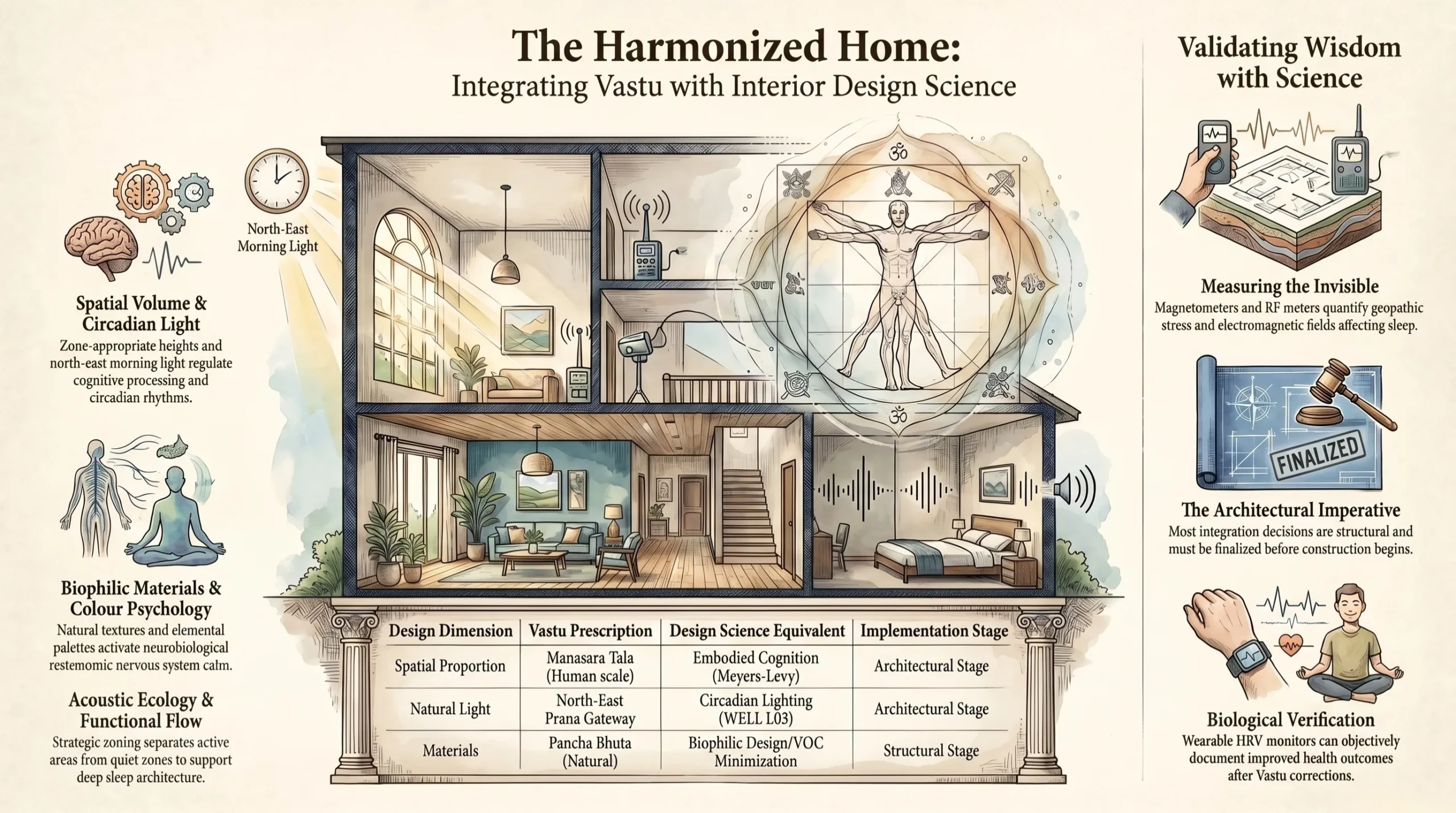
The following table maps eight design dimensions — from spatial proportion through natural light, colour, furniture layout, materials, acoustics, tactile environment, and threshold design — specifying the Vastu prescription, the interior design science equivalent, the physical mechanism they share, what their integration adds beyond either alone, and the construction stage at which each integration decision must be made.
|
Design Dimension |
Vastu Prescription |
Interior Design Science Equivalent |
Physical Mechanism Shared |
What Integration Adds Beyond Either Alone |
Construction Stage to Implement |
|
Spatial proportion and ceiling height |
Zone-appropriate proportional character; Manasara Tala system calibrated to human body scale; Brahmasthana sky connection; sleeping zone containment |
Space syntax and walkability; ceiling height and abstract thinking (Meyers-Levy and Zhu 2007); embodied cognition of spatial volume; prospect-refuge theory of spatial enclosure |
Embodied cognition: ceiling height modulates prefrontal abstract vs detail processing; prospect-refuge balance in each room activates specific limbic safety signals; spatial scale and human scale proportionality are neurobiologically grounded |
Vastu provides the directional and elemental rationale for which zones should be high and which contained; interior design science provides the specific neurobiological outcomes of different proportional choices and the evidence for how those choices are made correctly |
Architectural design stage — ceiling heights are structural commitments; cannot be changed post-construction without major intervention |
|
Natural light layering by zone |
North-east primary gateway for morning solar light; northern sky diffuse light for study zones; south-east managed for kitchen; south and west shaded and thermally massive for sleeping and afternoon zones |
Daylighting design (LEED IEQ credits 8.1 and 8.2); circadian lighting design (WELL Standard feature L03); biophilic design principle 2 — dynamic and diffuse light; Figueiro and colleagues circadian effectiveness of light quality |
Solar geometry: directional light quality differs predictably by compass face and time of day; circadian effectiveness requires specific spectral composition (melanopsin peak ~480 nm) at specific times; task performance and mood correlate with light quality by zone function |
Vastu’s directional light prescription and interior design science’s daylighting and circadian lighting guidance converge precisely on the same physical light quality prescriptions for each zone; integration produces a room-by-room light quality programme that is both directionally correct and circadian-effective |
Architectural design and window specification stage — window size, placement, and glazing specification are pre-construction decisions |
|
Colour strategy by zone |
Pancha Bhuta elemental colour associations: earth tones and warm ochres in SW; blues and greens in north and NE; terracotta and warm reds in SE; neutral light tones in living and study zones |
Environmental colour psychology (Elliot and Maier 2014); Valdez and Mehrabian arousal-valence colour model; chromotherapy evidence review; cultural colour meaning in Indian context; biophilic colour palettes (earth, stone, vegetation, sky) |
Autonomic nervous system response to colour: warm, high-saturation colours elevate sympathetic arousal; cool, low-saturation colours support parasympathetic calm; natural colour palettes (earth, stone, vegetation, water, sky) activate biophilic restoration pathways; specific colours affect cortisol and alpha-wave activity |
Vastu’s elemental colour associations specify which directional zones should express which elemental palette; interior design science’s colour psychology specifies what neurobiological outcomes each palette produces; integration creates a room-by-room colour programme that is both elementally correct and neurobiologically calibrated |
Fit-out and finish stage — paint and material colour is a late construction decision but depends on substrate (lime vs synthetic paint) which is an earlier decision |
|
Furniture layout and traffic flow |
Zone function integrity — furniture should support the zone’s function without blocking energy flow pathways; Brahmasthana unobstructed; sleeping position with solid wall backing; principal seating with prospect and refuge balance |
Space planning and wayfinding (Passini and Arthur); furniture arrangement and conversation quality (Sommer proxemics research); seating position and social interaction facilitation; traffic flow and spatial legibility; prospect-refuge in furniture arrangement |
Proxemics: furniture arrangement determines the social interaction distances that support different quality of engagement; traffic flow legibility reduces cognitive load; prospect-refuge in seating activates limbic safety; clutter and blocked pathways maintain amygdala vigilance |
Vastu’s zone function prescriptions specify what activity each space should support; interior design science’s proxemics and space planning specify how furniture arrangement implements that activity most effectively; integration produces furniture layouts that are both elementally correct and socially and cognitively optimised |
Fit-out and furniture placement stage — fully revisable post-construction, but most effectively planned at design stage |
|
Material selection by zone |
Pancha Bhuta elemental material character: dense natural stone and earth for SW; permeable lime and terracotta for NE; fired terracotta for SE; natural timber for living zones; lime and mineral plaster throughout |
Biophilic design principle 1 — connection with nature through materials; WELL Standard feature M03 — VOC minimisation; building biology material assessment (VOC, hygroscopic quality, electromagnetic neutrality); sensory richness of natural vs synthetic materials |
Biophilia science: natural material textures activate parasympathetic restoration through evolved biophilic visual and tactile pathways; VOC research: synthetic materials impair respiratory and neurological health through off-gassing; hygroscopic regulation: natural materials maintain optimal indoor humidity autonomously |
Vastu’s elemental material prescriptions specify which natural materials belong in each zone; interior design science’s biophilic design, material toxicology, and building biology frameworks specify what health and restoration outcomes those materials produce; integration creates a room-by-room material programme that is both elementally calibrated and biophilically optimised |
Structural and fit-out stage — structural materials (walls, floors) are early decisions; finish materials (plaster, paint, flooring) are late decisions; all must be specified before contractors are appointed |
|
Acoustic design by zone |
Brahmasthana acoustic character — the open centre affects the building’s acoustic resonance; sleeping zone acoustic quiet; zone function appropriateness in acoustic terms (kitchen away from sleeping zone) |
Room acoustics and reverberation time (Sabine equation); acoustic ecology and health (Birgitta Berglund and WHO noise guidelines); sleep acoustics research; acoustic ecology and cognitive performance; natural acoustic environments and biophilic restoration |
Acoustic physics: room mode standing waves from parallel hard surfaces produce low-frequency pressure variation that fragments sleep below conscious hearing threshold; natural acoustic environments (running water, leaves, birdsong) activate biophilic restoration; speech intelligibility and proxemics quality are RT60-dependent |
Vastu’s zone function prescriptions separate acoustically active zones (kitchen, social, mechanical) from acoustically quiet zones (sleeping, study, meditation); interior design science’s acoustic ecology framework specifies what reverberation time, sound level, and acoustic character each function zone requires for optimal performance and health |
Architectural and fit-out stage — room acoustic character is determined by surface materials, room geometry, and partition placement; key decisions are structural and finish material choices |
|
Tactile and sensory environment |
Pancha Bhuta material sensory character; natural material prescription; biophilic material and spatial quality; barefoot floor contact quality (terracotta, natural stone) |
Sensory design (Pallasmaa ‘The Eyes of the Skin’); haptic perception and material wellbeing; barefoot contact with natural materials and physiological grounding effects; neuroaesthetics of material richness; sensory environment and recovery from stress |
Neuroaesthetics: material texture, temperature, and weight engage the somatosensory cortex’s material quality assessment system; haptic contact with natural materials activates embodied biophilic pathways that visual contact alone does not; tactile material richness is a distinct restoration dimension not reducible to visual quality |
Vastu’s natural material prescriptions specify the materials whose tactile and sensory character is elementally appropriate for each zone; interior design science’s sensory design and neuroaesthetics framework specifies the neurobiological restoration that natural material contact provides; integration produces a home whose sensory experience is both directionally and neurobiologically restorative |
Fit-out and materials stage — flooring, wall texture, and surface finish are primary tactile environment determinants |
|
Threshold and transition design |
Zone function transitions in the Vastu Purusha Mandala — the spatial experience of moving between zones should support the psychological transition between activities; Brahmasthana as the home’s transitional breathing centre |
Environmental psychology of transitions; doorway effect (Radvansky and colleagues — memory and cognitive state transition at spatial boundaries); liminal space design; spatial sequencing and narrative in residential design; thresholds and emotional preparation for zone function |
Cognitive psychology: crossing a spatial threshold constitutes an ‘event boundary’ that partitions memory and resets cognitive set; deliberately designed transitions support intentional cognitive and emotional state changes; the quality of threshold experience affects how completely the occupant can psychologically inhabit the function of the zone they are entering |
Vastu’s zone allocation produces specific, functionally distinct zones whose threshold experience matters for the psychological completeness of the zone transition; interior design science’s environmental psychology of transitions specifies how those thresholds should be designed to support the state change each zone boundary requires; integration produces transitions that are both spatially and psychologically calibrated |
Architectural and fit-out stage — door placement, door width, threshold height changes, transition material changes are largely architectural decisions |
Reading this table as a whole, what is most striking is the column on ‘What Integration Adds Beyond Either Alone.’ In every case, the integration produces a design specification that is more complete, more specifically evidence-grounded, and more precisely implementable than either framework alone can generate. Vastu provides the directional and elemental framework that tells the designer which zones should express which qualities. Interior design science provides the neurobiological research base that tells the designer how to implement those qualities precisely and what specific health and wellbeing outcomes each implementation choice produces.
The second most important pattern in this table is the ‘Construction Stage to Implement’ column. Every integration decision is most effective — and most of them are only possible — at the architectural design stage, before structural commitments are made. The ceiling height of the Brahmasthana, the window placement for circadian morning light, the structural material of the south-west wall, the acoustic separation of kitchen and sleeping zones — these are architectural decisions whose Vastu-interior design integration cannot be retrofitted after construction. They must be addressed in the architect’s brief, specified in the structural and services drawings, and confirmed before a single foundation stone is laid.
How does evidence-based colour science extend Vastu's elemental colour prescriptions?
Colour is the dimension of interior design that most families are most consciously engaged with — and the dimension where the gap between common practice and the evidence-based integration of Vastu and interior design science is most consequential, most practically addressable, and most clearly beneficial. Understanding this integration illuminates why the colour choices made at the design and fit-out stage are among the most impactful single health design decisions available in any residential project.
Vastu’s Pancha Bhuta elemental colour prescription allocates specific colour palettes to specific directional zones: warm ochres and terracotta tones in the south and south-west (earth and fire zones); cool blues and blue-greens in the north and north-east (water and space zones); natural greens and light yellows in the east (air and prana zone); and warm but not intense tones in the living and social zones. This prescription is not merely aesthetic — it reflects the elemental character of each zone and its appropriate sensory expression.
Environmental colour psychology — the scientific study of how colour affects autonomic nervous system tone, mood, cognitive performance, and physiological activation — provides the neurobiological mechanism that explains why the Vastu elemental colour prescriptions produce the specific effects the tradition associates with them. High-saturation warm colours (reds, oranges, warm yellows) produce sympathetic nervous system activation, elevated heart rate, and increased physiological arousal — appropriate for the kitchen and activity zones but counterproductive in sleeping zones. Cool, desaturated colours (soft blues, muted greens, grey-beiges) produce parasympathetic calm and reduced physiological arousal — appropriate for sleeping and meditation zones but counterproductive in morning activation and social zones. Earth tones (terracotta, sandstone, ochre, natural timber) engage the biophilic pathway’s evolved association with sheltering natural materials, producing the specific combination of warmth and stability that the sleeping zone requires for its neurobiological refuge function.
The practical integration of Vastu’s elemental colour prescription with environmental colour psychology produces a room-by-room colour programme that is both directionally correct and neurobiologically calibrated. The south-west master bedroom receives its Prithvi earth-tone palette — warm, grounded, desaturated terracotta, sandstone, and natural timber — in a specification that is simultaneously the Vastu elemental prescription and the environmental colour psychology specification for maximum sleeping zone parasympathetic activation. The north-east morning zone receives its Jal water-element palette — soft blue-whites, light limestone, morning-sky tones — in a specification that is simultaneously the Vastu directional prescription and the environmental colour psychology prescription for the cool, clear, expansive quality that supports morning cognitive activation.
The family whose home is colour-specified at this level of integrated evidence is not living in a home that looks Vastu-correct or feels design-current. They are living in a home whose every room’s colour palette is serving their nervous system’s specific regulatory needs in that room’s specific functional context — delivering neurobiological effects that both the five-thousand-year-old Vastu tradition and the most current evidence-based colour science independently confirm are the most health-supporting choices available for each space.
What do acoustic ecology and environmental psychology add to Vastu's zone separation prescriptions?
The acoustic dimension of residential design is among the most consistently underspecified elements in Indian residential construction — and among the dimensions where Vastu’s zone separation prescriptions and interior design science’s acoustic ecology guidance converge most directly and most practically. Bringing them together at the design stage produces acoustic environments that support the health, cognitive performance, and emotional wellbeing of every zone’s occupants with a precision that neither framework alone is designed to achieve.
Vastu’s zone separation prescriptions — placing the kitchen in the south-east, the master bedroom in the south-west, the study in the north or north-east, the living zone in the east and north — produce, as one of their physical consequences, a specific acoustic separation between the home’s most acoustically active zones (the kitchen, the entrance, the living zone) and its most acoustically sensitive zones (the sleeping rooms, the study, the meditation space). This separation is not acoustically designed in the classical tradition’s vocabulary — the Manasara does not discuss reverberation time or flanking transmission paths — but it produces acoustic benefits that are entirely consistent with acoustic ecology’s prescriptions for residential zone separation.
Acoustic ecology — the field studying the health and wellbeing effects of sound environments — documents that the acoustic quality of the sleeping zone is among the most consequential determinants of sleep architecture quality: low-frequency room mode resonances at sleeping positions, insufficient acoustic separation from adjacent kitchen or bathroom zones, and building-fabric sound transmission from external sources all produce sleep fragmentation below the conscious hearing threshold — the occupant does not hear the sound as noise but the brainstem arousal system responds to it, fragmenting NREM sleep in ways that degrade sleep architecture quality. The acoustic separation that Vastu’s zone placement produces is not incidental to the tradition’s primary health purpose. It is one of the physical mechanisms through which the zone allocation serves the family’s sleep health.
Interior design science adds to this Vastu-acoustic alignment the specific acoustic specification that gives each zone its optimal acoustic character: the reverberation time prescription that supports good speech intelligibility in the living zone (RT60 ≈ 0.3–0.5 seconds for residential social spaces); the absorption coefficient requirements that prevent the low-frequency room mode problems that degrade sleeping zone acoustic quality; the sound insulation rating (STC/Rw) for partitions between acoustically active and sensitive zones; and the specification of natural materials (textured lime plaster, natural textile soft furnishing, natural timber joinery) whose inherent acoustic absorption and diffusion properties contribute to the acoustic quality of each zone in ways that synthetic materials — smooth vinyl, flat synthetic paint, hard composite surfaces — do not.
The family who builds with both Vastu zone separation and interior design science acoustic specification has a home in which every sleeping zone’s acoustic character supports slow-wave sleep quality, every study’s acoustic character supports sustained attention, and every living zone’s acoustic character supports the natural conversation and social engagement that family life requires. This integration is available at negligible additional cost when specified at the design stage — and is essentially irreversible without major reconstruction if it is not.
What errors occur when Vastu and interior design are not integrated — and how does the Vastu for New Plots and Construction service prevent them?
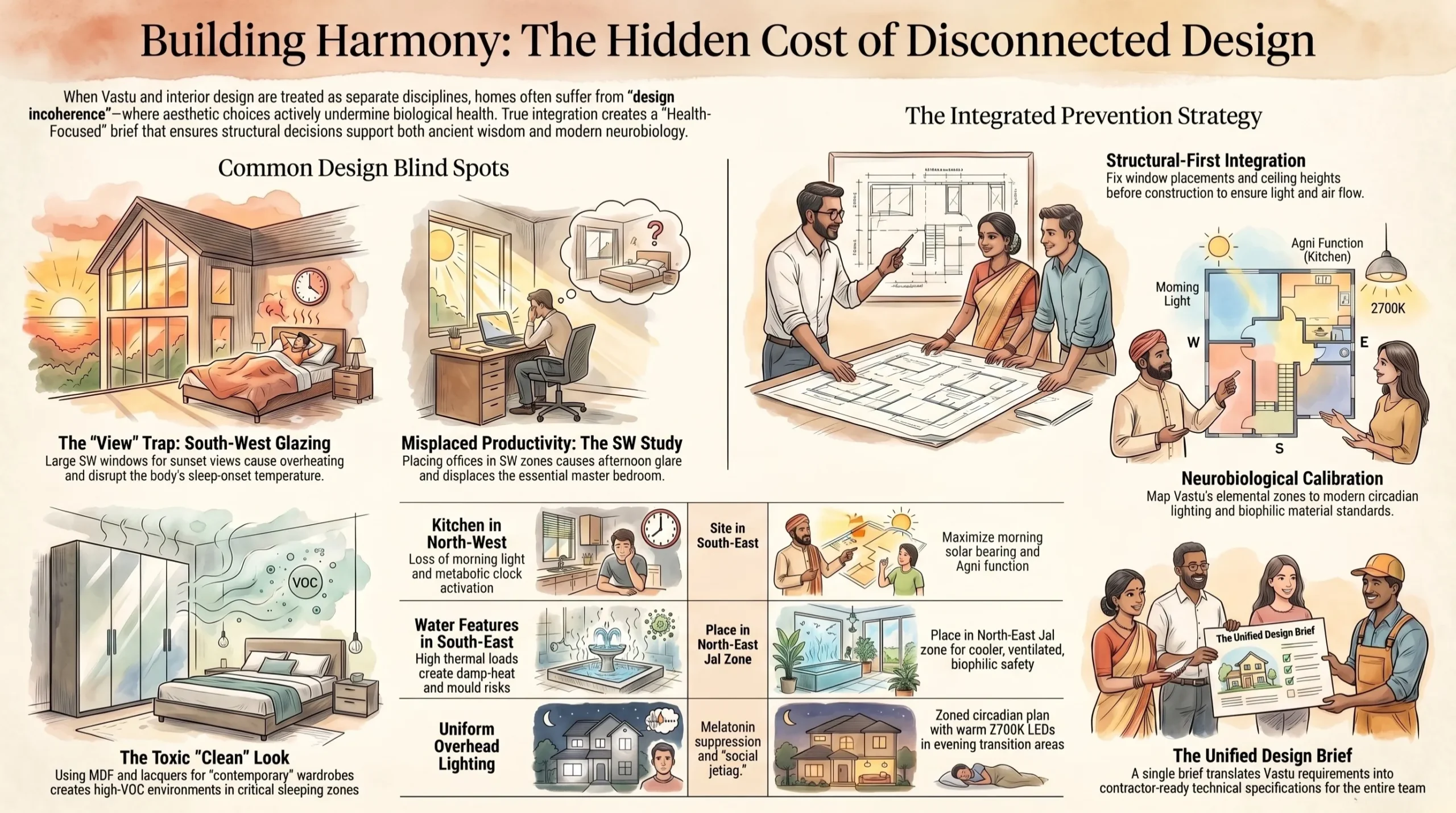
The most practically useful way to understand why Vastu and interior design science must be integrated at the design stage is to examine the specific, observable, consequential errors that occur when they are not — when Vastu assessment is conducted after the interior design has been completed, or when interior design proceeds without any Vastu input. The following table documents six common errors, their consequences from both Vastu and interior design science perspectives, and how integration at the new construction stage prevents each one.
|
Common Error |
Why It Occurs |
Vastu Consequence |
Interior Design Consequence |
How Integration at New Construction Stage Prevents It |
|
Master bedroom designed with large south or west-facing windows for ‘views and light’ |
Interior designer prioritising visual connection and daylight without understanding Vastu thermal and sleeping zone requirements; the south and west faces offer sunset views that clients request without understanding their sleep impact |
South-west zone loses its thermal mass function; bedroom overheats in evening; circadian temperature decline for sleep onset is opposed; geopathic stress in SW zone may be compounded by thermal stress |
WELL Standard sleep quality requirement violated; thermal comfort in sleeping zone impaired; biophilic view benefit partially offset by thermal and circadian cost; the large glazing that provides the view also creates the sleep-disrupting heat load |
Integration at design stage: SW bedroom specified with maximum thermal mass and minimum west and south glazing; view prescription redirected to north-east morning view rather than west sunset view; both Vastu and interior design science agree on thermal mass sleeping zone requirement |
|
Kitchen designed in north-west corner for ‘open plan living connection to the garden’ |
Floor plan driven by social connection priorities and developer preference for north or north-west kitchen in the social zone; no awareness of Agni zone function or morning light prescription for the kitchen |
South-east Agni zone left without its fire element function; kitchen in north-west produces incorrect elemental character in the food preparation zone; morning light chrono-nutritional prescription violated |
Loss of the most biophilically valuable morning light in the kitchen — the light that supports the cortisol awakening response and metabolic clock activation during morning food preparation; north kitchen is darker and more thermally stable, which is correct for a study but not a kitchen |
Integration at design stage: kitchen sited in south-east zone per Vastu; morning light prescription for south-east zone confirmed with solar bearing calculation; interior designer works with east-facing window and terracotta material programme to maximise Agni zone character |
|
Study or home office designed in south or south-west corner for ‘quiet and privacy’ |
Interior designer reasoning that quiet, protected zones are good for concentration; the south-west is indeed quiet and protected but its thermal mass character and Vastu prescription as the earth/master bedroom zone makes it suboptimal for the working mind |
Study in SW zone displaces the master bedroom from its correct zone, either forcing an inferior sleeping zone or creating a conflicted multi-function room; SW’s earth-element thermal mass character is not ideal for the alert, expansive thinking that a study requires |
Interior design science’s cognitive performance research supports study placement in north or north-east zones with diffuse northern sky light for consistent, glare-free working light and adequate morning CAR from north-east light; south zone study receives afternoon solar glare and thermal heat load |
Integration at design stage: study placed in north zone per Vastu (north is the Kubera/wealth zone associated with knowledge and productivity); north-facing diffuse sky light confirmed adequate for task illumination without glare; interior designer specifies acoustic treatment for north zone if needed |
|
Biophilic water feature installed in south-east zone for ‘aesthetic balance and visual interest’ |
Interior designer applying symmetric or visually balancing logic without awareness of elemental zone character; the south-east is a popular location for water features in feng shui influenced design that has found its way into Indian interior practice |
Jal (water) element placed in Agni (fire) zone creates elemental conflict; the humid microclimate from the water feature in the southeast zone’s thermal load produces the damp-heat combination that the tradition identifies as elementally inappropriate and Building Biology identifies as mould-risk |
Interior design science’s indoor air quality guidance contra-indicates water features in high solar thermal load zones (south-east receives morning solar load); the warm, humid air column from the water feature in the SE thermal zone elevates relative humidity toward mould threshold |
Integration at design stage: water feature specified for north-east Jal zone per Vastu; NE zone’s cooler, more ventilated character is confirmed as appropriate for the water feature’s humidity output; interior design provides the material and container specification that maximises biophilic quality while minimising structural water risk |
|
Bedroom wardrobes specified in MDF with polyurethane lacquer finish for ‘clean contemporary look’ |
Interior designer and contractor defaulting to the most commercially available and aesthetically standardised bedroom storage system without VOC or health consideration; the ‘clean contemporary look’ is produced by the very materials whose VOC off-gassing is the bedroom’s primary indoor air health risk |
Natural material prescription violated; bedroom indoor air quality compromised by formaldehyde (IARC Group 1) and lacquer solvent VOCs; Vayu (air element) quality of the sleeping zone degraded; occupant spends eight hours nightly breathing the VOC output of their own wardrobes |
WELL Standard V01 (VOC content) violated; indoor air quality research’s formaldehyde exposure guideline exceeded in the first 2–5 years after installation; LEED EQ prerequisite for low-emitting materials violated; the interior design standard that most directly aligns with Vastu’s natural material prescription is the VOC emission standard |
Integration at design stage: bedroom joinery specified as solid natural timber (Sal, teak, or deodar) with natural oil finish; or formaldehyde-free structural plywood with natural oil; interior designer incorporates natural timber aesthetics (grain, colour variation) as a design quality in itself rather than concealing it under lacquer; both Vastu and building biology agree on the formaldehyde-free specification |
|
Ceiling lighting designed as uniform high-intensity overhead illumination throughout |
Interior designer or electrical contractor defaulting to uniform, code-minimum illumination without circadian, spatial, or zone-function-appropriate lighting design; the Indian residential market still treats ‘bright = good’ as the default lighting brief |
Evening overhead illumination in living zones violates melatonin onset protection; the home’s own lighting delays the family’s DLMO, producing social jetlag; the spatial quality of uniform overhead light is also biophilically inferior — natural environments always have spatial light variation |
WELL Standard L02 (circadian lighting design), L03 (daylighting), L06 (colour quality), and L07 (electric light glare control) all contra-indicate uniform high-intensity overhead lighting as the sole residential illumination strategy; WELL specifies warm colour temperature, spatial variation, and low horizontal illuminance in evening residential zones |
Integration at design stage: room-by-room circadian lighting plan specified; primary living and sleeping zones at warm LED (2700 K) with dimming and spatial variation; morning zones at cooler temperature and higher lux; evening zones at low lux warm light as ambient; overhead glare control as standard specification; both Vastu morning light and interior design science evening light management agree on the zoned, quality-differentiated lighting programme |
The pattern across this table is consistent and instructive: every error listed occurs at the design stage, produces consequences that are structural and largely irreversible after construction, and is entirely preventable through integration of Vastu and interior design science in the design brief before any contractor is appointed. And in every case, the correction — the design choice that integration produces — is simultaneously the Vastu-correct choice and the interior design science-correct choice. There is no conflict between the two frameworks in any of these error cases. There is only a failure to bring both frameworks to the design brief at the right time.
The Vastu for New Plots & Construction service is specifically designed to prevent every error in this table. Its engagement begins at the architectural design stage — before zone allocation is committed to floor plans, before structural materials are specified, before window placement is fixed, before any interior design brief is developed — and it produces a zone-by-zone design brief that specifies the Vastu directional and elemental requirements for each space in terms that an architect and interior designer can immediately translate into specific design decisions. The brief is not ‘the bedroom should be Vastu-compliant.’ It is ‘the master bedroom requires a south-west position with a 300 mm dense stone west wall, maximum south-west window limited to ten percent of wall area, head-south sleeping position confirmed to clean geomagnetic field at this specific location, and a warm earth-tone material palette in terracotta and lime’ — a design brief that the interior designer can implement directly, that the architect can specify in drawings, and that the builder can price and execute.
What does neuroaesthetics contribute to the integration of Vastu and interior design?
Neuroaesthetics — the scientific study of how aesthetic experience is produced in the brain and how aesthetic qualities of the environment affect neurological and physiological function — is the most recent and most directly brain-grounded dimension of interior design science to engage with the questions that Vastu has always addressed about the experience of the built environment. Understanding what neuroaesthetics contributes to the Vastu-interior design integration illuminates why the aesthetic quality of the Vastu home is not separate from its health quality but identical to it.
The central finding of neuroaesthetics relevant to residential design is the discovery, through neuroimaging, that the aesthetic experience of a built space activates brain regions that are also central to emotional regulation, reward processing, and autonomic nervous system control. The default mode network — whose activity correlates with introspective and self-referential thinking, creative insight, and the sense of emotional ease — is strongly activated by spaces that possess certain qualities: spatial coherence (the parts of the space relate logically and pleasurably to the whole); material richness (the surfaces provide varied, interesting, sensorially engaging textural and tonal information); natural complexity (the organic variability of natural materials and natural light patterns); and proportional harmony (the spatial dimensions relate to human scale in ways that feel comfortable and supportive rather than overwhelming or confining).
These neuroaesthetically identified qualities correspond precisely to the qualities that Vastu’s proportional system, elemental material prescription, and directional light framework collectively produce in a correctly designed Vastu home. Spatial coherence is produced by the Vastu Purusha Mandala’s nine-zone system, which organises the home’s spatial programme around a single integrative directional framework rather than assembling rooms additionally and arbitrarily. Material richness is produced by the Pancha Bhuta natural material palette, whose stone, timber, terracotta, and lime plaster surfaces provide the organic tonal and textural variation that biophilic and neuroaesthetic research identifies as the most restorative material quality available in the built interior. Natural complexity is produced by the morning solar access through the north-east zone, whose changing angle, colour, and intensity through the morning hours creates the dynamic, varied natural light pattern that neuroaesthetics identifies as one of the most potent drivers of default mode network activation and cognitive restoration.
The neuroaesthetic implication is both intellectually satisfying and practically valuable: the Vastu home, correctly implemented with the natural material palette and proportional spatial character its classical prescriptions specify, is a neuroaesthetically restorative environment — a home that activates the default mode network’s restorative function, supports creative insight, and provides the deep aesthetic pleasure that comes from inhabiting a space whose every quality is in coherent, purposeful relationship with every other quality. This is what great Indian traditional architecture has always achieved. It is what Vastu-integrated interior design science makes accessible to every family building a new home in contemporary India — not as a privilege of heritage or wealth but as a design quality that is achievable within any budget when it is built in from the first day of design.
How does the WELL Building Standard align with Vastu — and what does it add for Indian families?
The WELL Building Standard — developed by Delos and now internationally adopted as the most comprehensive built environment health and wellbeing certification available — is the interior design science framework that most comprehensively addresses the same health dimensions that Vastu’s residential prescriptions target. Understanding the alignment between WELL and Vastu is both intellectually clarifying and practically valuable: it demonstrates the degree to which internationally validated health-building science has independently converged on Vastu’s prescriptions, and it provides Indian families building new homes with a set of internationally referenced, professionally credible health design specifications that can be translated directly into contractor briefs.
The WELL Standard’s ten concept categories — Air, Water, Nourishment, Light, Movement, Thermal Comfort, Sound, Materials, Mind, and Community — map onto Vastu’s primary health concerns with a specificity that goes beyond coincidence. WELL’s Air concept, with its VOC emission requirements, ventilation standards, and particulate matter thresholds, is the quantitative specification framework for Vastu’s Brahmasthana ventilation and natural material prescriptions. WELL’s Light concept, with its circadian lighting design, daylighting requirements, and colour quality specifications, is the quantitative specification framework for Vastu’s north-east prana gateway and evening melatonin protection prescriptions. WELL’s Thermal Comfort concept, with its radiant temperature, seasonal adaptability, and sleeping zone temperature prescriptions, is the quantitative framework for Vastu’s south-west thermal mass bedroom prescription.
WELL’s Materials concept — specifying VOC emission limits, banned chemical list, and material transparency requirements — is the quantitative specification framework for Vastu’s natural material and Pancha Bhuta elemental material prescriptions. The formaldehyde limits in WELL’s M04 specification are directly consistent with Vastu’s prescription for natural timber joinery over MDF in sleeping zones. The VOC content requirements in WELL’s V01 align precisely with Vastu’s preference for lime and mineral plasters over solvent-based synthetic paints. WELL’s Mind concept, with its restorative spaces requirement (Feature M01) and biophilic design requirement (Feature M03), is the evidence-based specification framework for Vastu’s Brahmasthana openness and natural material prescriptions.
For Indian families working with architects and interior designers who are familiar with the WELL Standard, framing the Vastu prescriptions in WELL’s vocabulary is among the most professionally effective integration strategies available. A design brief that specifies ‘master bedroom to achieve WELL V01 VOC compliance, WELL L02 circadian lighting, WELL T01 thermal comfort in the sleeping zone, and WELL M01 biophilic design’ is a Vastu design brief translated into internationally referenced interior design science specifications — and it is a brief that any WELL-familiar architect or interior designer can implement directly, in the specific technical detail that Vastu’s classical prescriptions, however accurate in their health intent, do not always provide at the contractor-ready specification level.
What does the Vastu for New Plots and Construction service deliver that embodies this integration?
The Vastu for New Plots & Construction service is, in its most complete form, an integration service — bringing Vastu’s directional, elemental, and earth energy framework together with the evidence-based interior design science specifications that implement those frameworks at the level of contractor-ready design briefs, material specifications, and zone-by-zone lighting, acoustic, and colour programmes. Understanding what the service delivers in this integrated form is the most practical conclusion this article can offer to a family currently planning new construction.
The service’s engagement at the architectural design stage begins with the Vastu assessment that establishes the foundational design decisions: site geopathic stress survey that determines where sleeping zones can and cannot be placed; solar orientation confirmation that establishes the building’s primary axis relative to the solar arc at the specific latitude; zone allocation that specifies master bedroom, kitchen, study, living zones, and Brahmasthana in their correct Vastu positions within the floor plan. These are the structural-level decisions that both Vastu and interior design science identify as the most consequential and the least reversible.
The service’s design brief then extends into the interior design science integration at each zone: the master bedroom’s material brief specifying the natural stone floor, lime plaster walls, solid timber joinery, and warm earth-tone colour palette that both the Vastu elemental prescription and the biophilic design, colour psychology, and building biology specifications require; the lighting design brief for each zone specifying colour temperature, lux level, and dimming specification that both the Vastu directional light prescription and the circadian lighting design standard require; the acoustic brief for each zone specifying material absorptions and zone separation standards that both Vastu’s zone function integrity and acoustic ecology prescriptions require; and the material VOC brief for all sleeping and living zones specifying the low-VOC, natural material palette that both Vastu’s Pancha Bhuta and WELL’s Materials concept require.
The family who engages this service receives not merely a Vastu assessment but an integrated Vastu-interior design science design brief that their architect, structural engineer, and interior designer can use directly — a brief whose every specification is grounded in both five thousand years of accumulated Indian building wisdom and the most rigorous contemporary evidence-based design research, and whose implementation produces a home that is simultaneously directionally correct, elementally balanced, circadian-effective, biophilically restorative, acoustically supportive, and VOC-safe. This is what a Vastu home built to the highest available standard looks like in contemporary India. And it is entirely achievable, at modest additional cost when specified at design stage, for every family willing to invest the attention the decision deserves.
Real Case Study — A Bengaluru Architect Who Made Vastu-Interior Design Integration Her Professional Practice:
An architect in Bengaluru came to me initially as a client — she was designing her own family home and wanted a Vastu assessment integrated with the interior design brief she had already developed. When she brought the brief to our first meeting, it was already excellent in its interior design quality: biophilic material palette, WELL-aligned lighting specification, acoustic separation designed carefully, proportional spatial character that would satisfy any evidence-based design review.
What the Vastu layer added, in our three-hour working session, was the directional precision that the interior design brief lacked. Her proposed master bedroom was in the north-east zone — the most common architectural choice in Indian middle-class apartments because the north-east corner tends to receive the best natural light and the best views. By every interior design science metric, it was an excellent bedroom location. By Vastu’s earth-energy and thermal mass prescription, it was the worst possible location for the master bedroom: the north-east is the Jal (water) zone, light and open, minimum thermal mass, maximum morning solar activation — excellent for a living room, study, or morning zone, but completely opposite to the Prithvi (earth) qualities of stability, thermal mass, and geomagnetic shelter that the sleeping zone requires.
She was initially resistant. ‘My clients always want the master bedroom in the north-east because of the light and views.’ I showed her the thermal mass physics: the north-east wall has minimum solar gain and minimum mass, producing the bedroom with the greatest diurnal temperature swing and the least circadian temperature support for sleep onset. I showed her the geomagnetic biophysics: the north-east zone is the most geomagnetically open zone of the building, with minimum earth-energy shelter. I showed her the Building Biology sleeping zone assessment that documents why the south-west, with its maximum thermal mass and earth-zone geomagnetic stability, produces the best sleep quality of any zone in a correctly oriented building.
She studied the references I gave her. At the next session: ‘You are right. The interior design science supports the Vastu prescription completely. I was optimising for the light and view quality the north-east provides — which is real and valuable — without understanding that those qualities are exactly wrong for a sleeping zone. The south-west gives the opposite: minimum light, maximum mass, maximum earth energy shelter. Which is exactly what sleep physiology requires.’
She redesigned the floor plan with the master bedroom in the south-west and the primary living and morning room in the north-east. Her family has been in the home for two years. ‘We sleep better than we have ever slept in any home we have lived in. My children sleep through the night without exception. And the living room’s north-east morning light is extraordinary — we have breakfast there every morning as a family ritual, which we never did in our previous apartment. The integration produced a better home than either framework alone would have given me.’
What the Best Indian Architecture Has Always Understood That Contemporary Practice Has Forgotten:
When I visit the great traditional residential buildings of India — the havelis of Rajasthan, the nalukettu courtyards of Kerala, the merchant houses of Tamil Nadu — what strikes me most forcefully is not their beauty, though they are beautiful. It is their integration. Every spatial decision is simultaneously a directional decision, a material decision, a light quality decision, and a social programme decision. The Brahmasthana courtyard is simultaneously the house’s cosmic energy axis, its passive ventilation system, its primary natural light distributor, its social gathering space, and its acoustic moderator. The south-west rooms are simultaneously the senior family members’ sleeping spaces, the house’s thermal anchor, its most geomagnetically sheltered zone, and its most biophilically restoring material expression.
The traditional Indian master builder did not separate Vastu from interior design because there was no separation to make. The Vastu framework was the interior design framework — the integrative system within which every spatial, material, lighting, acoustic, and proportional decision was understood as a dimension of a single health-generating physical programme for the family’s wellbeing.
Contemporary Indian residential practice has fragmented this integration into specialist disciplines that rarely talk to each other: the Vastu consultant who assesses the zone allocation without specifying the lighting or the material programme; the interior designer who specifies the lighting and materials without understanding the directional framework that determines their optimal expression; the structural engineer who specifies the wall construction without understanding the thermal mass requirement that the sleeping zone’s circadian biology demands. The family who builds in contemporary India typically receives three separate, partially conflicting design inputs — and no one whose brief it is to integrate them.
The Vastu for New Plots & Construction service exists to fill that integration gap — to be the practitioner whose brief it is to bring the directional framework, the earth energy assessment, the material science, the circadian lighting specification, the acoustic ecology, and the biophilic design principles together into a single coherent design brief for the architect, the structural engineer, and the interior designer to implement as a unified whole. Not tradition versus modernity. Not Vastu versus design science. The integrated wisdom that India’s finest building tradition and the world’s finest contemporary building health research, brought together, can offer every Indian family building a new home.
Vastu Wisdom. Interior Design Science. One Integrated Brief. Your Home Built Right, Once.
The home that is both Vastu-correct and interior design science-excellent is not a luxury. It is the standard that every Indian family building new construction deserves — and the standard that the Vastu for New Plots & Construction service is designed to achieve, for every family, at every budget, in every design context.
Your Vastu for New Plots & Construction service delivers:
- Site assessment — geopathic stress survey; solar arc confirmation; plot landscape and hydrology; geomagnetic field mapping of entire buildable area
- Vastu Purusha Mandala zone allocation — master bedroom, kitchen, study, living zones, and Brahmasthana placed correctly before structural commitment
- Brahmasthana structural brief — open centre specification; column avoidance; stack-effect ventilation and acoustic moderation axis design
- South-west master bedroom material brief — dense natural stone or earth wall specification; thermal mass calculation; geomagnetic transparency confirmation; WELL T01 thermal comfort alignment
- Zone-by-zone biophilic material programme — Pancha Bhuta natural material palette for every zone; WELL M01 biophilic design and M04 VOC compliance; natural timber joinery specification; lime plaster and terracotta integration
- Circadian lighting design brief — room-by-room colour temperature, lux level, and EML specification; WELL L02/L03 circadian lighting alignment; morning zone activation and evening DLMO protection programme; glazing and window specification
- Evidence-based colour programme — Pancha Bhuta elemental colour prescription integrated with environmental colour psychology for each zone; biophilic colour palette; neuroaesthetic coherence across the full home
- Acoustic ecology brief — zone function acoustic separation specification; reverberation time prescriptions; STC/Rw partition ratings for sleeping zone separation; natural material acoustic integration
- WELL Building Standard alignment — key WELL features mapped to Vastu prescriptions; professionally credible specification language for architect and interior designer engagement
- North-east prana gateway design — maximum opening specification; solar bearing confirmation; morning light lux and spectral quality assessment; biophilic water feature placement
- Electromagnetic construction brief — router and device infrastructure pre-planned; steel reinforcement guidance for geomagnetic field coherence; future-proofing for wired home infrastructure
- Construction stage milestone reviews — design, structural, fit-out reviews confirming integration is maintained through construction
- Architect and interior designer liaison — specifications in professional format; Vastu-interior design science integration brief deliverable for the design team
- One-on-one consultation with Mukesh Shah personally at every stage
- Detailed written brief — all zone specifications, material programmes, lighting plans, acoustic briefs, and WELL alignments in contractor-ready format
- 30 days of priority support through design and construction
- 100% satisfaction guarantee
Five thousand years of Vastu wisdom. The world’s finest contemporary interior design science. One integrated brief. For the home your family deserves.
Start your Vastu for New Plots & Construction today at vastumyhome.com
Vastu’s Pancha Bhuta natural material prescription — specifying natural stone, lime plaster, terracotta, and natural timber for each zone — directly corresponds to biophilic design’s first principle: connection with nature through materials. Both frameworks prescribe the same natural materials for the same reason: these materials activate the parasympathetic restoration response through the evolved koniocellular visual pathway that biophilic design science has characterised. Vastu specifies which natural materials belong in which directional zone based on elemental character; biophilic design science specifies what neurobiological restoration each natural material produces. Integration creates a room-by-room natural material programme that is both directionally correct and neurobiologically calibrated.
The WELL Building Standard’s ten concept categories map closely onto Vastu’s core health prescriptions. WELL Air (VOC emission limits, ventilation standards) aligns with Vastu’s natural material and Brahmasthana ventilation prescriptions. WELL Light (circadian lighting, daylighting) aligns with Vastu’s north-east morning light and evening melatonin protection prescriptions. WELL Thermal Comfort aligns with Vastu’s south-west thermal mass bedroom prescription. WELL Materials (low-VOC, formaldehyde limits) aligns with Vastu’s natural material prescription for sleeping zones. WELL Mind’s biophilic design requirement aligns with Vastu’s natural material palette and open Brahmasthana prescription. Framing Vastu prescriptions in WELL vocabulary allows architects and interior designers familiar with WELL to implement Vastu requirements in professionally credible, contractor-ready specification language.
The most important single Vastu-interior design integration decision for new construction is the zone allocation — specifically, the placement of the master bedroom in the south-west zone rather than the north-east zone. The north-east is the most desirable interior design location for a bedroom by natural light, views, and social energy criteria — and it is the worst possible Vastu location for a sleeping zone because it is the minimum thermal mass, maximum morning solar activation, geomagnetically most open zone in the building. The south-west is the opposite: maximum thermal mass, minimum morning activation, maximum earth-energy shelter — which is precisely what sleep physiology, Building Biology, and Vastu prescribe. This decision must be made at the architectural design stage before any floor plan is committed to construction.
Circadian lighting design and Vastu’s light prescriptions should be integrated through a room-by-room lighting brief that specifies both the Vastu directional light quality (north-east morning blue-spectrum activation, northern diffuse sky study light, southern protected sleeping zone) and the circadian photobiology specification (equivalent melanopic illuminance, correlated colour temperature, lux level at eye height, and dimming programme for each zone and time of day). The integration produces: morning zones specified at ≥ 1,000 lux, 5000–6000 K in the first hour after waking; study zones at diffuse northern sky equivalent without glare; sleeping and evening living zones at warm LED (2700 K) at ≤ 50 lux at eye height in the two hours before sleep. This brief is both Vastu-directionally correct and WELL L02/L03 circadian-lighting compliant.
The Vastu for New Plots & Construction service delivers a Vastu-interior design science integration brief for every new construction project — covering zone allocation (Vastu Purusha Mandala integrated with space planning); biophilic material programme (Pancha Bhuta elemental palette integrated with WELL M01/M04 and biophilic design principles); circadian lighting design brief (directional light prescriptions integrated with WELL L02/L03 circadian lighting); evidence-based colour programme (elemental colour prescription integrated with environmental colour psychology); acoustic ecology brief (zone function separation integrated with reverberation time and sound insulation specifications); and WELL Building Standard alignment for professionally credible contractor-ready specifications. Delivered with one-on-one consultation with Mukesh Shah, detailed written brief in contractor-ready format, construction stage milestone reviews, 30 days of priority support, and a 100% satisfaction guarantee.
I Would Love to Hear From You
I would love to hear your story or questions in the comments below. Have you experienced the impact of Vastu in your own home? Are you noticing any of the common defects I described above in your space? Share openly — every question is a step towards greater harmony.
Disclaimer: Vastu analysis and energy corrections are for harmonising your space and personal growth. They are not a substitute for professional medical, financial, legal or architectural advice.