
What Cultural Synergies Exist with Vastu? Ayurveda, Feng Shui & More | Vastu My Home
Namaste. I am Mukesh Shah. One of the most intellectually rewarding conversations I have with families who come to Vastu assessment through diverse cultural and health backgrounds is the conversation that begins: ‘I already practice Ayurveda — how does Vastu fit with that?’ Or: ‘My family has used Feng Shui for our business for two generations — is Vastu the same thing or different?’ Or: ‘I am a yoga practitioner and I find that my home practice feels different from the studio practice — can Vastu explain why?’ Or: ‘I work with a Building Biology practitioner — is there a traditional framework that aligns with what she does?’
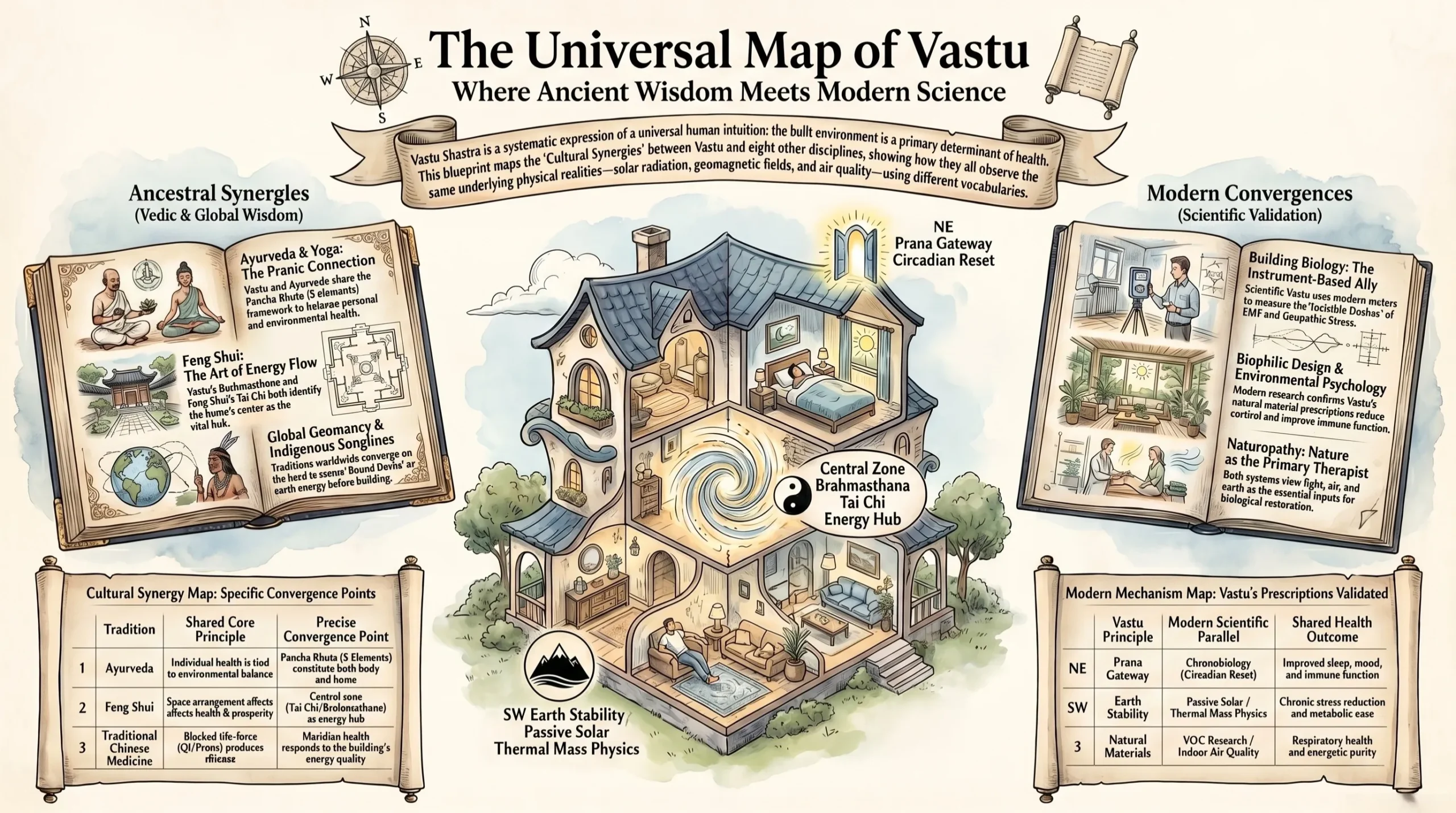
These questions are not distractions from the core work of Vastu assessment. They are the most direct pathway to the insight that makes the Complete Home Health Audit genuinely transformative rather than merely practically useful: the insight that Vastu Shastra is not a culturally isolated Indian practice but one of the most systematic and most historically grounded expressions of a universal human intuition — shared across civilisations, expressed through different vocabularies, and now confirmed by modern physical science — that the built environment we inhabit is one of the most consequential determinants of our health, wellbeing, and quality of life.
The cultural synergies with Vastu are not superficial resemblances. They are deep convergences between traditions that developed independently, in different cultures, over different time periods, using different philosophical frameworks — and arrived at many of the same conclusions about which physical environmental conditions most support human health and which most harm it. Feng Shui’s Qi flow through the home’s central zone and Vastu’s Prana through the Brahmasthana describe the same physical phenomenon — the convective ventilation that a central open zone creates — from two different cultural vantage points. Ayurveda’s Pancha Bhuta elemental framework and Vastu’s Pancha Bhuta zone allocation system share not only their vocabulary but their physical substance: the same five elements that constitute the human body in Ayurvedic medicine constitute the built environment in Vastu science. Biophilic design science’s fourteen principles of natural environment connection and Vastu’s natural material programme are prescribing the same physical environment qualities for the same biological reasons.
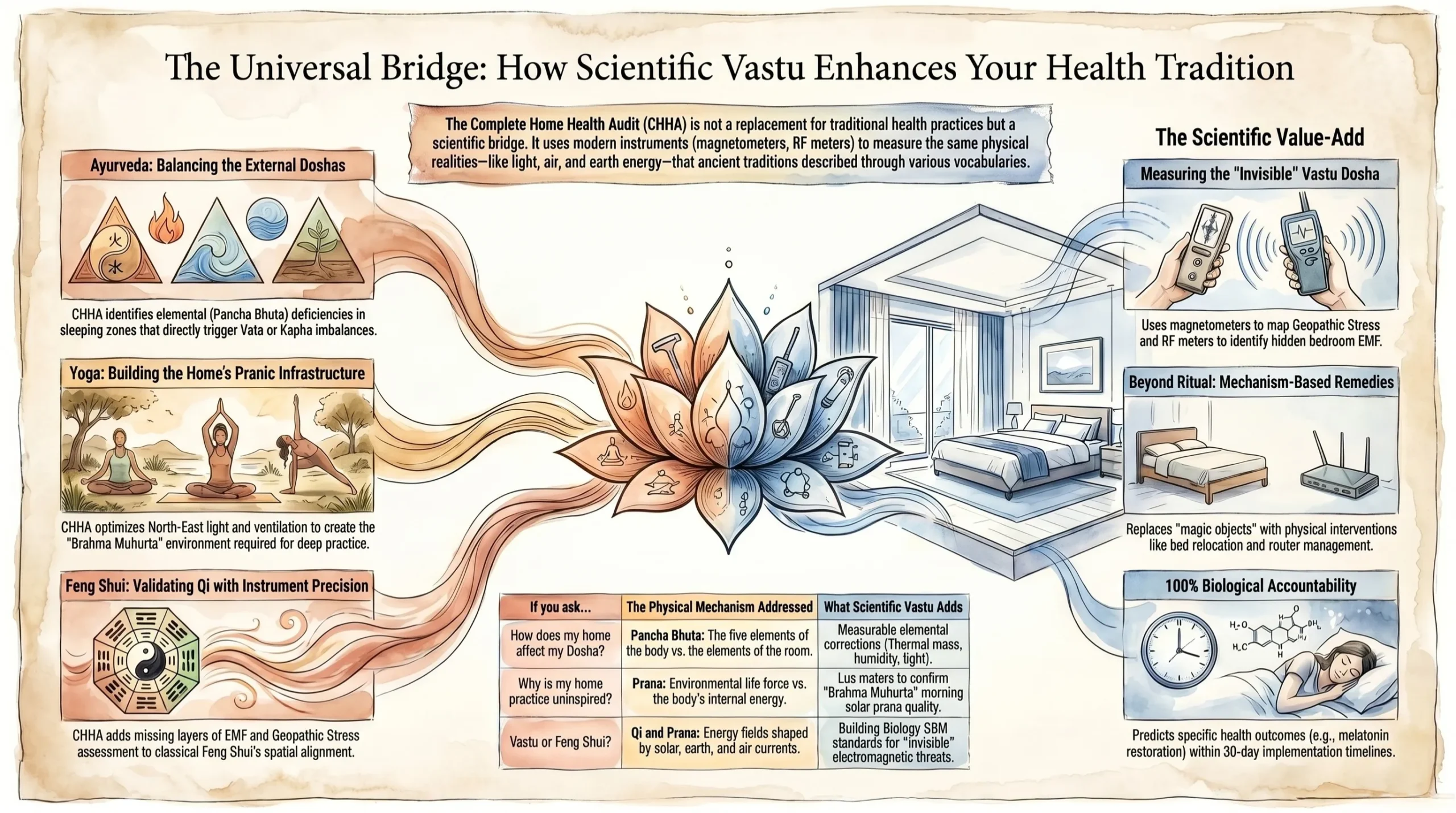
Understanding these synergies enriches both traditions — and it enriches the family’s engagement with the Complete Home Health Audit by situating the assessment within the broadest possible context of human wisdom about the relationship between the built environment and human health. The assessment is not asking the family to abandon their Ayurvedic practice or their Feng Shui awareness or their yoga and pranayama discipline or their Building Biology awareness. It is offering to add the most precisely instrument-based, most mechanism-grounded, and most comprehensively traditional expression of what all of those practices, in their different ways, already know.
Why do so many independent traditions arrive at the same built environment health prescriptions?
The convergence of Vastu with Feng Shui, Ayurveda, traditional Chinese medicine, yoga philosophy, Building Biology, biophilic design science, European geomancy, and indigenous earth awareness traditions is not a coincidence, and it is not a product of cultural borrowing. These traditions developed independently — in different geographic contexts, different cultural frameworks, different intellectual vocabularies, and different historical periods — and they converged on many of the same prescriptions because they were all observing the same underlying physical reality: the specific physical conditions of the built environment that most consistently affect the biological state of the human beings who inhabit it.
The human nervous system, immune system, endocrine system, and circadian system are the same biological systems in every culture and every historical period. The physical environmental factors that most consequentially affect those systems — the quality of morning solar light, the character of the earth’s energy field at the sleeping position, the quality of the indoor air, the electromagnetic character of the sleeping zone, the biophilic quality of the material surfaces — are the same physical factors in every geographic and cultural context. When different traditions converge on similar prescriptions for these environmental conditions, they are not agreeing with each other culturally. They are independently confirming the same physical truths.
This pattern of independent convergence is, philosophically, the strongest possible evidence for the validity of the prescriptions on which the traditions agree. A single tradition claiming that the sleeping zone’s orientation matters for health could be expressing cultural mythology. When Vastu, Feng Shui, Building Biology, Ayurveda, and modern chronobiology all converge on the same sleeping zone environmental prescriptions — from completely different starting points, using completely different investigative methods, across thousands of years of independent development — the probability that they are all simultaneously wrong about the same physical reality is vanishingly small.
The philosophical point is practically important: the family that engages the Complete Home Health Audit from a Feng Shui background, or an Ayurvedic background, or a Building Biology background, or a yoga background is not being asked to set aside what they already know. They are being offered the most precise, most instrument-based, and most mechanism-grounded expression of what their tradition, in its own vocabulary, has always been pointing toward. The Complete Home Health Audit is the convergence point where the world’s most important built environment health traditions meet — in the specific instrument measurements and the specific physical mechanisms that reveal what they were all describing all along.
How does the Ayurveda-Vastu synergy produce the most complete Indian health environment framework?
Of all the cultural synergies that Vastu engages with, the synergy with Ayurveda is the most intimate, the most intellectually profound, and the most practically consequential — because it is not merely a synergy between two parallel traditions. It is the restoration of an integration that was never, in its classical form, a separation. In the traditional Indian intellectual framework, Vastu Shastra and Ayurveda were not separate disciplines practised by different specialists. They were complementary dimensions of a single, integrated science of human health — with Ayurveda addressing the biological health of the individual’s body and Vastu addressing the environmental health of the built space that the individual’s body inhabited. Together, they constituted a comprehensive health framework that addressed both the organism and its environment simultaneously and in the same elemental vocabulary.
The shared Pancha Bhuta framework is the most profound expression of this integration. Ayurveda’s account of the human body as a configuration of the five elements — Earth (Prithvi), Water (Jal), Fire (Agni), Air (Vayu), and Space (Akasha) — is not merely a poetic description. It is a functional account of the body’s physical constitution whose therapeutic implications are precise and specific: a Vata-dominant individual (Air and Space constitutional excess) requires more Earth and Water element stability in their environment to maintain doshic balance; a Pitta-dominant individual (Fire and Water constitutional excess) requires more Air and Space cooling in their environment; a Kapha-dominant individual (Earth and Water constitutional excess) requires more Fire and Air element activation in their environment. These therapeutic prescriptions, articulated in Ayurvedic terms, translate directly into Vastu’s zone and material prescriptions when applied to the built environment.
The Vata-pacifying built environment is the same environment that Vastu prescribes for the master bedroom: maximum earth-element thermal mass in the south-west zone (grounding, stabilising, heavy and warm in elemental character), minimum exposure to moving air (Vata’s primary element), solid backing behind the sleeping position (earth refuge quality), warm earth-tone materials (terracotta, stone, natural timber). The Pitta-pacifying study or creative zone is the same environment that Vastu prescribes for the north zone: cool northern sky light (water element cooling), natural material surfaces without synthetic heat-generating materials, good ventilation for air-element freshening of the fire element’s tendency toward inflammation. The Kapha-activating morning zone is the same environment that Vastu prescribes for the north-east prana gateway: morning solar fire element activation through east and north-east solar radiation, open space quality (Akasha element), energising morning light.
The integration of Ayurveda and Vastu in the assessment context is the most intellectually complete health environment framework available to any Indian family — because it addresses both the individual’s biological constitution and the environmental conditions that support that constitution simultaneously, in the same elemental framework, from two complementary directions. The Complete Home Health Audit’s elemental zone assessment is, implicitly, an Ayurvedic environment prescription — and the family that understands this integration can bring both their Vastu assessment findings and their Prakriti awareness to their health programme as complementary rather than competing inputs.
What does the Feng Shui convergence reveal about the universal principles of built environment energy?
The conversation between Vastu and Feng Shui is, in the contemporary world, the most frequently conducted and the most frequently confused cross-traditional built environment health dialogue. It is confused because the popular versions of both traditions have been simplified and distorted in their commercial marketplace expressions to the point where many families either conflate the two (treating them as interchangeable) or dismiss both (treating their overlap as evidence that both are cultural superstition rather than evidence that both are addressing real physical phenomena). A clear and honest account of where Vastu and Feng Shui genuinely converge — and where they genuinely differ — serves both traditions and serves the families who engage with either.
The convergences are real and substantial. Both traditions place the home’s central zone — Vastu’s Brahmasthana and Feng Shui’s Tai Chi — at the energetic heart of the building’s function and prescribe its openness and freedom from obstruction as a primary health and prosperity condition. Both traditions orient the principal residence along cardinal directions as the first spatial health decision, with north-south and east-west axes as the most fundamental building orientation framework. Both traditions identify directional zone character — placing specific functions in specific directional zones — as a consequential determinant of the home’s energetic and health performance. Both traditions place water features in the northern and eastern zones. Both traditions prescribe the central zone as the home’s primary energy distribution axis.
The differences are equally real and should not be minimised. Feng Shui’s Five Elements (Wood, Fire, Earth, Metal, Water) have a different elemental ontology from Vastu’s Pancha Bhuta (Earth, Water, Fire, Air, Space) — Metal and Wood are Feng Shui elements without Vastu equivalents, and Vastu’s Air (Vayu) and Space (Akasha) are Vastu elements without precise Feng Shui equivalents. Feng Shui’s Ba-Gua directional framework allocates zones differently from Vastu’s Vastu Purusha Mandala in several directions. Feng Shui has no explicit geopathic stress assessment framework — the most important modern addition to sleeping zone health assessment — and no electromagnetic environment assessment methodology.
The most practically useful integration of Feng Shui and Vastu awareness is the one that takes seriously the convergences (central zone openness, directional zone function, water placement in north and east, sleeping orientation) as evidence of shared physical insight — and takes seriously the differences as evidence that the two traditions are not identical expressions of the same content but genuine independent perspectives that each illuminate dimensions the other does not fully address. The family that holds both traditions’ convergences and differences with equal intellectual respect, and that adds the instrument-based precision of the Complete Home Health Audit to their awareness, has access to a more complete picture of their home’s energy environment than any single tradition alone can provide.
What is the complete map of cultural synergies that enrich Vastu's understanding?
The following table provides a comprehensive reference for nine traditions and disciplines that share significant synergies with Vastu — specifying the core shared principle, where the two traditions converge most precisely, where they differ and what the difference reveals, and what each adds to the other when engaged together rather than in isolation.
|
Tradition / Discipline |
Origin and Scale |
Core Shared Principle with Vastu |
Where the Two Traditions Converge Most Precisely |
Where They Differ — and What the Difference Reveals |
What Each Adds to the Other |
|
Feng Shui (Classical Chinese Geomancy) |
China; approximately 3,000 years of recorded practice; residential, commercial, and civic scale |
The built environment’s physical arrangement, orientation, and energy quality directly and continuously affects the health, vitality, and prosperity of its occupants; directional zone character shapes the home’s energetic function |
Cardinal orientation of the primary building axis; the central zone (Tai Chi) as the energy distribution hub (= Vastu’s Brahmasthana); directional zone allocation of key rooms; the north as the primary energy reception direction; water element placement in the north and east; sleeping orientation recommendations overlapping significantly with Vastu’s head-South prescription |
Feng Shui’s Five Elements (Wood, Fire, Earth, Metal, Water) differ from Vastu’s Pancha Bhuta (Earth, Water, Fire, Air, Space); Feng Shui’s Ba-Gua directional system has different zone allocations in some directions; Feng Shui lacks Vastu’s explicit geopathic stress and electromagnetic assessment framework — these are the most practically significant modern additions that Scientific Vastu brings to the shared tradition |
Feng Shui enriches Vastu with its water feature placement precision and its business/commercial zone prosperity framework; Vastu enriches Feng Shui practice with its instrument-based earth energy and electromagnetic assessment, its explicit Indian-latitude solar calibration, and its thermal mass material physics |
|
Ayurveda (Indian Systems Medicine) |
India; the world’s oldest continuously practised medical system; approximately 5,000 years of recorded tradition; individual and community health scale |
The health of the individual cannot be separated from the physical environment they inhabit; the five elements (Pancha Bhuta) that constitute the body are also the five elements that constitute the built environment; therapeutic balance between the individual’s Prakriti (constitutional type) and their environmental Vikriti (imbalance) requires attention to their living environment |
Pancha Bhuta as the shared elemental framework — the same five elements (Earth, Water, Fire, Air, Space) constitute both the human body in Ayurveda and the built environment in Vastu; the Vata-imbalancing effects of an improperly oriented bedroom (cold, exposed, no thermal mass, irregular energy) correspond precisely to Vastu’s sleeping zone prescription for maximum thermal mass and earth-element stability; Kapha imbalance from stagnant, damp, closed environments corresponds to Vastu’s Brahmasthana ventilation prescription |
Ayurveda addresses the individual’s constitutional type and its therapeutic implications; Vastu addresses the environmental conditions that affect the general population; the integration of the two — Prakriti-calibrated Vastu — is an emerging and intellectually productive field that recognises that Vata-dominant individuals need more earth-element stability in their built environment than Pitta-dominant individuals, for example |
Ayurveda enriches Vastu with its constitutional framework for personalising environmental prescriptions; Vastu enriches Ayurveda with its specific, instrument-measurable built environment assessment that gives Ayurvedic physicians a rigorous environmental health tool for their patients |
|
Traditional Chinese Medicine (TCM) |
China; approximately 2,500 years of recorded practice; individual health and community wellness |
Qi (life force energy) flows through specific pathways in the body (meridians) and through specific pathways in the built environment; blockages in Qi flow produce disease; environmental Qi quality directly affects the body’s Qi quality and therefore health |
Qi flow in the built environment = Prana flow in Vastu; blocked Qi from cluttered, stagnant spaces = blocked Prana from obstructed Brahmasthana; the principle that meridian pathways in the body respond to the energy quality of the environment as a continuous feedback system parallels Vastu’s principle that the body’s energy systems are in constant exchange with the building’s energy environment |
TCM’s meridian-based treatment framework has no direct Vastu parallel; TCM’s dietary and herbal therapeutic framework is beyond Vastu’s environmental scope; TCM has no geopathic or electromagnetic assessment framework analogous to Scientific Vastu’s instrument-based tools |
TCM enriches Vastu with its sophisticated understanding of how environmental energy quality affects specific organ system meridians; Vastu enriches TCM practice with its built environment specificity and its instrument-based physical measurement capabilities |
|
Yoga Philosophy and Pranayama |
India; approximately 5,000 years; individual and community practice |
Prana (life force) is the primary agent of health and consciousness; the built environment is a primary determinant of the prana quality available to its occupants; correct spatial orientation and material quality supports pranayama practice; the body’s pranic field is in continuous exchange with the environmental pranic field |
Prana as the shared conceptual framework: what yoga calls prana in the body, Vastu calls prana in the environment; the north-east prana gateway in Vastu is the spatial prescription for the direction and time of day when prana is strongest and most health-generating — identical to yoga’s instruction to practice pranayama and meditation facing east at sunrise; the open Brahmasthana of the Vastu home is the spatial infrastructure for the pranayama practice space that yoga prescribes |
Yoga addresses the individual’s pranic management through breathing, posture, and meditation practice; Vastu addresses the environmental conditions that support or impede pranic health regardless of individual practice; the integrated home supports both dimensions: Vastu-correct environment enhancing the yoga practitioner’s pranic experience, and yoga practice deepening the occupant’s receptivity to the Vastu environment’s prana quality |
Yoga enriches Vastu with its sophisticated model of pranic anatomy and the specific conditions that support prana cultivation; Vastu enriches yoga practice with the built environment design that maximises the prana quality available to the practitioner in their home practice space |
|
Biophilic Design Science (Contemporary Western) |
Europe and North America; 20th–21st century; workplace, residential, healthcare design |
Human beings have an innate biological affinity for natural environments; built environments that replicate the sensory qualities of natural environments — natural light, natural materials, natural acoustic character, views of nature — produce measurable health, cognitive, and emotional benefits; connection with nature is a fundamental human biological need, not a preference |
Biophilic design’s 14 principles include: direct nature contact (natural materials, natural light, water) = Vastu’s Pancha Bhuta natural material prescription and NE morning light; indirect nature analogues (natural colour patterns, natural textures) = Vastu’s elemental colour and material programme; spatial conditions (prospect-refuge, mystery, complexity) = Vastu’s spatial proportion and zone allocation principles |
Biophilic design science has a contemporary peer-reviewed evidence base that provides the biological mechanism explanations for what Vastu observes traditionally; biophilic design lacks Vastu’s geopathic and electromagnetic assessment framework; biophilic design’s commercial focus (WELL, LEED) gives it professional credibility that Vastu is building toward but has not fully achieved in contemporary institutional contexts |
Biophilic science gives Vastu’s natural material prescriptions their peer-reviewed biological mechanism vocabulary; Vastu gives biophilic design its directional framework and its deeper traditional observational evidence base |
|
Geomancy (European Medieval / Celtic tradition) |
Europe; approximately 2,000 years; site selection, agricultural, and residential scale |
The Earth’s surface has specific energy qualities at specific locations — high-energy sacred sites, low-energy disturbed zones, neutral zones — that affect the health and wellbeing of people who inhabit or use those locations; correct siting of dwellings requires assessment of the site’s earth energy character |
Geopathic stress avoidance = the European geomantic tradition’s warning about disturbed earth zones (watercourses, fault lines) producing negative health effects for sleepers; ley lines in European geomancy = Hartmann and Curry Grid intersections in Building Biology; sacred site enhancement in geomancy = Vastu’s Devapada zone for the site’s most potent energy zone |
European geomancy lacks Vastu’s solar orientation framework and its elemental zone allocation system; it has more extensive documented history of sacred site enhancement than Vastu’s primarily residential focus; its contemporary scientific expression through Building Biology geopathic research is the most rigorously instrument-grounded of any traditional earth energy framework |
European geomancy enriches Vastu with its extensive European clinical research on geopathic health effects (Bachler, Hartmann); Vastu enriches geomancy with its comprehensive solar orientation, elemental zone allocation, and material prescription framework beyond the earth energy assessment alone |
|
Indigenous Australian Songlines / Country Awareness |
Australia; approximately 60,000+ years; landscape, movement, and dwelling scale |
The landscape has inherent energy qualities — songlines, sacred sites, dangerous zones — that must be understood and respected for the health and wellbeing of those who inhabit the land; correct relationship with Country is a health obligation, not merely a cultural one |
The most ancient documented expression of the earth energy awareness principle that Vastu’s Bhumi Pariksha (site assessment) expresses — the understanding that some sites support human habitation and some do not, and that the correct reading of site energy is a fundamental prerequisite of any building project |
Indigenous Australian Country awareness is embedded in a cultural and cosmological framework that is entirely distinct from Vastu’s Indian framework; its prescriptions are not translatable into Vastu’s zone allocation or solar orientation system; the convergence is at the level of shared foundational principle (earth energy assessment before building) rather than shared prescriptive framework |
Indigenous Australian tradition enriches Vastu with the profound recognition that the earth energy awareness principle that Vastu calls Bhumi Pariksha is one of the most ancient and most universally held insights in human building knowledge; Vastu enriches the contemporary application of indigenous site wisdom with its specific instrument-based earth energy measurement tools |
|
Building Biology (German Baubiologie) |
Germany; 1960s–present; residential and workplace health science |
The built environment is the primary man-made determinant of human health; every material, every electromagnetic field, every ventilation pathway in the built environment either supports or impairs the biological health of its occupants; the sleeping zone is the most consequential built environment health location |
Geopathic stress avoidance = Vastu’s Bhumi Pariksha and sleeping zone earth energy prescription; electromagnetic environment management = the modern extension of Vastu’s sleeping zone prana quality into the electromagnetic spectrum; natural material programme = Vastu’s Pancha Bhuta natural material prescription expressed in VOC-free, hygroscopic, biologically neutral materials; indoor air quality = Vastu’s Brahmasthana natural ventilation prescription in CO2 and VOC measurement terms |
Building Biology lacks Vastu’s solar orientation, directional zone allocation, and cosmological integration; Vastu lacks Building Biology’s instrument-based assessment precision and internationally referenced threshold standards; the two frameworks are most productively understood as complementary: Vastu provides the directional and elemental design framework, Building Biology provides the instrument-based physical measurement methodology |
Building Biology gives Vastu its most important contemporary assessment tools — magnetometer, RF meter, ELF meter, CO2 monitor — and its internationally referenced threshold standards; Vastu gives Building Biology its directional design framework that Building Biology’s purely health-science approach does not provide |
|
Traditional Naturopathy and Environmental Medicine |
19th–20th century Europe and North America; individual health and environmental health |
The natural environment — light, air, water, earth, and natural materials — is the primary therapeutic agent for human health; the built environment that maximises natural environment access and minimises artificial environment burden is the most health-supporting possible living space |
The naturopathic prescription for maximising natural light exposure = Vastu’s north-east morning light prescription; the naturopathic prescription for natural ventilation and clean indoor air = Vastu’s Brahmasthana prescription; the naturopathic preference for natural materials = Vastu’s Pancha Bhuta natural material programme; the naturopathic awareness of electromagnetic environment effects = the Scientific Vastu electromagnetic assessment |
Naturopathy’s therapeutic focus is on the individual patient’s treatment; Vastu’s focus is on the built environment’s design; naturopathy lacks the directional, elemental, and spatial design framework that Vastu provides; Vastu lacks the clinical therapeutic tools that naturopathy uses for the patient whose environmental correction is insufficient alone |
Naturopathy enriches Vastu with its clinical health framework and its documented evidence base for specific natural environment therapies; Vastu enriches naturopathy with the specific built environment design prescriptions that maximise the natural environment inputs its therapies depend on |
The pattern across this table is more significant than any individual row: every tradition listed — across continents, across millennia, across completely different intellectual frameworks — converges with Vastu at the same core physical reality. The built environment’s most consequential health dimensions are the sleeping zone’s earth energy quality, the electromagnetic environment, the morning solar access, the natural ventilation, and the biophilic material quality. These are the dimensions that every tradition addresses, in its own vocabulary, with its own investigative methodology, and with its own prescriptive framework — and they are the dimensions that the Complete Home Health Audit assesses with instrument precision.
The most intellectually honest observation about this table is also the most practically empowering: the families who are already engaged with any one of these traditions are not starting from scratch when they engage with Vastu assessment. They are already in relationship with the same physical reality, through the vocabulary and practice framework of their existing tradition. The Complete Home Health Audit gives that relationship its most precise, most instrument-confirmed, and most mechanistically grounded physical expression.
How does yoga philosophy illuminate the prana principle that Vastu's morning light prescription serves?
Of all the cultural synergies described in this article, the yoga-Vastu connection is the one that I find most personally meaningful — because it connects the tradition’s most physically precise prescription (the north-east morning light access) to the most sophisticated philosophical framework for understanding why that prescription matters. Yoga philosophy’s account of prana — the life force energy that permeates the universe, concentrates in living organisms, and is cultivated and distributed through the body by pranayama practice — provides the most complete conceptual vocabulary for understanding what Vastu’s north-east prana gateway is actually delivering to the home’s occupants.
In yoga’s cosmological framework, prana is most abundant and most health-generating in the period immediately following sunrise, when the solar radiation first reaches the Earth’s surface at the angle that maximises the atmospheric ionisation and the specific spectral composition of the light. This is the same morning solar period whose chronobiology the Nobel Prize-winning circadian research has characterised in the vocabulary of ipRGC melanopsin activation, cortisol awakening response, and circadian SCN entrainment. Yoga calls this the Brahma Muhurta — the auspicious period of the creator — and prescribes it as the optimal time for pranayama, meditation, and yogic practice. Building science calls it the most potent circadian entrainment window of the day. The physical reality being described is identical.
The Vastu north-east prana gateway is, in yoga’s vocabulary, the architectural prescription that maximises the home’s occupants’ daily access to this Brahma Muhurta prana — by ensuring that the north-east zone of the home, which receives the first direct morning solar radiation at Indian latitudes, is open, functional, and integrated into the family’s morning living activity. The family that wakes and moves to the north-east zone in the first thirty minutes after sunrise — preparing the morning chai, sharing the morning meal, engaging in the first activities of the day — is, in yoga’s framework, maximising their daily prana reception without any deliberate practice. The Vastu home does for prana what a well-designed pranayama retreat does for dedicated practitioners: it makes prana cultivation available through the simple act of daily life within a correctly designed built environment.
The practical implication for yoga practitioners who are experiencing a gap between their studio practice and their home practice quality is direct: if the home’s north-east zone is obstructed, occupied by storage, or receives no morning solar access because the apartment faces south-west, the prana environment of the home is deficient regardless of the quality of the practice itself. The most effective single environmental improvement available to a yoga practitioner whose home practice feels energetically impoverished is the restoration of the north-east zone’s morning solar prana access — a Vastu correction that the yoga tradition independently identifies, in its own vocabulary, as the most health-generating environmental condition available in the built space.
What does Building Biology contribute to the cultural synergy — and why is it the most important modern ally of Vastu?
Building Biology — the German-developed, internationally practised environmental health science that assesses the health impact of the built environment’s physical conditions on its occupants — is, in my view, the most important modern cultural synergy partner for Vastu Shastra, because it is the tradition that provides what Vastu most urgently needed in the contemporary context: the instruments, the measurement methodology, and the internationally referenced threshold standards that give Vastu’s environmental health prescriptions their most precise, most accountable, and most professionally credible contemporary expression.
The convergence between Vastu and Building Biology is so precise that it is difficult, in some dimensions, to describe as a convergence at all — it reads more like two independent investigators who have been studying the same phenomenon from the same vantage point, one for five thousand years and the other for sixty years. Vastu’s Bhumi Pariksha earth energy assessment and Building Biology’s magnetometer geopathic stress survey are measuring the same geomagnetic field distortions, identifying the same sleeping zone health risks, and prescribing the same sleeping position relocations — one in the vocabulary of earth prana and cosmic energy, the other in the vocabulary of microtesla field anomalies and HPA axis dysregulation. Vastu’s sleeping zone prana quality prescription and Building Biology’s RF and ELF electromagnetic assessment are addressing the same biological pathways — the melatonin suppression mechanism, the calcium ion channel activation — from five thousand years and sixty years of observation respectively. Vastu’s Pancha Bhuta natural material prescription and Building Biology’s VOC-free, hygroscopic, electromagnetically neutral material standards are specifying the same natural materials for the same health performance reasons.
The difference — the specific contribution Building Biology makes to the Vastu tradition — is precision. Building Biology has magnetometers, RF meters, ELF Gauss meters, CO2 monitors, and lux meters. It has the Building Biology SBM standard, with internationally referenced threshold values in specific physical units. It has sixty years of European clinical research on geopathic stress health effects (Bachler’s three thousand cases), bioelectromagnetics (AANAT suppression research, calcium ion channel research), and VOC health effects (formaldehyde IARC Group 1 carcinogen research). This precision — the ability to say ‘2.8 microtesla above background’ rather than ‘disturbed earth energy’, ‘4,200 microWatt per square metre’ rather than ‘poor prana quality’, ‘430 ppm CO2’ rather than ‘clear Brahmasthana’ — is what makes the Vastu tradition’s prescriptions accountable in the contemporary professional context.
Scientific Vastu is, in its most accurate description, the integration of Vastu’s five-thousand-year observational framework with Building Biology’s sixty-year instrument-based methodology — two traditions whose synergy produces a built environment health assessment that is both more comprehensively framed than Building Biology alone and more precisely measured than Vastu alone. The Complete Home Health Audit is the practical expression of this synergy for every family who engages it.
How does the Complete Home Health Audit serve families who come from different cultural health tradition backgrounds?
One of the most practically important dimensions of the cultural synergies described in this article is their implications for families who are already engaged with one or more health traditions — and who are considering the Complete Home Health Audit from within those existing frameworks. The following table provides a cross-traditional reference guide for how the audit serves families from six different cultural health backgrounds.
|
If a Family Member From This Tradition Asks… |
The Vastu Answer That Connects Both Frameworks |
The Physical Mechanism Both Traditions Address |
What Scientific Vastu Adds Beyond the Traditional Framework |
How a Complete Home Health Audit Serves This Family |
|
An Ayurveda practitioner or patient asks: ‘How does my living environment affect my dosha balance?’ |
The built environment’s elemental character directly affects the body’s elemental balance; a Vata-imbalancing bedroom (cold, exposed, inadequate thermal mass, no earth-element stability) produces the same environmental derangement of Vata that Ayurveda addresses therapeutically with warm oil, routine, and earth-element foods |
Pancha Bhuta: the five elements constitute both the body (Ayurveda) and the built environment (Vastu); the thermal mass, material quality, and elemental character of the sleeping zone are the environmental inputs to the body’s elemental balance that Ayurveda’s dietary and therapeutic prescriptions address from the other direction |
Instrument-based confirmation of the specific sleeping zone defects most likely to contribute to the patient’s dominant dosha imbalance; specific measurable corrections that address the environmental root of the dosha derangement alongside the Ayurvedic therapeutic programme |
The Complete Home Health Audit identifies the sleeping zone’s Pancha Bhuta deficiencies alongside its geopathic and electromagnetic deficiencies; the combined environmental correction supports the Ayurvedic therapeutic plan from the built environment direction |
|
A yoga practitioner asks: ‘Why does my home practice feel less energised than my studio practice?’ |
The studio almost certainly has better morning solar access, better natural ventilation, better natural material surfaces, and a east-facing practice space that the home Vastu assessment may reveal the practitioner’s own home lacks; the prana quality of the practice environment determines the depth of the pranic experience it supports |
Prana: the same life force energy that yoga cultivates through pranayama and asana practice is the same environmental quality that Vastu’s north-east morning light access and Brahmasthana ventilation maximise in the built environment; poor home prana from blocked NE zone and obstructed Brahmasthana impedes the pranic cultivation that the practice is working toward |
Lux meter assessment of the home practice zone’s morning light quality; CO2 monitoring during practice to confirm ventilation adequacy; RF assessment to confirm electromagnetic clarity in the practice space; east-facing orientation confirmation for the practice position |
The Complete Home Health Audit identifies and corrects the specific physical deficiencies in the home’s morning light access, ventilation quality, and electromagnetic environment that are limiting the practitioner’s home pranic experience |
|
A Feng Shui practitioner asks: ‘How does Vastu compare to Feng Shui — should I choose one or the other?’ |
Feng Shui and Vastu are two independently developed expressions of the same foundational insight: that the physical arrangement, orientation, and energy quality of the built environment directly affects the health and prosperity of its occupants. They converge most completely on the central zone principle, the directional orientation of key rooms, and the water element’s north/east placement. They complement each other most productively when Feng Shui’s commercial and Ba-Gua framework is combined with Vastu’s Indian-latitude solar calibration and earth energy assessment tools |
Qi and Prana: two vocabulary systems for the same physical phenomenon — the quality of the environmental energy field that is shaped by solar access, natural ventilation, earth energy quality, material character, and spatial organisation, and that continuously affects the biological state of the people who live in the environment |
Instrument-based earth energy and electromagnetic assessment that neither classical Feng Shui nor Vastu traditionally provides; Building Biology SBM standard thresholds that give both traditions a shared physical reference framework; post-correction re-measurement to confirm the physical change the combined framework prescribes |
The Complete Home Health Audit’s instrument-based assessment serves families who engage with either or both traditions equally well — the earth energy quality, electromagnetic environment, sleeping orientation, and morning light access it addresses are physical factors that both Feng Shui and Vastu’s most informed practitioners recognise as consequential |
|
A Building Biology practitioner or client asks: ‘Is there a traditional framework that integrates with Building Biology’s health prescriptions?’ |
Vastu is the most comprehensive and most anciently developed traditional building framework that converges with Building Biology’s health prescriptions; Vastu’s sleeping zone prescriptions, natural material programme, Brahmasthana ventilation principle, and earth energy assessment tradition align with Building Biology’s methodology at every major assessment dimension |
Physical health through built environment: Building Biology’s systematic investigation of the relationship between the built environment’s physical conditions and human health outcomes is the contemporary scientific expression of what Vastu has been practising as empirical observation for five thousand years; both frameworks identify the sleeping zone as the most consequential health-relevant environment in the home and the same physical factors (earth energy, electromagnetic environment, material quality, ventilation, light access) as the most consequential health determinants |
Vastu’s directional and elemental design framework that Building Biology lacks; the Vastu zone allocation system that gives Building Biology’s health assessments a spatial design home; the traditional observational evidence base that supplements Building Biology’s instrument-based clinical evidence |
The Complete Home Health Audit is the most complete integration of Vastu’s traditional wisdom and Building Biology’s instrument-based methodology available; it delivers Building Biology’s instrument precision within Vastu’s directional and elemental design framework |
|
A naturopath or environmental medicine practitioner asks: ‘What can Vastu contribute to my patient’s environmental health programme?’ |
Vastu’s sleeping zone assessment — geopathic stress, electromagnetic environment, sleeping orientation, morning light quality, indoor air quality — provides the specific built environment health assessment that environmental medicine’s therapeutic framework requires as its environmental input; the corrections Vastu prescribes are the specific built environment changes that the naturopath’s dietary, herbal, and lifestyle programme works most effectively within |
Natural environment as primary therapeutic agent: both naturopathy and Vastu are grounded in the principle that the natural environment — light, air, clean earth energy, natural materials — is the primary health-generating resource; the built environment is the mediating structure that either maximises or blocks the occupant’s access to these natural health inputs |
Specific instrument measurements of the patient’s sleeping zone health factors in physical units that the naturopath can incorporate into their clinical notes and discuss with the patient’s other treating practitioners; a physician-communicable report in the language that integrates with the patient’s broader healthcare team |
The Complete Home Health Audit provides the naturopath with the specific sleeping zone environmental health data — RF in µW/m², geomagnetic field in µT, CO2 in ppm, morning lux at eye level — that gives their environmental medicine therapeutic programme its most precisely targeted built environment complement |
|
A family engaged in mandir (home temple) practice asks: ‘How does Vastu guide the sacred space in the home?’ |
Vastu prescribes the north-east zone as the Ishanya direction — the zone of the divine, the cosmic, and the sacred; the home mandir belongs in the north-east corner of the home, facing east or north-east for morning solar activation of the sacred space; the Brahmasthana open centre symbolises the cosmic axis connecting the domestic space to the sacred vertical; the mandir’s natural material prescription (natural stone, brass, silver, natural cloth) is the Pancha Bhuta elemental prescription for the sacred zone’s material quality |
Prana quality and sacred space: the morning solar light that the north-east zone receives is the highest-prana environmental condition available in the home — which is precisely why Vastu places both the sacred zone and the morning light access in the north-east; the prana that yoga cultivates through pranayama is the same prana that the mandir’s sacred space concentrates through its correct orientation and elemental material quality |
Morning light lux assessment of the north-east zone to confirm the sacred space receives the morning solar prana that its correct orientation should provide; Brahmasthana clearance to ensure the cosmic axis of the home supports the mandir’s spiritual function; natural material confirmation of the sacred zone’s VOC-free, electromagnetically clean character |
The Complete Home Health Audit’s north-east zone assessment ensures that the family’s home mandir occupies both the correct Vastu zone and the correct physical environment quality — morning light, clean earth energy, natural materials — that sacred space tradition and physical health science equally recommend |
Reading across the final column — ‘How a Complete Home Health Audit Serves This Family’ — the consistent pattern is one of complementarity rather than replacement. In every case, the Complete Home Health Audit does not ask the family to abandon or diminish their existing tradition. It adds the instrument-based physical measurement and the mechanism-grounded Vastu prescription to the environmental health awareness that their tradition has already developed. The Ayurvedic patient receives an environmental assessment that addresses the built environment root of their dosha imbalance. The yoga practitioner receives a prana quality assessment of their home practice environment. The Feng Shui aware family receives the instrument-based earth energy and electromagnetic precision that classical Feng Shui lacks. The Building Biology client receives the directional and elemental design framework that Building Biology’s purely health-science approach does not provide.
The Complete Home Health Audit is, in the broadest possible cultural context, the service that brings the world’s most important built environment health traditions into their most precise, most accountable, and most personally relevant expression — in the specific measurements of the specific home — for every family whose cultural background, health practice, or professional training has already prepared them to understand and value what it delivers.
What does the sacred tradition of the Indian home mandir reveal about Vastu's spiritual-physical integration?
In almost every traditional Indian home, there is a mandir — a small sacred space, a corner of devotion, a place where the family’s spiritual life is anchored in the physical environment of their daily life. The placement, orientation, and physical character of this sacred space is one of the most personally meaningful dimensions of traditional Indian Vastu practice — and one of the most completely underappreciated in the contemporary Vastu consultation, where the mandir discussion is often reduced to a cursory north-east zone allocation without the deeper physical and spiritual reasoning that the tradition provides.
Vastu’s north-east zone prescription for the home mandir is, at its physical core, a prescription for placing the sacred space in the highest-prana environment available in the home. The north-east zone’s morning solar light — arriving first at dawn, carrying the specific spectral composition that activates the ipRGC melanopsin pathway and the highest morning serotonin synthesis — is, in the vocabulary of both yoga and contemporary circadian biology, the most health-generating and most consciousness-activating environmental condition available at any moment of the day. The family that performs its morning puja in the north-east zone at dawn is accessing this optimal prana environment naturally, as part of the sacred ritual rather than as a deliberate health optimisation. Vastu understood, millennia before circadian biology, that the morning solar prana of the north-east is simultaneously the most sacred and the most biologically potent environmental moment available to the family.
The Brahmasthana’s relationship to the home mandir is equally profound. The open central zone of the traditional Indian home is the space from which the home’s entire spatial experience radiates — the axis that connects the domestic space to the cosmic vertical. In many traditional Indian household arrangements, the Brahmasthana is also the location of the household’s most important ritual — the domestic fire, the family altar, the ancestral memorial. This placement is not merely symbolic. The Brahmasthana’s stack-effect ventilation, its connection to the sky above, and its central acoustic position in the home make it the physical location where the quality of air, light, and spatial presence is most completely available — the same qualities that sacred tradition and physical science agree are most conducive to meditative practice and spiritual cultivation.
The family that understands the sacred dimension of Vastu’s north-east and Brahmasthana prescriptions — that the tradition placed the home’s highest-prana environment in the sacred zone not as a cultural convention but as the physical recognition that the most health-generating and consciousness-supporting environment in the home is precisely where the sacred deserves to be — finds in the Complete Home Health Audit not merely a health service but a confirmation of the physical reality that their devotional tradition has always been pointing toward. The north-east zone assessment that confirms adequate morning solar lux at the mandir position is not just a health measurement. It is a sacred space quality confirmation.
How does the Ayurvedic constitution framework suggest personalising Vastu prescriptions?
The integration of Ayurveda’s Prakriti (constitutional type) framework with Vastu’s environmental prescriptions is one of the most intellectually productive frontiers in the contemporary Indian health environment science — and one of the most practically relevant for the families who engage both traditions seriously. Understanding how an individual’s Ayurvedic constitutional type relates to the specific environmental conditions that most benefit them opens the possibility of personalising the Vastu environment assessment in ways that go beyond the tradition’s standard zone and material prescriptions.
Ayurveda identifies three primary constitutional types — Vata (Air and Space elements dominant), Pitta (Fire and Water elements dominant), and Kapha (Earth and Water elements dominant) — each with specific environmental sensitivities and therapeutic environmental needs. The Vata-dominant individual is most sensitive to cold, irregular, exposed environments and most benefited by warm, stable, grounding earth-element environments. Applied to the built environment, this means that Vata-dominant family members are most sensitive to sleeping zone geopathic stress (which produces the cold, irregular energy that aggravates Vata) and most benefited by the thermal mass sleeping zone that Vastu’s south-west bedroom prescription provides. They are also most benefited by warm earth-tone material environments (terracotta, stone, natural timber in warm tones) and most harmed by the cold, metallic, synthetic material environments of contemporary construction.
The Pitta-dominant individual is most sensitive to excessive heat, excessive light, and excessive electromagnetic stimulation — and most benefited by cool, diffuse, spacious environments. The Pitta-dominant professional whose workspace is in the south or west zone, receiving intense afternoon solar heat load and bright direct sunlight, is experiencing a specific Pitta-aggravating environmental condition that Vastu’s zone prescription (which places the study in the cooler north zone with diffuse northern sky light) independently addresses. The bedroom RF field that suppresses melatonin is a Pitta-aggravating environmental condition not only through its biological mechanism but through its elemental character — artificial electromagnetic heat-generating radiation in the sleeping zone is the precise elemental opposite of the cool, spacious, water-element bedroom environment that Pitta requires for rest and recovery.
How does the Kapha constitution relate to the Brahmasthana ventilation prescription?
The Kapha-dominant individual — heavy, stable, cool, and prone to stagnation and accumulation — is most benefited by activating, moving, warm, open environments and most harmed by the closed, stagnant, humid indoor environment that a blocked Brahmasthana produces. The indoor CO2 accumulation that a sealed central zone produces — with its documented impairment of complex decision-making and its physical quality of stagnant, heavy air — is, in Ayurvedic terms, the precise environmental expression of Kapha excess: dense, heavy, slow, accumulating, cognitively enervating. The Brahmasthana clearance that Scientific Vastu prescribes for ventilation quality and cognitive performance reasons is, simultaneously, the Ayurvedic prescription for creating the activating, moving, Kapha-reducing air quality that Kapha-dominant family members most require.
The Ayurvedic constitution dimension of Vastu assessment is not yet a fully developed, instrument-based clinical framework — it remains, at present, an intellectually productive integration of two complementary traditional systems rather than a scientifically validated Prakriti-personalised built environment prescription. But the convergences described above suggest that this integration is both intellectually valid and practically valuable — and that the families who bring both their Prakriti awareness and their Vastu assessment findings to their integrated health programme are working with the most complete Indian health environment framework available.
The most practically accessible expression of this integration for any family is the simplest: identify the Ayurvedic constitutional type that is most dominant in each family member, and then review the sleeping zone and primary workspace environment assessment findings through the elemental lens of that constitution’s environmental needs. The Vata-dominant family member’s sleeping zone correction — maximum earth-element thermal mass, geopathic clean field, electromagnetic quiet — is simultaneously the Vastu correct sleeping zone and the Ayurveda correct Vata-pacifying environment. The integration is not a theoretical construct. It is visible in the specific prescriptions the two traditions converge on.
What does the Complete Home Health Audit deliver for the culturally synergistic family?
The Complete Home Health Audit is, for the families who come to it from within one or more of the cultural health traditions described in this article, the most precisely measured and most mechanism-grounded expression of the environmental health principles that their tradition has always articulated in its own vocabulary. It delivers what those traditions, in their traditional forms, cannot deliver alone: specific measurements in physical units, comparison against internationally referenced threshold standards, specific predicted health improvements in specific biological timelines, and a 100% satisfaction guarantee backed by the instrument-confirmed findings.
For the Ayurveda-aware family, the audit delivers the Pancha Bhuta element assessment of their sleeping zone’s earth, water, fire, air, and space character — and the specific corrections that restore the elemental balance that their Ayurvedic health programme is working to achieve from the other direction. For the yoga practitioner, it delivers the prana quality assessment of their home’s morning solar access and ventilation — and the specific corrections that restore the Brahma Muhurta prana environment that their pranayama practice most deeply requires. For the Feng Shui-informed family, it delivers the instrument-based earth energy and electromagnetic precision that classical Feng Shui practice has always understood conceptually but has not had the tools to measure. For the Building Biology client, it delivers the Vastu directional and elemental design framework that gives their instrument-based health assessment its most complete spatial design home.
For the family engaged in home mandir practice, it delivers the confirmation that the sacred space occupies the highest-prana environment in the home — and the identification and correction of any deficiencies in that environment’s morning solar quality, electromagnetic cleanliness, and natural material character that the sacred space’s function deserves. For the family uncertain about their Ayurvedic constitutional type and its environmental implications, it delivers the most directly applicable expression of Prakriti-calibrated environmental health available: the specific zone, material, orientation, and electromagnetic corrections that serve the most biologically vulnerable family member first, and that align with the Ayurvedic environmental needs of the dominant constitution in each case.
The Complete Home Health Audit is, in the deepest sense, an act of cultural synthesis — the bringing together of five thousand years of Indian Vastu wisdom, the parallel wisdom of Feng Shui, Ayurveda, yoga, and indigenous earth awareness, the clinical rigour of Building Biology, and the biological mechanism vocabulary of modern physical science, in the service of one specific question: what is happening in the physical environment of this specific home that is affecting the health and wellbeing of the specific family who lives in it, and what can be done about it? That question is as old as human building. The answer the Complete Home Health Audit provides is as precise and as accountable as any answer that question has ever received.
Real Case Study — A Kerala Family Who Arrived Through Ayurveda and Found Vastu Completed the Picture:
A family in Kochi came to me through their Ayurvedic physician, who had been treating the wife for chronic Vata imbalance for three years with partial improvement — good periods followed by recurrence — and who had recently begun investigating environmental contributors to her patients’ doshic instability. ‘She has a Vata constitution that is chronically aggravated despite excellent dietary and lifestyle compliance,’ the physician said. ‘I believe the environment is contributing. Can you assess her home?’
The wife’s primary symptoms were the classic environmental Vata profile: disturbed sleep (waking in the early hours, difficulty returning to sleep), mental restlessness (difficulty settling the mind despite pranayama practice), irregular energy (good periods alternating with depletion without clear lifestyle explanation), cold sensitivity, and the specific quality of anxious vigilance that Vata imbalance produces in the nervous system.
The assessment found the environmental root almost immediately. The master bedroom was in the north-east zone of the apartment — the most light-attractive and spatially beautiful bedroom position, which is why the developer had placed it there, and which is simultaneously the most Vata-aggravating Vastu sleeping zone position: maximum spatial openness (Akasha excess), minimum thermal mass (Prithvi deficiency), maximum morning solar activation (Agni stimulation), and minimum earth-element shelter. The precise environment that Vastu prescribes as wrong for sleeping and Ayurveda prescribes as wrong for Vata.
The magnetometer survey found a geopathic stress zone of 2.1 microtesla above background at the pillow position — the cold, irregular earth energy that is both the Vastu sleeping zone defect and the Ayurvedic Vata-aggravating environmental quality. The RF reading: 3,200 microWatt per square metre from the household router. Head-north orientation.
I explained each finding in both Vastu vocabulary and Ayurvedic vocabulary. ‘The north-east bedroom is the Jal-Akasha zone — light, open, moving. This is what Pitta and Kapha need for stimulation. It is the precise opposite of what Vata needs for grounding.’ The Ayurvedic physician, who was present for the assessment, said: ‘This is the Prithvi deficiency I have been trying to address with oil massage and grounding foods for three years. It is in the walls. Or rather, the absence of walls.’
Corrections: bed relocated to the south-west corner of the bedroom (within geopathic field clean zone, confirmed at 0.08 microtesla); router moved to study; head-South orientation; the Ayurvedic physician added specific Vata-pacifying design elements — warm terracotta tiles in the bedroom, heavy natural cotton curtains on the north-east window, a small natural stone sculpture as Prithvi element grounding object.
At eight weeks, the Ayurvedic physician’s assessment: ‘This is the most complete Vata stabilisation I have achieved in three years of treatment for this patient. Sleep consolidated from the first week. Morning pranayama quality dramatically improved — she says the practice feels grounded in a way it never did before. Energy consistent. The environmental Prithvi correction has done what the dietary and lifestyle Prithvi programme was pointing toward but could not fully achieve. I am now asking about Vastu in every patient intake where the constitutional imbalance is persistent despite good compliance with treatment.’
The Convergence Point: What Happens When Five Traditions Describe the Same Bedroom:
Here is a thought experiment I find intellectually compelling. Imagine a bedroom with the following characteristics: it is in the north-east zone of the building, with large windows on all sides, a lightweight synthetic wall, no thermal mass, a Wi-Fi router on the bedside table, the bed head oriented toward the north, and a geopathic stress zone of 3.2 microtesla above background beneath the sleeping position.
Ask each of the traditions described in this article to assess this bedroom:
Vastu: This bedroom violates the south-west master bedroom prescription, the thermal mass sleeping zone requirement, the electromagnetic prana quality prescription, and the head-South orientation. The geopathic stress zone violates the Bhumi Pariksha principle. Five major defects.
Feng Shui: The north-east position is the knowledge and spiritual growth zone, not the master bedroom zone (Ba-Gua). The router near the sleeping position disturbs the Qi quality. The absence of earth-element material in the space aggravates the bedroom’s energy balance. Multiple defects.
Ayurveda: This bedroom is maximally Vata-aggravating — Akasha and Vayu excess from the lightweight, open, north-east orientation; Prithvi deficiency from the absence of thermal mass; the electromagnetic burden is an Agni-Vata combination that disturbs both elements simultaneously.
Building Biology: The magnetometer reads 3.2 microtesla above SBM threshold. RF reads above SBM extreme concern. The synthetic wall provides no thermal buffer. Multiple Building Biology prescriptions violated.
Yoga philosophy: The sleeping position receives no morning prana from the Brahma Muhurta solar entry because the northern orientation does not capture the east-facing morning solar prana. The electromagnetic burden creates an energy field of the type yoga identifies as harmful to pranic cultivation.
Five independent traditions, five independent frameworks, five independent vocabularies — and one shared assessment: this bedroom is wrong. Not cosmetically wrong. Not culturally wrong. Physically wrong, in the specific ways that each tradition has developed its own methods for identifying. And the corrections that each tradition prescribes are, in their physical substance, the same corrections. Move the bed to the south-west. Move the router outside the room. Orient the head south. That is what all five traditions are saying, in their respective vocabularies. The Complete Home Health Audit measures it in microtesla and microWatt per square metre — and prescribes the same corrections.
Five Traditions. One Physical Reality. One Assessment That Measures It All.
Whether you come to the Complete Home Health Audit from Ayurveda, from Feng Shui, from yoga practice, from Building Biology, from the desire to honour your home mandir tradition, or from none of these — you are bringing the same fundamental human intuition: that the physical environment of your home matters for your health, your energy, and your quality of life. The Complete Home Health Audit brings this intuition its most precise, most instrument-confirmed, and most mechanism-grounded expression — in the specific measurements of your specific home.
Your Complete Home Health Audit delivers:
- Patented photo-scanning energy analysis — Vastu Purusha Mandala zone assessment; Pancha Bhuta elemental character assessment; Ayurvedic constitution alignment check for primary sleeping zone
- Geopathic stress magnetometer survey — the Bhumi Pariksha tradition in microtesla; Building Biology SBM threshold comparison; earth element quality confirmed for every sleeping position
- RF and ELF electromagnetic assessment — sleeping zone prana quality in µW/m² and mG; melatonin pathway mechanism; Vata-aggravating electromagnetic environment identified and corrected
- Sleeping orientation — head-South or head-East; geomagnetic biophysics; Feng Shui convergence on sleeping direction noted; HRV research cited
- North-east prana gateway assessment — morning solar lux and spectral quality; Brahma Muhurta prana timing; yoga pranayama practice zone quality; home mandir morning light confirmation
- Brahmasthana assessment — CO2 monitoring; stack-effect ventilation quality; Feng Shui Tai Chi correspondence noted; yoga-Vastu pranic space quality assessed
- Pancha Bhuta elemental zone assessment — each zone’s elemental character evaluated; Ayurvedic constitution alignment assessment for dominant Prakriti of primary family members
- Natural material assessment — biophilic quality; VOC-free confirmation; Ayurvedic earth-element material programme alignment; Building Biology material standard compliance
- Cultural tradition integration note — for families engaged with Ayurveda, Feng Shui, yoga, Building Biology, or other traditions: findings presented in cross-traditional vocabulary; integration guidance for existing health programme
- One-on-one consultation with Mukesh Shah personally
- Detailed written report — all findings, mechanisms, cross-traditional connections, corrections, and predicted outcomes with research citations
- 30 days of priority support through your full implementation
- 100% satisfaction guarantee
Vastu, Ayurveda, Feng Shui, yoga, Building Biology — five traditions, one physical reality, one assessment that measures every dimension of it for your family. The convergence your intuition always suspected. The instrument precision you have been waiting for.
Book your Complete Home Health Audit today at vastumyhome.com
Vastu and Feng Shui are two independently developed expressions of the same foundational insight — that the physical arrangement, orientation, and energy quality of the built environment directly affects the health and prosperity of its occupants. They converge most precisely on the central zone principle (Vastu’s Brahmasthana = Feng Shui’s Tai Chi as the home’s energy distribution hub), the directional orientation of key rooms, north and east water element placement, and sleeping orientation recommendations. They differ in their elemental frameworks (Vastu’s Pancha Bhuta vs Feng Shui’s Five Elements), their zone allocation systems (Vastu Purusha Mandala vs Ba-Gua), and their assessment tools (Scientific Vastu adds magnetometer geopathic stress and RF electromagnetic assessment that classical Feng Shui lacks). The two traditions are complementary rather than competing, and Scientific Vastu’s instrument-based precision benefits families from both backgrounds.
Vastu and Ayurveda share the Pancha Bhuta (five elements) framework — Earth, Water, Fire, Air, Space — as a common vocabulary for understanding both the human body’s constitution and the built environment’s elemental character. They are most productively understood as complementary dimensions of a single Indian health framework: Ayurveda addresses the biological health of the individual’s body through diet, herbs, and lifestyle; Vastu addresses the environmental health of the built space that body inhabits. A Vata-dominant individual (Air and Space elements) most benefits from the earth-element stability of the south-west master bedroom with maximum thermal mass — which is simultaneously the Vastu sleeping zone prescription and the Ayurvedic Vata-pacifying environment. The Complete Home Health Audit identifies sleeping zone defects in Pancha Bhuta vocabulary alongside its instrument measurements, serving Ayurveda-engaged families through both frameworks simultaneously.
Yoga philosophy identifies the period immediately after sunrise — the Brahma Muhurta — as the time of maximum prana availability, when the morning solar energy is most conducive to pranayama, meditation, and conscious cultivation of life force. This is identical to what circadian biology describes as the peak ipRGC melanopsin activation window that entrains the SCN master clock and triggers the cortisol awakening response. Vastu’s north-east prana gateway prescription ensures that the home’s primary waking and morning activity zones receive this maximum-prana morning solar light — making prana cultivation available to every family member through the simple act of morning life in a correctly designed home. The yoga practitioner whose home practice feels less energised than the studio practice almost always has a home with inadequate north-east morning light access.
Building Biology contributes the most important tool that Vastu’s classical methodology lacked: instrument-based physical measurement. The magnetometer for geopathic stress (measuring geomagnetic field distortions in microtesla), the RF meter for electromagnetic environment (measuring radiofrequency fields in microWatt per square metre), the ELF Gauss meter for wiring fields, the CO2 monitor for Brahmasthana ventilation quality, and the lux meter for morning prana light quality — together with the Building Biology SBM internationally referenced threshold standards — give Vastu’s five-thousand-year observational prescriptions their most precise, most accountable, and most professionally credible contemporary expression. Scientific Vastu is, in its most accurate description, the integration of Vastu’s traditional directional and elemental framework with Building Biology’s instrument-based measurement methodology.
The Complete Home Health Audit serves families from every cultural health tradition background by delivering the instrument-based physical measurement that every tradition recognises as consequential but that most cannot measure precisely. For Ayurveda-engaged families: Pancha Bhuta elemental zone assessment and Prakriti-calibrated sleeping zone correction. For Feng Shui-aware families: instrument-based earth energy and electromagnetic assessment adding the precision classical Feng Shui lacks. For yoga practitioners: morning prana quality lux assessment and Brahmasthana ventilation quality assessment for home practice space. For Building Biology clients: Vastu directional and elemental design framework supplementing the instrument assessment. For families with home mandir practice: north-east zone morning light confirmation for sacred space quality. All delivered with one-on-one consultation with Mukesh Shah, detailed written report with cross-traditional connections, 30 days priority support, and a 100% satisfaction guarantee.
I Would Love to Hear From You
I would love to hear your story or questions in the comments below. Have you experienced the impact of Vastu in your own home? Are you noticing any of the common defects I described above in your space? Share openly — every question is a step towards greater harmony.
Disclaimer: Vastu analysis and energy corrections are for harmonising your space and personal growth. They are not a substitute for professional medical, financial, legal or architectural advice.