

Why Consider Vastu in Business Environments? Workspace Productivity & Health | Vastu My Home
Namaste. I am Mukesh Shah. Business leaders and HR professionals who have heard of Vastu in a residential context sometimes ask me: does Vastu apply to workplaces? Is there a genuine case for considering Vastu in the design and management of a business environment — an office, a co-working space, a factory floor, a professional practice, a team workspace? Or is Vastu exclusively a home science whose principles do not translate to the commercial workplace context?
My answer is direct: Vastu applies to every environment where human beings spend significant time conducting activities that depend on the quality of their cognition, their energy, their health, and their collaboration. The business workplace is, for the people who work in it, the environment where the majority of their productive waking hours are spent. The physical conditions of that environment — its air quality, its light character, its electromagnetic burden, its acoustic character, its spatial organisation, its material quality — affect the biological functioning of the people who work in it with exactly the same mechanisms that residential Vastu addresses in the home environment. Impaired air quality impairs decision-making in an office with the same CO2-cognition mechanism it impairs it at home. Geopathic stress beneath a primary workstation produces the same chronic fatigue and HPA axis activation as it does beneath a sleeping position, operating through the same biological pathway across a different exposure duration. Poor acoustic design in an open-plan office fragments the same prefrontal attention that poor acoustic design in a bedroom fragments, through an identical neural mechanism.
The case for considering Vastu in business environments is, however, more specific and more commercially grounded than the general observation that physical environments affect people. It is a case about the specific, quantified, commercially consequential productivity and health gap between workspaces that align with the physical principles that Vastu’s prescriptions address and those that do not — a gap documented in peer-reviewed workplace research, WELL and LEED certification evidence, and the World Green Building Council’s comprehensive synthesis of the financial case for healthy workplaces. That gap, across a team of twenty knowledge workers, represents a measurable financial value that dwarfs the cost of the physical environment improvements that close it.
For business owners, HR leaders, and facility managers currently evaluating the performance ceiling of their team and the health burden in their staff — the Workspace Productivity & Health Audit is designed to identify the specific physical environmental factors most limiting their team’s performance, prescribe the specific corrections that will most efficiently close the performance gap, and provide the commercially quantified productivity improvement prediction that allows the investment to be evaluated against any other comparable business improvement initiative.
What is the financial scale of the workplace productivity gap that physical environment quality determines?
Before addressing how Vastu’s specific prescriptions address the workplace productivity and health gap, it is worth establishing the financial scale of the gap that physical workspace environment quality determines — because the scale is, in my experience, consistently underestimated by business leaders who have not engaged with the workplace research literature. The productivity differential between high-quality and low-quality physical work environments is not marginal. It is substantial, well-documented, and financially significant relative to any comparable business investment.
The World Green Building Council’s landmark 2014 report ‘Health, Wellbeing and Productivity in Offices’ synthesised the available evidence and concluded that a fifteen percent improvement in staff self-reported productivity is achievable through workspace environment quality improvements — and that for a typical knowledge-work business, the annual salary cost per employee is approximately one hundred times the annual cost of their workspace. This means that a one percent productivity improvement in the staff yields a financial return equivalent to the entire annual cost of the workspace. A fifteen percent productivity improvement yields a return fifteen times the workspace’s total annual cost. At this scale of financial leverage, the business case for workplace physical environment investment is not merely positive. It is among the highest available returns on any business expenditure.
The specific productivity dimensions that physical workspace quality most significantly affects — and that Vastu’s workplace prescriptions directly address — include: sustained deep work quality (the ability to maintain focused, high-complexity cognitive output over extended periods); strategic decision quality (the quality of deliberate, complex problem-solving and judgement); creative and integrative thinking (the capacity to connect disparate information and generate novel solutions); collaborative communication quality (the ability to communicate clearly, read social cues accurately, and engage constructively); and physical health and absenteeism (the direct cost of days lost and the indirect cost of presenteeism — working while unwell at reduced productivity). Each of these productivity dimensions has a specific physical workspace environmental determinant that Vastu’s workspace prescriptions address, and each has a specific, quantified productivity impact documented in the workplace research.
The Workspace Productivity & Health Audit quantifies this gap for the specific business’s specific workspace — providing the specific productivity improvement predictions against the specific corrections available — and translates them into the commercial language that any business investment decision requires: this correction, in this workspace, with this staff complement, is predicted to produce this productivity improvement, worth this annual financial value, for this investment cost, generating this return
How does the Brahmasthana ventilation principle address the most costly hidden productivity defect in Indian offices?
The most financially costly and most consistently unrecognised productivity defect in Indian office workspaces is also the simplest to identify, the simplest to measure, and the simplest to correct: the elevated CO2 concentration that accumulates in sealed, mechanically cooled office spaces during normal occupation, and whose impact on complex cognitive performance the Harvard Business School research has documented with a precision that should alarm any business leader whose office lacks adequate natural ventilation.
The typical Indian office in a modern commercial building operates with sealed windows, central air conditioning, and standard mechanical ventilation designed to meet code minimums for fresh air supply. Under normal occupation at typical Indian office densities, this mechanical ventilation typically maintains indoor CO2 at 800 to 1,200 parts per million during peak occupation — substantially above the 550 parts per million at which Harvard’s research documents the full benefit of well-ventilated workspace, and commonly above the 1,000 parts per million threshold at which measurable cognitive impairment begins. The specific cognitive functions that CO2 impairs in this range are precisely the functions that knowledge-work value most depends on: complex decision-making accuracy, information synthesis, strategic thinking, and creative problem-solving.
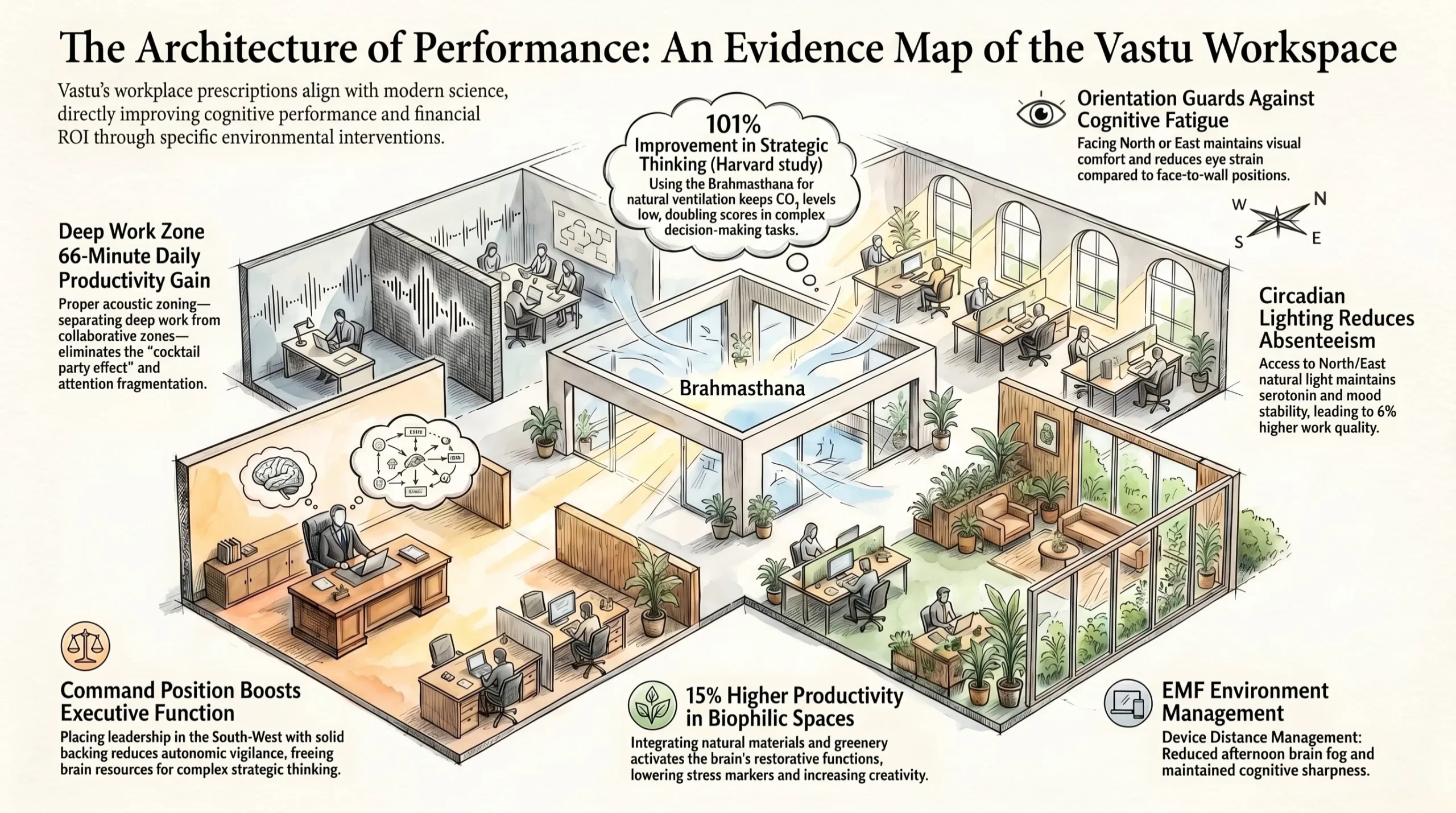
Joseph Allen’s Harvard research, published in a peer-reviewed journal and widely cited in the environmental health and workplace design literature, documents that doubling the ventilation rate — reducing indoor CO2 from approximately 1,000 ppm to approximately 550 ppm — produces a 101 percent improvement in strategic decision-making scores and a 299 percent improvement in the ‘crisis management’ cognitive performance category. These are not marginal improvements. They are transformative performance changes produced entirely by changing the air quality of the workspace — a change that costs far less than any comparable talent investment or productivity programme.
Vastu’s Brahmasthana principle is the architectural prescription that produces natural ventilation without mechanical systems, without energy consumption, and without maintenance: the open, unobstructed central zone of the workspace creates the convective air circulation that maintains near-outdoor CO2 levels throughout the building’s occupied hours. In the contemporary Indian office — where the Brahmasthana is almost invariably the most commercially pressured floor area and the most thoroughly obstructed by furniture, equipment, meeting rooms, and storage — the clearance of this central zone is the single most high-ROI productivity intervention available to the business.
I sometimes present this to business leaders as the most counter-intuitive piece of workspace design advice available: the most productive square metre in your office is not the square metre occupied by your most expensive workstation or your most sophisticated meeting room equipment. It is the square metre of open floor in the centre of the workspace that is doing nothing except enabling the air circulation that doubles your team’s decision quality. The business that understands this is the business that invests in Brahmasthana clearance rather than denser furniture configuration — and the business that consistently outperforms its comparably resourced competitors on the quality of its team’s cognitive output.
What does the electromagnetic environment of the modern office workspace do to staff health and productivity?
The modern Indian office workspace is, in its electromagnetic character, the most complex and most electrically dense physical environment that most of its occupants spend significant time in — with a concentration of RF-emitting devices, ELF-generating power infrastructure, and network equipment that produces electromagnetic exposure levels substantially higher than the typical residential environment. Understanding what this electromagnetic environment does to staff health and productivity is the most important modern Vastu contribution to office workspace design that the classical tradition never needed to address.
The typical contemporary Indian office workstation environment includes: one or more laptop computers and external monitors at close range (ELF fields from screens and power supplies); a shared Wi-Fi access point mounted at desk height or ceiling height within two to four metres (RF field at workstation position typically 200 to 2,000 microWatt per square metre, depending on access point proximity and building design); a mobile phone on the desk or in proximity (direct RF contribution and ELF from charging cable if charging); a dense power cable environment beneath the desk (ELF contribution from multiple power supplies and extension cables); and in many open-plan offices, a server room, network cabinet, or electrical distribution board within twenty metres of primary workstations. The cumulative electromagnetic environment at the typical Indian office workstation is, by Building Biology occupational guidance, substantially above the levels associated with optimal cognitive performance during extended exposure.
The biological mechanisms through which this occupational electromagnetic environment affects staff health and productivity are the same mechanisms that operate in the residential sleeping zone, but acting across a different exposure duration and in a context where the primary concern is cognitive performance quality rather than sleep architecture. Voltage-gated calcium ion channel activation by RF exposure elevates intracellular calcium in neurons, producing the fatigue response and reduced sustained attention capacity that many office workers describe as ‘screen fatigue’ or ‘afternoon brain fog’ without identifying the electromagnetic component of its cause. ELF exposure from dense power cable environments under desks maintains elevated sympathetic tone that compounds the autonomic burden of cognitive workload, accelerating the afternoon energy decline that reduces work quality in the second half of the day.
What are the most practical electromagnetic corrections available in an existing office workspace?
The most practically achievable electromagnetic corrections in an existing office workspace — without capital expenditure and without operational disruption — follow a specific protocol that the Workspace Productivity & Health Audit identifies and prescribes for the specific workspace’s specific electromagnetic profile. The highest-priority correction is almost always the Wi-Fi access point placement: access points mounted at desk height, or positioned within two metres of primary workstations, produce the highest RF field intensities at the workstation positions. Repositioning access points to ceiling level at the maximum available distance from workstation concentrations typically reduces the RF field at the most-occupied workstation positions by forty to eighty percent — a substantial reduction that requires no capital expenditure and no operational disruption.
The second most impactful correction is the replacement of Wi-Fi connectivity at primary workstations with wired ethernet connections — a change that eliminates the Wi-Fi access point’s contribution to the workstation RF environment entirely, replaces it with a physically more secure connection, and typically improves network performance consistency as a secondary benefit. The third correction is the cable management programme — organising and routing power cables away from the under-desk foot zone (where ELF exposure is highest for seated workers) and installing cable management trays that route cables to the rear of workstations rather than bunching them in the footwell.
These corrections cost very little. They are implementable over a weekend. And they address the electromagnetic dimension of the cognitive performance deficit that the Workspace Productivity & Health Audit identifies — contributing to the overall performance improvement programme alongside the CO2 ventilation, daylighting, acoustic, and spatial corrections that together constitute the full workplace health and productivity upgrade. The business that waits for a major office redesign to address electromagnetic hygiene is waiting unnecessarily: the highest-impact corrections are available right now, in the workspace as it stands, with no capital outlay and no operational disruption.
What is the complete evidence map for Vastu's workplace prescriptions and their productivity outcomes?
The following table provides a comprehensive reference for eight workspace dimensions addressed by Vastu’s commercial and workplace prescriptions — specifying the Vastu prescription, the workplace science equivalent, the biological or psychological mechanism, the evidence quality, and the specific measurable productivity outcome for each.
|
Workspace Dimension |
Vastu Prescription |
Workplace Science Equivalent |
Biological / Psychological Mechanism |
Evidence Quality |
Measurable Productivity Outcome |
|
Primary workstation orientation — staff and knowledge workers |
Staff facing north or east while working; principal workstation position with solid wall or partition backing and visual openness toward the room’s active zone; avoid face-to-wall-only positions |
Environmental psychology of workspace orientation: prospect-refuge in seated work positions; command position research in executive workspace design; facing direction and vigilance level |
Solid backing activates limbic safety signal, reducing background sympathetic monitoring load; northern light orientation maintains visual comfort and reduces glare-induced cognitive fatigue across the working day; prospect orientation keeps the default mode network’s spatial monitoring active without consuming prefrontal attention |
Moderate to strong — prospect-refuge theory in workspace design extensively studied; Kaplan attention restoration theory supports facing toward natural light; specific N/E facing and productivity less directly studied but mechanism grounded |
Reduced eye strain and visual fatigue; improved sustained attention duration; reduced reactive interruption behaviour; greater sense of task ownership and focus |
|
Leadership and decision-making zone — MD, team leads, senior staff |
Senior decision-makers in south-west zone of workspace; facing north while working; solid backing; command view of team workspace; strategically elevated position relative to operational floor |
Servicescape theory applied to internal workspace authority zones; environmental psychology of leadership spatial positioning; prospect-refuge in executive workspace design; Kaplan’s restorative environment and executive function |
SW zone provides maximum spatial refuge (maximum wall support), minimum acoustic intrusion from front-of-house activity, and the command visual position that environmental psychology associates with highest executive function quality; reduced autonomic vigilance in well-refuged positions frees prefrontal resources for strategic thinking |
Strong for servicescape theory and workspace design; moderate for specific SW zone prescription and leadership decision quality — mechanism grounded in prospect-refuge and prefrontal function research |
Improved strategic decision quality in spatially appropriate leadership positions; reduced reactive management behaviour; greater deliberate, proactive decision-making; leaders in command positions report and demonstrate higher clarity |
|
Indoor air quality — CO₂ and VOC management |
Brahmasthana as the workspace’s breathing centre; natural ventilation priority; natural material surfaces; minimum synthetic material VOC sources in workspace |
WELL Standard Feature V: air quality; Harvard Business School Allen et al. 2016 CO₂ and cognitive performance research; EPA indoor air quality workplace guidelines; LEED EQ credits for ventilation and low-emitting materials |
CO₂ above 800 ppm measurably impairs complex reasoning, working memory, and decision quality; above 1,000 ppm produces significant cognitive performance degradation; formaldehyde and aromatic VOCs add direct CNS depression; natural ventilation through open central zone maintains near-outdoor CO₂ continuously |
Strong — Harvard’s research among most rigorously designed; multiple independent replications; CO₂-cognition relationship well-established; VOC-cognition relationship moderately established |
101% improvement in strategic thinking scores at well-ventilated vs sealed workspace (Harvard); measurable reduction in error rate in complex tasks; significant reduction in afternoon cognitive fatigue; sustained performance quality across longer work sessions |
|
Electromagnetic environment of workstation zone |
Workspace prana quality includes artificial EMF management; dense electronic workspace requires specific device placement and wiring management; cluster server and networking equipment away from primary workstation positions |
WELL Standard Feature E: electromagnetic fields; Building Biology SBM standard for occupational RF and ELF; ergonomic workstation design includes EMF distance management from laptop and peripheral devices |
Chronic RF and ELF exposure at workstation positions (from dense device concentration, poorly routed power cables, Wi-Fi access points at desk height) suppresses melatonin — relevant to cognitive clarity during work; calcium ion channel activation by RF increases fatigue response; ELF from wiring raises sympathetic tone |
Moderate — occupational EMF and cognitive performance less studied than residential sleeping zone; mechanism grounded in bioelectromagnetics but occupational exposure durations shorter; Building Biology occupational guidelines less studied than residential |
Reduced afternoon cognitive fatigue and brain fog; maintained cognitive sharpness through extended work sessions; specifically relevant for staff who report headaches, fatigue, or reduced focus in the specific workspace location |
|
Natural light access at workstations |
East-facing and north-facing workspace windows; northern diffuse sky light for primary workstation zones; controlled solar access to avoid glare; Brahmasthana skylight for central workspace illumination |
WELL Standard Feature L: light; LEED IEQ credit 8: daylighting; circadian lighting design for workplaces; CIBSE lighting guidance for offices; biophilic workplace design daylighting principle |
Natural daylight entrains circadian clock through ipRGC pathway; morning solar light activates CAR for daily cognitive mobilisation; sustained daytime natural light exposure maintains serotonin synthesis for mood stability and social collaboration quality; inadequate workplace daylight produces circadian misalignment and afternoon performance degradation |
Strong — workplace daylighting and productivity extensively documented; circadian lighting and cognitive performance well-studied; World Green Building Council ‘Health, Wellbeing and Productivity in Offices’ report comprehensive |
15–20% improved productivity in daylit workspaces (World Green Building Council); 6% improvement in work quality with improved daylighting (Heschong Mahone Group); reduced absenteeism; improved mood and collaboration quality; reduced staff turnover |
|
Acoustic environment of workspace zones |
Zone function acoustic separation; Brahmasthana acoustic character; natural material acoustic absorption; quiet zone for deep work separated from collaborative and telephone zones |
WELL Standard Feature S: sound; ISO 3382 for open-plan office acoustic design; Leesman workplace research on acoustic privacy and productivity; environmental psychology of acoustic environment and cognitive performance |
Acoustic interruptions in open-plan workspaces are the primary driver of deep work fragmentation; involuntary attention capture by speech (the cocktail party effect) depletes directed attention capacity most rapidly; natural material surfaces provide diffuse acoustic absorption that reduces the reverberation and acoustic glare that makes every conversation audible across the whole space |
Strong — acoustic environment and knowledge worker productivity extensively documented; Leesman research confirms acoustic privacy as strongest single predictor of workspace productivity self-report; ISO 3382 office acoustic standards widely referenced |
Acoustic privacy enables deep work focus; 66-minute average daily productivity gain in acoustically appropriate workspaces (Leesman); significantly reduced error rate in complex tasks; improved staff satisfaction and retention in acoustically managed workspaces |
|
Thermal environment of workspace zones |
Zone function thermal character; SW zone’s thermal mass provides stable working temperature; workspace thermal comfort per seasonal and occupancy variation; natural ventilation thermal management through Brahmasthana |
WELL Standard Feature T: thermal comfort; ASHRAE 55 for thermal comfort in occupied spaces; CBE thermal comfort tool; research on thermal environment and cognitive performance; ISO 7730 thermal environment standard |
Core body temperature affects cognitive performance predictably: thermal discomfort (whether heat or cold) consumes prefrontal attention resources through thermoregulatory monitoring; slight warmth (22–24°C) supports creative and affiliative thinking; slight cool (19–21°C) supports analytical and focused thinking; thermal stability reduces involuntary attention interruption |
Strong — thermal environment and cognitive performance extensively studied; ASHRAE 55 standard based on extensive empirical research; thermal comfort and productivity relationship well-documented |
Thermally uncomfortable workspaces show 4–6% reduced productivity per degree of comfort deviation; optimal thermal range maintains sustained cognitive performance across extended sessions; thermal stability reduces attention interruption from thermoregulatory signals |
|
Biophilic workplace environment — natural materials, plants, views |
Natural material workplace surfaces; natural light; natural colour palette by zone; views of natural environments where possible; living plant elements in north-east zone |
Biophilic workplace design (Kellert et al.); World Green Building Council biophilia and productivity research; Terrapin Bright Green ’14 Patterns of Biophilic Design’; WELL Standard Feature M: mind, biophilic design requirement |
Biophilic elements activate the default mode network’s restorative function during micro-recovery periods; directed attention replenishment through involuntary attention engagement with natural patterns; cortisol reduction from biophilic visual pathway activation; improved creative thinking from default mode network activation |
Strong — biophilic design and workplace performance extensively documented; Kellert research foundation strong; World Green Building Council synthesis report documents financial case; specific ROI data increasingly available |
15% higher productivity in biophilic workplaces (World Green Building Council); 6% higher creativity in nature-view workspaces (University of Exeter); reduced stress markers in natural material environments; significantly improved staff retention (valued workspace as recruitment advantage) |
The evidence quality column across this table reflects the well-developed state of the workplace health and productivity research field: every major dimension of physical workspace quality that Vastu prescribes has at least moderate evidence support, and the most consequential dimensions — indoor air quality, natural light, acoustic environment, thermal comfort, and biophilic design — have strong, independently replicated, commercially quantified evidence. The specific productivity improvements documented in the final column represent the research-based predictions that the Workspace Productivity & Health Audit applies to the specific workspace’s specific deficiency profile.
The cumulative productivity improvement available from addressing all eight dimensions simultaneously — in a workspace that is currently deficient across several of them, as most Indian offices are — is not the sum of the individual improvements (which would double-count shared mechanisms). But the combined effect of CO2 correction, daylighting improvement, acoustic management, biophilic enhancement, and electromagnetic hygiene, applied to a team of twenty knowledge workers, represents a productivity improvement of fifteen to twenty-five percent on the dimensions that matter most — a financial return that, in terms of salary cost leveraged, is among the highest available returns on any comparable business investment. This is the financial scale of the opportunity that the Workspace Productivity & Health Audit is designed to identify and realise.
How does the south-west leadership zone prescription improve the quality of business decisions?
One of the most practically consequential and most consistently neglected Vastu workplace prescriptions is the south-west zone prescription for senior leadership — the specification that the managing director, the head of the practice, or the most strategically critical decision-maker in the organisation should be positioned in the south-west zone of the workspace, with a command view of the operational floor, solid backing, and the specific spatial and environmental character that the tradition identifies with the Prithvi (Earth) element of stability, grounded authority, and strategic deliberation.
The environmental psychology of workspace positioning provides the mechanism explanation for this prescription. The prospect-refuge framework — developed by Jay Appleton and extensively applied to workspace design — identifies that the quality of complex, strategic decision-making is highest in spatial configurations that provide both prospect (visual command of the environment, the ability to see what is happening) and refuge (solid backing, spatial enclosure that reduces the posterior threat monitoring load on the autonomic nervous system). The south-west zone of a correctly oriented workspace provides exactly this combination: maximum solid wall backing on the south and west walls, full visual command of the workspace through the north and east-facing visual openings, and the minimum acoustic intrusion from the building’s primary entry and operational activity zones that face north and east.
The cognitive consequence of this spatial configuration is a meaningful improvement in the quality of deliberate, strategic thinking — the thinking that business leadership most depends on. The executive who is positioned in the command zone is not merely more psychologically comfortable. Their prefrontal cortex is producing higher-quality executive function because the autonomic nervous system’s background vigilance load — which in a non-command position requires constant peripheral monitoring that consumes prefrontal resources — is reduced by the spatial refuge quality of the command position. This is not a subtle psychological effect. It is a measurable difference in the quality of complex problem-solving and risk assessment that environmental psychology has documented in multiple independent studies of spatial positioning and decision quality.
For the business owner or managing director who is currently working from a non-command position — a north or east-facing desk with their back to the open workspace, or a workstation in the operational zone with no solid backing and no visual command — the south-west command position relocation is among the most immediately impactful productivity improvements available. It requires no capital expenditure, no renovation, and no operational disruption: only the decision to prioritise the most financially consequential person in the organisation’s spatial position as a deliberate workspace design decision rather than an afterthought.
What does the acoustic design evidence reveal about the open-plan office workspace's most costly hidden defect?
The open-plan office — the dominant workspace format in contemporary Indian commercial real estate, driven by rental cost reduction and collaborative design ideology — is, by the most rigorous available workplace research evidence, a productivity impairment machine for knowledge workers whose primary work depends on sustained concentration and deep cognitive processing. Understanding why, and understanding the specific acoustic corrections that most cost-effectively address the problem, is among the most commercially valuable insights that the Workspace Productivity & Health Audit delivers.
The Leesman workplace research — the largest independent database of workplace experience and productivity self-report, covering hundreds of thousands of workers across thousands of workplaces globally — consistently identifies acoustic privacy as the single strongest predictor of workspace productivity self-report across all workspace types and all professional categories. Workers in acoustically impoverished open-plan offices report the most severe productivity deficits, the highest dissatisfaction, and the most frequent involuntary attention interruptions. The specific mechanism is the cocktail party effect: the human auditory system has an involuntary attention capture response to speech, particularly intelligible speech close to the ear — the neural system evolved to detect and track relevant social communication cannot be consciously suppressed, and in an open-plan office where multiple conversations are simultaneously audible, this involuntary attention capture consumes significant directed attention capacity that the knowledge worker is simultaneously trying to deploy for their own complex cognitive task.
The financial scale of this productivity impairment is substantial. The Leesman research documents an average daily productivity gain of sixty-six minutes per worker in acoustically appropriate workspaces compared to acoustically impoverished open-plan alternatives. For a team of twenty workers at a mid-market salary level, this sixty-six-minute daily productivity difference represents a financial value of several millions of rupees annually — from a correction that can be substantially achieved through acoustic zone separation, acoustic absorption material additions, and working protocol design rather than expensive architectural acoustic redesign.
Vastu’s zone function separation principle addresses the open-plan acoustic problem at the most fundamental level: it prescribes that acoustically active zones (reception, telephone calls, collaborative discussion) be separated from acoustically sensitive zones (deep work, strategic planning, focused writing) through zone allocation and spatial organisation. The Brahmasthana’s acoustic moderation function — the natural acoustic absorption and diffusion of an open central zone with natural material surfaces — provides the ambient acoustic quality that reduces the reverberation and acoustic glare that makes every conversation intelligible across the whole space. These are the same acoustic design principles that ISO 3382 and WELL’s sound standard specify for high-performance office acoustic environments, expressed in the Vastu tradition’s spatial and elemental vocabulary.
The Workspace Productivity & Health Audit’s acoustic assessment identifies the specific acoustic zones where speech intelligibility is most impairing concentrated work, prescribes the specific zone separation and absorption additions that will most efficiently reduce the intelligibility problem, and predicts the specific daily productivity gain per worker that the acoustic correction is expected to produce — giving the business a specific financial ROI calculation for the acoustic investment that makes the commercial case for implementation immediately actionable. The sixty-six-minute daily productivity gain documented in acoustically corrected workplaces is, for most businesses, the single largest available return on any workspace investment per rupee spent.
What business performance patterns indicate that a workspace has correctable Vastu health and productivity defects?
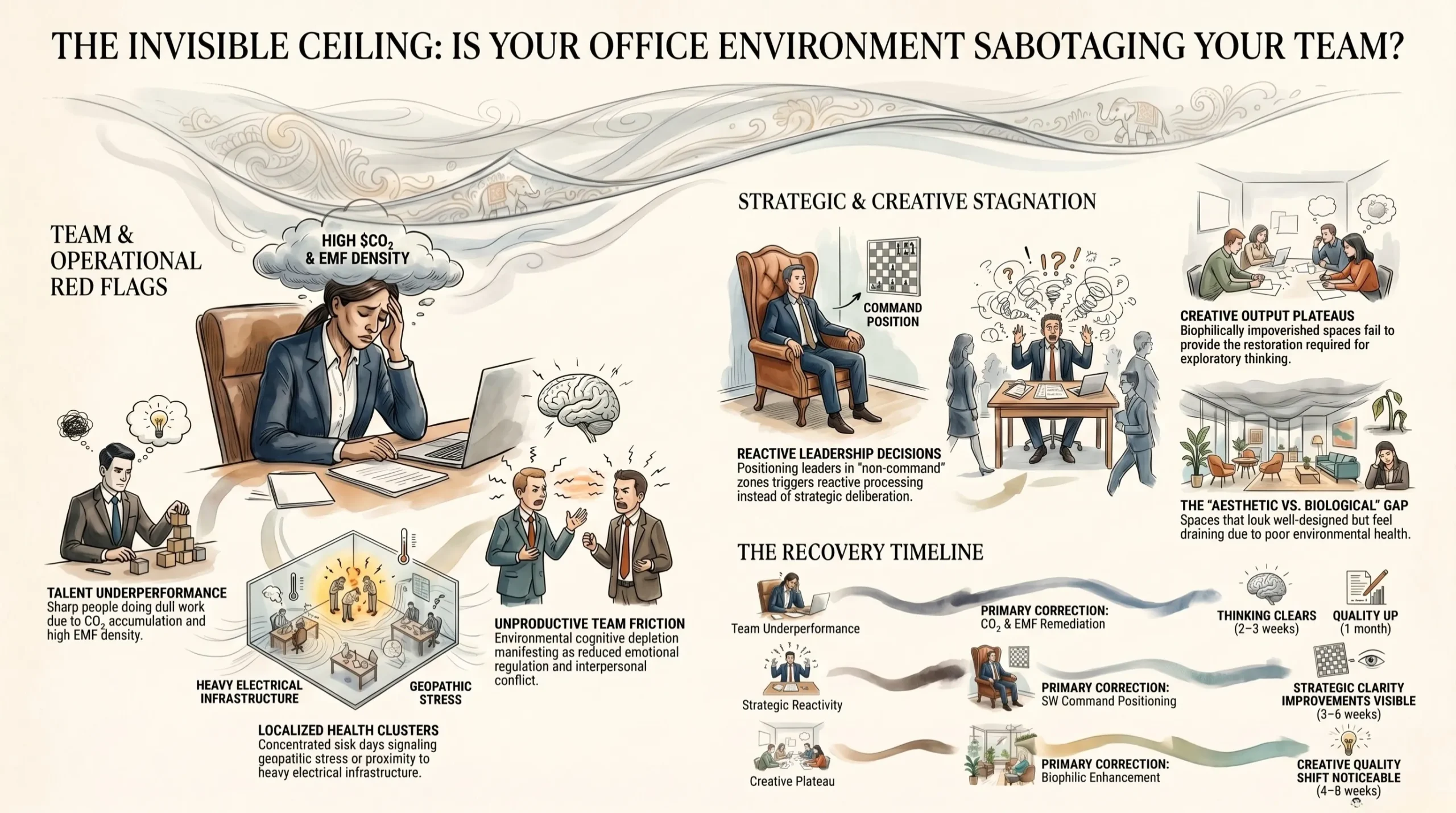
The most practically useful way to understand whether the Workspace Productivity & Health Audit would benefit a specific business is to assess the observable performance patterns that characterise workspaces with correctable physical environmental defects. The following table maps six common business performance patterns to their most likely workspace physical environmental roots, the priority assessment actions, and the expected performance outcomes after correction.
|
Observed Workplace Pattern |
What It Suggests About the Workspace |
Most Likely Vastu Workspace Defect |
Priority Assessment |
Expected Improvement After Correction |
|
Experienced team members consistently underperforming against potential — sharp people doing dull work |
The workspace physical environment is impeding the cognitive quality that these individuals are capable of producing; the ceiling on their performance is environmental, not skill-based |
High CO₂ from sealed workspace; dense device electromagnetic environment at primary workstations; inadequate natural light for circadian cognitive activation; workstations facing walls or corners creating attention deficit from spatial refuge without prospect |
CO₂ measurement during occupation; RF assessment at primary workstations; daylighting evaluation; workstation orientation review against north-east facing prescription |
Performance improvement within 3–6 weeks of CO₂ and EMF correction; staff themselves typically report ‘thinking more clearly’ within two to three weeks; team lead notices improved work quality within one monthly cycle |
|
High staff sick days and unexplained health complaints concentrated in specific workspace zones |
The workspace is producing or exacerbating health challenges in the staff occupying specific zones; the spatial concentration of the problem identifies an environmental rather than individual cause |
Geopathic stress zone beneath a cluster of workstations; concentrated EMF from server room, network equipment cluster, or electrical panel adjacent to the affected zone; poor ventilation in the affected zone producing localised CO₂ accumulation |
Magnetometer survey of affected workstation zones; RF and ELF assessment of equipment proximity; CO₂ monitoring in affected zone; building service route review for electrical panel proximity |
Health complaint reduction within 4–8 weeks of zone-specific environmental corrections; absenteeism reduction typically visible within one quarter; staff in corrected zone report improved wellbeing within 2–3 weeks |
|
Frequent unproductive conflict, friction, and communication breakdown in the team |
The team is experiencing parallel environmental cognitive depletion that manifests as interpersonal friction; chronically CO₂-impaired, EMF-burdened, or sleep-deprived team members have reduced emotional regulation capacity and empathic accuracy — the specific capacities that collaborative work requires |
Sealed workspace with CO₂ accumulated in the collaborative zone; harsh overhead lighting without biophilic elements producing chronic sympathetic baseline elevation; insufficient acoustic zone separation creating sensory overload in open-plan zones |
CO₂ monitoring in collaborative zones; lighting quality assessment against biophilic design standards; acoustic environment assessment of open-plan zones; Brahmasthana clearance assessment |
Social friction reduction within 3–6 weeks of air quality and acoustic corrections; team leads typically notice improved meeting quality and communication ease before individual team members attribute it to the environment |
|
Creative output has plateaued — the team produces reliable but uninspired work |
The workspace environment is not providing the default mode network restoration that creative thinking requires; the team is in an environment that supports routine task execution but not the exploratory, connective thinking that creative work demands |
Biophilically impoverished workspace: synthetic surfaces, artificial light, no natural views, no biophilic elements; inadequate natural light for default mode network restoration during micro-recovery moments; excessively uniform, overstimulating, or monotonous environment |
Biophilic quality assessment of workspace surfaces and views; natural light access evaluation; acoustic quality assessment; workspace variety and zone differentiation assessment |
Creative output quality improvement within 4–8 weeks of biophilic environment enhancement; natural material improvements and daylight access increase tend to produce the most rapid and most noticeable creative quality changes; management typically notices before the team does |
|
Senior leadership consistently making reactive rather than strategic decisions |
The leadership environment is not providing the spatial and environmental conditions that strategic thinking quality requires; leadership decisions are being made in an environment that activates reactive rather than deliberate processing |
Leadership team in north-east or east zone (correct for operational activity but not for strategic deliberation); conference room with inadequate acoustic privacy for strategic discussion; CO₂ accumulation in sealed meeting spaces; leadership workspace without spatial refuge quality |
Leadership workspace zone assessment against SW command position prescription; conference room CO₂ monitoring; acoustic privacy assessment of strategic discussion space; meeting room orientation and thermal comfort assessment |
Strategic decision quality improvement within 3–6 weeks of leadership workspace correction; this is the hardest pattern to quantify directly but the most financially significant; leaders describe the change as ‘more space to think’ and ‘less feeling of being on the back foot’ |
|
Workspace that looks well-designed but consistently feels draining — staff describe ‘leaving their energy at the office’ |
The workspace has achieved aesthetic congruence without achieving biological congruence; it looks professionally designed but fails to support the nervous system’s basic environmental health requirements |
Classic ‘designed but unhealthy’ pattern: architectural quality without environmental health quality — no natural light despite professional lighting design; natural-looking materials that are actually synthetic; good ventilation system design that is switched off or under-serviced; well-designed space with sealed Brahmasthana |
Full workspace environmental health assessment: CO₂ monitoring; RF measurement; natural light lux and spectral quality measurement; material VOC assessment; geopathic stress survey; instrument data compared against Building Biology and WELL standards |
Once the specific environmental health gap is identified and corrected, staff experience of the workspace typically transforms within 3–4 weeks; the gap between the workspace’s appearance quality and its actual health quality closes with targeted corrections rather than expensive redesign |
The pattern across this table that deserves most attention is the final row — the workspace that ‘looks well-designed but consistently feels draining.’ This pattern is among the most prevalent in contemporary Indian commercial workspaces because it is the predictable consequence of a commercial fit-out industry that optimises for visual quality and brand expression without routinely assessing or specifying the physical health and productivity dimensions that the WELL Standard, Building Biology, and Vastu science identify as most consequential for occupant performance. A workspace can have excellent lighting design, high-quality biophilic plant elements, and premium material finishes — and still be producing chronic cognitive fatigue if the Brahmasthana is obstructed, the Wi-Fi access points are at desk height, and the primary workstations are facing walls rather than natural light.
The Workspace Productivity & Health Audit’s instrument-based assessment — CO2 monitoring, RF measurement, lux meter evaluation, geopathic survey, acoustic measurement — reveals the gap between the workspace’s appearance quality and its actual environmental health quality with the precision and the specificity that instrument measurement provides and visual assessment cannot. The business that invests in this assessment before committing to an expensive workspace redesign avoids the risk of spending significantly on appearance improvements that leave the most consequential health and productivity defects unchanged.
How does staff health in the workplace relate to Vastu principles — and what is its financial cost when neglected?
Staff health — specifically, the rate of illness-related absence, the rate of presenteeism (working while unwell at reduced productivity), and the rate of chronic health challenge accumulation in the staff population — is the most directly financially quantifiable dimension of the workplace’s physical environment quality. The World Green Building Council’s research estimates that health-related productivity costs (absenteeism and presenteeism combined) represent two to three times the direct salary cost of absenteeism alone. For a medium-sized Indian professional services firm with twenty staff, the total health-related productivity cost represents a financial burden of several million rupees annually — a burden that a well-designed physical workspace can meaningfully reduce.
The specific workspace physical factors most directly linked to staff illness rates are the same factors that Vastu’s workplace prescriptions address. Indoor air quality — specifically CO2 accumulation and VOC burden from synthetic materials — is among the most extensively documented determinants of respiratory illness incidence, headache frequency, and general symptom burden in office workers. Building Biology research documents that the same VOC burden that impairs cognitive performance through CNS depression is also the primary driver of sick building syndrome — the constellation of non-specific symptoms (headache, eye irritation, fatigue, respiratory irritation) that characterise workspaces with poor indoor air quality. Natural ventilation and low-VOC natural material surfaces are the most cost-effective sick building syndrome prevention available.
Geopathic stress beneath primary workstation positions produces a more insidious and more slowly accumulating health burden: the chronic HPA axis activation from geopathic field exposure at the workstation produces the same immune depletion and cortisol dysregulation that residential geopathic stress produces over months and years of exposure, contributing to the higher-than-expected infection rates and the chronic fatigue that concentrated zone-specific staff health challenges represent. The Workspace Productivity & Health Audit’s magnetometer survey identifies geopathic stress zones beneath workstation areas and prescribes the specific workstation relocations that remove staff from chronic earth energy exposure — a correction whose investment is trivial compared to the health cost of the annual absenteeism it addresses.
The financial argument for addressing staff health through workspace physical environment correction is, if anything, more compelling than the productivity argument. Health-related costs are more directly quantifiable (sick days have a clear salary cost plus replacement and disruption cost), more immediately attributable to the workspace (when multiple staff in the same zone experience the same symptoms, the spatial concentration implicates the workspace rather than individual health choices), and more motivating to business leaders who are already managing the cost. The Workspace Productivity & Health Audit is the instrument that makes the invisible physical environmental contributors to staff health costs visible, quantified, and correctable — converting an apparently uncontrollable cost into a manageable one.
How does the WELL Building Standard validate Vastu's workplace prescriptions for contemporary Indian businesses?
The WELL Building Standard — developed by Delos and now internationally adopted as the most comprehensive built environment health and wellbeing certification framework available — provides the contemporary Indian business with a professionally credible, internationally referenced vocabulary for the same workplace physical environment qualities that Vastu’s prescriptions have always addressed. Understanding how WELL validates Vastu’s workplace prescriptions serves two practical purposes: it demonstrates the convergence between ancient wisdom and contemporary evidence-based design science, and it provides business leaders who are more comfortable with internationally certified standards than with traditional frameworks a credible reference point for the same physical environment investments.
WELL’s ten concept categories map onto Vastu’s workplace prescriptions with a specificity that confirms the frameworks are addressing identical physical realities from different intellectual starting points. WELL’s Air concept — specifying ventilation rates, CO2 limits, VOC emission standards, and air filtration requirements — is the quantitative specification framework for Vastu’s Brahmasthana ventilation and natural material prescriptions. WELL’s Light concept — specifying circadian lighting design, daylighting requirements, glare control, and colour quality — is the quantitative framework for Vastu’s directional natural light prescriptions for different workspace zones. WELL’s Sound concept — specifying maximum background noise levels, minimum speech intelligibility thresholds for focused work, and acoustic zoning requirements — is the quantitative framework for Vastu’s zone function acoustic separation prescriptions. WELL’s Mind concept — specifying biophilic design requirements, restorative space provision, and mental health support — is the quantitative framework for Vastu’s natural material, Brahmasthana open space, and biophilic workplace prescriptions.
For the Indian business whose clients, investors, or talent acquisition strategy benefits from demonstrated commitment to employee health and sustainability credentials, WELL certification provides the internationally recognised validation of the workspace quality investments that Vastu’s prescriptions deliver. The Workspace Productivity & Health Audit is not a WELL certification programme — but its findings and its prescribed corrections align with the WELL features whose implementation produces the most significant workplace health and productivity improvements, and the audit report can serve as an input to a subsequent WELL certification process for organisations that choose to pursue formal certification.
The business that implements the Workspace Productivity & Health Audit’s corrections is, whether it uses the WELL vocabulary or the Vastu vocabulary, investing in the physical workspace qualities that the world’s most rigorous contemporary built environment health and performance evidence identifies as the most consequential determinants of knowledge worker productivity, health, and wellbeing. The tradition and the standard are describing the same physical reality. The audit delivers both frameworks’ prescriptions in a single, instrument-based, commercially accountable assessment.
What does the Workspace Productivity and Health Audit deliver that no other workspace intervention provides?
The Workspace Productivity & Health Audit occupies a specific and uniquely valuable position in the landscape of workspace improvement investments available to Indian businesses — because it addresses the physical environmental substrate that determines how effectively every other workspace investment performs, using the instrument-based precision that makes its findings specific, its prescriptions actionable, and its improvement predictions commercially accountable.
Interior designers address aesthetics and brand. Furniture suppliers address ergonomics and equipment specification. IT consultants address technology infrastructure. HR consultants address process, culture, and talent. All of these are valuable. None of them systematically assesses the physical environmental conditions — the air quality, the electromagnetic environment, the earth energy quality, the natural light quality, the acoustic character — that determine whether the workspace’s occupants can perform at the cognitive quality their role requires. The Workspace Productivity & Health Audit fills this gap with the same rigour that a building survey applies to structural quality: instrument measurement at every relevant point, comparison against internationally referenced performance standards, specific finding for each dimension, and specific correction prescription with specific predicted improvement.
The Vastu dimension of the Workspace Productivity & Health Audit is not a cultural addition to a building science assessment. It is the integrative framework that connects the individual instrument findings — the CO2 reading, the RF measurement, the acoustic level, the lux meter reading — to the spatial, directional, and elemental logic that explains why each defect is present where it is and what the most systematically effective correction programme looks like. A CO2 problem in the workspace’s central zone is not just a ventilation problem. It is a Brahmasthana obstruction problem — and the most systematically effective correction is not merely improving the mechanical ventilation but clearing the physical obstruction in the central zone that is preventing the building’s natural convective ventilation from doing the work that the Manasara’s authors specified for it millennia before any mechanical ventilation system was invented.
The business that commissions a Workspace Productivity & Health Audit is making the most specific, most precisely targeted, and most financially accountable investment available in the physical environmental substrate of its team’s performance. It is not decorating the workspace. It is not upgrading the technology. It is not redesigning the brand. It is addressing the physical environmental conditions that determine whether the people in that workspace are capable of performing at the quality that their talent, their training, and the business’s ambitions for them require — conditions that have been neglected because no previous assessment framework has been able to see them clearly enough to address them precisely. The Workspace Productivity & Health Audit makes them visible, measurable, and correctable.
Real Case Study — A Mumbai Technology Firm Whose Team Performance Ceiling Lifted After a Workspace Audit:
The founder of a forty-person Mumbai technology consultancy came to me with a productivity puzzle that had frustrated him for eighteen months. His team was talented — he had hired well and knew it. His processes were good. His culture was positive. But the team’s output quality, and specifically the quality of the strategic analysis and client recommendations that the firm’s reputation depended on, had plateaued. Individual performance reviews were positive but the aggregate output quality was not matching the individual potential of his people. ‘They are capable of better than this,’ he said. ‘I cannot identify why they are not producing it here.’
The Workspace Productivity & Health Audit found three significant defects. First, the office’s central zone — a large open floor area in the building’s geometric centre — had been converted into a conference room by the addition of glass partitions and a full acoustic seal, eliminating the stack-effect ventilation pathway. CO2 monitoring during a full working day revealed peak concentration of 1,780 parts per million in the strategic analysis team’s zone — well above the threshold at which Harvard’s research documents significant complex reasoning impairment. Second, the primary server and network rack was positioned against the wall adjacent to the firm’s most senior analysts’ workstations, producing RF fields of 2,400 microWatt per square metre at the closest positions. Third, the firm’s primary conference room — used for the strategic planning meetings from which its client recommendations emerged — had a sealed, west-facing floor-to-ceiling glass wall producing direct afternoon solar glare on the presentation wall throughout the team’s primary afternoon meeting time.
Three corrections: the central conference room partition was removed and replaced with a mobile acoustic screen system, restoring the central ventilation pathway; the server rack was relocated to a dedicated equipment room; the conference room west glazing received solar film and the meeting schedule was restructured to use the room in morning hours for strategic sessions.
At eight weeks, the founder sent a specific message: ‘The quality of our strategic output has measurably improved. I can see it in the client proposals — they are more coherent, more creative, and more clearly argued. Our two most senior analysts have each commented, independently, that they feel they are thinking more clearly in the space. I do not know how to quantify this beyond saying that the quality ceiling that frustrated me for eighteen months has lifted, and the technical explanation you provided — doubled decision quality from CO2 correction, plus RF reduction at the most cognitively demanding workstations — is the only explanation I have found.’
The investment in the corrections was negligible — the partition removal was the largest cost, absorbed as routine office maintenance. The annual financial value of the strategic quality improvement, estimated conservatively against client proposal success rates, was substantially larger than the firm’s entire annual workspace cost.
What India’s Most Successful Tech Companies Have Discovered About Workspace Physical Quality:
The global technology industry’s most innovative companies — the ones that have consistently produced the highest-quality knowledge work output over decades — have made the physical environment of their workspaces one of their most deliberate and most heavily researched design priorities. The investment that companies like Google, Apple, and their Indian counterparts Infosys and Tata Consultancy Services make in campus design, natural light, biophilic elements, acoustic management, and air quality is not aesthetic self-indulgence. It is a specific, research-backed investment in the physical cognitive performance substrate of knowledge work.
What these companies have discovered — through their own research and through engagement with the growing evidence base in environmental psychology and workplace health science — is precisely what Vastu’s commercial prescriptions have always specified: that the physical conditions of the workspace where thinking occurs are among the most consequential determinants of the quality of that thinking; that natural light, natural ventilation, natural materials, acoustic design, and spatial organisation are not amenities but cognitive performance infrastructure; and that investment in these physical qualities generates returns in knowledge work quality that are consistently larger than comparable investments in technology, training, or process.
The Vastu tradition did not develop its commercial prescriptions by observing technology company campuses. It developed them by observing what physical environments produced the most productive, most vital, and most successful commercial enterprises across thousands of years of Indian business practice. The specific prescriptions it produced — the north-facing workspace for consistent light, the south-west command position for leadership, the open Brahmasthana for air and thinking quality, the natural material surfaces for cognitive restoration — are the same prescriptions that the world’s highest-performing knowledge-work organisations have independently arrived at through their own research and observation.
The Indian business that considers Vastu in its workspace design is not applying cultural convention to a commercial problem. It is accessing the most systematically accumulated and most rigorously tested environmental intelligence for knowledge-work performance available in any tradition — and now implementing it with the instrument precision and research backing that makes its contributions commercially accountable in the language that any business investment decision requires.
Your Team Is Capable of Better. The Physical Environment of Your Workspace May Be the Reason They Are Not Delivering It.
The productivity gap between a physically optimised workspace and the typical Indian commercial office represents a financial value — in decision quality, in sustained cognitive output, in staff health and retention — that dwarfs the investment required to close it. The Workspace Productivity & Health Audit identifies the specific physical environmental factors most limiting your team’s performance, prescribes the specific corrections that will most efficiently close the gap, and provides the commercially quantified productivity improvement predictions that allow every correction to be evaluated as a business investment.
Your Workspace Productivity & Health Audit delivers:
- Photo-scanning preliminary assessment — systematic physical information extraction from office photographs and floor plan; primary workspace defects identified before site visit
- CO₂ monitoring during occupation hours — 24–48 hour monitoring in strategic work zones, meeting rooms, and leadership spaces; Harvard research standards applied; decision quality impairment quantified; Brahmasthana clearance prescription with 101% decision quality improvement as target
- RF electromagnetic assessment at primary workstations — power density in µW/m² at key staff positions; access point placement assessment; server equipment proximity evaluation; wired ethernet migration prescription; cognitive fatigue reduction predicted
- ELF field assessment — under-desk wiring and equipment fields measured; cable management corrections prescribed; sympathetic tone reduction prediction
- Geopathic stress magnetometer survey — staff workstation zone mapping; zone-specific illness clustering correlated against field map; workstation relocation prescriptions for affected zones
- Natural light quality assessment — lux and spectral quality at all primary work zones; circadian lighting standard comparison; 15–20% productivity premium corrections identified and prescribed
- Acoustic environment assessment — background noise level and speech intelligibility measured; zone separation assessment; RT60 evaluation; 66-minute daily productivity gain programme prescribed
- Thermal comfort assessment — zone temperature stability; ASHRAE 55 comparison; thermal performance corrections for optimal cognitive range
- Biophilic design assessment — natural material quality, plant element adequacy, view quality evaluated against WELL M and World Green Building Council standards; 15% creativity premium corrections prescribed
- Vastu zone allocation assessment — leadership SW command position evaluation; Brahmasthana function assessment; zone function congruence review; spatial organisation corrections
- WELL Standard alignment — key WELL features assessed; certification readiness evaluation; professionally credible workspace quality documentation
- Financial productivity impact report — all corrections ranked by productivity ROI; specific staff performance improvement predictions by correction; annual financial value estimate at current staff complement and salary cost
- One-on-one consultation with Mukesh Shah personally
- Detailed written report — all instrument findings, mechanisms, corrections, WELL alignments, and financial productivity predictions with research citations
- 30 days of priority support through your full implementation
- 100% satisfaction guarantee
Five thousand years of built environment wisdom. Harvard Business School research. Building Biology instruments. The financial productivity case in commercial language. For your team — starting Monday.
Book your Workspace Productivity & Health Audit today at vastumyhome.com
Yes — Vastu applies to every environment where human beings spend significant time conducting activities that depend on cognitive quality, physical health, and collaborative capacity. The office workspace is where most knowledge workers spend the majority of their productive hours, making its physical environment one of the most consequential determinants of their performance. Vastu’s workplace prescriptions address the specific physical factors most limiting knowledge worker productivity: indoor air quality and CO2 through the Brahmasthana ventilation principle; electromagnetic environment through workspace device management prescriptions; natural light through directional zone prescriptions; acoustic environment through zone function separation; and strategic decision quality through the south-west leadership zone and command position prescriptions.
Harvard Business School’s research (Allen et al. 2016) documented a 101% improvement in strategic decision-making quality and a 299% improvement in crisis management performance from doubling office ventilation rates and reducing indoor CO2 from approximately 1,000 ppm to approximately 550 ppm. For a team of twenty knowledge workers, this performance improvement represents a financial value many times larger than the cost of the ventilation improvement. Vastu’s Brahmasthana prescription — the open, unobstructed central zone that drives natural convective ventilation — is the most cost-effective method of achieving this CO2 reduction: it requires no mechanical equipment, no energy, and no maintenance. Clearing the central workspace zone is the highest-ROI productivity intervention available to most Indian offices.
The south-west zone provides the combination of maximum spatial refuge (solid wall backing on south and west sides) and command prospect (visual openness toward the operational floor) that environmental psychology’s prospect-refuge theory identifies as producing the highest quality of complex, strategic decision-making. The solid backing reduces the autonomic nervous system’s background spatial monitoring load, freeing prefrontal cognitive resources for deliberate strategic thinking. The command view of the workspace provides the organisational situational awareness that leadership requires without creating the open-exposure anxiety of a workstation with no backing. Environmental psychology research on executive workspace positioning consistently documents improved decision quality and reduced reactive management behaviour in command-position configurations.
The Leesman workplace research identifies acoustic privacy as the single strongest predictor of knowledge worker productivity self-report, with acoustically impoverished open-plan offices documenting the most severe productivity deficits. The mechanism is the cocktail party effect: involuntary attention capture by intelligible speech near the ear depletes directed attention capacity, which is simultaneously required for complex knowledge work. Vastu’s zone function separation principle addresses this at the design level — separating acoustically active zones (reception, telephone calls, collaborative discussion) from acoustically sensitive zones (deep work, strategic planning) — and the Brahmasthana’s open centre with natural material surfaces provides the acoustic diffusion and absorption that reduces the reverberation and acoustic glare that makes every conversation audible across the full open plan.
The Workspace Productivity & Health Audit delivers: CO2 monitoring during occupation hours with Harvard decision quality improvement standards applied; RF measurement at primary workstations with Building Biology SBM comparison; ELF field assessment with cable management corrections; magnetometer geopathic stress survey of staff workstation zones; lux meter natural light quality assessment; acoustic environment measurement with reverberation time analysis; thermal comfort assessment; biophilic design evaluation; Vastu zone allocation review including leadership command position assessment; WELL Standard alignment assessment; and a financial productivity impact report ranking all corrections by ROI with specific annual financial value predictions at the business’s staff complement and salary cost. Delivered with one-on-one consultation with Mukesh Shah, detailed written report, 30 days of priority support, and a 100% satisfaction guarantee.
I Would Love to Hear From You
I would love to hear your story or questions in the comments below. Have you experienced the impact of Vastu in your own home? Are you noticing any of the common defects I described above in your space? Share openly — every question is a step towards greater harmony.
Disclaimer: Vastu analysis and energy corrections are for harmonising your space and personal growth. They are not a substitute for professional medical, financial, legal or architectural advice.