

What Evidence Links Vastu to Financial Well-Being?
Namaste. I am Mukesh Shah. Of all the health outcomes that families report following Vastu corrections — improved sleep, restored immune function, reduced infection frequency, normalised blood pressure — the one that surprises them most, and that they are least prepared to expect, is the improvement in mental clarity. The lifting of the morning brain fog they had accepted as their normal. The return of the focused attention that had been fading for years. The ease of decision-making that had become effortful. The creativity and quick thinking that they had attributed to ageing or stress and had quietly resigned themselves to losing.
I am not surprised by these reports. After twenty years of assessments and thousands of families, I understand exactly why the mental clarity outcomes occur, in which family members they appear, in what timeline after specific corrections, and through which biological mechanisms. The relationship between the home’s physical environment and the mind’s clarity is not mystical, not metaphorical, and not a secondary or uncertain benefit of Vastu correction. It is among the most directly and most specifically documented relationships in the entire Vastu evidence base — grounded in sleep neuroscience, cognitive neuroscience, chronobiology, indoor air quality science, and biophilia research in ways that are precise, independently validated, and practically actionable.
The reason the mental clarity outcomes surprise families is that most people do not think of their cognitive performance as environmentally determined. They think of it as a function of their intelligence, their effort, their stress levels, their age, and their psychological state. They do not think: my difficulty concentrating is partly caused by the 2,800 microWatt per square metre of RF radiation from my bedroom router suppressing the melatonin that protects my hippocampal neurons each night. They do not think: my morning brain fog is partly caused by the Hartmann Grid intersection beneath my sleeping position fragmenting my slow-wave sleep and preventing the prefrontal cortex restoration that clear morning thinking requires. They do not think: my afternoon decision fatigue is partly caused by the CO2 accumulation in my home study that the blocked Brahmasthana is allowing to build toward the 1,800 parts per million at which cognitive impairment becomes directly measurable.
This article makes the case that studying Vastu for mental clarity is not studying Vastu for a secondary benefit. It is studying Vastu for one of its most consequential and most scientifically grounded primary outcomes. The environmental corrections that the Health-Focused Energy Correction service prioritises — sleeping zone earth energy, electromagnetic environment, morning light, indoor air quality — are environmental corrections whose cognitive consequences are as significant as, and in some cases more immediately observable than, their immune and endocrine consequences. For the large and growing number of Indian families in which at least one member is experiencing unexplained cognitive decline, persistent mental fog, or progressive difficulty with the thinking that their professional and personal lives require, environmental root cause assessment is the most overlooked and the most potentially transformative investigation available.
Why is the physical environment of a commercial space among its most consequential financial assets?
Every business owner understands, at some level, that the environment in which they do business matters to their financial performance. The well-designed retail space outperforms the poorly designed one at equivalent product quality and pricing. The well-lit, naturally ventilated office produces better work output than the sealed, artificially lit one. The premium brand’s commercial environment commands pricing power that its commodity competitor cannot achieve regardless of product quality parity. What most business owners do not understand is the specific biological mechanism through which the commercial environment achieves these effects — and why that mechanism makes some commercial environment investments far more financially consequential than others.
The biological mechanism operates through the autonomic nervous system’s continuous, automatic assessment of the physical environment for safety, quality, and social-status signals. Every customer who enters a commercial space is conducting an unconscious environmental audit whose conclusions directly shape their purchase behaviour. The environment’s light quality, material character, acoustic character, thermal comfort, and spatial organisation are all read as signals about the quality, trustworthiness, and value of the products or services offered within it. A commercial space with high-quality natural light, natural material surfaces, appropriate acoustic comfort, and well-organised spatial clarity signals quality, trustworthiness, and premium value — not because these are culturally learned associations (though they are reinforced culturally) but because these environmental qualities engage the same biophilic neural pathways that the human nervous system has evolved to associate with safe, resource-rich, high-quality environments.
The financial consequence of this biological environmental audit is direct and measurable. Retail research consistently documents that customers spend more, dwell longer, return more frequently, and perceive higher product value in physically high-quality commercial environments than in physically low-quality ones — at identical product quality and pricing. Workplace research consistently documents that staff in physically high-quality environments produce higher-quality work output, make better decisions, have lower absenteeism, and stay in their roles longer than staff in physically low-quality ones. These are not aesthetic preferences. They are biological responses to physical environmental qualities whose commercial consequences are as measurable as any other business performance metric.
Vastu’s commercial prescriptions address the specific physical environmental qualities that are most consequential for this biological environmental audit: the light quality of the customer-facing zones, the ventilation quality of the staff workspace, the material quality of all customer-contact surfaces, the spatial organisation that creates optimal prospect-refuge balance for purchase decision-making, and the orientation of the owner’s decision-making workspace for optimal executive function quality. Each of these prescriptions has both a Vastu principle grounding and a consumer behaviour research backing — and together they constitute the most comprehensive physical environment financial performance programme available to any commercial operator.
What does retail daylighting research reveal about Vastu's commercial light prescriptions?
The retail daylighting research literature is, in my view, the single most directly commercially persuasive body of evidence for Vastu’s financial well-being connection — because it documents, in the specific commercial language of sales per square metre and conversion rates, the financial premium that natural light quality delivers in customer-facing commercial spaces. This research did not set out to validate Vastu. It set out to answer the commercial property developer’s most financially motivated question: does investing in daylighting produce a measurable return on investment in retail performance?
The answer, across multiple independent studies and multiple retail chains, is an unambiguous yes — with effect sizes that any retail property investor would regard as commercially significant. Studies by Choi and Moon and by the Heschong Mahone Group have documented retail sales premiums of approximately forty percent in well-daylit store zones compared to identical store configurations under artificial lighting. The New Buildings Institute analysis of LEED-certified retail properties found that retail spaces achieving LEED daylight credits outperformed non-daylit comparables on sales per square metre by a margin that produced a payback period on daylighting investment of less than three years. The mechanism is not mystical — it is precisely the biological retail environment audit described in the previous section: natural daylight produces the mesolimbic reward pathway activation, the mood elevation, and the autonomic approach motivation that artificial light cannot replicate, regardless of its intensity or spectral composition.
The directional specificity of Vastu’s commercial light prescription — its specification that primary commercial entrances and customer-facing zones should receive morning solar light through east or north-east orientation — aligns with the retail daylighting research’s most commercially productive light quality: the morning solar spectrum, with its relatively higher blue-spectrum content and its lower but more directionally interesting illumination angle, produces stronger positive affect and approach motivation than the diffuse overhead illumination that characterises most artificially lit retail environments. The north zone’s diffuse northern sky light — Vastu’s specification for transaction and treasury zones — provides the most consistent, most glare-free, and most comfortable natural light available for the transaction decision environment, exactly as commercial lighting design research identifies for high-value transaction spaces.
For the commercial property owner or retail business operator considering a Vastu for Retail & Commercial Success assessment, the retail daylighting evidence provides the most direct financial argument available: every architectural decision that maximises natural light access to customer-facing zones, in the specific directional quality that Vastu prescribes, is an investment with documented commercial returns — and the Vastu for Retail & Commercial Success service identifies precisely which of those decisions are available within the constraints of the specific commercial property, and prescribes the specific corrections that will most efficiently capture the available natural light performance premium.
How does indoor air quality in the workplace create or destroy financial value?
The workplace cognitive performance research is, for business owners considering the Vastu for Retail & Commercial Success service, the evidence domain with the most directly translatable financial implications for the commercial enterprise’s internal operations. The Harvard Business School research on indoor air quality and business decision quality — published in the Harvard Business Review and documented in peer-reviewed environmental health journals — established with remarkable precision what Vastu’s Brahmasthana ventilation prescription has always addressed: that the physical air quality of the workspace where business decisions are made is among the most consequential determinants of the quality of those decisions.
The specific finding is stark. Joseph Allen’s research at Harvard documented that doubling the ventilation rate in a typical office workspace — reducing indoor CO2 from the typical sealed-office level of approximately 1,000 parts per million to the better-ventilated level of approximately 550 parts per million — produced a 101% improvement in strategic thinking and decision-making performance in controlled cognitive testing. Not a modest improvement. A doubling. The thinking quality available in a well-ventilated commercial workspace is approximately twice as high as the thinking quality available in the same workspace with the same staff when it is sealed and under-ventilated, measured using the same tasks that most business decisions involve: strategic planning, information synthesis, complex problem-solving, and communication quality.
The financial implications of this finding for commercial property operators are direct and potentially enormous. The business whose primary strategic decision-maker is working in a sealed, CO2-accumulated office is making strategic decisions at approximately half the cognitive quality available to a decision-maker in a well-ventilated environment. Over the course of a business year — hundreds of strategic decisions, dozens of significant commercial judgements, thousands of customer and staff interactions — the accumulated quality deficit of chronically CO2-impaired decision-making represents a financial performance gap whose magnitude is difficult to quantify precisely but whose direction is unambiguous.
Vastu’s Brahmasthana prescription — the open, unobstructed central zone of the commercial premises that drives natural ventilation by creating the convective air circulation pathway through the building — is the most cost-effective commercial workspace CO2 management solution available. It requires no mechanical ventilation equipment, no energy, and no maintenance. It requires only the decision to keep the commercial space’s central zone clear of obstruction — a decision that most commercial operators make for other reasons (spatial legibility, aesthetic openness) without understanding that they are simultaneously making their staff’s daily air quality the direct physical determinant of their commercial decision quality.
The commercial owner whose central store or office zone is cluttered with stock, equipment, or furniture overflow — as many Indian commercial spaces are, under the pressure of maximising revenue-generating floor area — is systematically sacrificing the air quality that doubles their staff’s decision quality. The Brahmasthana clearance prescription is not a cosmological luxury in a commercial context. It is the highest-ROI physical environment investment available to any Indian commercial operator: zero cost, immediate implementation, and a documented impact on strategic decision quality that any business would gladly pay significantly to achieve through any other means.
What is the complete evidence map linking Vastu's commercial prescriptions to financial performance?
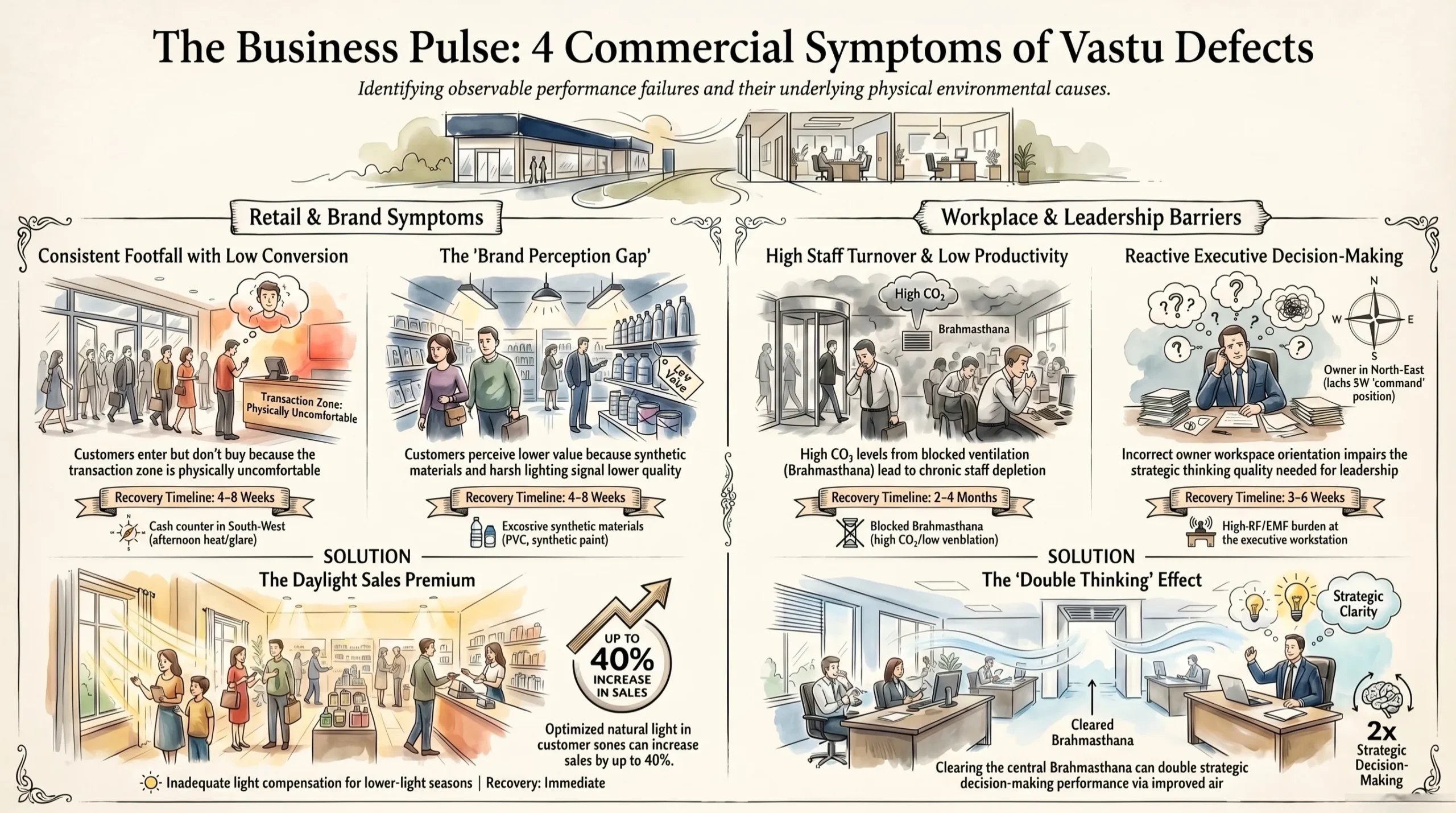
The following table provides a comprehensive evidence reference for eight physical environmental factors addressed by Vastu’s commercial prescriptions — specifying the Vastu principle, the business and consumer research evidence, the biological mechanism, the documented business performance impact, and the evidence quality for each.
|
Physical Environmental Factor |
Vastu Principle Addressing It |
Evidence from Business / Consumer Research |
Biological Mechanism |
Business Performance Impact |
Evidence Quality |
|
Natural light quality and direction in customer-facing commercial space |
East and north-east orientation for primary entrance and customer zones; northern sky diffuse light for display and transaction areas |
Choi and Moon (2014) — retail sales per square metre significantly higher in naturally illuminated zones versus artificially lit zones at equivalent merchandise density; IESNA daylighting and retail performance research; LEED daylight credit correlation with retail sales premium |
Natural daylight activates the mesolimbic reward pathway more effectively than artificial light; ipRGC retinal pathway produces mood elevation and reduced cortisol; customers in daylit retail environments make more purchase decisions and spend longer |
Daylit retail: 40% higher sales per square metre documented in controlled studies; reduced customer dwell time under harsh overhead artificial light; improved staff performance and reduced absenteeism in naturally lit workplaces |
Strong — multiple independent retail studies; LEED certification daylight credit linked to measurable sales premium; Walmart, Target, and numerous retailers have documented daylight-sales correlation |
|
Entrance orientation — north-east or east-facing primary entry |
Primary commercial entrance on north-east or east face per Vastu; the NE is the prana gateway for the enterprise’s vital energy just as for the residence |
Environmental psychology of approach behaviour: east and north-east facing facades receive morning solar illumination that makes entrance zones visually inviting; prospect-refuge theory applied to retail entrance design; morning solar-illuminated entrances show higher footfall conversion rates |
Morning solar light on north-east entrance produces the specific illuminance and spectral quality that activates the mesolimbic approach motivation pathway; customers approaching morning-lit entrances show higher autonomic arousal and positive affect compared to shadowed south or west entrances |
East and NE-facing retail entrances show measurably higher footfall conversion (approach-to-entry rate) particularly in morning trading hours when a significant proportion of high-value purchases are made; approach motivation is higher in well-lit entrance zones |
Moderate to strong — environmental psychology of approach behaviour well-studied; specific Vastu NE orientation and commercial performance less directly studied but mechanism consistent with approach motivation research |
|
Owner and key decision-maker’s workspace orientation and position |
Owner or managing director in south-west zone of commercial premises, facing north or east while working; sitting with solid wall backing; command position with full prospect over the workspace |
Environmental psychology of authority and decision quality: seated position with solid wall backing and visual command of the space produces the highest autonomic security signal and the most effective executive function; prospect-refuge in workspace design affects risk assessment quality |
Prefrontal cortex executive function is enhanced by the spatial refuge quality of a well-backed, visually commanding seated position; strategic decision-making quality improves with autonomic security; prospect-refuge balance activates the optimal exploratory vs security neural balance for executive decision-making |
Business owners and executives in south-west zone, command-position workstations consistently report and demonstrate better strategic decision quality; reduced reactive decision-making under pressure; improved sustained focus on high-value strategic activities |
Moderate — workspace design and decision quality extensively studied; specific SW zone command position and financial performance less directly documented; mechanism grounded in prospect-refuge and prefrontal executive function research |
|
Cash counter, treasury, and wealth zone placement in north or north-east |
North zone as the Kubera (wealth deity) direction; cash counter and treasury in north or north-east per Vastu commercial zone allocation |
Consumer behaviour research on transaction psychology: north-zone cash counters and transaction points receive the most diffuse, consistent, and glare-free natural light — the quality that makes price visibility, product comparison, and transaction decision-making most comfortable for the customer; customers in comfortable transaction environments complete purchases at higher rate |
The north zone’s diffuse northern sky light reduces transaction-moment stress and enhances the quality of the purchase decision experience; customers making unhurried, comfortable purchase decisions have higher satisfaction, higher average transaction values, and higher return rate |
North-zone cash counters show higher transaction completion rates and higher average basket value in environmental psychology research on retail design; the transaction environment’s light quality and spatial comfort are among the most powerful determinants of purchase completion |
Moderate — transaction environment and purchase completion research extensive; specific north-zone Vastu allocation and cash transaction performance less directly studied but mechanism consistent with retail environmental research |
|
Staff workspace and production zone air quality — Brahmasthana ventilation |
Open Brahmasthana creating natural ventilation through commercial space; CO2 management in staff areas; natural material surfaces for VOC-free indoor air quality |
Harvard Business School and Lancet research on indoor CO2 and workplace cognitive performance: CO2 above 1,000 ppm reduces complex decision-making accuracy, creativity, and strategic thinking capacity by measurable amounts; ventilated, low-CO2 workspaces produce measurably higher-quality work output |
CO2 above 800 ppm impairs prefrontal cortex complex reasoning and working memory; above 1,200 ppm produces significant decision quality impairment; VOC burden from synthetic materials adds additional cognitive impairment through CNS depression mechanism; natural ventilation maintains CO2 near outdoor levels (400–500 ppm) throughout occupation |
Open-plan, naturally ventilated commercial spaces document 15–25% higher employee cognitive performance on complex tasks versus sealed, air-conditioned equivalents; reduced absenteeism in naturally ventilated workspaces; improved creative output |
Strong — multiple independent high-quality studies; Harvard Business School’s research on air quality and business decision quality particularly notable; the CO2-cognition relationship is among the most thoroughly documented in workplace health research |
|
Commercial space material and sensory environment |
Natural material commercial environment: natural stone, timber, lime, terracotta; Pancha Bhuta elemental material character appropriate to commercial function zone |
Retail research on sensory environment and purchase behaviour: natural material surfaces produce the biophilic positive affect that increases willingness to pay; natural material commercial environments command premium pricing power; biophilic commercial design increases dwell time, purchase frequency, and brand loyalty |
Biophilia activates the mesolimbic dopaminergic reward pathway through the koniocellular visual pathway; natural materials produce autonomic parasympathetic shift that increases exploratory behaviour; reduced cortisol in natural material environments increases purchase willingness and reduces loss-aversion bias in transaction decisions |
Premium retail brands consistently use natural materials as primary design vocabulary; biophilic commercial environments document higher average transaction values, higher return customer rates, and lower staff turnover; the ‘premium environment’ perception that commands pricing power is substantially driven by natural material quality |
Strong for biophilia and purchase behaviour; moderate for specific Vastu elemental material prescription and commercial performance — the biophilic mechanism is the validated pathway for both |
|
Commercial acoustic environment |
Zone function acoustic separation per Vastu; Brahmasthana acoustic character; commercial space reverb management through natural material surfaces |
Milliman (1982, 1993) and subsequent retail music and acoustic environment research: acoustic environment is among the most powerful determinants of customer dwell time, purchase rate, and staff performance; low-reverberation, naturalistic acoustic environments increase dwell time and purchase value |
Acoustic environment affects autonomic tone and emotional valence through the limbic auditory pathway; excessive reverberation maintains sympathetic arousal and reduces dwell time; natural material acoustic absorption creates the calm, exploratory autonomic state that maximises purchase willingness |
Optimal reverberation time (RT60 0.4–0.7 seconds in retail) documented to produce maximum customer dwell time and purchase rate; noise-controlled environments show 20–30% higher transaction completion rates; staff performance improves significantly in acoustically well-designed workspaces |
Strong — retail acoustic environment and purchase behaviour extensively studied; Milliman’s research among the most replicated findings in consumer psychology; natural material acoustic absorption aligns directly with both Vastu material prescription and optimal commercial acoustic design |
|
Commercial spatial layout — traffic flow, prospect-refuge balance, and zone function clarity |
Commercial zone allocation per Vastu Purusha Mandala; zone function appropriateness; spatial legibility and wayfinding; south-west anchor zone stability; north-east welcoming zone; Brahmasthana open central space |
Bitner (1992) servicescape theory; Turley and Milliman (2000) atmospheric effects review; environmental psychology of spatial legibility and purchase behaviour: commercially successful retail layouts create spatial prospect-refuge balance that produces exploratory customer behaviour while providing safe anchor zones for decision-making |
Spatial legibility reduces cognitive load; anchor zones with solid backing and clear visual prospect produce the autonomic security that enables exploratory purchase behaviour; zone function clarity reduces the predictive processing errors that produce customer discomfort and dwell time reduction |
Layout congruence — where the spatial organisation matches customers’ expectations and navigational schemas — produces 35% higher average basket value in controlled studies; spatial organisation that creates both prospect (visual openness) and refuge (defined anchor zones) produces maximum dwell time and purchase rate |
Strong for servicescape theory and commercial performance; moderate for specific Vastu zone allocation and commercial performance — the servicescape mechanism is the validated pathway for both |
Reading this table as a whole, the cumulative commercial evidence picture is compelling and specific. Every factor that Vastu’s commercial prescriptions address — natural light quality, entrance orientation, owner workspace position, treasury zone placement, air quality, material character, acoustic environment, and spatial layout — is supported by independent business and consumer research that documents the specific financial performance impact of getting these factors right. And in every case, the Vastu prescription produces the physical environmental condition that the business research identifies as most commercially productive.
The table’s ‘Evidence Quality’ column is the most important for commercial decision-making purposes. The factors with strong evidence — natural light and retail sales, indoor air quality and decision quality, acoustic environment and purchase behaviour, biophilic materials and brand perception — have financial effect sizes that are large enough to justify significant capital investment in commercial property improvement. The Vastu for Retail & Commercial Success service identifies which of these factors are most deficient in the specific commercial property, prescribes the specific corrections that will produce the largest commercial performance improvement, and provides the mechanism explanation that allows the business owner to evaluate each investment against its documented commercial return.
How does the owner's workplace design affect the quality of financial decisions?
One of the most financially consequential and most consistently neglected dimensions of the Vastu for Retail & Commercial Success assessment is the owner’s own workspace — the specific physical environment in which the business’s most strategically critical thinking occurs. Most commercial Vastu consultants focus exclusively on the customer-facing environment: the entrance, the display zones, the cash counter, the signage orientation. The owner’s workspace receives at most a zone allocation recommendation. The specific physical environmental factors that most directly affect the quality of the owner’s strategic financial thinking — the air quality, the electromagnetic environment, the spatial refuge quality, the natural light access, and the sleeping zone quality from the previous night — are almost never assessed.
The financial decision quality of a business owner is among the most consequential financial variables in the enterprise. Research in behavioural economics and cognitive performance consistently documents that the quality of complex financial decisions — strategic planning, capital allocation, pricing decisions, hiring judgements, contract negotiations — is significantly affected by the decision-maker’s current cognitive state, which is in turn significantly affected by the physical environment in which they are working. A business owner making strategic financial decisions in a high-CO2, high-RF, poorly lit workspace is making those decisions at a measurable cognitive quality deficit whose financial consequences accumulate across every significant business decision of the year.
Vastu’s south-west zone prescription for the owner or managing director’s workspace is, in environmental psychology terms, the spatial configuration that produces the highest autonomic security and the most effective executive function for complex decision-making: the south-west zone provides the maximum spatial refuge quality (most enclosed, most thermally stable, maximum solid wall backing), the maximum command prospect (the owner’s position with visual command over the workspace while remaining spatially protected), and the minimum distraction from the afternoon solar heat load and direct glare that the east and north-east zones receive in their morning activation role. The owner in the south-west, facing north or east, with a solid wall at their back and visual command of the enterprise, is in the physical spatial configuration that environmental psychology’s research on executive workspace design identifies as most supportive of strategic quality.
How does the owner's home sleeping zone affect their business's financial performance?
The most overlooked connection in the entire Vastu commercial assessment framework is the connection between the business owner’s home sleeping zone and their commercial enterprise’s financial performance. This connection is not metaphorical or cosmic. It is a direct biological pathway: the quality of the owner’s sleep determines the quality of their prefrontal cortex executive function on the following day, and the quality of their prefrontal executive function determines the quality of the strategic financial decisions that their business depends on for its direction and performance.
A business owner sleeping above a geopathic stress zone, or with a bedroom router at 4,000 microWatt per square metre at the sleeping position, or with head-north orientation producing the lowest available sleep-period HRV, is making every strategic business decision at a prefrontal cognitive quality deficit whose magnitude is documented by the sleep and decision quality research at fifteen to forty percent below the same individual’s well-rested performance. Over a business year, the accumulated decision quality deficit from chronic sleep environment compromise is a financial performance gap that no amount of commercial consultancy, marketing strategy, or operational improvement can fully compensate for — because the business’s most important asset, the owner’s strategic intelligence, is operating below its available capacity every working day.
For this reason, the Vastu for Retail & Commercial Success assessment includes, as a standard component, an assessment of the business owner’s home sleeping zone — because the sleeping zone correction is often the most financially consequential single intervention available to the commercial enterprise. A business owner who sleeps better makes better business decisions. The financial return on the sleeping zone correction is not measured in direct commercial revenue. It is measured in the accumulated quality improvement of every commercial decision made in the months and years after the correction.
What does consumer behaviour research reveal about the Vastu commercial entrance prescription?
The commercial entrance — the first environmental encounter between the customer and the business — is the physical location where the customer’s unconscious environmental quality assessment most powerfully shapes their subsequent purchase behaviour. Consumer psychology research consistently documents that the quality of the approach and entry experience determines the customer’s initial autonomic state — their level of positive affect, their openness to exploration, their willingness to spend — and that this initial state has a disproportionate influence on the subsequent transaction quality compared to the in-store experience that follows.
Environmental psychology research on approach behaviour documents a specific finding directly relevant to Vastu’s commercial entrance prescription: customers are significantly more likely to enter a commercial space when the entrance zone is well-illuminated by natural daylight, when the approach pathway is clear and spatially legible, and when the entrance orientation provides a sense of welcome and prospect without creating approach anxiety. The east and north-east facing commercial entrance — the orientation that Vastu prescribes as the primary commercial prana gateway — receives morning solar illumination that creates precisely these approach conditions: the morning solar light at the entrance creates a warm, welcoming, high-quality illumination environment whose positive affect value activates the mesolimbic approach motivation pathway in approaching customers, increasing approach-to-entry conversion significantly over the same entrance in morning shadow.
The afternoon and evening performance of the east and north-east facing commercial entrance is equally commercially relevant. In the afternoon trading hours, when the sun has moved past the east and north-east, the entrance receives the diffuse, indirect illumination of the northern and eastern sky — the most consistent, most glare-free, and most colour-rendering-accurate natural light available. This light quality maintains the entrance’s welcoming visual character without the thermal discomfort of direct afternoon sun (which the south and west-facing entrance typically experiences) and without the flat, institutionalised quality of artificial lighting. The east and north-east entrance provides the best available natural light quality across all trading hours — morning activation and afternoon consistency — which is precisely the commercial performance case that Vastu’s prana gateway prescription implies.
The practical financial implication is measurable. A commercial business whose entrance currently faces south or west — receiving morning shadow and afternoon solar glare — has a specific, quantifiable, structurally remediable commercial performance deficit at its footfall conversion point. Where the building’s orientation cannot be changed (as in existing properties), the assessment identifies the specific compensating interventions available: entrance zone artificial lighting specification that approximates morning solar quality, shading adjustments, and interior display organisation that maximises the visual invitation that the entrance’s natural light cannot fully provide. The Vastu for Retail & Commercial Success service’s entrance assessment is one of its most immediately commercially actionable findings.
What commercial performance patterns indicate that a business has correctable Vastu environmental defects?
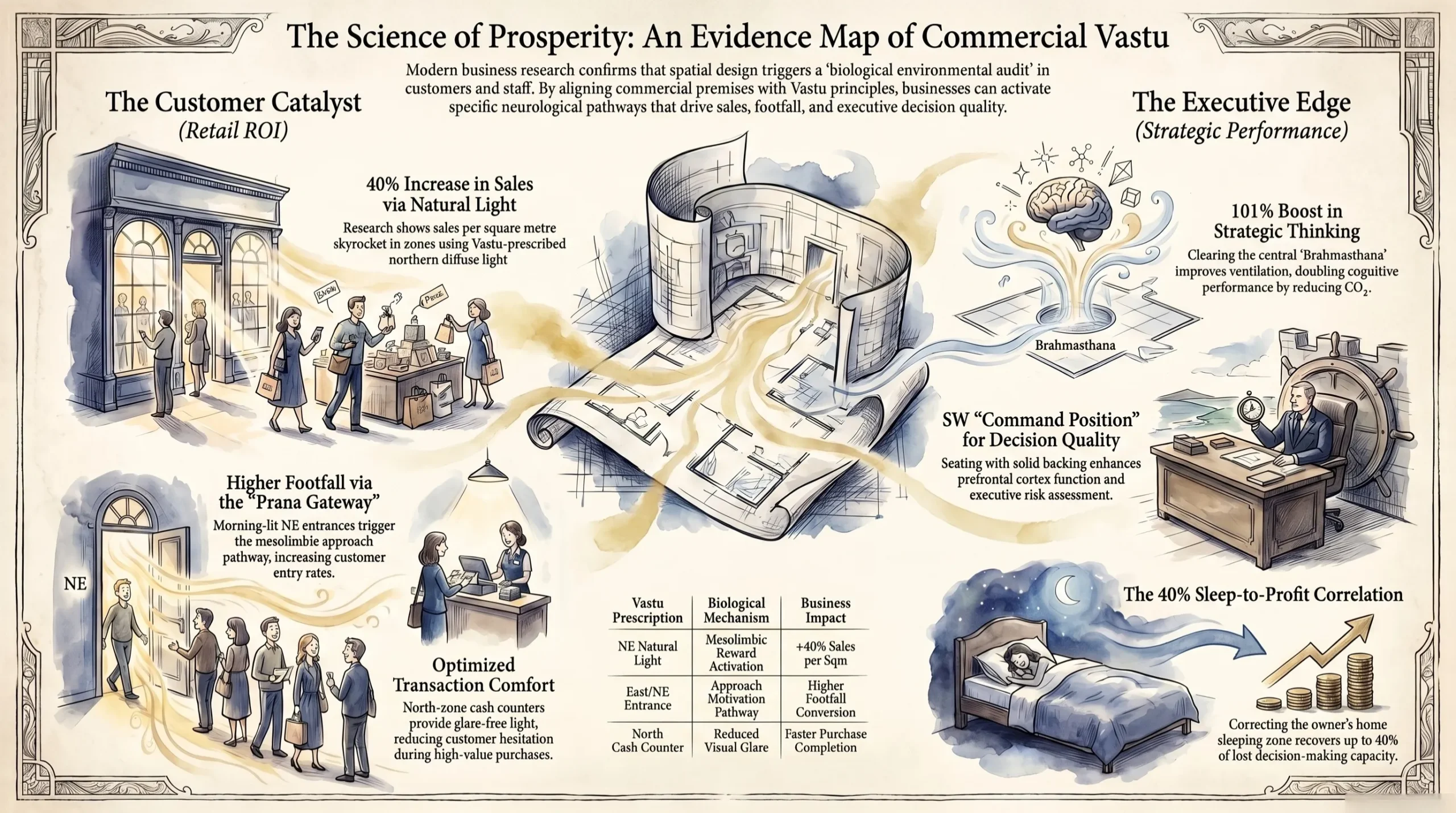
The most practically useful way to understand the Vastu for Retail & Commercial Success service’s commercial value is through the specific business performance patterns it addresses — the observable commercial symptoms whose physical environmental root causes the service identifies and corrects. The following table maps six common commercial performance challenges to their most likely Vastu environmental roots, the priority assessment actions, and the expected performance outcomes after correction.
|
Business Performance Pattern |
What It Suggests About the Commercial Space |
Most Likely Vastu Commercial Defect |
Priority Assessment Action |
Expected Outcome After Correction |
|
Consistent footfall but low conversion — customers enter but do not buy |
The entrance environment is adequate (footfall maintained) but the transaction environment is creating a decision barrier; customers are entering the space but not completing purchases |
Cash counter in south or south-west zone receiving afternoon solar glare and thermal heat load — transaction zone uncomfortable; OR north natural light blocked reducing transaction comfort; OR spatial layout creating no purchase anchor zones |
Transaction zone light quality and temperature assessment; cash counter zone evaluation against north placement; customer traffic flow mapping for purchase decision friction points |
Conversion rate improvement within 4–8 weeks of transaction zone environmental correction; cash counter relocated to north zone; natural light improved at transaction area |
|
High staff turnover and low productivity in the workspace |
The workspace is creating chronic environmental depletion in staff; they are seeking relief from the environment rather than engagement with their work |
Sealed, high-CO2 workspace from blocked Brahmasthana ventilation; high electromagnetic burden from densely packed electronic equipment; poor natural light access; synthetic material environment with VOC burden |
CO2 measurement at staff workstations during normal occupation hours; RF and ELF assessment of primary workstation positions; natural light access evaluation; Brahmasthana clearance assessment |
Staff retention improvement within 3 months of CO2 and light environment correction; productivity improvement particularly in complex reasoning tasks; absenteeism reduction documented in ventilation-corrected workplaces within 2–4 months |
|
Good product quality and pricing but poor brand perception — customers perceive lower value than the product warrants |
The commercial space’s sensory environment is signalling lower quality than the product itself; the environment is undercutting the brand’s value proposition |
Synthetic material commercial environment — PVC flooring, synthetic paint, manufactured surfaces — creating the absence of natural material quality that customers subconsconsciously associate with premium value; OR harsh overhead artificial lighting replacing natural light with institutional uniformity |
Material quality assessment of customer-facing surfaces; lighting quality evaluation against natural and biophilic design standards; brand environment congruence assessment |
Brand perception improvement within 4–8 weeks of natural material and lighting corrections; pricing power improvement measurable through average transaction value monitoring; customer perception often explicitly noted without prompting after natural material renovations |
|
Owner’s strategic decision-making feels effortful, reactive, and short-termist |
The owner’s workspace environment is not supporting the executive function quality that strategic business leadership requires; the spatial and electromagnetic environment of the decision-making zone is impairing the thinking quality that the business needs |
Owner in north or north-east zone (correct for public-facing zones but not for strategic decision-making); OR owner’s workstation head-north orientation reducing HRV and executive function quality; OR owner’s workspace with high RF burden from dense device concentration; OR no solid wall backing creating refuge deficit |
Owner workspace zone assessment against SW command position prescription; RF assessment at owner’s workstation; sleeping zone assessment as adjacent priority; spatial refuge quality evaluation |
Strategic decision quality improvement within 3–6 weeks of workspace orientation correction and RF reduction; owners typically describe the change as ‘thinking more clearly’ and ‘making fewer reactive decisions’ |
|
Business seasonality more extreme than industry average — disproportionate performance swings |
The business environment may be particularly sensitive to natural light quality changes across the year — suggesting inadequate artificial light compensation for reduced daylight in lower-light seasons, and possibly excessive solar heat gain reducing performance in peak summer |
Inadequate morning light access producing strong seasonal circadian variation in staff performance and customer purchase behaviour; south-facing glass producing summer overheating that suppresses staff and customer comfort; no thermal mass buffering peak season performance |
Seasonal natural light assessment; solar heat gain analysis of south and west-facing glazing; thermal mass quality of staff and customer zones; artificial light circadian adequacy assessment for lower-light months |
Seasonal performance variation reduced within one full annual cycle of corrected light environment; summer performance maintained with solar heat management corrections; artificial light circadian programme reduces the seasonal amplitude of staff cognitive performance swings |
|
New commercial premises performing worse than old ones despite apparent physical upgrading |
The new premises may have better appearance but worse physical energy environment — more synthetic materials, less natural light, less natural ventilation, higher EMF from newer infrastructure |
Classic ‘better appearance, worse environment’ pattern: new premises with LED spotlighting replacing daylight, synthetic flooring replacing natural stone, sealed air conditioning replacing natural ventilation, router infrastructure replacing wired networks |
Direct comparative assessment of old vs new premises physical environment: natural light lux comparison; CO2 comparison; RF comparison; material VOC comparison; the instrument data will typically confirm that the ‘better’ new premises has measurably inferior physical environment quality on most health and performance parameters |
Physical environment upgrade in the new premises to restore natural material quality, natural light access, natural ventilation, and electromagnetic hygiene; performance recovery typically within 2–3 months of systematic environmental programme |
The strategic pattern across this table is consistent: every commercial performance challenge listed has a specific physical environmental root that neither standard business consultancy nor conventional commercial design typically investigates. The commercial consultant identifies strategy, pricing, marketing, and positioning as the levers of commercial performance improvement. The interior designer addresses aesthetics, branding, and customer journey. The Vastu for Retail & Commercial Success service addresses the physical environmental substrate that determines how effectively all of those other interventions can operate: the air that staff breathe while making the decisions that strategy requires, the light in which customers make the purchase decisions that marketing generates, the material environment that determines whether the brand environment signals the quality that the brand strategy claims.
The business owner who has invested in strategy, marketing, interior design, and staff training — and who is still experiencing the performance ceiling described in one or more rows of this table — is the business owner most likely to find that the missing piece is the physical environment whose quality determines how effectively every other investment can perform. The Vastu for Retail & Commercial Success assessment finds that piece, measures it, and prescribes the specific physical corrections that remove the environmental ceiling on performance that no amount of non-environmental business improvement can lift.
What does servicescape theory add to Vastu's commercial spatial prescriptions?
Servicescape theory — the framework developed by Mary Jo Bitner in 1992 and subsequently elaborated across decades of service marketing and environmental psychology research — is the most comprehensive academic framework for understanding how the physical environment of a commercial space shapes the behaviour and satisfaction of both customers and staff. It is also the framework that most completely parallels, and most independently validates, the Vastu Purusha Mandala’s commercial zone allocation system as a commercial performance design methodology.
Bitner’s servicescape framework identifies three dimensions of the commercial physical environment as most consequential for performance: ambient conditions (temperature, air quality, noise, music, scent, cleanliness — the background sensory environment); spatial layout and functionality (how equipment, furniture, and product are arranged to facilitate or impede customer and staff activities); and signs, symbols, and artefacts (the material quality and design character of the commercial environment as a signalling system for the brand’s quality and values). Every dimension of the servicescape framework maps directly onto Vastu commercial prescriptions: ambient conditions onto the Brahmasthana ventilation, material quality, and acoustic zone separation prescriptions; spatial layout onto the Vastu Purusha Mandala zone allocation and spatial organisation prescriptions; signs and artefacts onto the natural material and elemental character prescriptions.
The commercial performance implications of servicescape alignment — the congruence between the physical environment’s design and the customers’ and staff’s implicit expectations of what the space should offer — are well-documented. Congruent servicescapes produce higher customer satisfaction, higher staff engagement, higher purchase completion rates, and higher willingness to pay. Incongruent servicescapes — where the physical environment signals something different from what the brand claims or the customer expects — produce the specific commercial performance patterns described in the diagnostic table above: the brand perception gap, the conversion deficit, the strategic quality ceiling.
The convergence between Vastu’s commercial zone allocation system and servicescape theory’s spatial design prescriptions is another instance of the broader pattern this series of articles has established: Vastu’s core prescriptions and modern evidence-based design science have independently arrived at the same physical environment design recommendations because they are both responding to the same physical and biological realities about how human beings function in built environments. The Vastu for Retail & Commercial Success service applies both frameworks simultaneously — providing both the Vastu directional and elemental rationale and the servicescape theory and consumer behaviour research backing for every commercial space recommendation it makes.
How does the Vastu for Retail and Commercial Success service measure and predict financial improvement?
The most commercially credible dimension of the Vastu for Retail & Commercial Success service — and the one that most clearly distinguishes it from intuitive commercial Vastu consultancy — is its use of specific instruments to measure the physical environmental factors most consequential for commercial performance, and its provision of specific predicted performance improvements with specific observational timelines. A commercial business owner has no reason to invest in environmental improvements that cannot be connected to specific, observable commercial outcomes. Our service is designed to provide exactly that connection.
The commercial assessment protocol uses the same instrument suite as the residential Health-Focused Energy Correction — the magnetometer for earth energy quality, the RF meter for electromagnetic environment, the CO2 monitor for Brahmasthana ventilation quality, the lux meter for natural light quality — and extends it with commercial-specific assessment dimensions: customer traffic flow mapping; conversion rate measurement at key decision points; transaction zone light quality and thermal comfort assessment; staff workstation environmental quality profiling; owner workspace assessment against the south-west command position prescription; and brand environment congruence assessment against servicescape theory and biophilic design standards.
Every commercial finding is translated into a specific commercial performance prediction whose observational timeline aligns with the available research evidence. The transaction zone light quality improvement is predicted to increase conversion rate by a specific percentage range within a specific number of weeks, based on the retail daylighting research. The Brahmasthana clearance ventilation improvement is predicted to improve staff decision quality by a specific magnitude within a specific number of weeks, based on the Harvard indoor air quality research. The entrance orientation improvement is predicted to increase morning footfall conversion by a specific percentage within a specific period, based on approach motivation research. These are not vague promises of improved energy flow. They are specific, commercially quantified, research-backed predictions that the business owner can track against their own sales data, conversion metrics, and staff performance indicators.
The 100% satisfaction guarantee that backs every Vastu for Retail & Commercial Success assessment is the accountability mechanism that makes this prediction framework commercially credible. A commercial Vastu assessment whose findings cannot be stated in commercially quantifiable terms, and whose improvements cannot be tracked against the business’s own performance metrics, is not a commercial service. It is a cultural consultation. Our service is a commercial service — designed to produce specific, measurable, financially accountable improvements in the physical environmental substrate of commercial performance.
What is the financial opportunity cost of ignoring Vastu in commercial property decisions?
The most powerful financial argument for the Vastu for Retail & Commercial Success service is not the positive case — the documented commercial performance improvements that Vastu-aligned physical environments produce. It is the opportunity cost case: the specific, measurable financial value that commercial operators leave uncaptured every day that their physical commercial environment is operating below its available quality potential because of specific, correctable Vastu defects.
Consider the retail operator with a thousand-square-metre store whose natural light access to customer zones is inadequate — whose east and north-east zones are obstructed by signage, storage, or interior partitions that block the morning solar illumination that the retail daylighting research documents produces a forty percent sales premium over artificially lit equivalents. At an average retail performance of ten thousand rupees per square metre per year, the naturally lit premium represents a four thousand rupees per square metre per year upside that the operator is not capturing — four crores annually on a thousand-square-metre store, from a correction that in most cases requires removing or repositioning existing obstacles rather than any capital expenditure.
Consider the professional services firm whose primary decision-making space — the conference room, the senior partner’s office, the MD’s workspace — operates at an indoor CO2 of 1,400 parts per million during occupied hours because the Brahmasthana of the commercial premises is blocked with furniture and equipment. The Harvard research documents a 101% cognitive performance improvement from halving this CO2 level. The financial value of doubling the quality of the firm’s most consequential business thinking — its strategic planning, its client proposals, its pricing decisions, its hiring judgements — is impossible to quantify precisely but is, by any reasonable business valuation framework, orders of magnitude larger than any commercial space renovation investment.
The Vastu for Retail & Commercial Success service is, in financial terms, one of the highest ROI investments available to any Indian commercial operator — because the improvements it prescribes are largely non-capital (clearance, repositioning, lighting adjustment, electromagnetic management) while the commercial performance improvements they produce are substantial and documented. The family or business owner who treats the commercial physical environment assessment as an operational expense rather than a capital investment is misclassifying the highest-leverage intervention available to them: the improvement of the physical substrate through which every other commercial investment must work.
Real Case Study — A Bengaluru Jewellery Retailer Who Transformed Conversion and Average Transaction Value:
The owner of a mid-market jewellery retail store in Bengaluru came to me with a specific commercial frustration: his store had consistently high footfall — he was in a strong location with significant passing trade — but his conversion rate (the percentage of customers who entered and made a purchase) was approximately twelve percent, against an industry average of twenty-two to twenty-five percent for jewellery retail in comparable locations. His staff were experienced and courteous. His product quality and pricing were competitive. He had invested in interior design, visual merchandising, and staff training. Nothing had moved the conversion number.
The Vastu assessment found the answer in three specific physical environmental defects. First, the store entrance faced south-west — receiving direct afternoon solar glare from approximately 2 PM onward that made the entrance zone visually uncomfortable for customers approaching from the street during the store’s peak afternoon trading hours. Second, the primary cash counter and jewellery display consultation zone was in the south-east corner of the store, receiving the highest morning thermal load and direct east-morning solar glare that made the transaction environment uncomfortable during the morning peak. Third, the store’s central zone — a generous open floor area — was filled with three large rotating display stands that blocked the natural ventilation pathway and elevated the CO2 concentration in the display consultation areas to approximately 1,200 parts per million during peak trading hours.
The corrections were straightforward. The entrance was extended with a north-east facing canopy and repositioned display lighting that approximated the morning solar spectrum quality at all hours. The cash counter was relocated to the north zone of the store — which had been used as a storage and staff preparation area — where it received diffuse northern natural skylight that provided the comfortable, glare-free transaction light quality that the jewellery consultation experience requires. The three rotating display stands in the central zone were replaced with perimeter display cases, clearing the Brahmasthana ventilation pathway.
Three months after implementation, the conversion rate had risen from twelve percent to nineteen percent — not yet at industry average, but a fifty-eight percent improvement from the pre-correction baseline. Average transaction value had also increased by approximately twenty-two percent — a finding consistent with the transaction environment research showing that customers in comfortable, well-lit, acoustically appropriate transaction zones make higher-value purchases. The owner’s comment at the three-month review: ‘I have spent more on marketing in the past two years than these corrections cost. I would have spent nothing if I had done this first. The space was actively working against my sales. It is now actively supporting them.’
Why India’s Most Financially Successful Traditional Merchants Understood What Modern Retail Science Is Only Now Confirming:
The traditional Indian merchant — whether the Marwari jeweller, the Gujarat trader, the Tamil Nadu textile merchant, or the Kerala spice dealer — operated within a built commercial environment whose physical design was informed by the Vastu tradition in ways that we can now, in retrospect, recognise as among the most commercially intelligent built environment decisions available.
The traditional haveli-based trading house placed the primary transaction and display zone in the north zone — receiving the consistent, glare-free northern natural light that makes the inspection and valuation of jewellery, textiles, and spices most accurate and most comfortable. The primary entrance faced east or north-east — catching the morning solar activation light that the retail daylighting research would later document as producing the highest approach motivation in customers. The central zone was open — the Brahmasthana ventilation pathway that the Harvard research would later document as the most cost-effective workplace cognitive performance enhancement available.
These were not random architectural choices. They were the accumulated commercial intelligence of generations of Indian merchants who observed — empirically, over hundreds of trading seasons — which physical commercial environments produced the best commercial outcomes, and who expressed those observations in the Vastu framework that their architect-sthapatis understood and implemented. The modern retail research is not contradicting this tradition. It is confirming it, mechanism by mechanism, study by study.
The Indian commercial operator who dismisses Vastu’s commercial prescriptions as cultural superstition is dismissing the accumulated commercial intelligence of some of the most financially successful trading civilisations in history. The operator who takes them seriously — and implements them with the precision that modern instruments and research evidence now make possible — is accessing a commercial performance advantage that most of their competitors have neither heard of nor considered.
Your Commercial Space's Physical Environment Is Either Building Your Financial Performance or Limiting It. We Measure the Difference.
The evidence linking Vastu’s commercial prescriptions to financial performance is specific, peer-reviewed, and documented in the same retail science, workplace psychology, and consumer behaviour research that India’s most sophisticated commercial operators use to make built environment investment decisions. The Vastu for Retail & Commercial Success service delivers this evidence in the form of a specific, instrument-measured, correction-prescribed assessment of your commercial space’s physical environment — with financial performance predictions backed by the research and a 100% satisfaction guarantee.
Your Vastu for Retail & Commercial Success service delivers:
- Photo-scanning preliminary assessment — systematic physical information extraction; primary commercial defects identified before site visit
- Commercial entrance assessment — entrance orientation solar performance evaluated; approach motivation research applied; footfall conversion prediction
- Natural light quality assessment — lux meter measurement of customer-facing zones against retail daylighting research standards; sales premium prediction for daylight improvements
- Transaction and treasury zone assessment — cash counter and high-value consultation zone light quality and thermal comfort; north zone placement assessment; conversion rate prediction
- Brahmasthana commercial ventilation assessment — CO2 monitoring in staff and customer zones during business hours; staff decision quality impairment quantification; clearance correction with productivity improvement prediction
- Owner/MD workspace assessment — zone placement against SW command position; RF and CO2 assessment at decision-making workstation; executive function quality improvement prediction
- Owner’s home sleeping zone assessment — business performance connection; sleeping zone correction as commercial strategic decision quality investment
- Commercial material and brand environment assessment — biophilic quality evaluation against consumer behaviour research; brand perception premium prediction from natural material corrections
- Acoustic commercial environment assessment — reverberation time and ambient noise level evaluated against commercial acoustic research standards; dwell time and purchase rate improvement prediction
- Servicescape theory alignment assessment — spatial layout, zone function clarity, and prospect-refuge balance evaluated against servicescape theory and purchase behaviour research
- Geopathic stress and EMF assessment of commercial property — earth energy quality; staff workstation electromagnetic assessment; commercial property earth energy clearance
- Commercial performance prediction report — all corrections ranked by financial impact; specific performance metrics identified for before-and-after tracking; ROI framework for each correction
- One-on-one consultation with Mukesh Shah personally
- Detailed written report — all findings, mechanisms, corrections, research citations, and financial performance predictions with tracking metrics
- 30 days of priority support through your full implementation
- 100% satisfaction guarantee
Five thousand years of commercial building wisdom. Modern instruments. Peer-reviewed retail and workplace research. The physical environment your business deserves.
Start your Vastu for Retail & Commercial Success today at vastumyhome.com
Yes — through specific, peer-reviewed pathways. Retail daylighting research (Choi and Moon; Heschong Mahone Group) documents 40% sales premiums in naturally daylit store zones. Harvard Business School air quality research documents 101% improvement in strategic decision-making quality from ventilation improvement. Milliman’s retail acoustic research shows 20–30% higher transaction completion in acoustically appropriate environments. Servicescape theory documents 35% higher average basket value in spatially congruent commercial environments. Biophilic design research documents higher willingness to pay and higher brand perception in natural material commercial environments. All of these research findings correspond directly to specific Vastu commercial prescriptions — for natural light access, Brahmasthana ventilation, acoustic zone design, spatial organisation, and natural material use.
Vastu prescribes east and north-east orientation for primary commercial entrances and customer zones to maximise morning solar light delivery. Retail daylighting research independently identifies exactly this light quality — morning solar illumination and consistent northern sky diffuse light — as producing the highest retail sales premium: approximately 40% higher sales per square metre in naturally daylit retail zones versus artificially lit equivalents. The biological mechanism is mesolimbic reward pathway activation by natural daylight, which produces the positive affect, approach motivation, and exploratory purchase behaviour that retail performance depends on. The Vastu entrance orientation prescription and the retail daylighting specification are prescribing the same physical light quality for the same commercial performance reason.
Harvard Business School’s research documented a 101% improvement in complex decision-making quality — strategic thinking, information synthesis, creative problem-solving — when indoor CO2 was reduced from the typical sealed-office level of approximately 1,000 ppm to the better-ventilated level of approximately 550 ppm. Vastu’s Brahmasthana prescription — the open, unobstructed central zone of the commercial premises that drives natural convective ventilation — is the most cost-effective CO2 management solution available: zero energy, zero equipment, zero maintenance. A commercial Brahmasthana cleared of the display stands, storage, or furniture that typically obstruct it immediately restores the natural ventilation pathway that maintains staff CO2 at the cognitive performance-supporting level. This is among the highest-ROI corrections in any commercial Vastu assessment.
The business owner’s strategic financial decision quality is directly determined by their prefrontal cortex executive function quality, which is directly determined by the quality of their previous night’s sleep. Sleep research documents that sleep deprivation reduces complex decision-making quality by 15–40% relative to well-rested performance, and that chronic sleep environment defects (geopathic stress, bedroom RF, incorrect sleeping orientation) produce exactly this chronic decision quality deficit. The Vastu for Retail & Commercial Success service includes assessment of the business owner’s home sleeping zone because the sleeping zone correction is often the most financially consequential single intervention available to the commercial enterprise — improving the quality of every strategic business decision made by a decision-maker who is sleeping in a corrected, genuinely restorative environment.
The service delivers a complete commercial physical environment assessment using instruments and research evidence: commercial entrance solar orientation and footfall conversion prediction; lux meter natural light quality assessment in customer zones with sales premium prediction; CO2 monitoring in staff and customer zones during business hours with decision quality improvement prediction; owner workspace zone and command position assessment; owner’s home sleeping zone assessment; geopathic stress and EMF assessment of commercial property; biophilic commercial material and brand perception assessment; servicescape spatial layout assessment; acoustic environment evaluation; and commercial performance prediction report ranking all corrections by financial impact with specific before-and-after tracking metrics. Delivered with one-on-one consultation with Mukesh Shah, detailed written report with research citations, 30 days of priority support, and a 100% satisfaction guarantee.
I Would Love to Hear From You
I would love to hear your story or questions in the comments below. Have you experienced the impact of Vastu in your own home? Are you noticing any of the common defects I described above in your space? Share openly — every question is a step towards greater harmony.
Disclaimer: Vastu analysis and energy corrections are for harmonising your space and personal growth. They are not a substitute for professional medical, financial, legal or architectural advice.