

What Scientific Tools Measure Vastu Energies? Magnetometer, RF Meter & More | Vastu My Home
Namaste. I am Mukesh Shah. When I began practising Vastu twenty years ago, the assessment tools available to me were the same tools the classical tradition had used for centuries: a compass, a careful reading of the sun’s arc, a trained eye for the home’s spatial and material character, and the accumulated pattern recognition of hundreds of prior assessments calibrated against observed outcomes. These tools have genuine value. They remain the foundation of every assessment I conduct. But twenty years of practice have taught me something that the classical tradition could not have anticipated: the most important Vastu defects in the contemporary Indian home are invisible to these tools.
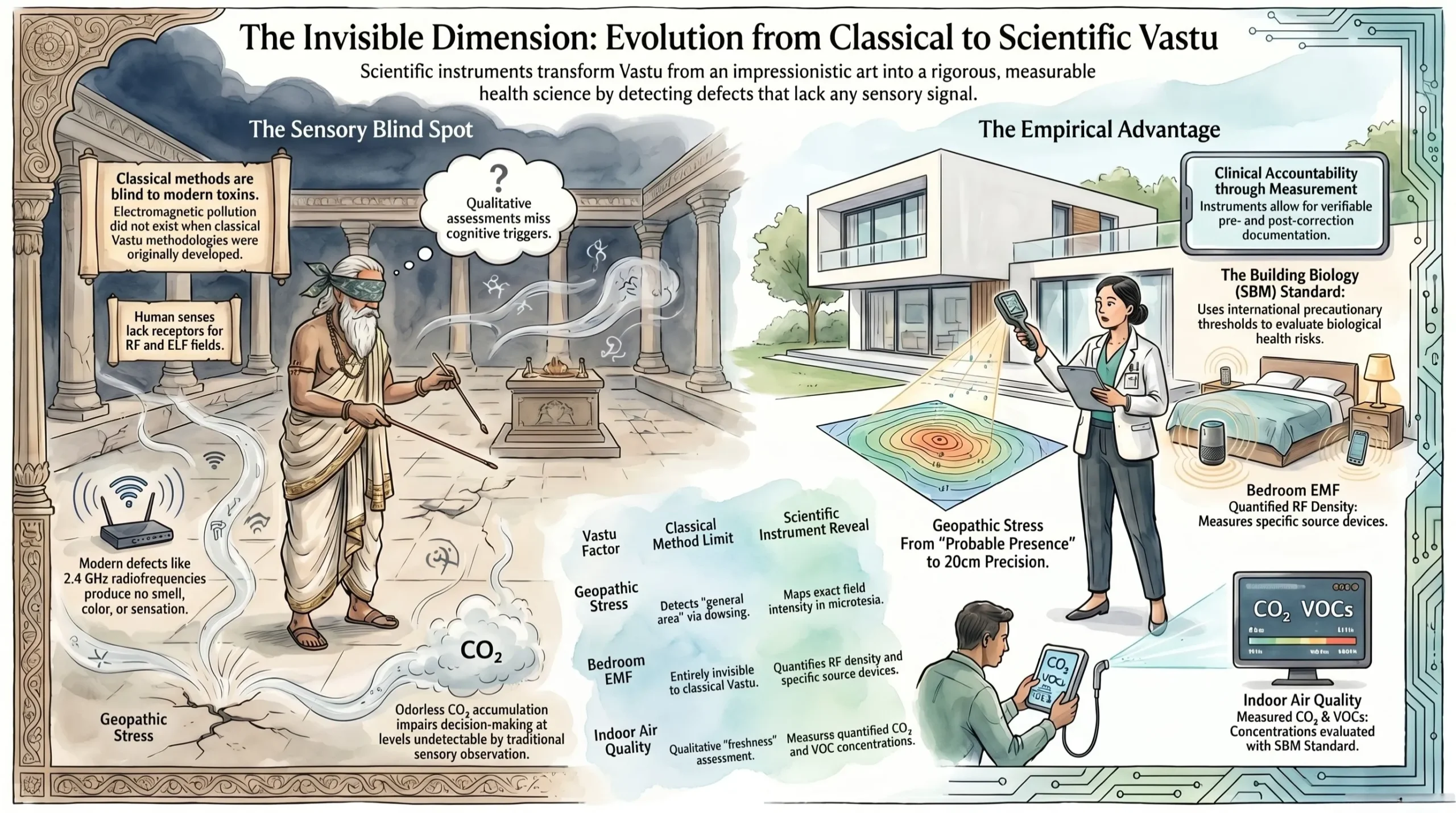
The geopathic stress zone beneath the sleeping position — whose chronic disruption of the family’s slow-wave sleep has been quietly impairing their immune function, their emotional regulation, and their cognitive performance for years — produces no visual signal. No shadow pattern, no soil discolouration, no architectural feature reveals it. Only a magnetometer, reading the local geomagnetic field in microtesla at centimetre resolution, makes it visible. The radiofrequency field from the bedroom router — suppressing the family’s melatonin, degrading their immune programme, and fragmenting their REM emotional processing each night — produces no sensory signal whatsoever. No smell, no colour, no sensation. Only an RF meter, reading in microWatt per square metre at the sleeping body position, reveals both its intensity and its correction’s effectiveness. The elevated CO2 in the home study — impairing the professional’s complex decision-making through four hours of daily working from home — is completely odourless. Only a CO2 monitor makes it visible.
This is the core argument of this article: scientific instruments do not merely add precision to Vastu assessment. They reveal the most consequential Vastu defects in the contemporary Indian home that no classical assessment methodology can see at all. And the corrections those instruments enable — moving a router, relocating a bed, opening a corridor — are so specific, so measurable, and so biologically consequential that the instrument-based assessment is, for the contemporary Indian family, not an optional enhancement to classical Vastu practice but its necessary evolution.
Understanding what each scientific tool measures, what it reveals, how it is used in a Complete Home Health Audit, and how the measurement translates into a specific, outcome-predicted correction is the knowledge that transforms Vastu from an impressionistic ancient art into the rigorous, accountable environmental health science that the tradition’s finest classical authors always intended it to be.
Why do scientific instruments reveal Vastu defects that no classical method can detect?
The gap between classical Vastu assessment methodology and scientific instrument-based assessment is not a gap of intellectual quality or analytical sophistication. The classical practitioners were, within the capabilities of their available tools, empirical scientists of the first order — careful observers who calibrated their prescriptions against observed health outcomes across thousands of dwellings and generations. The gap is simply a gap of instrument availability. The classical tradition assessed every physical factor affecting the home’s energy environment that it had instruments to assess. The instruments now available extend the assessment into physical domains that were entirely inaccessible to the classical methodology.
The most fundamental of these inaccessible domains is the electromagnetic spectrum below visible light — the radiofrequency and extremely low frequency electromagnetic fields that pervade every modern home and that have no visible, audible, or olfactory signal. The human sensory system has no receptor for these fields. No amount of training, experience, or intuitive sensitivity gives a practitioner direct perceptual access to a 2.4 GHz radiofrequency field at 3,500 microWatt per square metre at the sleeping position — the field that is suppressing the family’s melatonin by thirty percent each night. An RF meter measures it in three seconds. And the measurement is reproducible, verifiable by any practitioner with the same instrument, and directly comparable to the Building Biology SBM standard that characterises its health significance.
The second inaccessible domain is the geomagnetic field’s fine spatial structure beneath the building. The classical Vastu tradition assessed earth energies through Bhumi Pariksha — soil analysis, topographic reading, indicator plant observation, dowsing. These methods have genuine signal value: they are drawing on real physical information about the site’s underground geology and hydrology. But their spatial resolution is insufficient for the specific clinical application that the sleeping zone assessment requires. A dowsing assessment can identify that a geopathic stress feature is present in the general area of a bedroom. A magnetometer can locate the stress zone to within twenty centimetres, confirm that the sleeping position is within it or outside it, and verify that the proposed corrected sleeping position is in a genuinely clean field zone rather than a different stress position.
The third inaccessible domain is the quantitative indoor air environment. The classical tradition assessed air quality through direct sensory assessment — the smell and feel of the indoor air, the observation of condensation and mould patterns, the functional assessment of the Brahmasthana’s ventilation pathway. These sensory assessments are valid for gross air quality problems. They cannot detect CO2 accumulation at 1,500 parts per million — a concentration that impairs complex decision-making measurably in controlled studies but is entirely odourless and invisible. They cannot quantify formaldehyde off-gassing from MDF wardrobes at 0.08 parts per million — below the WHO guideline but accumulating exposure that Building Biology characterises as relevant to chronic health risk in sleeping zones.
The scientific instruments do not replace the classical assessment. They extend it into the physical domains that the classical methodology cannot reach — the domains where the most consequential contemporary Indian home Vastu defects live. A Vastu practitioner conducting an assessment without instruments today is like a physician conducting a health assessment without laboratory tests — working with the clinical observation tools of an earlier era, producing qualitatively valid but quantitatively insufficient assessments for the specific health challenges the contemporary patient presents with.
How does the magnetometer measure geopathic stress — and what does the reading actually mean?
The magnetometer is the most consequential single instrument in the Scientific Vastu assessment toolkit. It measures the geomagnetic field — the Earth’s magnetic field produced by the motion of molten iron in the outer core — at the specific location where the measurement is taken, with a precision typically of 0.1 nanotesla or better in modern fluxgate and proton precession instruments. Understanding what the magnetometer reading means in the context of a sleeping zone assessment is essential for any family who wants to engage intelligently with their assessment results.
The Earth’s geomagnetic field at most locations in India has a total field strength of approximately 30,000 to 50,000 nanotesla (30–50 microtesla), pointing roughly downward toward magnetic north with a specific inclination angle. This background field is what the magnetometer reads in an undisturbed location — and it is the field in which the human body has evolved to sleep, to orient, and to conduct the biological processes (including the magnetite-based and cryptochrome-based magnetoreception processes) that depend on geomagnetic reference. In a geopathically stressed zone, the local geomagnetic field is distorted from this background by the electromagnetic effects of underground water courses, geological fault lines, or mineral deposits — producing a local anomaly in which the field strength differs from the surrounding background by a measurable amount.
The Building Biology SBM standard — the most widely referenced international standard for indoor geomagnetic environment quality — characterises geopathic stress in terms of the anomaly delta: the difference between the local field reading and the undisturbed background field in the same room. Anomaly deltas above approximately 0.5 microtesla above background are associated with the sleep quality impairment, immune depletion, and HPA axis dysregulation that the European Building Biology clinical research has documented at geopathically stressed sleeping positions. Anomaly deltas above 1.0 microtesla are associated with more severe and more rapidly manifesting health effects. The highest residential readings I encounter in twenty years of assessment — typically produced by the intersection of a Hartmann Grid major crossing with an underground water course above a geological structure — reach 3 to 4 microtesla above background at the sleeping position.
What is the practical assessment sequence for magnetometer geopathic stress measurement?
The practical magnetometer assessment sequence in a Complete Home Health Audit follows a specific protocol designed to map the sleeping zone field accurately, identify the highest anomaly positions, confirm the background field for correct delta calculation, and verify the cleanliness of the proposed corrected sleeping position before recommending the relocation. This protocol is reproducible, independently verifiable, and produces a specific numerical finding that the family can understand and that any subsequent practitioner can confirm or replicate.
The sequence begins with a background measurement in an area of the home most likely to be free of local disturbance — typically a central zone away from major wiring, appliances, and the building’s structural steel. This background reading establishes the local field baseline against which all subsequent readings are compared. The practitioner then measures at a grid of points across the sleeping zone — typically at thirty centimetre intervals across the bed’s full extent and two metres in each direction from the current sleeping position — recording the reading at each grid point to produce a field map. The measurement height is at mattress level (approximately thirty to forty centimetres above the floor) for sleeping position assessment, since this is where the sleeping body’s most biologically sensitive tissues — the brainstem, the pineal gland, the gonadal tissue — are located.
The field map identifies the highest anomaly positions, the spatial extent of the stress zone, and the boundaries of the clean field zones on either side. The practitioner then specifically measures the proposed corrected sleeping positions — confirming that the relocation recommendation places the sleeping body’s head, specifically, in a zone where the anomaly delta is below the 0.3 microtesla threshold that Building Biology associates with no-concern geomagnetic environment quality. The corrected position recommendation is stated in specific spatial terms: ‘the bed’s head to be positioned at a specific measured distance from the south wall, confirmed clean at 0.08 microtesla above background.’
This level of specific, instrument-confirmed precision is what separates a Scientific Vastu geopathic stress assessment from a dowsing-based or intuition-based assessment. The family does not need to trust the practitioner’s sensitivity. They need to trust the instrument’s measurement — which is reproducible, independently verifiable, and stated in physical units that a physicist or physician can immediately evaluate.
What does the RF meter reveal about the bedroom that the most experienced classical practitioner cannot?
The RF meter — measuring radiofrequency electromagnetic field power density in microWatt per square metre — is the instrument that most dramatically expands the Vastu assessment’s reach beyond anything the classical methodology could achieve, because it measures the single most prevalent, most biologically significant, and most universally present Vastu defect in the contemporary Indian urban home: the bedroom electromagnetic burden that the classical tradition had no concept of and no tool to assess.
The typical Complete Home Health Audit RF measurement sequence reveals, in the large majority of Indian urban homes assessed, a bedroom electromagnetic environment that would register as extreme concern by the Building Biology SBM standard’s most conservative threshold. The household Wi-Fi router, typically installed for maximum signal coverage rather than minimum bedroom exposure, commonly produces 1,000 to 8,000 microWatt per square metre at the sleeping position when mounted on the bedroom wall or in the adjacent hallway. The family’s smartphones, charging on the bedside table at arm’s reach from the sleeping head, each contribute 200 to 1,000 microWatt per square metre of additional RF burden during their active charging and data synchronisation cycles. A smart speaker on the bedside table adds its own RF field from its always-on network monitoring. An external mobile base station on the building’s rooftop or on an adjacent building facade may contribute a background RF level of 50 to 500 microWatt per square metre that is structural — present regardless of any household device management.
The RF meter makes all of this visible in a way that nothing else can. It identifies not only the total RF burden at the sleeping position but the relative contribution of each source — allowing a correction programme that targets the highest-contributing source first and verifies the correction’s effectiveness by post-relocation re-measurement. A correction that moves the router from the bedroom wall to the study, replacing the bedroom RF burden of 4,800 microWatt per square metre with 180 microWatt per square metre — a twenty-seven-fold reduction confirmed by the post-correction re-measurement — is a correction that the family can verify, that can be communicated to a physician, and that can be compared against the predicted melatonin restoration and sleep improvement outcomes in the specific biological timeline the mechanism predicts.
The RF meter’s contribution to the Vastu assessment is not merely precision. It is accountability. Without the RF meter, the bedroom electromagnetic correction is a recommendation without confirmation. With it, the correction is a measured intervention with before-and-after documentation — the same standard of evidence that medicine applies to any intervention whose biological consequences are claimed to be significant.
What is the complete reference guide to every scientific tool used in Vastu energy assessment?
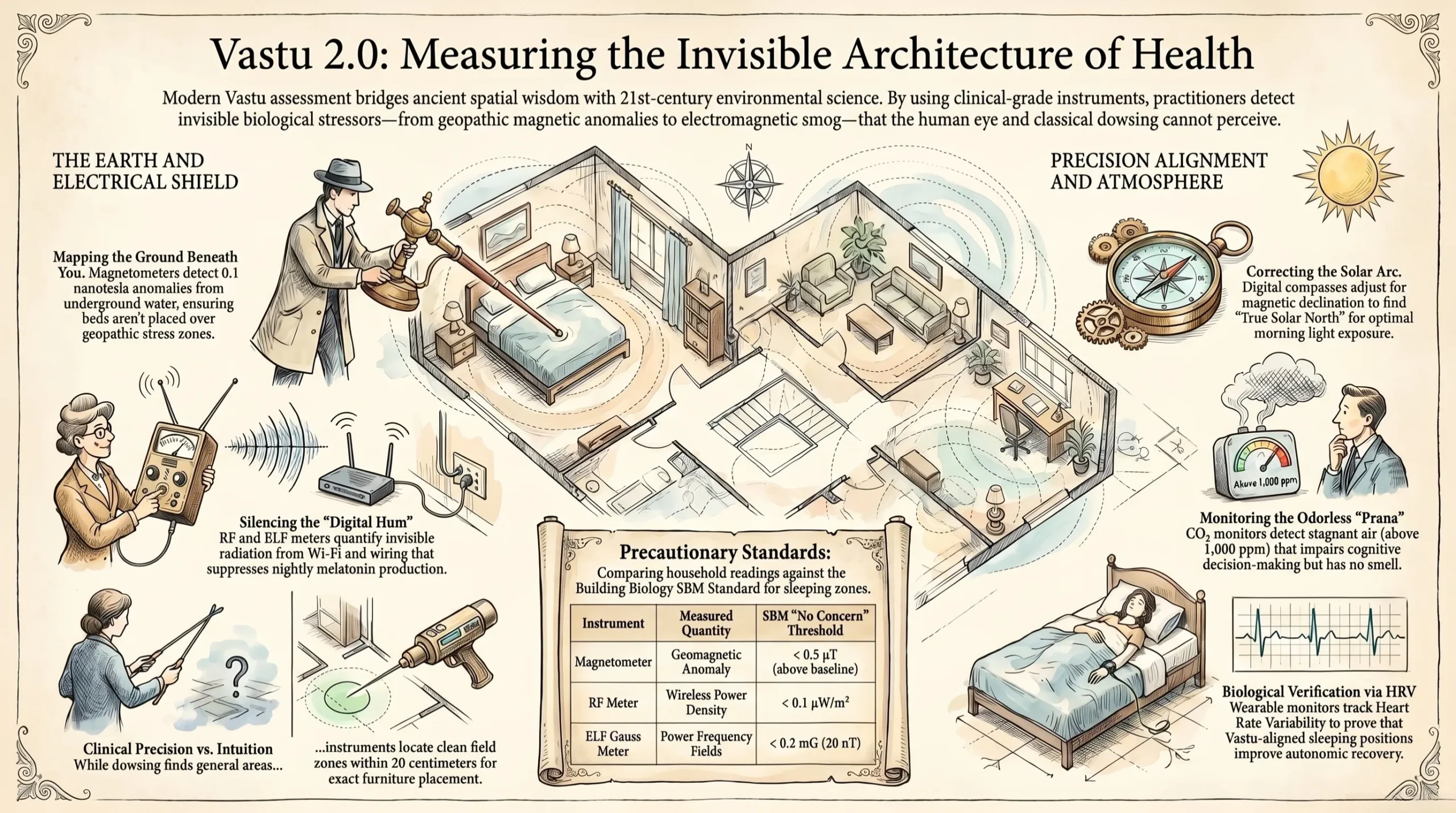
The following table provides a comprehensive reference guide to eight scientific instruments used in Scientific Vastu assessment — specifying the physical quantity each measures, its unit, the Vastu principle it serves, what it reveals beyond classical assessment capability, the Building Biology reference standard against which its readings are evaluated, and the specific correction it enables.
|
Instrument |
Physical Quantity Measured |
Unit |
Vastu Principle Served |
What It Reveals That Classical Assessment Cannot |
Building Biology Reference Standard |
Correction It Enables |
|
Fluxgate magnetometer / proton precession magnetometer |
Geomagnetic field strength and anomaly delta |
Microtesla (µT) and nanotesla (nT) |
Geopathic stress avoidance; Bhumi Pariksha earth energy assessment; sleeping zone earth quality |
Exact field intensity and spatial extent of geopathic stress zones beneath sleeping positions; Hartmann and Curry grid intersection detection; underground water course magnetic signature; geological fault anomaly characterisation |
SBM standard: normal residential geomagnetic background 20–65 µT; anomaly above 0.5 µT above local baseline warrants sleeping zone relocation |
Precise sleeping position relocation to instrument-confirmed clean field zone; pre- and post-correction field verification; annual recheck protocol |
|
High-frequency RF (radiofrequency) meter / spectrum analyser |
Radiofrequency electromagnetic field power density |
Microatt per square metre (µW/m²) or milliwatts per square metre (mW/m²) |
Sleeping zone electromagnetic prana quality; melatonin protection; bedroom RF environment |
Direct measurement of Wi-Fi router (2.4/5 GHz), mobile phone, smart speaker, and external base station RF contribution at sleeping body position; identification of highest-contributing source; post-correction compliance verification |
SBM standard: No concern < 0.1 µW/m²; slight concern 0.1–10 µW/m²; strong concern 10–1,000 µW/m²; extreme concern > 1,000 µW/m² |
Router and device relocation protocol; mesh access point repositioning; overnight scheduling prescription; RF shielding assessment where external base station is primary source |
|
Low-frequency ELF (extremely low frequency) Gauss meter |
Power frequency alternating magnetic field from household wiring and appliances |
Milligauss (mG) or nanotesla (nT); 1 mG = 100 nT |
Bedroom ELF electromagnetic environment; calcium ion channel biological pathway; autonomic sleep quality |
Measurement of 50 Hz alternating current magnetic field from bedroom wiring, junction boxes, consumer units, and adjacent appliances; identification of wiring configurations producing elevated field at sleeping positions; night-time circuit breaker protocol assessment |
SBM standard: No concern < 0.2 mG (20 nT); slight concern 0.2–1 mG; strong concern 1–5 mG; extreme concern > 5 mG |
Circuit breaker protocol — switching off bedroom wiring circuits at the consumer unit each night; appliance relocation; wiring route assessment for renovation projects |
|
Precision digital compass / solar bearing calculator |
Compass bearing to magnetic north; calculated true north from magnetic declination; solar azimuth calculation for specific latitude and date |
Degrees (°) magnetic and true |
Sleeping orientation; building solar orientation; directional zone allocation relative to true north and solar arc |
Exact degree-level compass bearing of sleeping position head; confirmation of true solar north after magnetic declination correction; precise zone boundary mapping; building facade orientation relative to solar arc at specific Indian latitude |
No specific SBM standard for orientation; practice standard: head-South ± 20° or head-East ± 20° for sleeping; building primary axis within 15° of cardinal for optimal solar orientation |
Precise sleeping position reorientation prescription in compass degrees; solar orientation optimisation for new construction; zone boundary precision for floor plan analysis |
|
CO₂ / indoor air quality monitor |
Carbon dioxide concentration; optionally: VOC total concentration, PM2.5 particulate, temperature, relative humidity |
Parts per million (ppm) for CO₂; µg/m³ for PM2.5; mg/m³ for VOCs; °C for temperature; % for humidity |
Brahmasthana natural ventilation function; prana air quality; indoor respiratory and cognitive environment |
Real-time CO₂ concentration in sleeping zone and study zone during normal occupation; identification of CO₂ accumulation patterns from blocked Brahmasthana ventilation; post-correction ventilation improvement verification; humidity regulation performance of natural vs synthetic materials |
WHO indoor air quality: CO₂ < 1,000 ppm preferred; > 1,000 ppm impairs decision-making; > 2,000 ppm significant cognitive impairment. Humidity: 40–60% optimal (Building Biology) |
Brahmasthana clearance; cross-ventilation pathway optimisation; window opening protocol; natural material corrections for humidity regulation |
|
Thermal imaging camera (FLIR or equivalent) |
Infrared thermal emission pattern across surfaces and building fabric |
Temperature (°C) as false-colour thermal map |
SW bedroom thermal mass quality; building envelope thermal performance; moisture infiltration detection; geopathic stress warm zone indication |
Thermal mass performance visualisation — demonstrates the heat absorption and release pattern of SW wall materials; moisture infiltration detection in walls (damp walls have distinctive thermal signature); cold bridge identification; sleeping zone temperature distribution at body level |
No specific SBM standard; practice: sleeping zone floor-level temperature 18–20°C; wall surface temperature within 3°C of air temperature (no cold bridge or radiant heat asymmetry) |
SW bedroom material correction prescription; moisture remediation identification; cold bridge elimination; sleeping zone temperature optimisation guidance |
|
Wearable HRV (heart rate variability) monitor |
Beat-to-beat cardiac interval variability during sleep; RMSSD and HF/LF ratio as autonomic balance indicators |
RMSSD (ms); HF power (ms²); LF/HF ratio (dimensionless) |
Sleeping orientation validation; geopathic and EMF correction outcome verification; autonomic circadian sleep quality assessment |
Pre- and post-correction HRV comparison providing objective biological verification of sleeping zone improvement; identification of which sleeping orientation produces highest nocturnal RMSSD and most favourable HF/LF ratio for specific individual; long-term monitoring of sleeping zone health quality |
No specific SBM standard; HRV research practice: nocturnal RMSSD > 30 ms in adults desirable; head-South sleeping documented to produce higher RMSSD than head-North in peer-reviewed studies |
Sleeping orientation optimisation for specific individual; objective correction outcome verification beyond subjective sleep quality reporting; long-term health monitoring |
|
Lux meter / spectroradiometer |
Illuminance (total light quantity) and spectral power distribution (light quality by wavelength) |
Lux (lx) for illuminance; mW/m²/nm for spectral power distribution |
North-east morning prana gateway light quality; circadian entrainment light prescription; evening DLMO protection; zone-appropriate daylighting |
Morning illuminance in north-east zone at ipRGC-relevant times (7–9 AM); spectral composition of morning light vs evening artificial light (blue content at 480 nm, correlated colour temperature); evening home lighting lux level at eye height; comparison against DLMO-protection thresholds |
Circadian photobiology: > 1,000 lux at eye in first 30 minutes after waking for full CAR; < 50 lux at eye in 2 hours before sleep for DLMO protection; < 10 lux optimal for melatonin-protective evening environment |
North-east zone opening optimisation; LED colour temperature and dimming prescription; room-by-room circadian-appropriate lighting plan; morning light protocol for social jetlag correction |
Reading across this table, the most important pattern to notice is the one in the ‘Building Biology Reference Standard’ column: every instrument in the table has an established, independently developed, internationally referenced threshold standard against which its readings can be evaluated. This is not proprietary Vastu interpretation. It is Building Biology science, developed by independent researchers across Europe, North America, and Australia — primarily through clinical observation of the health outcomes associated with different electromagnetic and environmental exposure levels in residential sleeping zones — and now referenced in the assessment protocols of Building Biologists in Germany, Switzerland, Austria, the United Kingdom, Australia, and India.
The Building Biology SBM standard — the Standard of Building Biology Testing Methods — is the most widely used residential indoor environment quality reference framework in the world. Its thresholds for RF, ELF, geomagnetic field quality, and indoor air quality are precautionary thresholds developed from clinical observation of biological effects, not regulatory limits defined by technical feasibility. Their use in Vastu assessment is not a claim that they are Vastu-specific. It is a claim that they represent the best available internationally referenced standard for evaluating the same environmental parameters that Vastu’s sleeping zone prescriptions address — and that a family whose home’s readings are within Building Biology no-concern thresholds has, by the best available international standard, a sleeping environment whose physical character is unlikely to be impairing their health.
How does the ELF Gauss meter reveal a hidden Vastu defect that most families never suspect?
The ELF (extremely low frequency) Gauss meter measures the alternating magnetic field produced by household electrical wiring and appliances at the power frequency of 50 Hz — and it reveals, in a significant proportion of the Indian urban homes I assess, a Vastu defect that is entirely hidden from classical assessment, entirely invisible to the occupants, and entirely correctable without any structural intervention or expenditure.
The ELF field in a bedroom is produced primarily by the wiring in the bedroom walls, ceiling, and floor — the alternating current magnetic field that any wire carrying alternating current produces around itself at the power frequency. The field intensity at the sleeping position depends on the wiring’s layout and current load in the circuits serving the bedroom. In well-designed wiring systems, the outgoing and return conductors run in close parallel — which allows their alternating fields to cancel approximately, minimising the net ELF field in the space. In poorly designed or modified wiring systems — common in older Indian apartments and in homes that have undergone informal wiring additions — the outgoing and return conductors may be separated (running through different walls), which maximises rather than cancels the ELF field in the bedroom space between them.
The result is that some Indian bedrooms have ELF fields at the sleeping position that are ten to fifty times the Building Biology no-concern threshold of 0.2 milligauss — produced entirely by the building’s own wiring, without any wireless device present. The occupant has no awareness of this field. They feel nothing. They smell nothing. They see nothing. But the voltage-gated calcium ion channels in their cells are experiencing an alternating magnetic field that peer-reviewed bioelectromagnetics research associates with biological effects on calcium signalling, melatonin synthesis, and cell membrane electrical activity. The correction is typically the most elegantly simple available: switching off the bedroom wiring circuits at the consumer unit each night before sleep — a circuit breaker protocol that eliminates the ELF field completely at negligible inconvenience.
The before-and-after ELF measurement in the circuit breaker protocol assessment — typically showing a reduction from five to eight milligauss at the sleeping position to less than 0.1 milligauss with the circuits off — is among the most visually striking single demonstrations of instrument-based Vastu assessment available. The families who see this measurement understand, immediately and viscerally, why their bedrooms have been working against them in ways they had no capacity to identify without the instrument.
The ELF Gauss meter is, of all the instruments in the assessment toolkit, the one that most consistently produces the family’s most surprised and most motivated response. The discovery that the bedroom wiring itself — not a wireless device, not an external source, but the building’s own electrical infrastructure — has been producing a significant ELF field at the sleeping position every night is the kind of specific, instrument-confirmed, immediately correctable finding that transforms a sceptic into a committed implementer.
How does instrument-based assessment compare to classical Vastu assessment for each major factor?
The following table provides a direct, factor-by-factor comparison of classical Vastu assessment methodology and scientific instrument-based assessment — specifying what each approach can and cannot determine for six of the most important Vastu factors, and why the instrument advantage matters clinically for the families who receive assessments.
|
Vastu Factor |
Classical Assessment Method |
What Classical Method Can Determine |
Scientific Instrument |
What the Instrument Additionally Reveals |
Why the Instrument Advantage Matters Clinically |
|
Geopathic stress beneath sleeping zone |
Dowsing (water divining rod or pendulum); indicator plant and animal observation; soil discolouration; occupant health history |
Probable presence of a geopathic stress feature in the general area; directional trend of underground water course; site-level assessment of major fault and water features |
Fluxgate magnetometer |
Exact field intensity in microtesla at sleeping position; spatial boundary of stress zone to 20 cm resolution; confirmation that relocated position is in clean field; distinguishes Hartmann Grid from underground water from fault signature |
Sleeping position relocation to a confirmed clean zone is only possible with instrument measurement; without instrument, the family may relocate to another stress position; pre-correction and post-correction comparison requires a measurement, not an intuition |
|
Bedroom electromagnetic environment |
No classical Vastu methodology — electromagnetic pollution did not exist in the classical era; classical practitioners had no awareness of artificial RF or ELF fields |
Nothing — this defect category is entirely invisible to classical Vastu assessment methodology |
RF meter and ELF Gauss meter |
Exact RF power density at sleeping body position in µW/m²; identifies highest-contributing source device; identifies reflected RF from metallic construction elements; ELF field from specific wiring circuits at sleeping position; comparison against Building Biology thresholds |
The most prevalent and most biologically consequential modern Vastu defect is entirely invisible without instruments; its correction cannot be targeted or verified without measurement; this is the most important single gap between classical and scientific Vastu assessment |
|
Sleeping orientation |
Compass bearing estimation from sun position; architectural orientation reading; accumulated practitioner experience |
Approximate cardinal direction of sleeping orientation; identification of head-north as obviously contraindicated |
Precision digital compass with magnetic declination correction |
Exact degree bearing of sleeping position to ± 0.5°; true north correction for local magnetic declination; precise zone boundary mapping; bearing confirmation for each family member’s specific sleeping position |
Prescription of specific corrected bearing (e.g., ‘head at 175° magnetic = head-South’) rather than approximate direction; removal of ambiguity about borderline orientations (head at 155° — is this acceptable south?); objective pre-correction and post-correction documentation |
|
Building solar orientation |
Solar observation at specific times; shadow casting; experienced practitioner visual assessment |
Approximate building orientation relative to solar arc; identification of major orientation errors |
Solar bearing calculator + digital compass + GPS latitude input |
Exact solar arc at specific latitude; precise determination of true solar south vs magnetic south (varies by location); calculation of optimal building orientation for maximum NE morning light and SW afternoon thermal mass at the specific site’s latitude and longitude |
Passive solar design optimisation requires knowing the exact solar arc at the specific latitude; magnetic south and true solar south differ by the local magnetic declination, which ranges from -5° to +5° across India; optimal building orientation requires this correction |
|
Indoor prana air quality |
Observation of ventilation patterns; sensory assessment of air freshness; Brahmasthana functional assessment; occupant respiratory symptom history |
Qualitative assessment of ventilation adequacy; identification of blocked Brahmasthana; sensory assessment of indoor air staleness |
CO₂ monitor + VOC sensor + humidity sensor |
Quantified CO₂ concentration at specific zones and times; identification of cognitive impairment threshold crossings; humidity regulation quality of existing finish materials; VOC concentration from synthetic materials; post-correction ventilation improvement quantification |
CO₂-related cognitive impairment occurs at levels (>1,000 ppm) that have no distinguishable sensory signal — the air does not smell different at 1,500 ppm than at 500 ppm; without CO₂ measurement, this defect and its correction are entirely invisible to both practitioner and occupant |
|
Thermal sleeping environment |
Observation of bedroom orientation and material character; assessment of thermal mass; practitioner experience with the Indian climate’s seasonal patterns |
Qualitative assessment of thermal mass adequacy; identification of obvious thermal mass deficiencies; directional assessment of solar heat load on bedroom faces |
Thermal imaging camera + temperature datalogger |
Thermal mass performance measurement — actual heat absorption and release pattern vs ideal thermal time constant; cold bridge and moisture identification; sleeping zone floor-level temperature map; overnight temperature stability verification at sleeping position |
A bedroom that appears to have adequate thermal mass may have cold bridges or moisture penetration that degrade its actual thermal performance; thermal imaging reveals the gap between apparent and actual thermal mass performance; sleeping zone temperature logging provides the objective before-and-after data that motivates family implementation |
The column that matters most in this table is the last one — ‘Why the Instrument Advantage Matters Clinically.’ In every case, the instrument advantage is not merely a matter of precision for its own sake. It is the difference between a recommendation that the family implements without being able to verify and a prescription that the family implements with confident documentation — and then verifies with a post-correction re-measurement that confirms the physical environmental change the correction was intended to produce.
This before-and-after measurement protocol is the most important quality standard that instrument-based Vastu assessment enables — and the most important thing that distinguishes it from every form of assessment that relies on intuitive, ritual, or qualitative methods alone. A correction that cannot be measured before and after cannot be confirmed as having produced the physical environmental change that its biological health prediction depends on. And a prediction that cannot be confirmed is not a scientific prediction — it is a belief, however sincerely held and however culturally authoritative it may be.
How is the lux meter and spectroradiometer used to assess the north-east prana gateway's circadian performance?
The lux meter and spectroradiometer are the instruments that bring the most elegant single connection in the entire Vastu science to measurement: the connection between the north-east prana gateway prescription and the Nobel Prize-winning circadian biology it serves. Using these instruments to assess the morning light delivery quality of the north-east zone transforms what could be a qualitative impression (‘the north-east zone gets some morning sun’) into a quantified, clinically evaluated circadian environment assessment.
The lux meter measures illuminance — the total quantity of visible light falling on a surface, in lux — at the occupant’s eye level in the primary waking zones of the home. The circadian photobiology standard for full-amplitude cortisol awakening response activation requires approximately 1,000 lux at eye level in the first thirty minutes after waking. For context, a north-east facing room in a correctly oriented Indian home on a clear morning typically provides 2,000 to 5,000 lux at eye level within thirty minutes of sunrise — more than sufficient for full CAR activation. The same measurement in a north-east zone that is obstructed by an adjacent building, shaded by an overhanging balcony, or whose window is covered by blackout curtains may show only 50 to 200 lux — entirely insufficient for CAR activation and circadian entrainment.
The spectroradiometer adds the dimension of light quality to the quantity measurement — specifically characterising the spectral power distribution of the morning light at different wavelengths, and confirming whether the 480 nanometre blue-spectrum component that maximally activates the ipRGC melanopsin circadian pathway is present in adequate proportion in the morning light entering the north-east zone. Morning skylight is characteristically enriched in the 460–490 nanometre range relative to afternoon light — the quality that makes it the most potent circadian entrainment signal of the day. A north-east zone that is receiving morning light through coloured glass, through heavily tinted window film, or through a frosted panel may show adequate lux but a dramatically reduced blue-spectrum component — delivering light quantity without the specific spectral quality that makes morning light circadian-effective.
The evening light assessment is equally important for the family whose circadian delayed melatonin onset is producing social jetlag: measuring the lux level and the correlated colour temperature of the home’s evening artificial lighting at eye height in the living zones identifies whether the home’s own evening lighting is delaying the family’s DLMO. A living room ceiling fixture producing 200 lux at 6,500 K colour temperature at eye level is, for any occupant sitting beneath it in the two hours before sleep, a circadian schedule-delaying machine — and this fact is entirely invisible without a lux meter and a spectroradiometer to make it observable.
What does wearable HRV monitoring contribute to Vastu correction verification?
Heart rate variability monitoring — using wearable devices that measure the beat-to-beat cardiac interval throughout the night and derive HRV metrics including RMSSD (root mean square of successive differences) and the HF/LF power ratio — is the most direct and most biologically meaningful post-correction verification tool available for the sleeping zone corrections that Vastu prescribes. Understanding how HRV monitoring is used in the assessment context transforms the Vastu correction from a subjective experience of feeling better into an objective, cardiologically validated, physiologically documented biological improvement.
The theoretical basis for using nocturnal HRV as a Vastu correction verification tool is well-established in the research literature. HRV is the most validated non-invasive measure of autonomic nervous system balance available — specifically, of the balance between sympathetic activation (low HRV, LF dominance) and parasympathetic recovery (high HRV, HF dominance). During healthy sleep, the autonomic nervous system progressively shifts toward parasympathetic dominance as sleep deepens, reaching its maximum parasympathetic tone during the slow-wave NREM stages and maintaining elevated parasympathetic engagement through REM. This nightly autonomic trajectory — from waking sympathetic to deep sleep parasympathetic — is the autonomic expression of the biological restoration programme the sleeping body is conducting, and its quality is directly reflected in nocturnal RMSSD.
The research literature on sleeping orientation and HRV documents that head-South sleeping produces higher nocturnal RMSSD and greater HF power than head-North sleeping in controlled studies — providing a direct, biologically validated confirmation of the Vastu orientation prescription that any family with a wearable HRV monitor can verify personally. A family member who wears a wearable HRV device for two weeks head-North and then two weeks head-South will, in the large majority of cases, observe a measurable improvement in nocturnal RMSSD following the orientation correction — an improvement that reflects the geomagnetically aligned sleeping body’s improved autonomic circadian pattern and that is confirmed by a physiological measurement they can share with their cardiologist.
For families in which a cardiologist, internist, or general physician has noted reduced HRV or elevated resting heart rate as a health concern, the sleeping orientation correction and sleeping zone EMF correction are specifically HRV-relevant interventions — not alternative therapies, but specific physical environmental interventions with documented autonomic mechanism and measurable HRV outcome. The HRV monitor makes the outcome visible in the family’s own data, converting a Vastu practitioner’s recommendation into a verified health metric whose clinical relevance their physician can immediately appreciate.
The use of wearable HRV monitoring as a Vastu correction verification tool represents the most complete available integration of ancient environmental health wisdom and modern physiological measurement. The family that measures their own nocturnal HRV before and after sleeping zone correction has, in their own data, one of the most compelling personally relevant demonstrations of what Vastu environmental science — applied with instrument precision — actually does to the human body’s nightly restoration quality.
How do these instruments work together in a Complete Home Health Audit sequence?
The instruments described in this article are not used independently in a Complete Home Health Audit. They are used as a coordinated assessment toolkit whose sequence and combination are designed to build a complete picture of the home’s physical energy environment from the most consequential defects toward the more refined ones — with each instrument’s findings informing the application of the next.
The assessment sequence in a Complete Home Health Audit begins with the magnetometer survey, because geopathic stress is the most consequential earth energy factor and the one whose presence or absence most directly determines the sleeping zone’s fundamental biological quality. The magnetometer is used systematically across all sleeping positions in the home — the master bedroom, children’s bedrooms, and any other zones where family members regularly sleep or rest for extended periods. The field map produced by the magnetometer survey determines the clean zone boundaries that will guide the sleeping position relocation prescriptions — and it is conducted first so that the EMF assessment can focus specifically on the positions within those clean zones.
The RF and ELF assessment follows, measuring the electromagnetic burden at the existing sleeping positions and at the clean field positions identified by the magnetometer survey. This sequencing ensures that the corrected sleeping position is not only clear of geopathic stress but also clear of the highest RF and ELF burden — because in some homes the clean field position and the lowest EMF position do not coincide, requiring a specific trade-off recommendation.
The compass and solar bearing assessment confirms the sleeping orientation and the building’s solar orientation, providing the sleeping orientation correction recommendation in specific degree terms. The CO2 monitor is typically left running for twenty-four to forty-eight hours in the primary study and sleeping zones, providing a comprehensive picture of the CO2 accumulation pattern across a full occupation cycle rather than a snapshot reading at the assessment moment. The lux meter and spectroradiometer are used in the first thirty minutes of the assessment, when the morning light conditions are most informative about the north-east zone’s circadian performance. The thermal imaging camera, where used, captures the sleeping zone thermal mass performance during the afternoon or early evening when thermal mass absorption and release dynamics are most visible.
The result of this coordinated instrument sequence is not a collection of independent readings but a physically coherent picture of the home’s complete energy environment at the sleeping position — including every factor that modern Building Biology and chronobiology have characterised as most consequential for the family’s health, presented in specific physical units with specific Building Biology thresholds for evaluation and specific predicted health outcomes for each correction. This is what a Complete Home Health Audit delivers: not the impression of an experienced eye, not the authority of a lineage tradition, but the instrument-confirmed physical assessment of the home’s most consequential health parameters — measurable, verifiable, and accountable.
What does choosing an instrument-based Vastu assessment mean for a family's confidence and outcomes?
The most important practical consequence of choosing an instrument-based Vastu assessment — a Complete Home Health Audit using the scientific tools described in this article — over an intuition-based or ritual-based assessment is not primarily the precision of the findings, though precision matters. It is the accountability that precision enables. Accountability to specific predictions, accountable to specific timelines, held to account by a satisfaction guarantee that the instrument-confirmed findings make meaningful.
When a practitioner can tell a family: ‘your sleeping position reads 2.7 microtesla above background on the magnetometer; the Building Biology no-concern threshold is 0.3 microtesla above background; I recommend relocating the bed head to a position I will confirm reads 0.06 microtesla above background; within three weeks of this correction you should observe the following improvements in sleep quality, and within six to twelve weeks you should observe these specific immune function improvements’ — that family has a specific, verifiable, temporally bounded prediction to evaluate their experience against. They can confirm the correction’s effectiveness in a way they cannot confirm a prediction that reads ‘this correction will improve the cosmic energy of your sleeping zone.’
The accountability that instrument-based assessment enables has a second, equally important dimension: it protects the family from the most common Vastu marketplace failure. The practitioner whose assessment findings are not measured cannot be held accountable for them. The practitioner who tells a family their home has ‘negative energy’ without measuring anything cannot be asked: ‘what specifically did you measure, what was the reading, and what is the standard against which you evaluated it?’ The practitioner who recommends a correction without an instrument cannot provide a post-correction measurement that confirms the physical environmental change actually occurred. Instrument-based assessment is, therefore, not merely more precise — it is more honest, more accountable, and more genuinely respectful of the family’s right to know what they are paying for, what they can expect, and how to verify that they received it.
The tradition that has always, at its finest, been a rigorous empirical science of the built environment — the tradition that the Manasara embodies in its precise, mechanism-grounded, observation-derived prescriptions — is most faithfully practised by the practitioners who bring to it the most precise instruments available for measuring what it has always cared about: the physical environmental conditions that most consequentially affect the health and wellbeing of the families who trust the tradition with the most important physical environment in their lives: their home.
Real Case Study — A Sceptical Mumbai Cardiologist Who Requested the Full Instrument Protocol:
A cardiologist in Mumbai — who had referred several patients to us and wanted to understand the instrument protocol before recommending it more broadly — came to observe a full Complete Home Health Audit being conducted on her own apartment. ‘I want to understand every instrument and every measurement before I recommend this to my patients,’ she said. ‘Walk me through everything, show me the readings, and explain every number.’
We began with the magnetometer survey of her master bedroom sleeping positions. The first pass over her current sleeping position — the bed positioned centrally in the bedroom as is common in Indian apartments — read 2.9 microtesla above the room’s background field at the pillow zone. I showed her the instrument’s display. She recorded the reading on her phone. I explained the SBM threshold (0.3 µT above background for no-concern), showed her the published Building Biology standard, and explained the delta calculation. She said: ‘So this is three times above a clinical threshold. What is the proposed corrected position?’
We moved the probe systematically across the room’s field map. The south-west corner — already the correct Vastu zone for the master bedroom — read 0.07 microtesla above background. I marked the position. She recorded it.
The RF assessment of her existing sleeping position: 3,800 microWatt per square metre, primarily from a router mounted on the bedroom’s shared wall with the corridor. She photographed the instrument display and looked up the SBM standard on her phone while I waited. ‘Strong concern is ten to one thousand. This is extreme concern. And the melatonin suppression threshold — what does the peer-reviewed literature say?’ I cited three papers by name. She found two on PubMed in under two minutes. ‘AANAT suppression by calcium channel activation. This is real bioelectromagnetics. I have been sending my patients with treatment-resistant hypertension to sleep next to this field for years without knowing.’
ELF reading at her bed: 3.4 milligauss from the bedroom wiring. She understood the circuit breaker protocol immediately and implemented it that evening.
Sleeping orientation: head-north-west. I showed her the HRV research on orientation. She was already familiar with HRV as a cardiac metric. ‘The autonomic circadian pattern argument — head-South produces highest parasympathetic dominance during sleep — this is consistent with the cardiac literature on nocturnal autonomic recovery. I am going to wear my HRV monitor and measure this.’
Six weeks later, she called. ‘My nocturnal RMSSD has improved from 28 to 41 milliseconds since the corrections. That is clinically significant. I have referred twelve more patients. I am now asking every hypertensive patient about their bedroom router and their sleeping direction. The instrument readings make it impossible to dismiss.’
What the Building Biology SBM Standard Means — and Why Its Thresholds Are the Right Reference for Vastu Assessment:
The Building Biology Standard of Building Biology Testing Methods (SBM) is a German-developed, internationally referenced residential indoor environment quality standard that specifies precautionary thresholds for electromagnetic fields, indoor air quality parameters, and other building environment factors based on the clinical observation of biological health effects in residential sleeping zones. It is updated regularly by Building Biologists in Germany, Switzerland, and Austria based on the accumulating research literature.
The SBM’s thresholds are explicitly precautionary — meaning they are set at the level below which the available evidence does not document biological health effects, rather than at the level at which regulatory authorities have determined effects are proven beyond reasonable doubt. This is the appropriate standard for a residential sleeping zone assessment, because the sleeping zone is the environment in which the most biologically sensitive processes occur — processes for which the precautionary standard, not the regulatory limit, is the medically responsible reference.
The reason I use the Building Biology SBM standard as the reference for Vastu instrument readings is not that it is a Vastu document — it has nothing to do with Vastu. It is the most rigorously developed and most widely referenced independent standard available for evaluating the same physical environmental parameters that Vastu’s sleeping zone prescriptions address. Using it allows the Vastu assessment’s findings to be communicated in the internationally referenced vocabulary of building health science — not as Vastu-specific claims, but as independently evaluated environmental health assessments whose reference standards any physician or engineer can verify.
This is the intellectual integrity standard that Vastu assessment should always be held to: not ‘trust me because I have practised this tradition for twenty years’ but ‘here is the measurement, here is the international reference standard, here is how the measurement compares to it, and here is the peer-reviewed research that connects the measurement to the health outcome.’ That is what the instruments make possible. And that is what every family deserves from the Vastu tradition.
Every Instrument. Every Reading. Every Finding — Measured, Explained, and Accountable.
The Complete Home Health Audit uses every scientific instrument described in this article to assess the physical environmental conditions most consequential for your family’s health — producing findings in specific physical units, evaluated against internationally referenced Building Biology standards, with specific predicted health outcomes in specific biological timelines, and verified by post-correction re-measurement. This is not intuition. This is not ritual. This is Vastu science as the Manasara’s authors always intended it: precise, empirical, grounded in physical observation, and accountable to the outcomes it predicts.
Your Complete Home Health Audit delivers:
- Patented photo-scanning energy analysis — systematic physical information extraction; top 5 critical defects identified by Mukesh Shah personally before any site visit
- Fluxgate magnetometer geopathic stress survey — field map at 30 cm resolution across all sleeping positions; anomaly delta in microtesla; SBM standard comparison; corrected position confirmed at < 0.3 µT above background
- RF electromagnetic field assessment — power density in µW/m² at sleeping body position; each source device’s contribution identified; SBM extreme/strong/slight/no-concern classification; post-correction re-measurement included
- ELF Gauss meter assessment — bedroom wiring field in milligauss; circuit breaker protocol assessment; before-and-after circuit-off measurement demonstrated
- Precision compass and solar bearing assessment — sleeping orientation to ± 0.5° with magnetic declination correction; true solar north calculation for the specific latitude; zone boundary precision mapping
- CO₂ and indoor air quality assessment — 24–48 hour monitoring in sleeping and study zones; cognitive impairment threshold comparison; humidity regulation assessment; VOC risk identification
- Lux meter and spectroradiometer — morning light quantity and spectral quality in NE zone; ipRGC melanopsin wavelength adequacy; evening DLMO-suppression risk from existing home lighting; circadian-appropriate lighting prescription
- HRV monitoring guidance — sleeping orientation verification protocol; pre- and post-correction nocturnal RMSSD comparison protocol; physician-communicable cardiac metric documentation
- Thermal imaging — SW bedroom thermal mass performance; cold bridge and moisture identification; sleeping zone temperature distribution map
- Building Biology SBM standard applied to every instrument finding — internationally referenced thresholds; specific health outcome predictions; biological mechanism explanations with research citations
- One-on-one consultation with Mukesh Shah personally
- Detailed written report — all measurements, units, SBM comparisons, mechanisms, corrections, and predicted health outcomes with research references
- 30 days of priority support through your full implementation
- 100% satisfaction guarantee
Five thousand years of Vastu observation. Building Biology’s most rigorous instrument standards. Every reading you can verify. Every prediction you can hold us to.
Book your Complete Home Health Audit today at vastumyhome.com
Scientific Vastu assessment uses eight primary instruments: a fluxgate magnetometer to measure geopathic stress (geomagnetic field anomaly in microtesla at sleeping positions); an RF meter to measure radiofrequency electromagnetic fields from routers and devices (microWatt per square metre at sleeping body position); an ELF Gauss meter to measure alternating current fields from bedroom wiring (milligauss); a precision digital compass with solar bearing calculation for sleeping orientation and building solar orientation assessment; a CO₂ and indoor air quality monitor for Brahmasthana ventilation assessment; a thermal imaging camera for sleeping zone thermal mass performance; a wearable HRV monitor for sleeping orientation and correction verification; and a lux meter and spectroradiometer for north-east morning light circadian quality assessment.
In a Vastu geopathic stress assessment, the magnetometer measures the local geomagnetic field strength in microtesla at the sleeping position — and specifically the anomaly delta: how much the local field differs from the undisturbed background field in the same room. The Earth’s normal background field in India is approximately 30–50 microtesla. Geopathic stress zones produced by underground water courses, geological fault lines, or Hartmann Grid intersections create local anomalies where the field strength differs from background by measurable amounts. The Building Biology SBM standard identifies anomaly deltas above 0.5 microtesla above background as warrantying sleeping zone relocation. The magnetometer’s reading at the proposed corrected sleeping position confirms that the relocation has placed the sleeping body in a genuinely clean field zone.
The RF meter is the most important instrument in modern Vastu assessment because it measures the single most prevalent, most biologically consequential, and most completely invisible Vastu defect in the contemporary Indian urban home: the bedroom electromagnetic burden from Wi-Fi routers, smartphones, and other wireless devices. This defect is entirely invisible to every classical Vastu assessment methodology and to all human sensory systems — it has no smell, colour, or sensory signal. The RF meter reveals it in microWatt per square metre at the sleeping body position, identifies the highest-contributing source device, and provides pre- and post-correction measurements that confirm the physical change the correction produces. Without the RF meter, this defect category — whose melatonin suppression and immune disruption mechanisms are peer-reviewed — cannot be assessed, targeted, or verified.
The Building Biology Standard of Building Biology Testing Methods (SBM) is a German-developed, internationally referenced residential indoor environment quality standard that specifies precautionary thresholds for RF electromagnetic fields, ELF fields, geomagnetic field quality, indoor air parameters, and other building environment factors. Its thresholds are set at the level below which the available peer-reviewed literature does not document biological health effects in residential sleeping zones. It is used in Vastu assessment because it provides independently developed, internationally referenced thresholds for the same physical environmental parameters that Vastu’s sleeping zone prescriptions address — allowing Vastu assessment findings to be communicated in the vocabulary of building health science rather than as Vastu-specific claims, and enabling comparison with a standard any physician or engineer can independently verify.
The Complete Home Health Audit applies all eight instruments in a coordinated assessment sequence: magnetometer geopathic stress field map of all sleeping positions; RF measurement at sleeping body position with source identification; ELF circuit assessment with circuit breaker protocol; compass sleeping orientation assessment; CO₂ monitoring over 24–48 hours in sleeping and study zones; lux meter morning light quality in north-east zone; thermal imaging of sleeping zone thermal mass; and HRV monitoring guidance for correction verification. Every finding is presented in physical units, compared against the Building Biology SBM standard, explained through its biological mechanism with peer-reviewed research citations, and accompanied by a specific predicted health outcome in a specific biological timeline. Delivered with one-on-one consultation with Mukesh Shah, detailed written report, 30 days of priority support, and a 100% satisfaction guarantee.
Disclaimer
The instrument descriptions, measurement protocols, and Building Biology SBM standard references in this article are presented for educational purposes. Building Biology SBM thresholds are precautionary guidelines, not regulatory standards, and are presented as reference frameworks for evaluating indoor environmental quality. This article does not constitute medical, electrical engineering, or structural advice. Families with health concerns should consult qualified physicians. Instrument-based environmental assessment informs corrections to the physical home environment; it does not diagnose or treat medical conditions.
I Would Love to Hear From You
I would love to hear your story or questions in the comments below. Have you experienced the impact of Vastu in your own home? Are you noticing any of the common defects I described above in your space? Share openly — every question is a step towards greater harmony.
Disclaimer: Vastu analysis and energy corrections are for harmonising your space and personal growth. They are not a substitute for professional medical, financial, legal or architectural advice.