

What Is the Connection Between Vastu and Circadian Rhythms? Nobel Science | Vastu My Home
Namaste. I am Mukesh Shah. When the Nobel Prize in Physiology or Medicine was awarded in 2017 to Jeffrey Hall, Michael Rosbash, and Michael Young for their discovery of the molecular mechanisms controlling circadian rhythms, the scientific world celebrated a breakthrough in our understanding of biological time. I celebrated something more personal: the recognition, by the highest scientific authority in medicine, of the biological system that Vastu Shastra has been designing homes around for five thousand years.
The Vastu tradition did not use the word ‘circadian.’ It used ‘prana’ — the life force carried by morning solar radiation that the north-east gateway was designed to admit. It used ‘Agni’ — the solar fire element that the south-east zone embodies and that the kitchen’s morning light relationship honours. It used ‘Prithvi’ — the earth element of the south-west zone whose thermal mass preserves the stable sleeping temperature that the circadian clock requires for deep sleep initiation. These are the classical vocabulary entries for what chronobiology now calls the zeitgeber system, the SCN master clock, the cortisol awakening response, and the core body temperature circadian rhythm. Different words. The same physical reality.
The connection between Vastu and circadian rhythms is not an analogy, not a metaphor, and not a post-hoc intellectual mapping designed to give an ancient tradition the appearance of modern scientific credibility. It is a direct, specific, mechanistically grounded correspondence between the physical environmental conditions that Vastu’s core prescriptions are designed to optimise and the physical environmental conditions that circadian biology has independently characterised as the most consequential determinants of the circadian system’s health. Every major Vastu prescription for the sleeping zone, the waking zone, the morning light entry, and the evening spatial character addresses a specific, named, peer-reviewed dimension of circadian biology with a precision that, I would argue, cannot be coincidental.
For the families who engage our Health-Focused Energy Correction service, understanding the Vastu-circadian connection is not academic. It is the explanation for why the corrections work, in which family members, in what biological timeline, and through which physiological systems. It is the most complete scientific account available for the health outcomes that our assessments produce — and it is grounded in the same Nobel Prize-winning research that the world’s leading medical institutions now cite as foundational to the understanding of sleep, metabolism, immunity, and disease.
What is the circadian clock — and why is it the most important biological system that Vastu protects?
The circadian clock is the body’s internal timekeeper — the molecular system that coordinates the timing of virtually every biological process across the twenty-four-hour day-night cycle. ‘Circadian’ derives from the Latin circa dies — approximately a day — and the name reflects a fundamental property of the system: it runs on an endogenous approximately twenty-four-hour cycle that is only approximately right, requiring daily calibration from the external environment to maintain precise synchrony with the solar day.
This calibration requirement is the biological fact that makes Vastu’s home design so consequential for circadian health. The circadian clock does not maintain itself in isolation from the environment. It depends on specific environmental signals — zeitgebers, from the German for time-givers — to correct its natural drift and maintain the precise phase alignment with the solar cycle that enables every downstream biological process to run at the right time. The primary zeitgeber for the master circadian clock in the suprachiasmatic nucleus of the hypothalamus is the quality and timing of morning light. Secondary zeitgebers include the timing of meals, the timing of physical activity, and the social and temperature cues of the day-night cycle. Every one of these zeitgeber inputs is addressed by a specific Vastu prescription.
The molecular mechanism of the circadian clock — the CLOCK/BMAL1 transcription factor complex that drives the Period and Cryptochrome protein feedback loops — operates in every cell of the human body, not only in the SCN master clock. The liver has its own circadian clock. The immune cells have their own circadian clocks. The heart, the gut, the skin, the reproductive organs — every organ system has peripheral clocks whose phase must be kept in synchrony with the SCN master clock for their functions to be correctly timed relative to each other and to the day-night cycle. The maintenance of this system-wide phase synchrony — the coordination of perhaps one hundred trillion peripheral clocks — is what the circadian system does. And the primary environmental input through which this synchrony is maintained is the quality of the physical home environment, experienced most intensively during the eight hours of sleep and the first waking hours of each morning.
The circadian clock is, therefore, not one of many biological systems that Vastu corrections benefit. It is the central regulatory system that coordinates the timing of every biological function the body performs — and the physical home environment is the most consistently consequential environmental input to that system across the entire lifespan. A home designed to support circadian entrainment is a home that is supporting metabolic health, immune function, cardiovascular health, reproductive health, cognitive performance, and mood regulation simultaneously — because all of these are expressions of circadian biology that the home environment either supports or undermines, every day, for every year of occupation.
How does the north-east prana gateway function as a circadian zeitgeber delivery system?
The north-east prana gateway is Vastu’s single most precise chronobiological prescription. I want to explain exactly why — in the specific vocabulary of photobiology and circadian neuroscience — because this explanation makes the tradition’s intellectual sophistication visible in a way that no amount of cultural appreciation can replicate.
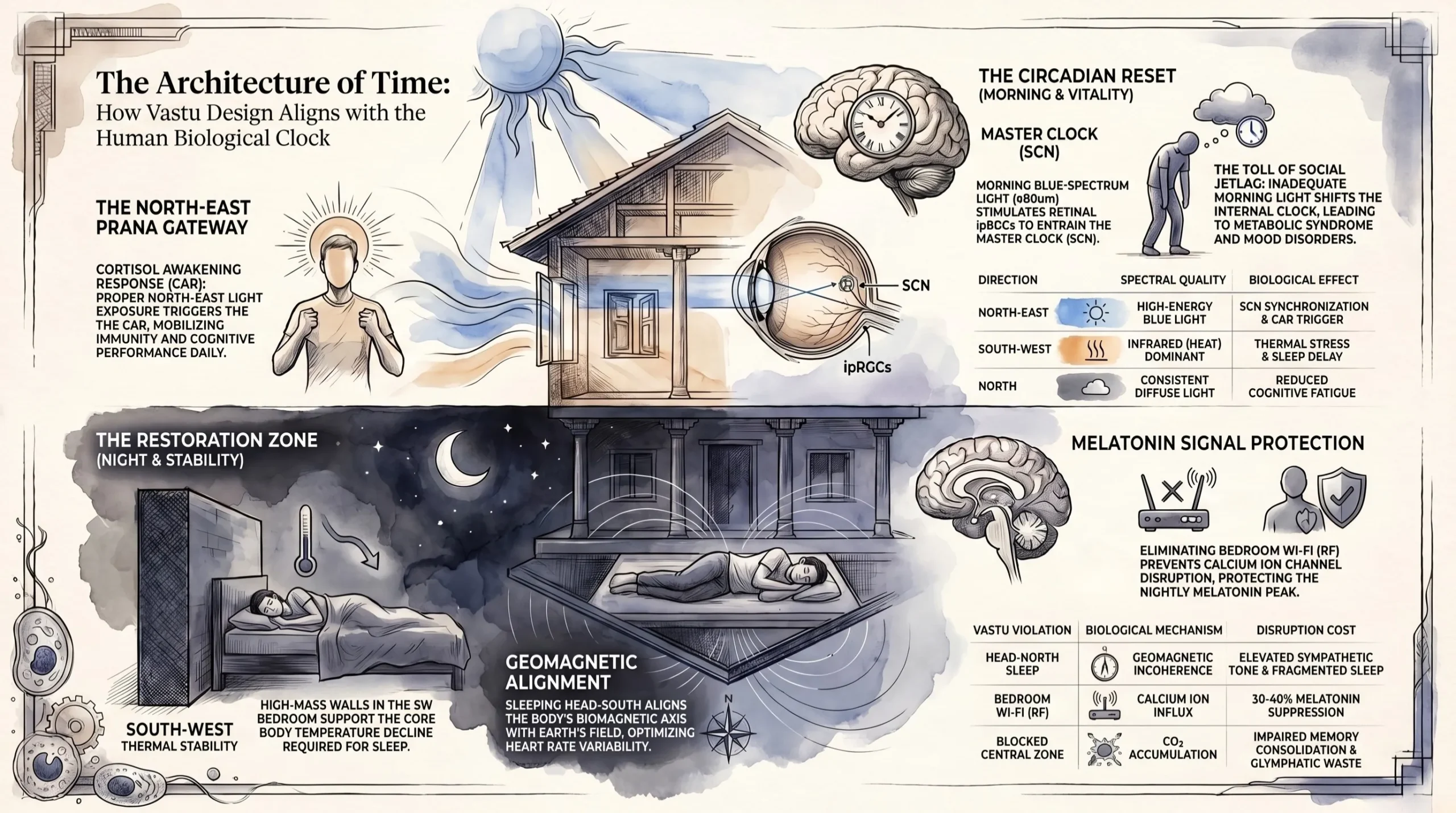
The SCN master clock’s light input pathway begins in the retina with a specific class of photoreceptors called intrinsically photosensitive retinal ganglion cells, or ipRGCs. These are not the rod and cone photoreceptors responsible for vision. They are dedicated, non-image-forming photoreceptors whose sole biological function is to detect ambient light intensity and spectrum and transmit this information via the retinohypothalamic tract to the SCN. The ipRGCs contain the photopigment melanopsin, which is maximally sensitive to light at approximately 480 nanometres wavelength — the blue-green region of the visible spectrum that is most abundant in clear morning skylight and in the first two hours after sunrise at tropical and subtropical latitudes.
At Indian latitudes (8°N to 35°N), the solar spectrum in the first two hours after sunrise is characterised by a specific blue-spectrum composition that differs from the solar spectrum later in the day. The sun’s low angle at sunrise means that the solar radiation must travel through more atmosphere, filtering out some UV but enriching the relative proportion of the blue-green spectrum that penetrates atmospheric scattering most effectively. The result is a morning light spectrum that is, for the ipRGC melanopsin pathway, the most potent circadian entrainment signal of the entire day — more potent than the full-intensity midday sun, because the ipRGC pathway is not simply a brightness detector but a specific spectrum-sensitive circadian signal transducer.
The north-east face of a correctly oriented Indian home at Indian latitudes receives this morning solar spectrum at precisely the right time, from precisely the right solar angle, and in precisely the right spectral composition to maximise the ipRGC entrainment signal delivered to the occupants through the north-east zone’s windows, openings, and living spaces. A family member who spends even fifteen to thirty minutes in the north-east zone of a correctly oriented home within the first two hours of sunrise — in the kitchen preparing morning chai, at the dining table, or in a north-east bedroom — receives a daily circadian entrainment dose that the Nobel Committee’s research characterises as the most important single environmental health input the built environment can provide.
The prana of the north-east morning light is, in the language of photobiology, the melanopsin-mediated ipRGC activation that calibrates the SCN’s CLOCK/BMAL1 molecular oscillator to solar time, triggering the cortisol awakening response, initiating the day’s serotonin synthesis cascade, resetting the phase of every peripheral clock from liver to immune cell to gonadal tissue. The classical Vastu authors observed that families living in homes with abundant north-east morning light were healthier, more vital, and more harmoniously organised in their daily rhythms. They encoded this observation as the prescription for the prana gateway. Chronobiology has spent sixty years discovering exactly why that observation was correct.
What does the circadian temperature rhythm reveal about the south-west bedroom's biological necessity?
Core body temperature is the most precisely clocked of all circadian output rhythms — a biological signal whose timing and amplitude are maintained with extraordinary precision by the SCN master clock and whose relationship to sleep onset, sleep architecture, and sleep quality is among the most thoroughly characterised in all of sleep physiology. Understanding this circadian temperature relationship is the key to understanding why the south-west bedroom placement, with its maximum thermal mass and minimum opening character, is not simply a traditional spatial preference but a specific chronobiological design prescription.
The circadian core body temperature rhythm follows a characteristic pattern across the twenty-four-hour cycle: highest in the late afternoon to early evening (typically peaking around 6–8 PM at 37.0–37.2°C in most adults), then declining in a sustained and temperature-precise curve toward a nadir in the early morning hours (typically reaching its minimum of 36.2–36.6°C around 4–6 AM), then rising progressively with waking. This nightly temperature decline is not merely a consequence of becoming inactive — it is an active, SCN-driven process in which the circadian clock causes peripheral vasodilation in the hands and feet, promoting heat loss from the body’s core and producing the temperature reduction that gates sleep onset.
The critical relationship between the bedroom’s thermal environment and the circadian sleep onset mechanism is this: the bedroom’s ambient temperature must not oppose or confound the body’s circadian temperature decline. If the bedroom is too warm — above approximately 20–21°C — it imposes a thermal environment that makes it harder for the body to achieve the core temperature decline required for sleep initiation. The body must work harder against the warm ambient environment to maintain its downward temperature trajectory. Sleep onset is delayed. Sleep architecture is fragmented by thermal arousal events. The first deep NREM episode — during which growth hormone secretion is circadian-timed — is delayed or truncated. The entire circadian sleep programme shifts phase.
Why is the south-west wall's thermal mass the most biologically important material choice in the home?
The south-west bedroom wall’s thermal mass stores the afternoon solar heat load — absorbed during the day from the south-west face’s maximum afternoon solar exposure — and releases it slowly across the evening and overnight hours, but at a rate that a correctly specified thermal mass wall in the south-west zone keeps the bedroom’s ambient temperature well within the circadian-appropriate range through the night. A correctly specified south-west wall in the Indian climate — 300 to 350 millimetres of compressed earth or dense brick — has a thermal time constant that delays the release of its afternoon heat absorption by twelve to sixteen hours, releasing it primarily through the next morning’s waking hours rather than into the sleeping zone during the early night.
A south-west bedroom with lightweight synthetic partition walls and no thermal mass has no buffering capacity against the afternoon heat load. The sun heats the synthetic wall directly, and the heat passes through to the bedroom interior within two to four hours, raising the sleeping zone temperature to twenty-five, twenty-six, or higher degrees by the time the family member attempts to sleep. At this temperature, the circadian core body temperature decline required for sleep onset is impeded. The family member lies awake, thermally uncomfortable, their circadian sleep programme stalled at its onset point. They eventually fall asleep — often after the room’s temperature has fallen somewhat — but the first deep NREM episode is delayed, the growth hormone secretion pulse is shortened, and the night’s circadian sleep programme never quite catches up.
The south-west bedroom’s thermal mass is, in chronobiological terms, a passive circadian temperature support system — a thermal infrastructure whose function is to ensure that the bedroom’s ambient temperature never opposes the body’s circadian core temperature decline. The correct material is not an aesthetic choice or a cultural preference. It is the material specification that fulfils this circadian support function. Dense natural stone, rammed earth, compressed earth block — these are the materials whose thermal effusivity and thermal time constant meet the circadian temperature support specification. Lightweight synthetic partitions do not. And no amount of air conditioning can replicate the circadian appropriateness of a thermal mass wall’s gradual, passive, night-time heat management — because air conditioning actively intervenes in the thermal environment in ways that create their own circadian disruptions through acoustic noise, air movement, and the temperature volatility of cycling on and off through the night.
What is the complete map of how Vastu's core prescriptions align with circadian biology?
The following table maps eight of Vastu’s most important residential prescriptions to their specific circadian biology connections — specifying the molecular or physiological mechanism, the biological cost of violating the prescription, and the evidence quality supporting the connection. This is the most comprehensive Vastu-circadian reference available in a single document.
|
Vastu Principle |
Circadian Biology Connection |
Specific Molecular / Physiological Mechanism |
Disruption Cost When Violated |
Evidence Quality |
|
North-east morning light (prana gateway) — maximum openings on the north-east building face |
Primary circadian zeitgeber — morning blue-spectrum light entrains the SCN master clock and sets circadian phase for the full 24-hour cycle |
ipRGC photoreceptors in the retina respond maximally to ~480 nm blue light; signal to SCN via retinohypothalamic tract; SCN calibrates CLOCK/BMAL1 transcription-translation feedback loop; cortisol awakening response triggered; peripheral clock resynchronisation begins |
Circadian phase drift — each morning without adequate light entrainment shifts the internal clock 15–30 minutes later; cumulative misalignment produces social jetlag; metabolic dysregulation; immune dysfunction; mood disorder |
Strong — Nobel Prize 2017; ipRGC photobiology very well characterised; CAR–morning light relationship peer-reviewed in multiple journals |
|
South-west master bedroom (maximum thermal mass, minimum opening) |
Thermoregulatory circadian coupling — core body temperature rhythm is a core output of the circadian clock; bedroom thermal stability supports the nightly core body temperature decline required for circadian-aligned sleep onset |
Circadian clock drives the distal vasodilation that begins 1–2 hours before habitual sleep onset, producing the core body temperature decline (0.5–1°C) that gates sleep initiation; SW thermal mass prevents bedroom from heating above 20°C overnight, supporting this decline |
Thermal arousal events from warm, low-mass bedroom fragment NREM sleep; circadian temperature signal is disrupted; HPA axis activated; cortisol rises out of phase; next-morning circadian temperature rhythm is shifted |
Strong — core body temperature–sleep circadian coupling extensively characterised; thermal environment and sleep architecture peer-reviewed |
|
Head-South or head-East sleeping orientation |
Geomagnetic–circadian interface — the circadian timing system may use geomagnetic reference signals through magnetite-based or cryptochrome-based biological compass to maintain temporal orientation; autonomic circadian rhythm (HRV pattern) optimised by correct geomagnetic alignment |
Head-South aligns body’s longitudinal biomagnetic axis with Earth’s southward-pointing field lines; HRV research documents highest sleep-period parasympathetic tone in head-South orientation; autonomic circadian rhythm shows most complete nocturnal parasympathetic dominance in geomagnetically aligned sleepers |
Head-North sleeping produces lowest sleep-period HRV, most elevated sympathetic tone, most fragmented autonomic circadian pattern; progressive HPA dysregulation from chronic autonomic circadian disturbance |
Strong for HRV effects; moderate for mechanism (geomagnetic–circadian coupling in humans remains active research area) |
|
Bedroom electromagnetic quiet — RF and ELF elimination |
Melatonin–circadian master signal protection — melatonin is simultaneously the pineal gland’s output signal encoding darkness to the circadian system and the primary coordinator of the circadian phase in every peripheral organ |
RF at Wi-Fi frequencies activates voltage-gated calcium ion channels in pineal cells; calcium influx suppresses melatonin synthesis enzymes (arylalkylamine N-acetyltransferase — AANAT); suppressed nocturnal melatonin peak truncates the darkness signal that keeps peripheral clocks synchronised with the SCN master clock |
Peripheral clock desynchronisation from melatonin suppression — liver, immune cells, gut, heart all lose phase coherence with SCN; metabolic syndrome risk; immune dysregulation; accelerated cellular ageing; chronic disease elevation |
Strong — AANAT suppression by RF peer-reviewed; melatonin as peripheral clock synchroniser well-characterised; calcium ion channel pathway independently replicated |
|
Open Brahmasthana — unobstructed central zone for natural ventilation |
Circadian oxygen and CO2 homeostasis — the quality of air during sleep directly affects the circadian autonomic programme; elevated CO2 during sleep produces sympathetic activation that fragments the circadian autonomic pattern |
Natural ventilation through Brahmasthana maintains O2 above 19.5% and CO2 below 800 ppm in sleeping zones; elevated CO2 during sleep activates chemoreceptors; this chemoreceptor activation produces arousal events that fragment NREM slow-wave sleep and interrupt the circadian-programmed deep sleep phases |
Chronic sleep-zone CO2 elevation fragments circadian slow-wave programme; reduces growth hormone secretion (GH peak is circadian-timed to first slow-wave episode); impairs circadian immune programme; degrades overnight memory consolidation |
Strong — indoor CO2 and sleep architecture peer-reviewed; chemoreceptor arousal mechanisms well-characterised; GH circadian secretion well-documented |
|
East-facing kitchen — meal preparation with morning light |
Food timing–circadian alignment — food intake timing is among the most powerful peripheral clock zeitgebers; morning kitchen activity in eastern morning light aligns the metabolic peripheral clocks in liver and gastrointestinal tract with the SCN phase |
Morning light in east kitchen activates the CAR; breakfast preparation and consumption in morning light phase-sets hepatic peripheral clocks through insulin and nutrient signalling; timed feeding in circadian-appropriate window reduces metabolic disease risk |
Kitchen in west or north without morning light produces delayed meal timing; peripheral metabolic clocks in liver drift out of phase with SCN; metabolic syndrome risk elevation even with identical caloric intake and identical food quality |
Moderate — food timing and circadian metabolic health extensively peer-reviewed; specific kitchen orientation and circadian food timing alignment less directly studied |
|
Natural material surfaces — no synthetic VOCs in sleeping zone |
Circadian air quality protection — VOC exposure during sleep, when the circadian programme of cellular repair is most active, imposes an additional metabolic burden on the repair processes that the circadian clock orchestrates |
Natural materials produce no VOC burden; CIRCADIAN-timed cellular repair (DNA base excision repair, protein quality control, lipid peroxidation clearance) operates during specific sleep stages; synthetic VOC exposure during sleep imposes additional oxidative burden on these circadian repair windows |
Chronic VOC exposure during sleep increases the oxidative load against which circadian repair must work; reduces net cellular repair achieved per sleep period; contributes to biological ageing acceleration; hippocampal neurogenesis impairment |
Strong for individual VOC toxicology; moderate for specific VOC–circadian repair interaction |
|
Evening spatial light quality — warm, low-intensity light in living zones |
Circadian melatonin onset protection — the timing of melatonin onset (DLMO — dim light melatonin onset) determines circadian phase; bright or blue-enriched evening light in the home delays DLMO and shifts the entire circadian schedule later |
Evening artificial light above 10 lux at the eye’s retinal plane activates ipRGCs and suppresses melatonin onset; bright overhead lighting in Indian homes commonly produces 100–300 lux at eye level; this light suppresses DLMO by 2–4 hours in sensitive individuals, producing chronic circadian delay syndrome |
Chronic circadian delay from bright evening lighting produces social jetlag; metabolic syndrome risk; mood disorder vulnerability; immune dysregulation; the family’s circadian schedule is artificially delayed every evening by the home’s own lighting design |
Strong — DLMO suppression by indoor evening light extensively characterised; lux threshold and wavelength sensitivity well-documented |
Reading this table as a whole, what becomes unmistakable is that Vastu’s core prescriptions constitute a comprehensive home design programme for supporting every major input to the circadian system simultaneously — the morning zeitgeber light input, the thermoregulatory support for circadian sleep onset, the geomagnetic environment for circadian autonomic rhythm quality, the melatonin protection for peripheral clock synchronisation, the air quality for circadian sleep architecture preservation, the food timing facilitation through kitchen orientation, the molecular repair window protection through natural materials, and the evening melatonin onset protection through spatial lighting quality.
No other residential design framework in the history of human building practice has addressed all eight of these circadian dimensions simultaneously. Modern building science addresses them in fragments — passive solar design addresses light and temperature; Building Biology addresses electromagnetic environment; indoor air quality science addresses CO2 and VOC; environmental psychology addresses biophilic quality. Vastu addressed them as a system five thousand years before any of these specialist disciplines existed, through the integrative observational intelligence of a civilisation that was, it appears, paying very close attention to how the homes it built affected the bodies that lived in them.
What does melatonin's role as a circadian master signal reveal about bedroom EMF's systemic health consequences?
Melatonin is, in the language of circadian biology, the most important single molecule produced by the circadian system. Its role extends far beyond being a sleep hormone — it is the primary chemical signal through which the SCN master clock communicates darkness and the body’s circadian phase to every peripheral clock in every organ system. Understanding this signalling function explains why bedroom electromagnetic field reduction is not merely a sleep health intervention but a systemic circadian health intervention whose consequences reach from immune function to metabolic health to cancer risk.
The mechanism by which the SCN communicates time of day to peripheral clocks involves multiple pathways, but melatonin is the most important humoral (blood-borne) pathway. During darkness, the SCN disinhibits the pineal gland’s melatonin synthesis pathway, allowing nocturnal melatonin production to rise from its daytime nadir (less than five picograms per millilitre) to its nocturnal peak (sixty to one hundred fifty picograms per millilitre, depending on the individual’s age and health status). This nocturnal melatonin rise is the chemical representation of darkness — a blood-borne signal that reaches every cell in the body, activating melatonin receptors on peripheral clock cells and helping to synchronise peripheral clock phase with the SCN’s current phase reading.
The specific mechanism by which radiofrequency electromagnetic fields from bedroom Wi-Fi routers suppress this melatonin signal is the voltage-gated calcium ion channel pathway. RF fields at 2.4 GHz and 5 GHz activate L-type voltage-gated calcium channels in pineal gland cells, producing calcium influx that suppresses the activity of arylalkylamine N-acetyltransferase (AANAT) — the rate-limiting enzyme in melatonin synthesis. Suppressed AANAT activity reduces melatonin production. A bedroom router producing 2,000 to 6,000 microWatt per square metre at the sleeping position — a range that is entirely typical in Indian urban apartments — can suppress nocturnal melatonin amplitude by twenty to forty percent, depending on the field intensity and individual sensitivity.
The systemic circadian consequences of this twenty to forty percent melatonin suppression are not limited to the sleeping body’s direct melatonin concentration. They include the downstream desynchronisation of peripheral clocks that depend on the melatonin signal for their phase calibration. The liver’s circadian clock, which times the body’s metabolic processes to match anticipated meal timing, loses phase coherence when its melatonin signal is attenuated. The immune cells whose circadian-timed NK cell activation depends on the melatonin receptor signal lose their circadian immune programme’s full amplitude. The gut’s circadian clock, which governs the timing of digestive enzyme secretion, gut motility, and the microbiome’s circadian rhythmic activity, drifts in phase when the melatonin signal is consistently weaker than the biological system requires.
The bedroom router is not merely a sleep quality problem. It is a systemic circadian disruption device — and the correction of moving the router outside the bedroom is not a minor adjustment but a restoration of the primary hormonal signal through which the circadian system maintains the phase coherence of every peripheral clock in the occupant’s body. The metabolic, immune, and cancer risk consequences of chronic melatonin suppression from bedroom EMF are real, they are documented in peer-reviewed literature, and they are entirely preventable by a correction that is free, non-structural, and implementable tonight. This is what the Health-Focused Energy Correction service identifies and prioritises for every family in whose bedroom an active Wi-Fi router is present — and that is the majority of Indian urban families.
How does social jetlag — the circadian misalignment most common in Indian urban families — relate to Vastu defects?
Social jetlag is the term chronobiologists use to describe the systematic misalignment between an individual’s internal circadian phase and the social schedule imposed by work, school, and family obligations. It is called jetlag because the physiological experience is identical to travelling across multiple time zones without the benefit of actual relocation — the body’s internal clock is running at a different time than the social world requires, producing the characteristic symptoms of jetlag without anyone having boarded an aircraft. It is called ‘social’ because the misalignment is produced not by travel but by the social schedule’s imposition on a biological clock that has been phase-shifted by inadequate morning light entrainment and excessive evening light.
Social jetlag is, by the most conservative estimates, present to some degree in a majority of the Indian urban working population. The typical pattern is straightforward: the individual’s home blocks adequate morning light entrainment (the north-east zone is used as a store or the apartment faces south-west, receiving no morning light); the individual’s evening home lighting is bright and blue-enriched, delaying melatonin onset each evening; the internal clock drifts progressively later; by Thursday or Friday of a working week, the individual is running two to four hours behind solar time while their alarm insists on a biologically premature waking hour; on Saturday and Sunday they sleep until nine or ten in the morning, attempting to recover the sleep debt and partially resetting their clock — only to begin the cycle again on Monday.
The health consequences of chronic social jetlag are as documented and as serious as those of more recognised circadian disorders. Epidemiological research documents that social jetlag magnitude — measured as the difference between the midpoint of sleep on workdays versus free days — is independently associated with elevated body mass index, metabolic syndrome risk, depression prevalence, immune dysfunction markers, and cardiovascular risk. These associations hold after controlling for sleep duration, meaning that the circadian misalignment itself — not merely the sleep debt it produces — is the risk factor. The body running at the wrong biological time is a body whose metabolic, immune, and cardiovascular systems are also running at the wrong time.
The Vastu corrections that most directly address social jetlag are the morning light correction — maximising north-east zone openings for morning solar access — and the evening light correction — replacing cold white overhead LED with warm low-intensity table lighting in the two hours before sleep. These two corrections address the two ends of the circadian phase equation: more morning signal to pull the clock earlier; less evening signal to stop pushing it later. Together they can resolve three to four hours of social jetlag within two to three weeks of consistent implementation — a circadian restoration that produces measurable improvements in metabolic markers, mood stability, sleep quality, and morning cognitive performance without any medication, without any medical procedure, and without any professional involvement beyond the initial identification of the light environment corrections required.
What circadian symptom patterns indicate that a family's health challenges have Vastu environmental roots?
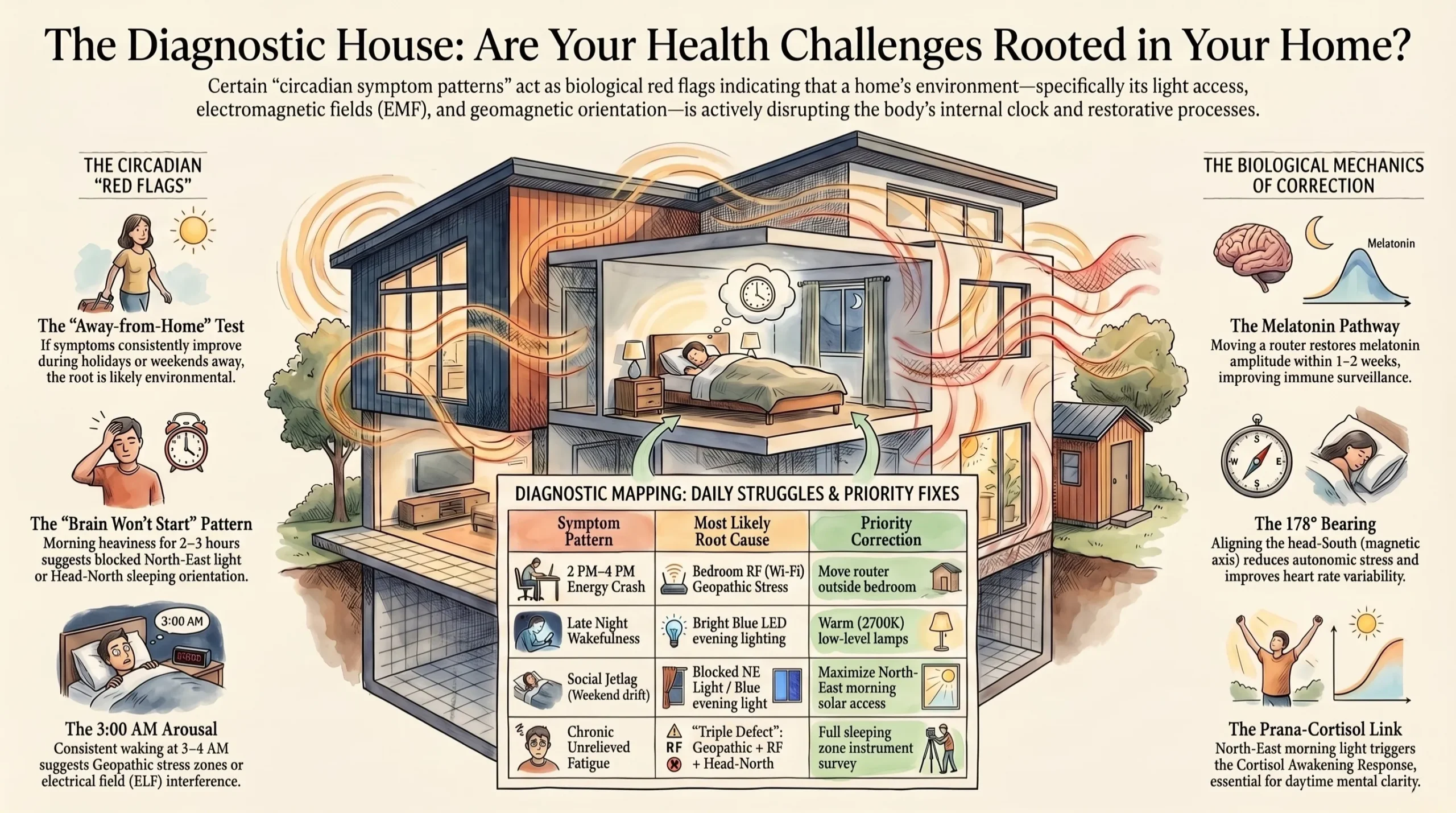
Circadian misalignment produces a characteristic set of symptom patterns that, when present in a specific form and with specific temporal characteristics, strongly suggest an environmental Vastu root cause rather than a purely internal or medical cause. The following diagnostic table maps seven circadian symptom patterns to their most likely Vastu environmental roots, their confirming signs, and the priority corrections that should be assessed.
|
Circadian Symptom Pattern |
What It Means Biologically |
Most Likely Vastu Root Cause |
Confirming Sign |
Priority Energy Correction |
|
Morning heaviness lasting 2–3 hours — ‘brain will not start’ |
Blunted cortisol awakening response; circadian wake signal not reaching full amplitude; prefrontal cortex activation delayed |
Blocked north-east morning light access; geopathic stress producing shallow slow-wave sleep that blunts CAR; head-north orientation reducing HRV and delaying parasympathetic-to-sympathetic morning transition |
Mornings are better on weekends when there is no pressure and more natural morning light exposure; mornings are best on holidays in naturally lit settings |
North-east zone morning light assessment; geopathic stress survey; sleeping orientation correction to head-South |
|
Energy crash between 2 PM and 4 PM — disproportionate to the day’s demands |
Circadian cortisol trough coinciding with insufficient circadian amplitude; the post-lunch dip is physiologically normal but is exaggerated by circadian misalignment from the previous night’s disrupted sleep |
RF-mediated melatonin suppression producing shallow sleep architecture; geopathic stress zone fragmenting NREM; the morning CAR was insufficient to maintain cortisol above the afternoon energy threshold |
The crash is worse after poor sleep nights; the crash is relieved more by coffee than by genuine energy; the family member feels physically tired but could not nap — classic circadian cortisol trough pattern |
Bedroom RF elimination as first priority; geopathic stress correction as second priority; CAR amplitude restoration follows sleep restoration |
|
Difficulty falling asleep before midnight — lying awake despite tiredness |
Delayed dim light melatonin onset (DLMO); circadian schedule has been shifted later by evening light exposure; the internal clock is signalling ‘still daytime’ while the body is tired |
Bright overhead lighting in living zones producing lux levels above 50–100 at eye level in the 2–3 hours before sleep; cold white LED (5000–6500 K) maximising blue-spectrum melatonin suppression in evening hours |
The family member can fall asleep in a dark room but not with the home’s normal evening lighting; they fall asleep faster when the lights are low; they sleep better in hotel rooms where they control light levels more carefully |
Evening lighting correction: warm LED (2700 K) at low intensity in all living zones; primary overhead lights off 90 minutes before sleep; warm low-level table lamp as evening ambient lighting |
|
Waking at 3–4 AM and unable to return to sleep |
Circadian cortisol beginning its morning rise phase too early; OR geomagnetic stress disrupting the second half of the night’s sleep architecture; OR REM-NREM cycle interrupted by bedroom EMF in the lighter second half of the night |
Geopathic stress zone beneath sleeping position causing arousal events in the second half of the night; bedroom ELF field from wiring producing autonomic arousal in the pre-dawn lighter sleep phase; head-north producing elevated sympathetic tone that fragments the second-half sleep architecture |
Waking is consistently at the same time each night — suggests circadian-timed arousal mechanism; waking is more random — suggests environmental stimulus (geopathic field, EMF); the bedroom itself feels different at 3–4 AM — ‘the energy is different’ — suggests geopathic zone or field pattern |
Magnetometer survey with specific attention to second-half-of-night arousal patterns; ELF circuit breaker protocol; sleeping orientation correction |
|
Social jetlag — weekday schedule chronically misaligned from weekend schedule |
The internal circadian clock’s preferred phase differs from the socially required schedule; most often produced by inadequate morning light entrainment and bright evening light delaying the clock |
North-east light access blocked or inadequate producing insufficient morning entrainment; evening home lighting too bright and too blue, delaying melatonin onset each evening and shifting the clock later each night; bedroom not dark enough during sleeping hours |
The family member’s natural preferred sleep time on unrestricted days (weekends, holidays) is 2–4 hours later than their required weekday schedule; they describe themselves as ‘night owls’ but have not always been so |
North-east morning light maximisation as first priority; evening light correction second; bedroom darkness confirmation third; social jetlag typically resolves within 3–4 weeks of light environment correction |
|
Seasonal worsening — cognitive and mood symptoms worse in winter or during extended cloudy periods |
Seasonal reduction in morning light intensity and duration reduces the morning entrainment signal; circadian amplitude falls; the cortisol awakening response blunts; serotonin synthesis reduces in proportion to morning light reduction |
North-east prana gateway too small, too obstructed, or north-east zone used as non-living space — the light deficit is present year-round but becomes critical in reduced-light seasons; apartment orientation blocking southern sky light in winter months |
Symptoms improve noticeably with sunny days; symptoms worsen with consecutive overcast periods; symptoms are significantly better in summer than in winter — circadian seasonal sensitivity pattern |
North-east opening maximisation; supplemental morning light therapy (10,000 lux SAD lamp used within 30 minutes of waking) as an interim measure while architectural corrections are considered; east and north-east zone function reassessment |
|
Fatigue that is not relieved by rest — present despite adequate sleep duration |
Circadian quality of sleep is low despite adequate quantity; the body is spending hours in bed but not accessing the deep, architecturally intact circadian sleep programme; or circadian phase is misaligned so that sleep is occurring at a biologically wrong time |
Geopathic stress producing qualitatively impoverished sleep; RF field suppressing melatonin and reducing slow-wave depth; sleeping orientation producing low HRV and non-restorative autonomic sleep pattern; all three simultaneously producing severe circadian sleep quality impairment despite adequate sleep hours |
The family member says ‘I sleep eight hours but wake as tired as when I went to bed’; they frequently describe their sleep as ‘not deep’ or ‘always on the surface’; their doctor has ruled out thyroid, anaemia, and sleep apnoea |
This is the highest-priority pattern for full sleeping zone correction: all three defects (geopathic, EMF, orientation) should be assessed simultaneously; this pattern typically resolves most dramatically with full correction |
The most important single diagnostic question across every row of this table is the same question that appears in the cognitive symptom diagnostic: does the symptom improve consistently when the family member spends time away from the home? The home-vs-away question is the most efficient pre-assessment screening tool available, and for circadian symptoms — whose environmental root causes are almost always in the home’s light, electromagnetic, or thermal sleep environment — the answer is usually clear. A consistent ‘yes, I feel more energetic and better rested on holiday’ is a circadian misalignment pattern that the home’s physical environment is producing and maintaining.
For families with children, I would add a specific circadian diagnostic question: does the child have consistent difficulty waking on school mornings — but no difficulty at all waking on holiday mornings or when naturally woken by sunlight? This pattern is the childhood social jetlag signature, and it is almost always produced by a combination of inadequate morning light entrainment in the bedroom (north-east light blocked or bedroom facing west) and excessive screen and artificial light use in the evening (delaying DLMO and pushing the child’s circadian schedule one to two hours later than the school schedule requires). The correction is environmental, not disciplinary — and the child who is perceived as lazy or difficult to wake is more often experiencing a light-environment-produced circadian disruption than a motivational failure.
What does the circadian immune programme reveal about the health consequences of night-time Vastu defects?
The immune system does not operate at constant intensity around the clock. It is one of the biological systems most deeply and most precisely regulated by the circadian clock — with specific immune functions timed to specific circadian phases in a way that makes the daily timing of the immune programme as important as its overall capacity. Understanding the circadian immune programme makes the health consequences of sleeping zone Vastu defects more specific and more clinically meaningful than the generic ‘weakened immunity’ framing that is sometimes used.
During the first half of the night — characterised by deep slow-wave NREM sleep and its associated high growth hormone secretion — the immune system is in its primary activation phase. Natural killer cell activity is at its daily peak. T-lymphocyte proliferation is most active. The dendritic cells that process and present antigens for immune memory formation are most effective. The pro-inflammatory cytokines IL-12 and TNF-alpha are at their circadian maximum, supporting the active, searching immune surveillance that identifies and eliminates aberrant cells and pathogens. This first-half immune programme depends critically on the depth and continuity of the deep NREM slow-wave sleep phase.
During the second half of the night — characterised by the transition to REM-dominant sleep — the immune regulatory programme takes over. Anti-inflammatory cytokines (IL-10) balance the first-half pro-inflammatory activation. Regulatory T-cells maintain immune tolerance, preventing autoimmune overactivation. Cortisol begins its circadian rise, modulating the immune activation of the first half to prevent excessive inflammation. This second-half regulatory programme is what prevents the night’s immune activation from spilling over into pathological inflammation.
A sleeping body above a geopathic stress zone, or in a bedroom with significant RF field exposure, or sleeping with incorrect orientation — experiences the characteristic circadian immune programme disruption that Building Biology field research has documented across decades of clinical observation. The first half of the night’s deep NREM phase is shortened and fragmented, truncating the NK cell activation, T-cell proliferation, and IL-12 production that depend on it. The second half’s regulatory programme is disrupted by the arousal events from the stress zone or EMF field, preventing the orderly anti-inflammatory resolution. The result is the immune pattern that many chronically affected families present with: increased infection frequency from impaired first-half NK and T-cell activation; in some cases increased inflammatory marker levels from impaired second-half regulatory programme; and the treatment-resistant pattern of chronic low-grade inflammation that conventional medicine addresses symptomatically without investigating the circadian immune disruption that is sustaining it.
The Health-Focused Energy Correction’s sleeping zone assessment is, from the perspective of the circadian immune programme, a restoration of the two-phase nightly immune programme on which the family’s infectious defence, tumour surveillance, and autoimmune regulation all depend. The geopathic stress survey, the RF measurement, and the sleeping orientation correction are not independent immune interventions. They are coordinated corrections of the three factors most consistently documented to disrupt the circadian immune programme — and their combined correction produces the immune restoration timeline that families observe: improved infection frequency within six to twelve weeks, reduced inflammatory markers within three to six months, normalised immune panel in family members whose previously abnormal values were attributable to circadian immune programme disruption.
How does the circadian metabolic clock connect Vastu's food zone prescriptions to long-term health?
The relationship between Vastu’s kitchen orientation prescription and circadian metabolic health is one of the most intellectually fascinating connections in the entire Vastu-chronobiology intersection — because it demonstrates that the tradition’s prescriptions address not only the sleeping body’s circadian needs but the waking body’s metabolic circadian needs through the physical design of the home’s food preparation and consumption environment.
The liver’s circadian clock — one of the most robustly characterised peripheral clocks in chronobiology — governs the timing of the body’s primary metabolic processes: gluconeogenesis, lipid metabolism, bile acid synthesis, xenobiotic detoxification, and the enzymatic pathways that determine how efficiently energy is extracted from food, stored as fat, or converted to heat. This metabolic peripheral clock receives its phase calibration from three primary inputs: the SCN master clock’s melatonin signal; the timing of food intake (nutrient availability is a powerful peripheral clock zeitgeber operating through insulin signalling and nutrient-sensing pathways); and the physical activity timing cue.
Research from the field of chrono-nutrition — the study of the relationship between the timing of food consumption and metabolic health outcomes — has established that eating the largest meal in the morning or at midday, when the liver’s metabolic clock is in its active enzyme phase, produces significantly better metabolic outcomes than eating the same calories at the same macronutrient composition in the evening, when the liver’s metabolic clock is in its reductive, repair-oriented phase. Epidemiological studies document that night-shift workers — whose food timing is systematically misaligned with their circadian phase — have dramatically elevated rates of metabolic syndrome, type 2 diabetes, and cardiovascular disease even when their total caloric intake and dietary composition are comparable to day workers.
Vastu’s east-facing kitchen prescription is, in this chrono-nutritional context, a prescription for a food preparation environment that is naturally illuminated by the morning solar spectrum — the spectrum that triggers the strongest cortisol awakening response, the most effective circadian phase calibration, and the earliest metabolic clock activation. A family preparing and consuming its morning meal in an east-facing kitchen bathed in morning light is a family whose metabolic peripheral clocks are receiving the food intake zeitgeber signal at the circadian phase most conducive to metabolic efficiency. The morning meal in a morning-light kitchen is not merely a cultural practice. It is a chrono-nutritional environmental prescription whose metabolic health consequences extend over the entire lifespan.
The metabolic consequences of Vastu’s kitchen orientation prescription accumulate subtly across decades, making them harder to attribute directly to the kitchen’s orientation than the acute effects of sleeping zone corrections are to sleeping position changes. But they are real — and for the millions of Indian families whose kitchens face west or north, whose morning cooking occurs in artificial light without morning solar entrainment, and whose circadian metabolic clock begins each day without the photon zeitgeber that activates its morning phase, the kitchen orientation is a chronic metabolic disadvantage that correct new construction planning could eliminate entirely — and that is the specific reason the Vastu for New Plots & Construction service includes kitchen zone placement as a foundational design brief element.
What does the Health-Focused Energy Correction deliver for the family's circadian system specifically?
The Health-Focused Energy Correction service is, from a chronobiological perspective, a comprehensive assessment and correction of the physical environmental factors that most consequentially affect the circadian system’s four primary inputs: morning light zeitgeber quality, melatonin signal integrity, thermoregulatory circadian support, and geomagnetic autonomic circadian rhythm quality. Every instrument measurement it takes and every correction it prescribes is directed at one or more of these four circadian inputs, through the specific physical mechanisms that chronobiology has characterised.
The magnetometer geopathic stress survey addresses the geomagnetic input to the circadian system — removing the distorted field conditions that disrupt the circadian autonomic rhythm and fragment the slow-wave sleep architecture through which the circadian immune and metabolic programmes are conducted. The RF meter assessment addresses the melatonin signal integrity — identifying and correcting the bedroom electromagnetic burden that is suppressing the nocturnal melatonin peak that keeps peripheral clocks synchronised with the SCN. The sleeping orientation correction addresses the geomagnetic-autonomic circadian interface — restoring the head-South or head-East alignment that produces the highest sleep-period HRV and the most complete parasympathetic circadian pattern. The north-east morning light assessment addresses the primary zeitgeber input — evaluating the quality and unobstructedness of the morning solar access that calibrates the SCN daily. The evening light review addresses the DLMO protection — identifying the home’s evening lighting conditions that are most likely to be causing circadian phase delay.
The correction programme that follows is sequenced specifically by circadian impact priority. For most Indian families, the bedroom RF and sleeping position corrections produce the first and most immediately observable circadian improvement — sleep architecture restoration typically becomes perceptible within one to three weeks, CAR amplitude improvement within two to four weeks. The geopathic stress correction, where present, amplifies and sustains these improvements. The light environment corrections — north-east maximisation and evening light reduction — produce the progressive circadian phase consolidation that translates the sleep improvements into sustained daytime energy, mood stability, and metabolic health over the following weeks and months.
The Health-Focused Energy Correction service does not position itself as a circadian medicine intervention — it is an environmental health assessment that addresses the physical environmental conditions most consequential for circadian health, through the tradition that five thousand years ago developed the most comprehensive set of environmental prescriptions for those conditions that human building practice has ever produced. But the families who understand the circadian biology behind each correction are the families who implement them with the most confidence, observe their effects with the most insight, and maintain them with the most persistence. The Nobel Prize in Physiology or Medicine 2017 was awarded for the discovery of the molecular mechanisms of circadian rhythms. The home design that protects those mechanisms has been described, in meticulous prescriptive detail, since the Manasara was first written.
Real Case Study — A Bengaluru Endocrinologist Who Found Circadian Medicine in Her Own Home:
A consultant endocrinologist at a Bengaluru hospital came to me for assessment of her own home, not in her professional capacity but as a patient. She had been experiencing fatigue that her physician colleagues described as ‘simply the burden of your workload’ — but that she, with her own endocrinological knowledge, suspected had a chronobiological dimension. ‘My cortisol is elevated at 9 PM and low at 7 AM,’ she said. ‘That is a reversed HPA rhythm. My workload has not changed in five years. Something has changed in my environment.’
She was right. The assessment found a severely compromised circadian light environment: her apartment’s north-east zone was entirely used as a study stacked with books and equipment, receiving no living function; her bedroom faced south-west but had blackout curtains she used for shift-work sleep that she had never removed when her schedule normalised; her bedroom router produced 5,400 microWatt per square metre at the sleeping position; and her home used 6,500 K cold white LED throughout, including a 400-lux overhead living room fixture under which she worked and unwound in the evenings.
The magnetometer found a moderate geopathic stress zone at her pillow position. Her sleeping orientation was head-west.
She listened to each mechanism explanation with the precision of a specialist engaging with a new clinical discipline. At the RF-melatonin mechanism, she said: ‘Calcium ion channel activation by RF. I know this literature. I have been sitting under 400 lux of cold white LED until 11 PM and sleeping next to a router. My DLMO is probably at 2 AM. That explains the 9 PM cortisol elevation — my HPA has been working to keep me alert when my circadian clock says it is the middle of the night.’
She implemented all corrections: north-east study cleared to function as morning living zone; blackout curtains removed; warm 2,700 K LED at 80 lux maximum installed in living zone; router moved to study; bed repositioned head-south; ELF circuit breaker switched off at night.
Six-week follow-up: ‘My morning cortisol is now higher than my evening cortisol for the first time in two years. My sleep is consolidated. I am waking before my alarm feeling rested, which I had not done since medical school. My clinical work is sharper. I have referred four patients with treatment-resistant fatigue and abnormal cortisol profiles for your assessment. In three of the four, you found the same pattern I had. I am now asking every patient with HPA axis dysregulation about their bedroom light and electromagnetic environment. This should be standard endocrinology practice.’
Her comment for this article: ‘The circadian biology is unimpeachable. The Vastu framework is the most comprehensive built environment design programme for circadian health that I have encountered. Every endocrinologist should understand both.’
The Nobel Prize and the Manasara: Two Ways of Knowing the Same Physical Truth:
When Jeffrey Hall, Michael Rosbash, and Michael Young received the 2017 Nobel Prize in Physiology or Medicine, the award citation described their discovery as revealing ‘how plants, animals and humans adapt their biological rhythm so that it is synchronised with the Earth’s revolutions.’ The key phrase is that last one: synchronised with the Earth’s revolutions. The circadian clock is, at its most fundamental biological level, a mechanism for aligning the body’s internal biological programme with the Earth’s rotation on its axis — the planetary phenomenon that produces the solar day.
The Manasara — written in a cultural and intellectual context that had no molecular biology, no photobiology, and no concept of the suprachiasmatic nucleus — prescribed the same alignment through the language of prana, Agni, and directional cosmic forces. The north-east prana gateway delivered the morning solar radiation that we now know synchronises the SCN with the Earth’s revolution. The south-west thermal mass supported the core body temperature decline that we now know is the circadian clock’s primary gate for sleep initiation. The sleeping orientation prescription aligned the body’s biomagnetic axis with the Earth’s geomagnetic field in a way that we now know optimises the autonomic circadian pattern.
Two traditions, five thousand years apart, using completely different intellectual vocabularies, describing the same physical alignment: the human body, in its built environment, synchronised with the Earth’s daily revolution. The Nobel Prize celebrates the molecular mechanism. The Manasara celebrated the observational prescription. Neither is complete without the other — because the prescription without the mechanism is tradition without understanding, and the mechanism without the prescription is science without a home. The Health-Focused Energy Correction brings them together, in every assessment it delivers, for every family whose health depends on the physical truth that both traditions, each in its own language, have been pointing at all along.
The Nobel Prize Described the Clock. Vastu Designed the Home Around It. We Measure Both.
The circadian system is the biological foundation of your family’s sleep, immunity, metabolism, mood, and cognitive performance. It is synchronised daily by the physical environment of your home — by the quality of morning light through the north-east zone, by the thermal stability of the south-west sleeping zone, by the integrity of the melatonin signal that your bedroom’s electromagnetic environment either protects or suppresses, and by the geomagnetic field quality at the sleeping position where your body conducts its nightly circadian programme.
The Health-Focused Energy Correction service assesses every one of these circadian inputs with instrument precision and corrects the specific defects that are disrupting your family’s circadian system — with specific predicted outcomes in specific biological timelines, backed by the Nobel Prize-winning research that has characterised every mechanism, and guaranteed by our 100% satisfaction commitment.
Your Health-Focused Energy Correction for circadian health delivers:
- Geopathic stress magnetometer survey — geomagnetic circadian interface assessed; sleeping position confirmed in clean field zone; HRV and autonomic circadian rhythm restoration timeline predicted
- Bedroom RF electromagnetic assessment — melatonin signal integrity evaluated; AANAT suppression pathway quantified; peripheral clock desynchronisation risk assessed; router relocation and circuit protocol prescribed
- ELF field assessment — bedroom wiring field measured; calcium ion channel and autonomic circadian mechanism explained; circuit corrections prescribed
- Sleeping orientation correction — head-South or head-East prescription; geomagnetic–HRV circadian mechanism explained; autonomic circadian pattern restoration timeline predicted
- North-east morning zeitgeber assessment — ipRGC melanopsin pathway delivery evaluated; morning solar access to living zones confirmed; CAR restoration prescription provided
- Evening light circadian protection review — DLMO suppression risk from existing home lighting evaluated; warm LED correction specified; lux level and colour temperature guidance provided; social jetlag resolution timeline predicted
- Thermal circadian support assessment — SW bedroom thermal mass quality evaluated; core body temperature circadian decline support prescription provided
- Circadian symptom pattern mapping — family member’s specific circadian symptoms mapped to identified environmental defects; specific chronobiological mechanism explained; restoration timeline predicted for each
- Kitchen chrono-nutritional orientation check — morning light delivery to food preparation zone assessed; metabolic peripheral clock activation potential evaluated
- Priority-ranked correction programme — maximum five corrections ordered by circadian health impact; all non-structural; all mechanism-explained with Nobel-Prize-calibre research citations
- One-on-one consultation with Mukesh Shah personally
- Detailed written report — all circadian mechanism explanations, measurements, corrections, and restoration timelines with research references
- 30 days of priority support through your full implementation
- 100% satisfaction guarantee
Five thousand years of Vastu wisdom. The 2017 Nobel Prize in Physiology or Medicine. The most precise instrument-based circadian environment assessment available. For your family’s health — tonight.
Book your Health-Focused Energy Correction today at vastumyhome.com
Vastu’s core home design prescriptions address every major input to the circadian system: the north-east prana gateway delivers morning solar radiation that entrains the SCN master clock through the ipRGC melanopsin pathway (Nobel Prize 2017 research); the south-west master bedroom’s thermal mass supports the core body temperature circadian decline required for sleep initiation; head-South sleeping orientation produces the highest sleep-period HRV and best circadian autonomic pattern; bedroom EMF elimination protects the nocturnal melatonin signal that synchronises peripheral clocks; Brahmasthana natural ventilation maintains CO2 below cognitive and sleep-disruption thresholds; and evening spatial lighting design protects melatonin onset timing. Vastu is, in chronobiological terms, a comprehensive home design programme for circadian entrainment.
Social jetlag is the misalignment between the internal circadian clock’s preferred phase and the socially required schedule — the experience of living in a different time zone than your alarm clock requires. It is produced by inadequate morning light entrainment (which should pull the clock earlier) and excessive bright evening light (which pushes the clock later). Vastu corrections address both causes: maximising north-east zone morning solar access strengthens the morning zeitgeber; replacing cold white LED evening lighting with warm low-intensity light protects the dim light melatonin onset (DLMO). Social jetlag of three to four hours typically resolves within two to four weeks of consistent light environment correction — with measurable improvements in morning energy, mood stability, and metabolic health markers.
The bedroom router affects the circadian system through the melatonin pathway. Radiofrequency fields at Wi-Fi frequencies (2.4–5 GHz) activate voltage-gated calcium ion channels in pineal gland cells, suppressing the activity of arylalkylamine N-acetyltransferase (AANAT) — the rate-limiting enzyme in melatonin synthesis. This reduces nocturnal melatonin amplitude by twenty to forty percent. Since melatonin is the primary chemical signal through which the SCN master clock communicates darkness to peripheral clocks in the liver, immune cells, gut, and cardiovascular system, this suppression produces peripheral clock desynchronisation across every organ system — elevating metabolic disease risk, impairing the circadian immune programme, and degrading the quality of the sleep architecture that slow-wave sleep depends on.
The circadian clock drives a core body temperature decline of 0.5–1°C from the late afternoon peak to the early-morning nadir, beginning one to two hours before habitual sleep onset. This temperature decline — produced by SCN-driven peripheral vasodilation — is the circadian gate for sleep initiation: sleep onset requires the body to achieve a specific core temperature below its daytime range. A south-west bedroom with insufficient thermal mass permits the afternoon solar heat load to raise the bedroom’s ambient temperature above 20–21°C by bedtime, thermally opposing this circadian temperature decline. A correctly specified south-west bedroom with 300–350 mm of dense natural stone or compressed earth has a thermal time constant that delays heat release to the morning waking hours, passively maintaining the bedroom in the 18–20°C range optimal for circadian-aligned sleep onset.
The Health-Focused Energy Correction service delivers instrument-based assessment of every major physical input to the circadian system: magnetometer geopathic stress survey for geomagnetic–circadian autonomic interface; RF meter assessment for bedroom melatonin signal integrity; ELF field measurement; sleeping orientation correction; north-east morning zeitgeber assessment; evening light DLMO protection review; thermal circadian support assessment; and circadian symptom pattern mapping. Each finding is explained through its specific chronobiological mechanism with research citations. All corrections are prioritised by circadian health impact, are non-structural, and come with specific restoration timelines. Delivered with one-on-one consultation with Mukesh Shah, detailed written report, 30 days of priority support, and a 100% satisfaction guarantee.
Disclaimer
The chronobiology, photobiology, and bioelectromagnetics information in this article is presented for educational purposes to explain the biological mechanisms connecting Vastu’s physical environmental prescriptions to circadian health outcomes. This article does not constitute medical advice. Vastu environmental correction addresses physical environmental conditions that affect circadian system health; it does not diagnose or treat circadian disorders, metabolic disease, or any other medical condition. Families experiencing significant health concerns should consult qualified physicians. The symptom patterns described are general educational guidance; individual presentations vary and require professional medical assessment. Building Biology measurement guidelines cited are precautionary reference frameworks, not regulatory standards.
I Would Love to Hear From You
I would love to hear your story or questions in the comments below. Have you experienced the impact of Vastu in your own home? Are you noticing any of the common defects I described above in your space? Share openly — every question is a step towards greater harmony.
Disclaimer: Vastu analysis and energy corrections are for harmonising your space and personal growth. They are not a substitute for professional medical, financial, legal or architectural advice.