

What Is the Foundational Philosophy of Vastu Shastra?
Namaste. I am Mukesh Shah. I want to begin this article with a statement that may surprise you, coming from a man who has devoted twenty years of his professional life to Vastu Shastra: questioning the tradition is not a sign of disrespect for it. It is a sign of genuine respect. A tradition that cannot survive honest questioning is not a tradition worth following. A tradition that can — and whose core principles emerge from that questioning not merely intact but strengthened, not merely defensible but confirmed by independent modern science — is a tradition that deserves not only respect but active, engaged, intellectually demanding practice.
The question of why we should question traditional Vastu in modern contexts is, at one level, very simple: the modern Indian home is not the same as the home for which the classical Vastu texts were written. The family living in a fourteenth-floor apartment in a Mumbai high-rise is not the family living in the open-compound Brahmin household that the Manasara’s residential prescriptions primarily address. The woman sleeping in a north-east bedroom next to a Wi-Fi router and a mobile phone charging station is not the sleeper the Manushyalaya Chandrika’s sleeping zone prescriptions envisioned. The engineer choosing between reinforced concrete and autoclaved aerated concrete blocks for his new construction is not the builder selecting between sun-dried brick and limestone for the construction types the Mayamata specifies. The physical context has changed profoundly. The tradition’s prescriptions must be examined through this changed context, not applied to it as though nothing has changed.
But there is a deeper level at which this question matters — and it is the level I most want to engage with in this article. Questioning traditional Vastu in modern contexts is not merely an adaptation exercise: translating ancient measurement units to modern ones, adjusting regional material prescriptions for contemporary availability. It is a disciplined intellectual process of separating, within the tradition’s accumulated body of prescription, what is physically grounded and universally valid from what is culturally contextual and historically contingent — and what has been added by post-classical commercial interests and has no genuine classical or scientific standing at all. This separation is the most important intellectual task facing the Vastu tradition today, and it is the task that Scientific Vastu has made its central commitment.
The families who benefit most from this questioning are the ones who engage the Complete Home Health Audit with the understanding that what they are receiving is not a ritual performance of ancient authority but a rigorous, mechanism-grounded, instrument-supported assessment of their home’s physical environment — conducted within the framework of a tradition that has been examined, questioned, and found, at its physical core, to be as relevant to the modern Indian home as it was to the classical Indian one.
What does it mean to question tradition rigorously — and why does the Vastu tradition itself demand it?
To question a tradition rigorously means to ask, of every principle it contains, a specific set of questions: What is the observational basis for this principle? What physical mechanism explains why it produces the effects it is claimed to produce? Does the principle apply universally, or was it calibrated to specific geographic, climatic, social, or material contexts? Has it been tested in the modern context, and if so, what did the testing reveal? And has the principle remained intact through its transmission across centuries, or has it been modified, embellished, or replaced by something culturally similar but substantively different in the process of transmission?
These are demanding questions. They require genuine knowledge of the tradition’s classical texts, genuine engagement with the modern science whose findings are relevant to the tradition’s physical claims, and genuine intellectual honesty about what that engagement reveals. Not every practitioner is prepared to ask them. And the tradition’s cultural authority — the reverence with which Vastu Shastra is held in Indian culture — creates a social environment in which questioning is easily read as disrespect, and where the pressure to perform authority rather than demonstrate knowledge is considerable.
But the tradition itself, at its finest, demands exactly this questioning. The Manasara — the most comprehensive and most rigorously systematic of the classical Vastu texts — is not a text that asks for faith. It is a text that provides reasoning. Its prescriptions for site assessment are followed by explanations of why specific site features produce specific outcomes. Its sleeping zone prescriptions are accompanied by accounts of the health consequences of incorrect zone placement. Its directional prescriptions are grounded in accounts of the directional character of solar radiation and earth energy. The Manasara’s authors were not asking the families of their era to accept their prescriptions on the basis of cosmic authority. They were providing the best available account — in the scientific vocabulary of their era — of why each prescription produces the outcomes it is claimed to produce.
Rigorous questioning is, therefore, not a departure from the tradition’s spirit. It is the fulfillment of the spirit that the tradition’s finest practitioners have always embodied — the spirit of empirical inquiry, disciplined observation, and honest accounting of the relationship between building design and human health. The practitioner who cannot answer ‘why does this prescription produce this effect?’ is failing the Manasara’s own standard. The practitioner who can — and who supplements the classical account with the physical mechanisms that modern science has now identified — is the tradition’s most faithful heir.
What has the modern built environment introduced that the classical texts could not have anticipated?
The modern Indian built environment has introduced three categories of physical reality that the classical Vastu texts could not have anticipated and that require active, explicit integration into contemporary Vastu assessment if the tradition is to remain practically relevant to the families it serves. Each of these new categories is not a marginal addition to the assessment framework. Each is a primary environmental health factor whose impact on the family’s health and wellbeing is, in the modern urban home, as significant as or more significant than many of the traditional Vastu factors the classical texts address.
The first and most consequential new category is the electromagnetic environment. The classical Vastu tradition assessed earth energies — the geomagnetic field, geopathic stress zones, the directional character of cosmic and solar radiation. It did not and could not assess the artificial electromagnetic environment created by domestic Wi-Fi routers operating at 2.4 and 5 GHz, by the 50 Hz alternating current fields from household wiring, by the radiofrequency radiation from mobile phone base stations positioned on the rooftops and facades of neighbouring buildings, or by the specific concentrations of these fields in the confined, poorly ventilated spaces of modern urban apartments. These are real, measurable, biologically significant environmental factors whose impact on sleep quality, melatonin production, immune function, and cellular health is documented in peer-reviewed literature. A traditional Vastu assessment that ignores them is an assessment that is missing the single most important category of modern environmental health risk in the Indian urban home.
The second new category is the indoor air quality degradation produced by modern synthetic building and finish materials. The classical Vastu tradition prescribed natural materials — earth, stone, lime, terracotta, natural timber — whose biophilic, thermal, hygroscopic, and air quality properties were understood through centuries of empirical observation. Modern construction has replaced most of these materials with synthetic alternatives — solvent-based paints, formaldehyde-containing MDF and particleboard, PVC flooring, synthetic carpet fibres, polyurethane adhesives and sealants — that off-gas volatile organic compounds into the indoor environment at concentrations that indoor air quality research documents as significant health risks. A Vastu assessment that addresses directional zone allocation but ignores the VOC burden of the bedroom’s synthetic materials is an assessment that has missed a critical and highly correctable environmental health factor.
The third new category is the specific spatial and functional constraints of apartment living. The classical texts primarily address independent residential structures on owned land, where the family has complete control over the building’s orientation, zone allocation, compound design, underground water placement, and site grading. The large majority of modern Indian urban families live in apartments where the building’s orientation is fixed, the floor plan is predetermined, the underground systems were designed without Vastu consideration, and the available range of physical corrections is limited to what can be achieved within the fixed structural frame of an existing multi-story building. The tradition’s application to this context requires not a wholesale abandonment of its principles but a specific, thoughtful assessment of which principles are fully applicable, which require adaptation, and which corrective approaches are available within the constraints the apartment presents.
Integrating these three new categories — electromagnetic environment, modern material indoor air quality, and apartment spatial constraints — into a contemporary Vastu assessment framework is not optional. It is the minimum requirement for a Vastu practice that is genuinely serving the health needs of modern Indian families, rather than performing the cultural forms of an ancient tradition for families whose actual environmental health challenges are substantially different from those the tradition’s original authors were addressing.
Which traditional Vastu prescriptions most urgently need questioning in the modern urban context?
Not all traditional Vastu prescriptions are equally in need of modern questioning. Some — the sleeping orientation prescription, the geopathic stress avoidance principle, the sleeping zone placement in the South-West, the open Brahmasthana — are as applicable to the modern urban apartment as to the classical rural compound, and their physical mechanisms are as strong and as well-validated in the contemporary research literature as they ever were in the tradition’s accumulated observational evidence. These prescriptions do not need to be questioned — they need to be applied with the instrument-based precision that modern Building Biology makes possible.
The prescriptions that most urgently need questioning are those whose original context differs most significantly from the modern urban one, whose claimed effects extend beyond their documented physical mechanisms, or whose continued unquestioned acceptance in the popular Vastu marketplace is causing practical harm to the families who receive them. Let me name the most important of these explicitly.
The first prescription that deserves questioning is the blanket application of all classical zone and proportion prescriptions to modern high-rise apartment buildings as though the apartment were an independent compound. A traditional Vastu prescription for a south-west compound wall of maximum height is a sensible passive solar and geomagnetic prescription for an independent bungalow on open land. Applied to an apartment on the fourteenth floor of a tower block, where the south-west wall faces either the external facade or an adjacent apartment, it is a prescription that has lost its physical referent. The physical principle — maximum thermal mass and minimum openings on the south-west face — remains valid; its expression in a fourteenth-floor apartment requires a different implementation than its expression in a ground-floor compound.
What is the most damaging traditional Vastu claim that modern questioning consistently disproves?
The most damaging traditional Vastu claim — both to the individual families who receive it and to the tradition’s credibility with the educated public — is the conflation of Vastu’s documented environmental health effects with personal fortune prediction. This conflation has become so pervasive in the popular Vastu marketplace that many families who have never encountered Scientific Vastu believe that Vastu’s primary purpose is to predict and influence personal financial fortunes, relationship outcomes, and life events through the energetic manipulation of building zones.
The classical texts do not support this claim. The Manasara, the Mayamata, the Brihat Samhita — these texts consistently frame Vastu’s effects in terms of health, vitality, and household harmony — outcomes that are physically grounded in the documented relationship between building environment and human biological functioning. They do not claim that placing the master bedroom in the south-west will cause a business deal to succeed, or that a north-east blocked by a storage unit will prevent a promotion, or that the direction a front door faces determines the family’s financial trajectory in the coming year. These claims are not Vastu. They are astrology dressed in Vastu vocabulary — the product of the conflation between Jyotish (Vedic astrology) and Vastu Shastra that the popular marketplace has commercialised with great financial success and at great cost to both traditions’ intellectual integrity.
Questioning this conflation rigorously is not merely an intellectual nicety. It is a practical necessity for every family that comes to Vastu consultation with genuine health concerns — concerns that deserve a genuine environmental medicine response, not a fortune-telling session in which the specific, documentable, correctable physical root causes of their sleep disorders, immune depletion, and chronic fatigue remain unaddressed while cosmic explanations for their financial circumstances are offered in their place
What does honest modern questioning reveal when applied to each major traditional Vastu claim?
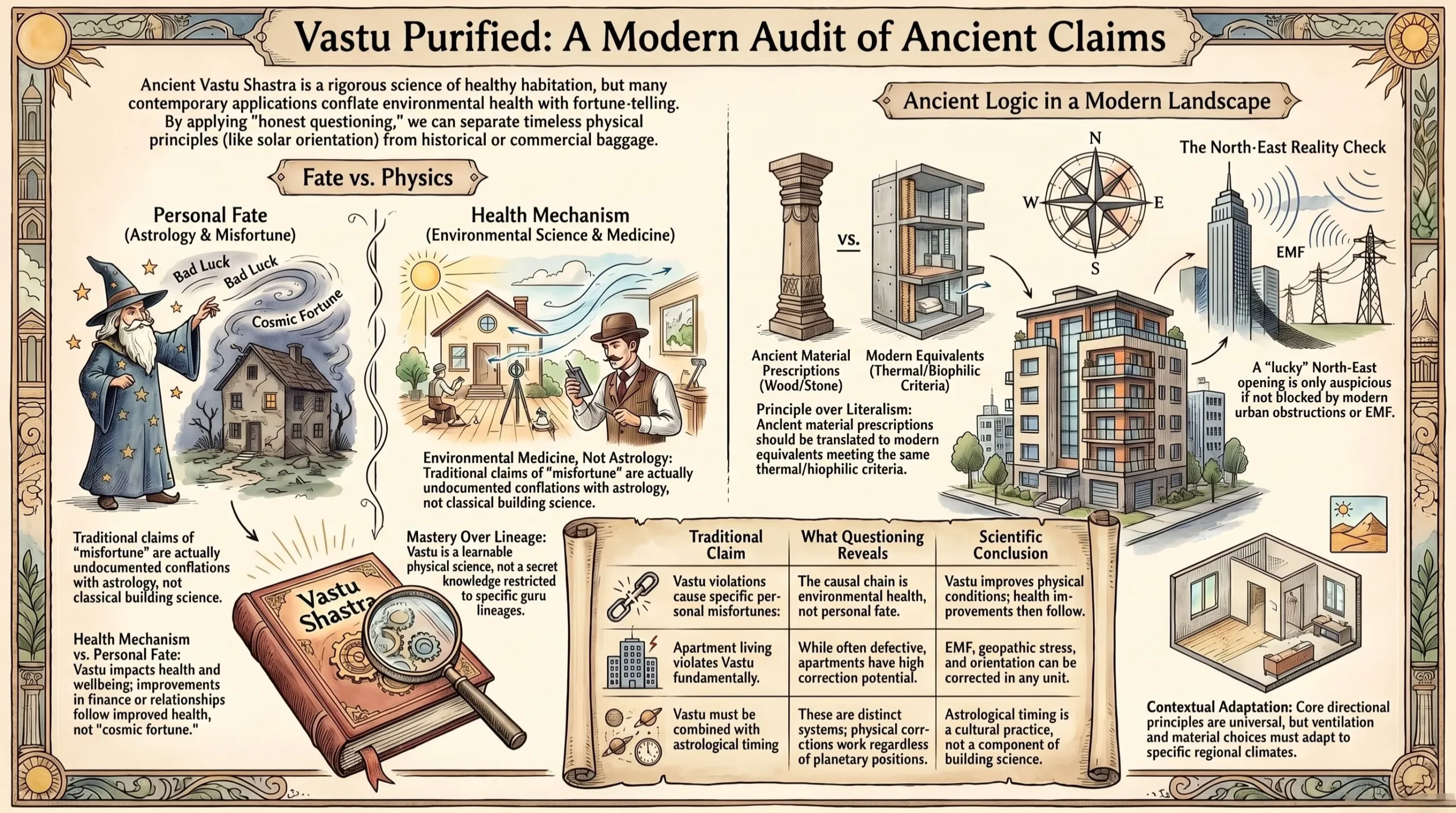
The following table applies rigorous modern questioning to eight traditional Vastu claims that are among the most widely held and the most frequently misapplied in the contemporary marketplace. For each claim, the table identifies why it deserves questioning in the modern context, what honest questioning reveals, and what Scientific Vastu concludes — separating the universally valid physical core from the contextually dependent or entirely unsupported peripheral claim.
|
Traditional Vastu Claim |
Why It Deserves Questioning in Modern Context |
What Honest Questioning Reveals |
What Scientific Vastu Concludes |
|
All classical prescriptions apply universally to every Indian home |
Classical texts were calibrated to specific regional climates, building materials, and social contexts; Indian subcontinent spans 8°N–35°N latitude and multiple climate zones |
Most core directional prescriptions hold universally; some material and proportion prescriptions require climate-zone adaptation |
Universal: orientation, zone allocation, sleeping direction, geopathic avoidance. Climate-adapted: ventilation details, thermal mass thickness, material choices |
|
Vastu violations cause specific personal misfortunes (illness, financial loss, divorce) |
This causal claim conflates environmental health effects (documented) with personal fortune telling (undocumented); represents the astrology-Vastu conflation, not classical Vastu science |
The tradition documents environmental effects on health and wellbeing — not personal fortune predictions; the causal chain is health, not fate |
Vastu correction improves physical environmental conditions; health improvements follow; financial and relational improvements often follow health improvements — but the mechanism is health, not cosmic fortune |
|
Only practitioners from specific guru lineages can conduct valid assessments |
Classical texts define Vastu knowledge by mastery of physical principles, not lineage or initiation; restricting access to lineage perpetuates unverifiable authority |
The tradition’s physical principles are learnable, testable, and verifiable by anyone with the relevant scientific and classical training |
Practitioner quality should be assessed by knowledge quality, methodology rigor, and documented outcomes — not by lineage claims or guru affiliation |
|
Ancient proportional systems (Tala, Angula measurements) must be followed precisely for modern buildings |
These systems were calibrated to human body proportions, traditional materials, and pre-industrial construction methods; direct application to modern construction requires translation |
The underlying principle — human-scale proportionality — is valid and biophilically supported; the specific ancient measurement units require translation to modern equivalents |
Proportionality principle: fully applicable. Specific ancient unit prescriptions: require translation to contemporary architectural practice with modern materials |
|
North-East openings are always auspicious regardless of what surrounds the plot |
The NE prescription is calibrated to an unobstructed site; a modern urban apartment with a tall building blocking the NE has a different energy reality than an open rural site |
The physical principle (morning solar access, fresh air from NE) is valid; application requires site-specific assessment of actual NE conditions |
The principle always applies; the implementation must account for the modern urban site’s actual NE conditions — including obstructions, EMF sources, and built environment context |
|
Material prescriptions (wood species, stone types) from classical texts must be followed literally |
Classical texts prescribed materials locally available in their region and era; many specified species are now endangered, unavailable, or legally restricted |
The underlying material principles — thermal mass, hygroscopicity, biophilic quality, low VOC — are valid; the specific species must be translated to contemporary available equivalents |
Material principles: fully applicable. Specific species prescriptions: translate to contemporary natural materials meeting the same thermal, hygroscopic, and biophilic criteria |
|
Vastu must be combined with astrological timing for maximum effect |
This conflates two distinct Indian knowledge systems; classical Vastu texts do not prescribe astrological timing as a prerequisite for physical corrections |
Astrological timing is a separate discipline from Vastu building science; physical corrections work through physical mechanisms regardless of planetary positions |
Physical corrections are effective when correctly implemented; astrological timing is a separate cultural practice with its own evidence questions and is not a component of Scientific Vastu |
|
Apartment living violates Vastu fundamentally and cannot be corrected |
This claim discourages families from seeking assessment; classical texts address multi-family dwelling; apartments have Vastu defects but also considerable correction potential |
Apartments cannot always achieve perfect zone allocation, but can always improve geopathic stress, EMF burden, sleeping orientation, and elemental activation within their constraints |
Apartment assessments consistently identify significant correctable defects; outcomes in correctly corrected apartments are comparable to independent homes in the dimensions that most affect health |
The pattern across this table is the most important finding of the entire questioning exercise: the physical core of the Vastu tradition — the directional prescriptions grounded in solar geometry and geomagnetic physics, the geopathic stress and electromagnetic environment assessments grounded in Building Biology research, the natural material prescriptions grounded in biophilia and indoor air quality science — survives modern questioning with its credibility enhanced rather than diminished. What does not survive questioning is the cultural and commercial periphery: the fortune-prediction claims, the commercial object prescriptions, the lineage authority claims, and the blanket application of context-specific prescriptions to modern urban environments without adaptation.
This is the most important discovery available to any family who genuinely engages with the Vastu tradition through the lens of modern scientific questioning: questioning the tradition does not empty it — it purifies it. What remains after rigorous questioning is a genuine, physically grounded, scientifically validated body of environmental wisdom that is as relevant to the modern Indian family’s health and wellbeing as it was to the classical family for whom it was originally developed.
How does the modern apartment specifically challenge traditional Vastu — and what does Scientific Vastu offer instead?
The modern Indian apartment presents the most practically demanding test case for the Vastu tradition’s adaptability — because it concentrates, in a single building type that now houses the majority of India’s urban families, all three of the new environmental challenges I described earlier (electromagnetic environment, synthetic material air quality, and spatial constraint) while simultaneously limiting the family’s ability to implement many of the most important classical Vastu corrections that require control over building orientation, zone allocation, and underground systems.
The traditional Vastu response to the apartment — the response I encounter most frequently among practitioners operating in the ritual tradition — is the prescription of a comprehensive set of corrections, zone-specific remedies, and commercial objects intended to ‘correct’ the apartment’s Vastu defects within the constraints of its existing structure. The south-east zone gets a lamp or fire element; the north-west zone gets a wind chime; the south-west gets a heavy metal object or earth element; the north-east gets a fountain and a crystal cluster. The family is given the impression that these placements, correctly executed, will bring the apartment’s energy into Vastu alignment regardless of the building’s fixed structural constraints.
The Scientific Vastu response is fundamentally different — and fundamentally more honest. It begins with an instrument-based assessment of what can actually be measured and what can actually be changed. The geopathic stress survey maps the stress zones across the apartment and identifies whether the sleeping positions are above clean geomagnetic field zones — and if not, whether there is a clean zone within the apartment to which the sleeping position can be relocated. The RF and ELF electromagnetic measurement identifies the specific wireless devices and wiring configurations that are most significantly impacting the bedroom environment — and prescribes the specific relocations and circuit interventions that will measurably reduce the electromagnetic burden at the sleeping position. The sleeping orientation assessment prescribes the specific head-South or head-East reorientation for each family member, regardless of the apartment’s building orientation.
These corrections — geopathic stress relocation, EMF reduction, sleeping orientation — are fully applicable in every apartment regardless of the building’s fixed structural constraints, because they do not require any change to the building’s structure. They require the movement of furniture within the fixed structure. And they address, with instrument-confirmed precision, the three factors that research most consistently identifies as the most consequential environmental determinants of sleep quality, immune function, and overall health in the modern urban bedroom.
The Scientific Vastu response to the apartment is therefore not a consolation prize for families who cannot build their own traditional Vastu home. It is a precisely targeted, measurement-validated, health-impact-ranked assessment of what can be improved within the apartment’s actual constraints — and a focused, implementable correction plan that delivers the maximum available health improvement from the minimum necessary intervention. This is what the tradition can offer modern urban families when it is applied with intellectual honesty and modern scientific tools — and it is significantly more than the commercial object placement that the ritual tradition offers in its place.
What does questioning reveal about the tradition's treatment of modern electromagnetic fields?
The electromagnetic environment question is the starkest illustration of why traditional Vastu, applied without modern integration, is insufficient for the contemporary Indian home — and why scientific questioning of the tradition’s scope is not an attack on its validity but a necessary expansion of its relevance. The classical Vastu tradition’s assessment of electromagnetic energy was comprehensive for its era: it assessed the earth’s geomagnetic field through the directional prescriptions; it assessed geopathic earth energy distortions through the Bhumi Dosha protocols; it assessed the quality of cosmic and solar radiation through the directional prana framework. What it could not assess — because it did not exist — was the artificial electromagnetic environment of the modern home.
The scale of this artificial electromagnetic environment in the contemporary Indian urban apartment is, for many families, their most significant and most immediately correctable environmental health risk. A standard modern Indian apartment bedroom typically contains: one or two active Wi-Fi routers (sometimes the apartment’s own, sometimes also the neighbour’s through shared walls); one or two mobile phones charging within arm’s reach of the sleeping position; often a television; the ELF field from the bedroom’s electrical wiring at intensities commonly three to ten times the Building Biology precautionary level; and, increasingly, the external RF field from mobile phone base stations mounted on the building or adjacent buildings at intensities that regularly exceed Building Biology no-concern thresholds at the sleeping position.
Traditional Vastu assessment — even the most carefully conducted traditional assessment using the full classical methodology of compass reading, zone analysis, and Vastu Purusha Mandala overlay — is entirely blind to this electromagnetic environment. It cannot see the 4,000 microWatt per square metre RF field at the sleeping position produced by the router on the bedroom wall. It cannot detect the 8 milligauss ELF field at the headboard produced by the bedroom’s wiring configuration. It cannot map the Hartmann Grid intersection beneath the sleeping position that is compounding the effects of all three electromagnetic stressors. And because it cannot see these factors, it cannot prescribe the specific, instrument-validated corrections that would address them.
The integration of Building Biology electromagnetic assessment into Scientific Vastu is therefore not optional, not supplementary, and not a departure from the tradition. It is the necessary expansion of the tradition’s environmental assessment scope to include the electromagnetic dimension of the modern built environment — the dimension that the tradition’s classical authors would unquestionably have included had they had access to the measurement instruments and the bioelectromagnetics research that makes it assessable today. The tradition assessed every environmental factor affecting human health that it had the tools to assess. Scientific Vastu does the same.
What does questioning the tradition's cultural accretions reveal about what is genuinely classical?
One of the most practically valuable outcomes of rigorous modern questioning of the Vastu tradition is the ability to distinguish, with increasing precision, between what is genuinely classical — grounded in the Manasara, the Mayamata, the Brihat Samhita, and the other foundational texts — and what has been added to the tradition by post-classical cultural processes, commercial interests, or the conflation with other Indian knowledge systems that has occurred, particularly in the post-1990s urban Vastu revival.
The most important cultural accretion to identify and separate is the astrology-Vastu conflation I have already mentioned — the systematic blurring of the boundary between Vastu Shastra (building science) and Jyotish Shastra (Vedic astrology) that has produced the popular marketplace understanding of Vastu as a system for managing personal fortune through building energy manipulation. The classical texts are unambiguous about this boundary: Vastu Shastra and Jyotish Shastra are distinct disciplines, each with its own methodology, its own textual tradition, and its own domain of application. The Manasara is a building science text. It does not prescribe horoscope casting before bedroom placement. It prescribes physical site assessment, directional orientation, and zone allocation based on the physical qualities of the building site and the building’s relationship to solar and earth energies.
The second major cultural accretion is the elaborate ritual framework that has become attached to Vastu consulting in the popular marketplace — the prescription of specific pujas before implementing corrections, the requirement for astrologically auspicious timings for moving furniture, the mandating of specific mantras for energising zones after physical corrections. These rituals may have genuine spiritual significance for the families who practise them, and I would never dismiss their personal and cultural value. But they are not classical Vastu science. They are not prescribed in the foundational Vastu texts as prerequisites for physical corrections. And when they are presented as mandatory components of the Vastu process — as many practitioners present them — they serve primarily to extend the scope of the practitioner’s authority and, often, to generate additional fees for ritual services that the family could not evaluate independently.
What specific questions identify whether a practitioner is drawing on classical texts or commercial invention?
The most direct way to determine whether a practitioner’s prescription is grounded in the classical texts or in post-classical commercial invention is to ask one simple question: in which classical text does this prescription appear, and in which chapter? An ethical, classically grounded practitioner can answer this question for every significant prescription they make. The sleeping direction prescription: Manushyalaya Chandrika and Charaka Samhita. The south-west master bedroom: Manasara Chapter 14, Mayamata Chapter 8. The open Brahmasthana: all classical texts, Manasara most emphatic. The north-east water feature: elemental zone theory from the Vedic Pancha Bhuta framework.
But the commercial Vastu object prescription: no classical text. The copper pyramid: no classical text. The specific crystal arrangement for the south-east wealth corner: no classical text. The monthly energy maintenance ritual: no classical text. The auspicious timing calculation for moving the sofa: no classical text. These are post-classical commercial inventions. And a practitioner who cannot identify their classical textual source when asked — or who responds with vague references to ‘ancient tradition’ or ‘Vedic knowledge’ rather than specific text and chapter — is prescribing from the commercial periphery, not the classical core.
This specific text-and-chapter question is the most powerful single tool available for distinguishing genuine Vastu science from commercial Vastu performance. A practitioner who can answer it specifically, consistently, and for every prescription they make is a practitioner drawing on the tradition’s genuine intellectual heritage. A practitioner who cannot is drawing on the tradition’s cultural authority without its intellectual content — using the tradition’s prestige while delivering something the tradition’s finest authors would not have recognised as their own.
What does the Vastu tradition look like after it has survived rigorous modern questioning?
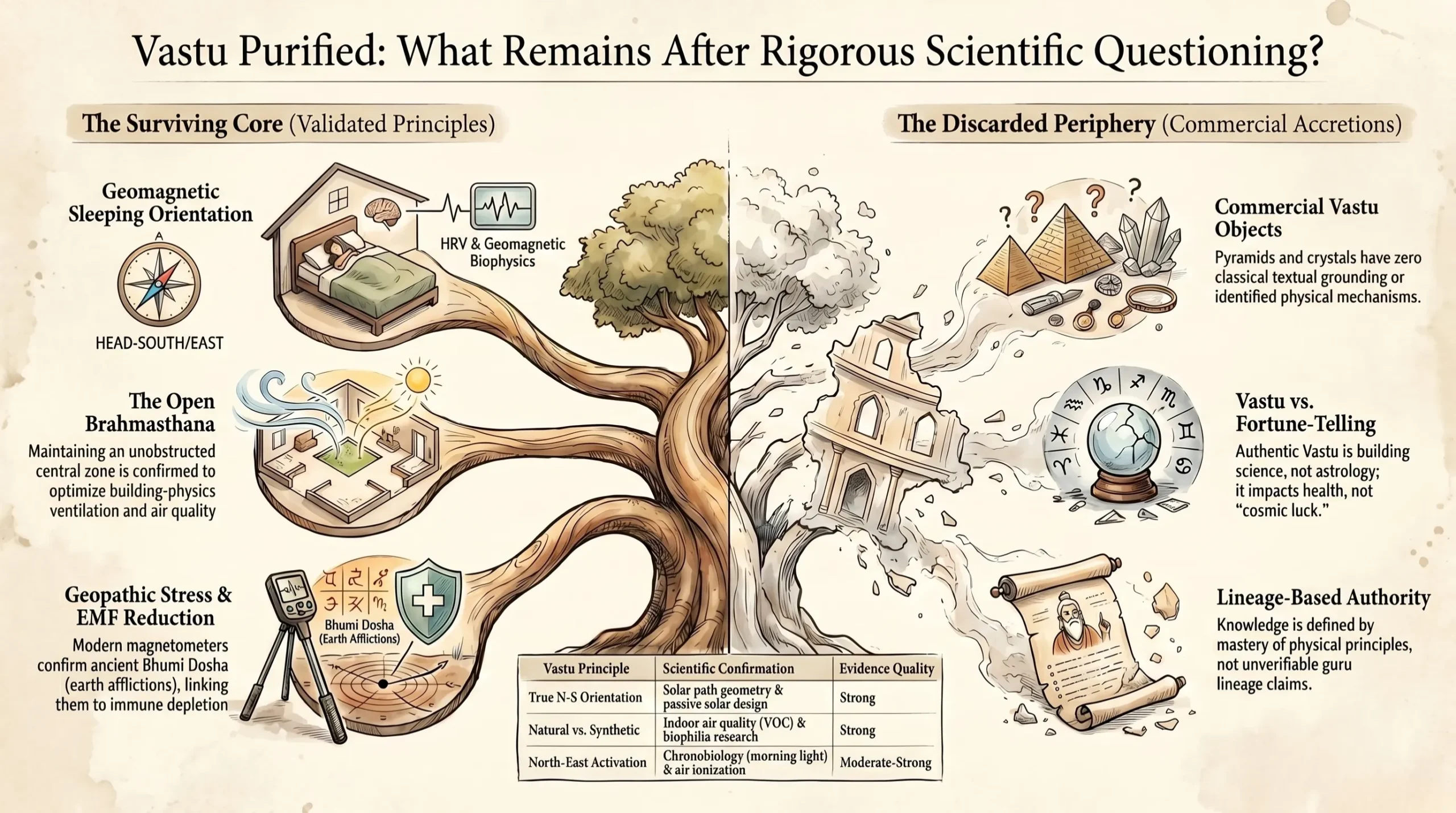
The most important question this entire article has been building toward is the simplest one: after all this questioning — of the tradition’s cultural accretions, its fortune-prediction claims, its commercial object prescriptions, its blanket application to modern contexts it was not designed for, its lineage-authority claims, its ritual requirements without physical mechanism — what remains? What is the Vastu tradition after it has been subjected to the most rigorous modern scientific questioning available?
|
Vastu Principle |
Does It Survive Modern Scientific Questioning? |
Evidence Quality |
Modern Science Confirmation |
Applicability to Urban Apartment |
|
True North-South building orientation |
Yes — fully |
Strong |
Solar path geometry; geomagnetic field alignment; passive solar design |
Partially limited by existing building — but sleeping orientation within apartment always correctable |
|
Head-South or head-East sleeping |
Yes — fully |
Strong |
Geomagnetic biophysics; HRV research; Building Biology SBM standard |
Fully applicable in any apartment regardless of building orientation |
|
Geopathic stress avoidance beneath sleeping zones |
Yes — fully |
Strong |
Dr. Bachler 3,000-case study; European Building Biology field research; magnetometer measurement |
Fully applicable — geopathic stress survey of apartment sleeping zones always possible and always valuable |
|
Bedroom EMF reduction (RF and ELF) |
Yes — fully |
Strong |
Peer-reviewed melatonin suppression research; calcium ion channel studies; Building Biology SBM standard |
Fully applicable — often most impactful correction available in apartments |
|
South-West master bedroom placement |
Yes — with adaptation |
Strong for geomagnetic and thermal components; moderate for spatial refuge |
Building Biology geomagnetic stability; passive solar thermal mass; environmental psychology refuge quality |
Applicable where floor plan allows; most valuable when geopathic stress also in current bedroom |
|
Open, unobstructed Brahmasthana |
Yes — fully |
Strong for ventilation; moderate for acoustic and spatial psychology components |
Building physics stack-effect ventilation; indoor air quality CO2 reduction; biophilic spatial psychology |
Fully applicable — central zone clearance often the single most impactful apartment improvement |
|
Natural materials over synthetic |
Yes — fully |
Strong |
Indoor air quality VOC research; biophilia science; hygroscopic material building physics |
Fully applicable in any apartment — often the easiest correction with the most wide-ranging benefit |
|
North-East zone activation |
Yes — with site-specific adaptation |
Moderate to strong |
Chronobiology morning light; negative air ionisation; biophilic water feature |
Applicable where NE zone has actual morning solar access — requires site assessment |
|
Pancha Bhuta elemental zone allocation |
Core principle yes; specific object prescriptions no |
Moderate for zone functions; strong for elemental material quality |
Environmental psychology of zone function; biophilic elemental expression; air quality and thermal dynamics |
Applicable in zone function allocation and material choice; less applicable where floor plan is structurally fixed |
|
Avoidance of commercial Vastu objects |
Yes — fully |
Strong (absence of evidence) |
No classical text prescribes them; no peer-reviewed validation; no physical mechanism identified |
Fully applicable everywhere — these objects serve no physical function regardless of property type |
Looking at the ‘Does It Survive?’ column of this table, the answer is unmistakable: the Vastu tradition’s physical core — its directional prescriptions for sleeping orientation, zone placement, electromagnetic environment management, natural materials, and elemental activation — survives modern questioning comprehensively, with evidence quality ranging from moderate to strong across every dimension. What does not survive is not the tradition. It is the post-classical commercial accretion that was never genuinely part of the tradition’s intellectual heritage.
What the Vastu tradition looks like after rigorous modern questioning is a lean, precise, physically grounded, scientifically validated environmental medicine framework that addresses the most consequential determinants of the modern Indian family’s health and wellbeing in their built environment — with more precision, more applicability, and more accountability than any other available framework for assessing and improving the health of the domestic environment. This is not a diminished tradition. It is a purified one. And it is the tradition that the Complete Home Health Audit delivers to every family that engages it.
How does questioning traditional Vastu serve the families who need it most?
The families who most need rigorous questioning of traditional Vastu are, paradoxically, the families who are most deeply invested in the tradition’s cultural authority — the families whose genuine health concerns have brought them to Vastu consultation in hope and trust, and who are therefore most vulnerable to the commercial practitioner who exploits that trust rather than honouring it. The family whose child has been chronically ill for three years and who comes to Vastu out of desperate hope that the tradition holds a solution they have not found in mainstream medicine deserves to receive the genuine physical environmental assessment that Scientific Vastu offers — not the ritual performance and commercial object sales that unquestioned traditional Vastu too often delivers in its place.
Questioning the tradition serves these families by clarifying what Vastu can genuinely do and what it cannot. It can assess, with instrument precision, whether the family’s sleeping zones sit above geopathic stress zones that are imparing their sleep and immune function. It can measure the RF and ELF electromagnetic burden in the bedroom and prescribe specific, effective, cost-free corrections that will measurably reduce it. It can identify the sleeping orientation, zone placement, and material environment factors that are contributing to the family’s health challenges and prescribe specific physical corrections for each. These are genuine, documentable, measurable contributions to the family’s health — the real products of the tradition’s intellectual heritage, available to every family regardless of their cultural background or spiritual orientation.
What rigorous questioning protects these families from is the false hope that commercial object placement will cure a child’s chronic illness; that a prescribed ritual will resolve a family member’s anxiety disorder; that a structural demolition they cannot afford will unlock the cosmic support that is blocking their financial recovery. These are not the tradition’s genuine offerings. They are the commercial exploitation of the tradition’s authority — and the families who need genuine help most urgently are the ones least able to afford the time and money spent on interventions that will not address the physical root causes of their difficulties.
Questioning traditional Vastu in modern contexts is, ultimately, an act of service to the families the tradition exists to help — because it ensures that those families receive the tradition’s genuine power rather than a commercial substitute that borrows the tradition’s authority while failing to deliver its substance. The tradition that survives this questioning is stronger, more credible, more practically beneficial, and more genuinely faithful to the empirical spirit of its classical authors than the unquestioned tradition that the commercial marketplace has allowed to develop in its name.
Real Case Study — A Sceptical Mumbai Software Engineer Who Questioned Everything and Found Genuine Value:
A software engineer in Mumbai, aged 42, came to me with what he described as ‘the most sceptical possible attitude toward Vastu.’ He had been convinced to attend our consultation by his wife, who was concerned about the family’s persistent sleep difficulties and his own increasingly treatment-resistant hypertension. His opening statement: ‘I am here as a favour to my wife. I believe Vastu is a collection of cultural superstitions with no scientific basis. Please convince me otherwise — or confirm that I am right.’
I told him: ‘I will not try to convince you of anything. I will show you what we measure, explain the physical mechanism for what we find, predict the specific outcomes of the corrections I prescribe, and you can evaluate the evidence yourself. If the evidence does not convince you, you should not implement the corrections. If it does, you should. This is how science works.’
The assessment found three defects. First: a Hartmann Grid intersection directly beneath his sleeping position, confirmed by magnetometer at 2.9 microtesla above baseline. I explained the geomagnetic biophysics — the mechanism of delta-wave sleep disruption, the Building Biology research, Dr. Bachler’s field study. He read the references I cited on his phone during the consultation. Second: a dual-band Wi-Fi router mounted on the shared bedroom wall at 5,600 microWatt per square metre at sleeping position. I showed him the peer-reviewed melatonin research on his own laptop. He read two abstracts and said: ‘This is real science.’ Third: sleeping orientation head-north-west. I explained the HRV research on sleeping orientation.
He asked the question I most respect: ‘What specifically will change, in what timeline, in what measurable way?’ I told him: router off at night — sleep onset improvement within one week; bed relocated 1.5 metres east of current position, head-south — delta-wave improvement within three weeks; hypertension review with his cardiologist at three months after consistent sleep restoration.
He implemented all three corrections that evening. Four-week message: ‘I slept through the night on night three after the corrections. I have not done that in four years. My wife thinks you are a miracle worker. I think you are an environmental scientist who happens to use an ancient framework. Both of us are grateful.’ At three months, his cardiologist — who knew nothing of the Vastu assessment — noted a blood pressure reduction that prompted a medication review for the first time in two years.
His final reflection: ‘What convinced me was not the tradition. It was the mechanism explanation, the measurement instruments, the research references, and the specific outcome predictions that came true. If more Vastu practitioners operated this way, this tradition would be taken seriously by every engineer and doctor in India.’
What does questioning traditional Vastu reveal about what a Complete Home Health Audit genuinely offers?
The Complete Home Health Audit is the direct product of twenty years of rigorous questioning of the Vastu tradition — of the ongoing process of separating what the tradition’s physical core genuinely delivers from what its commercial periphery merely promises, and of building a service that is exclusively committed to delivering the former. Every design decision in the audit reflects a specific conclusion from this questioning process.
The decision to use instruments — magnetometers for geopathic stress, RF meters for electromagnetic environment, ELF meters for bedroom wiring — rather than intuitive or ritual assessment reflects the conclusion that the tradition’s physical claims are most reliably and most accountably assessed through physical measurement. The decision to prescribe no commercial objects reflects the conclusion that these objects have no classical textual grounding and no identified physical mechanism. The decision to provide mechanism explanations for every finding reflects the tradition’s own standard of empirical transparency — the standard the Manasara itself exemplifies in its reasoning accounts for its prescriptions. The decision to focus on a maximum of five primary defects rather than generating comprehensive correction lists reflects the proportionality principle that rigorous questioning identifies as both more honest and more effective than the inflation of correction scope for commercial purposes.
The decision to offer the complete service — assessment, corrections, support, and satisfaction guarantee — for a single, transparent consultation fee, with no product sales, no commission arrangements, and no ongoing subscription, reflects the conclusion that the tradition’s genuine power is best expressed through the highest possible quality of the assessment and correction guidance itself, not through the volume of products or services that can be attached to the assessment process. And the 100% satisfaction guarantee reflects the accountability principle that rigorous questioning demands of any genuine empirical practice: if the predicted outcomes are not observed, the assessment has not delivered what it promised, and the client is not obligated to pay for what has not worked.
This is what the Vastu tradition looks like when it has been questioned rigorously and found, at its physical core, to be genuinely credible — and when that credible core has been delivered through a service designed with intellectual honesty, commercial integrity, and the specific instrument-based precision that the modern Indian home’s specific environmental health challenges require. The tradition that survives rigorous questioning is not weaker than the tradition that demands unquestioning acceptance. It is stronger, more useful, more trustworthy, and more genuinely respectful of both the families it serves and the extraordinary intellectual heritage it draws on.
What Genuine Respect for a Tradition Looks Like:
I am sometimes asked, by practitioners who are uncomfortable with my questioning of traditional Vastu prescriptions, whether my approach reflects a lack of respect for the tradition. I want to answer this directly, because it matters.
The greatest disrespect I could show the Vastu tradition would be to allow the commercial exploitation of its authority to continue unchallenged — to permit the families who trust the tradition to be sold pyramids that have no classical grounding, frightened by fortune predictions that have no textual basis, and prescribed structural demolitions in place of the specific, non-structural, instrument-validated corrections that would actually address their health challenges.
The Manasara’s authors did not build the most comprehensive building science text of their era by accepting tradition without question. They built it by observing, testing, reasoning, and recording — by the same empirical commitment that modern scientific practice applies through different instruments and different vocabulary. Respecting them means applying the same commitment they applied. It means asking, of every prescription: what is the observational basis? What is the mechanism? Does it hold in the modern context? And if the honest answer is ‘yes, fully’ — as it is for the sleeping orientation, the geopathic stress assessment, the electromagnetic environment correction — then applying it with full confidence and full precision. And if the honest answer is ‘no — this is a commercial invention with no classical basis and no physical mechanism’ — as it is for the pyramid, the crystal cluster, the fortune-prediction — then saying so clearly, directly, and without apology.
This is what respect for a tradition looks like: not the performance of its forms, but the faithful application of its intellectual spirit. The families who receive a Complete Home Health Audit conducted in this spirit are receiving the Vastu tradition at its finest — the tradition that the Manasara’s authors would recognise as their own.
The Vastu Tradition, Questioned and Found Genuine — Applied with Modern Precision to Your Home.
The Vastu tradition, when subjected to rigorous modern questioning, does not collapse — it clarifies. Its physical core — sleeping orientation grounded in geomagnetic biophysics, geopathic stress avoidance validated by Building Biology, electromagnetic environment correction confirmed by melatonin and calcium channel research, South-West bedroom placement supported by geomagnetic stability and thermal dynamics, open Brahmasthana validated by building physics ventilation science — survives every question with its credibility enhanced and its relevance to the modern Indian home fully intact.
What does not survive is the commercial periphery: the objects, the fortune predictions, the ritual performances that have attached themselves to the tradition’s authority without sharing its intellectual substance. Our Complete Home Health Audit delivers the tradition’s genuine core — and only its genuine core — with the instrument precision, mechanism transparency, and outcome accountability that rigorous modern practice demands.
Your Complete Home Health Audit delivers:
- Patented photo-scanning energy analysis — top 5 critical Vastu and energy defects identified by Mukesh Shah personally
- Geopathic stress magnetometer survey — instrument-confirmed stress zone mapping; every sleeping position confirmed stress-free or relocated
- Full electromagnetic assessment — RF at sleeping body position; ELF from bedroom wiring; all corrections non-structural, cost-free where possible
- Sleeping orientation — head-South or head-East prescription with geomagnetic mechanism explained; applicable in any apartment
- Nine-zone Vastu Purusha Mandala — classical textual source cited for every zone prescription; mechanism explained for every correction
- Modern material and EMF integration — the electromagnetic and VOC dimensions the classical texts could not address, now assessed with modern instruments
- Apartment-specific correction plan — fully applicable corrections within your apartment’s structural constraints identified and prioritised
- Zero commercial objects — no pyramids, no crystals, no yantras; every recommendation is a physical intervention with an identified mechanism
- Classical textual grounding for every finding — every prescription traceable to its source text and chapter
- One-on-one consultation with Mukesh Shah personally
- Detailed written report — findings, classical sources, physical mechanisms, corrections, and expected improvement timelines
- 30 days of priority support through your full implementation
- 100% satisfaction guarantee
Five thousand years of disciplined observation. Modern instruments. Intellectual honesty. The tradition at its best.
Book your Complete Home Health Audit today at vastumyhome.com
No — questioning the tradition rigorously is the most respectful thing a practitioner or a family can do. The classical Vastu texts themselves — particularly the Manasara — do not ask for faith-based acceptance. They provide reasoning, mechanism accounts, and observational evidence for their prescriptions. Applying that same standard of empirical inquiry to the tradition’s modern application is faithful to the tradition’s intellectual spirit, not a departure from it. What questioning protects the tradition from is the commercial exploitation of its authority by practitioners who deliver objects, rituals, and fortune predictions without the physical mechanism grounding the classical authors always provided.
Three major categories: first, the artificial electromagnetic environment — Wi-Fi routers operating at 2.4–5 GHz, 50 Hz ELF fields from household wiring, and external RF from mobile base stations — whose effects on sleep quality, melatonin production, and immune function are now peer-reviewed but were unknown to the classical authors. Second, the indoor air quality degradation from synthetic building materials off-gassing formaldehyde, benzene, and other VOCs. Third, the specific spatial and functional constraints of high-rise apartment living, where building orientation and zone allocation are fixed and corrective approaches must work within existing structural constraints. Scientific Vastu integrates all three through Building Biology assessment tools.
The physical core survives comprehensively. Head-South sleeping orientation: confirmed by geomagnetic biophysics and HRV research. Geopathic stress avoidance beneath sleeping zones: confirmed by Building Biology field research. South-West master bedroom: confirmed by geomagnetic stability and thermal dynamics research. Open Brahmasthana: confirmed by building physics stack-effect ventilation. Natural materials over synthetic: confirmed by indoor air quality and biophilia science. Bedroom EMF reduction: confirmed by peer-reviewed melatonin and calcium channel research. What does not survive is the commercial object prescription (no classical textual basis, no identified mechanism), fortune-prediction claims (no classical basis), and ritual requirements as mandatory Vastu prerequisites (not prescribed in classical texts).
Yes — with the right approach. Many traditional Vastu prescriptions require full control over building orientation, zone allocation, and underground systems that apartment dwellers cannot change. But several of the most health-impactful corrections are fully applicable in any apartment: sleeping orientation (head-South or head-East) requires only furniture movement; geopathic stress relocation requires only repositioning within the existing room; electromagnetic environment correction requires only moving a router or switching a circuit breaker; Brahmasthana clearance requires only removing furniture from the central zone; natural material improvements can be made in any apartment. A Scientific Vastu assessment identifies which of these corrections are available and prescribes them in priority order by health impact.
The Complete Home Health Audit delivers exclusively the physically grounded core that survives modern questioning. It uses instruments (magnetometer for geopathic stress, RF and ELF meters for electromagnetic environment) rather than intuitive assessment. It cites classical textual sources for every prescription. It explains the physical mechanism for every finding. It prescribes no commercial objects. It provides mechanism-grounded, timeline-specific outcome predictions for every correction. It is applicable in any home, including apartments, within their structural constraints. Delivered with one-on-one consultation with Mukesh Shah, a detailed written report, 30 days of priority support, and a 100% satisfaction guarantee.
I Would Love to Hear From You
I would love to hear your story or questions in the comments below. Have you experienced the impact of Vastu in your own home? Are you noticing any of the common defects I described above in your space? Share openly — every question is a step towards greater harmony.
Disclaimer: Vastu analysis and energy corrections are for harmonising your space and personal growth. They are not a substitute for professional medical, financial, legal or architectural advice.